




What would New Zealand be without kiwi? Without Fiordland rainforest, or the haunting call of kōkako? If we run down our ecosystems, and thin out the ocean, is the weight of that loss not greater than the commodity value of the timber or tonnage of fish?
We need to understand the value of our wild places, figure out how they work, and what they contribute to society. We also need to better understand the changing nature of our society, especially in the digital age.
How do we define ourselves when social media seeps through every crevice and AI exports our knowledge culture? How are we to distinguish ourselves when the founding values of te ao Māori or the contributions of Pasifika, Asian and Indian diaspora have been reduced to a shadow?
If all we see is social media slop, we risk everything we are for identity-sapping mediocrity. Follow this course and we become a lacklustre state within a withered environment, culturally akin to America, with a distant indigenous history, quaint British notes and some cultural adjacency to Australia—though wetter, colder and more infuriatingly eager to please.
If we are to stand up as Kiwis, we need to identify and celebrate what makes us unique in the world.
*
New Zealand Geographic’s core responsibility has not changed in 36 years: To ensure that readers understand our society and environment, so that we can be better New Zealanders. We’re now the only mainstream outlet with a largely environmental focus, one of the few general interest magazines, and the only title in the country still commissioning longform photojournalism.
Our voice is important in the public conversation, particularly as there persists a false narrative that the integrity of our environment must be balanced against economic prosperity. This is not true—in an economy dominated by the primary sector and tourism, long term prosperity is only possible when our environment remains healthy.
This fact needs to be repeated every two months for one reason: because short term gains remain more attractive—both publicly and politically—than long term investment.
To that end, New Zealand Geographic runs a bimonthly print magazine with 416,000 readers per issue, a website with 85,000 users a month, social channels reaching 160,000 users a month, an email newsletter to 60,000 recipients, even an education programme (in association with Blake Trust) that gives 40,000 students virtually real experiences of our wild places in 250 schools each year.
In addition we have developed innovative reef-monitoring technologies with University of Auckland, established a new charity with Cawthron Institute called Citizens of the Sea that uses environment DNA to monitor ocean health across 1.5 million square kilometres of the South Pacific, co-developed citizen science technology to support conservation in Tokelau with Conservation International, and made a number of submissions to government—based on our reporting—to inform the Fast Track Bill, the Hauraki Gulf Marine Protection Bill and the (now mothballed) Fair Digital News Bargaining Bill.
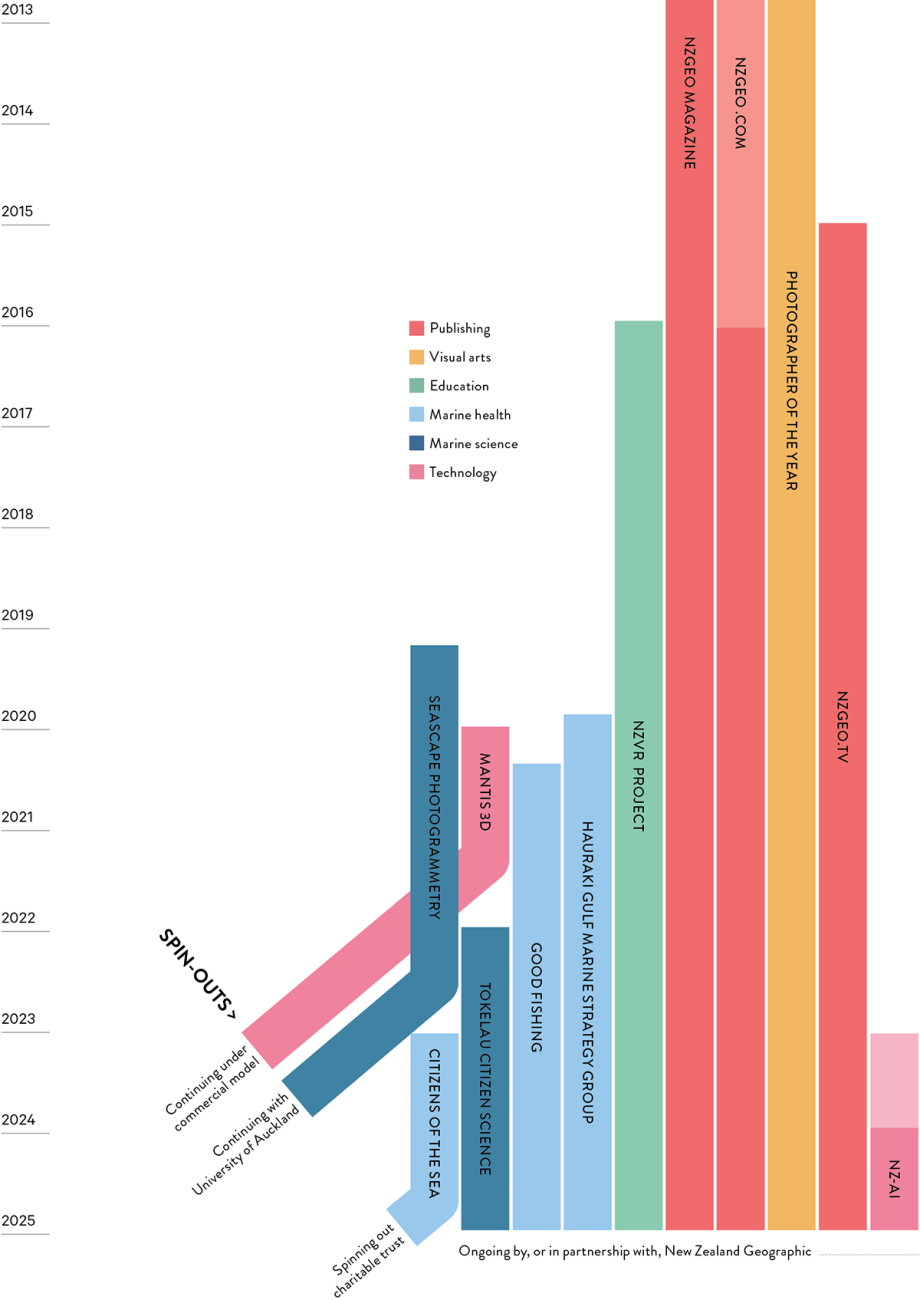
Some activities make sense to continue under NZGeo management, others are better placed into the care of charities or spun out into independent entities. We’re pragmatic about where they land, what matters is that they get started.
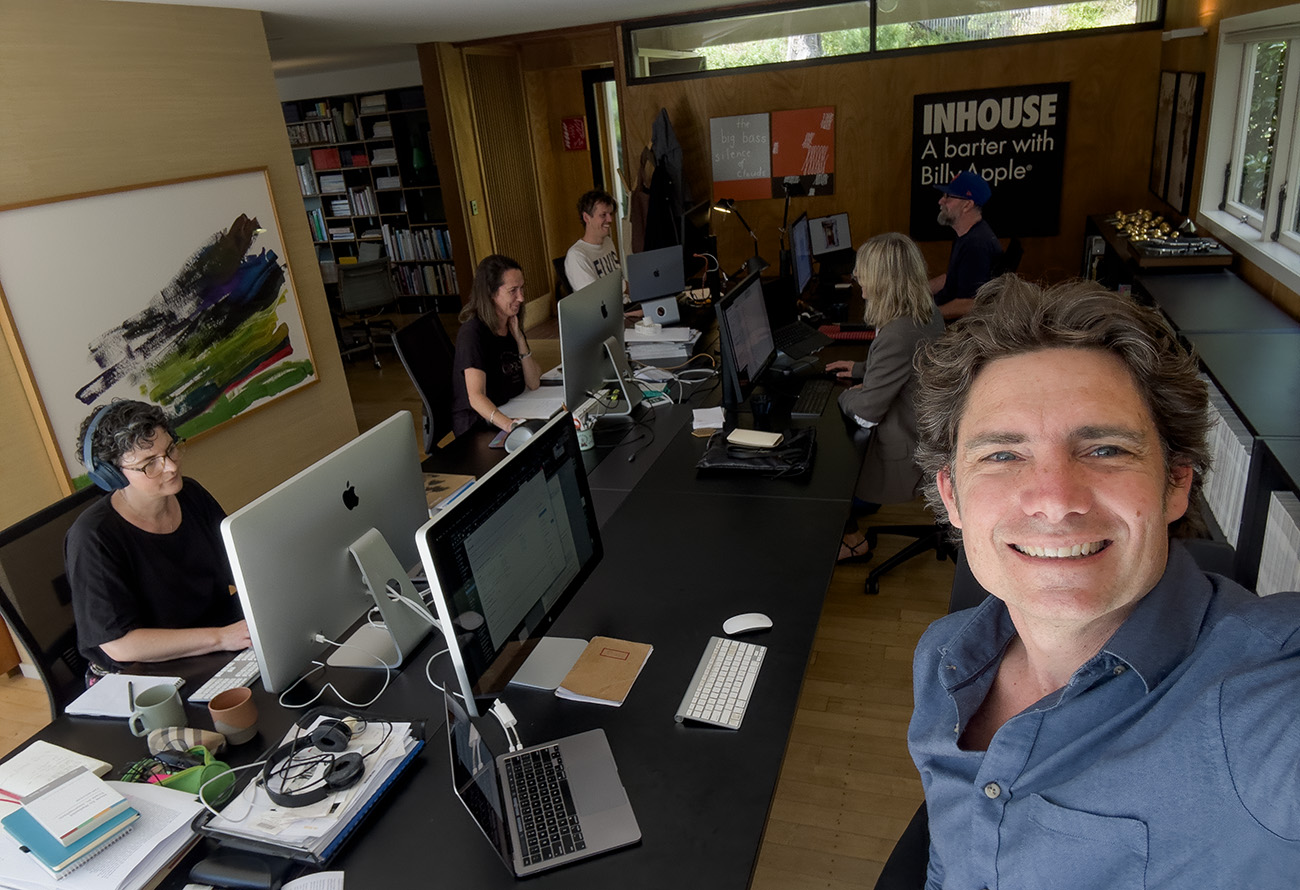
At times, New Zealand Geographic might appear more like a for-purpose entity than a private publisher, but it’s all part of the same kaupapa started by John Woods and Kennedy Warne 36 years ago. Our commercial publishing simply allows us to remain apolitical and independent of external influence, as it’s powered—largely, thankfully—by your subscriptions.
*
We measure our influence by the number of people we reach and the feedback we receive.
While other magazines have experienced cliff-like declines in readership over the past 15 years, New Zealand Geographic has grown. In fact, our readership has almost doubled in that period—an indicator of increasing relevance.
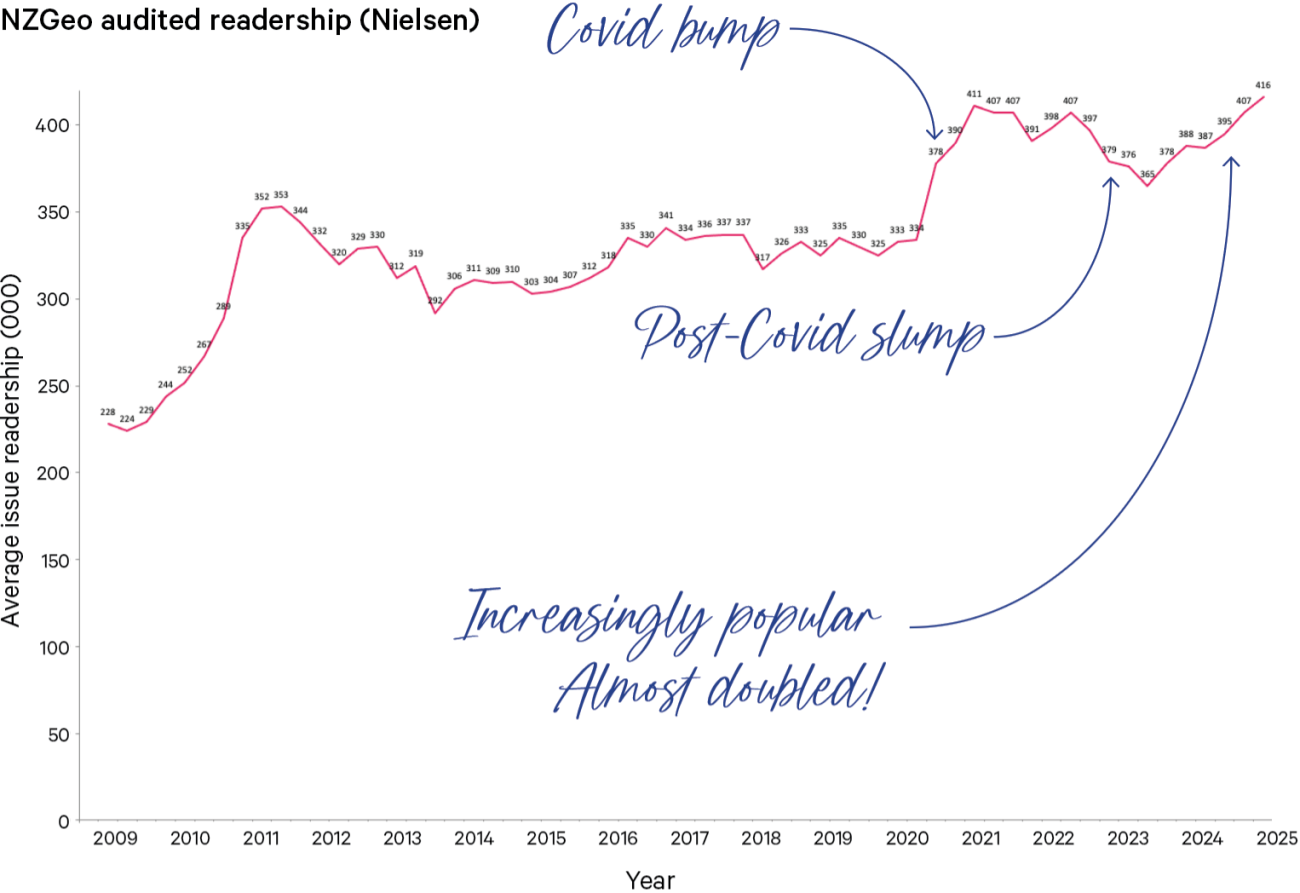
NZGeo has quietly become the third-most popular magazine in New Zealand. We also know that our readers are younger and more diverse than any other magazine—younger and more diverse even than the population average.
Our stories cover the country too. Right now we have a team covering sheepdog trials in Ashburton, another documenting fur seals in Kaikōura, and a photographer hooning around after kākā in Wellington city.
It’s easy to measure awards and audience, harder to measure impact. As media people, we know that readers form their views according to the information they receive, and receiving high-quality stories in a compelling and visually rich format helps the facts sink in. When you read well-researched stories about climate or conservation, land use or landslides in NZGeo, it is incorporated into your thinking more readily, we hope, than a strident post on social media. It has more influence than influencers.
A wildlife hospital doing it tough in Oamaru was flooded in donations after we covered it. After reading our story about Niue’s bid to remove invasive weeds, a gang of readers travelled to the island with chainsaws to lend a hand. Our reporting and subsequent submission on the Fast Track Bill secured important concessions for the environment, and our affidavits in support of a legal challenge on lobster fishery decisions went all the way to the High Court, ultimately forcing Fisheries to make a decision more consistent with their mandate.
Sometimes just beginning to report on a subject is enough to change behaviour. As we investigated the problem of city lights affecting seabirds, two of Auckland’s largest light polluters decided to scale back activity—before the story even went to press!
What we’re seeing is not just a slow change in public sentiment, but the power of committed journalism to directly affect outcomes and public policy.
A subscription to New Zealand Geographic is good for you, and it’s also good for New Zealand. It gives voice and energy to environmental concerns and it celebrates and promotes a better society and environment through every available channel.
We also feel a weight of responsibility. North & South was once a powerhouse of public interest journalism, it’s now gone. A couple of weeks ago Metro lost its entire staff. Community newspapers have been winding up, or winnowing. More than ever, in that absence, New Zealand Geographic is worth keeping.
By all means, buy NZGeo because it’s an award-winning reading experience. But remember, too, that your investment is underwriting a rare voice in the public conversation.
If you believe in what we do, subscribe or renew, and keep us doing it. The rules of supply-and-demand suggest that we need you exactly as much as you need us.
More by James Frankham