




Last year, they were hit with a deadly virus. The year before that, starvation. What will this breeding season bring for the thousands of fur seals hauled up on our coasts?
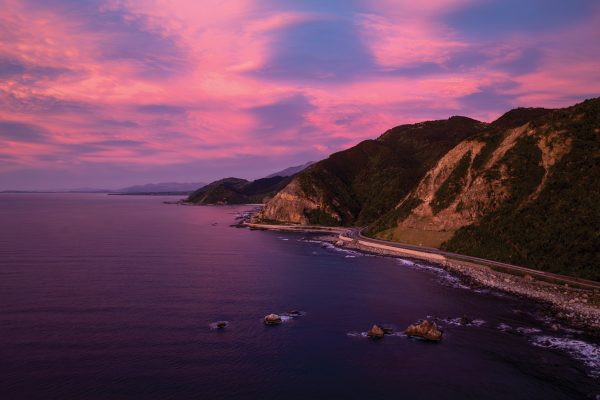
Along the rocky Ōhau coast, north of Kaikōura, fur seals loll in the sunshine. Yesterday was stormy, restless; now they’re sleeping it off. Pups suckle from their soporific mothers. Many of these females are also heavily pregnant; the next season’s babies are due two months from now.
In the shallows, youngsters wave their dark flippers, the fins almost indistinguishable from the wide blades of bull kelp that writhe in the suck of the tide. Everywhere, there is a pungent carnivore smell: excrement laced with dried sea-creature. And in a few places, where a pup lies among the stones, sun-shrivelled and petrel-scavenged, there is also a whiff of death.
Black-backed gulls chorus overhead. Breakers detonate in white spray. The seals trill and squeal. And a dozen adorable pups gathered on a rock turn their heads in unison—in te reo the fur seals are kekeno, meaning “look around”—to watch the Department of Conservation’s Jody Weir scurry hunched and alert over the boulders.
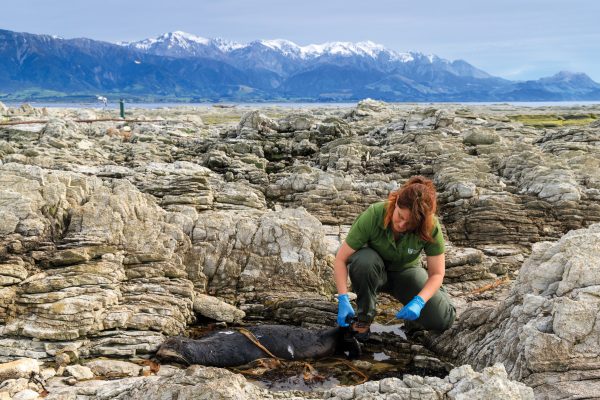
It is the first day of spring. The raucous breeding season is still a few months away; the big males are out at sea, fattening up before they return to fight and mate. In this moment of calm, Weir has come to check on the colony. Specifically, she is scanning for more death than usual.
Some mortality is to be expected. Female kekeno work hard. A mother has to feed herself, her unborn pup, and the pup born last season. She can dive 200 metres deep and fish at sea for as long as a week at a time. But if she can’t catch enough fish to fuel three lives, she can miscarry, or lose her milk supply, meaning her yearling pup will die. “Spring is the hardest time of year for them,” Weir says.
At this early stage, Weir isn’t too concerned. Though she points out one pup with its skin hanging loose like rumpled clothes, and the parched remains of another, most of the babies and mums seem healthy enough so far. But this is just the beginning. Over the next few months, Weir will make the half-hour drive up the coast from Kaikōura every few weeks, on edge until she gets a good look at the colony.
Weir has been watching this, our largest seal colony, for more than a decade. Last spring, and the one before, she discovered new and concerning threats. A famine. A lethal virus. So she is wary. What will this season hold?
*
According to DOC’s classification system, fur seals are not threatened. Though scientists haven’t done enough counting to be sure, it’s estimated there are between 130,000 and 240,000 kekeno scattered around our shores, including lots in the subantarctic islands.
Seals take up space. Two hundred thousand of them might seem like more than enough. But genetic and historical evidence indicates that before humans arrived, there were as many as three million fur seals here, hunting offshore and parked up on rocky coasts all over Aotearoa.
Māori hunted the seals for food, for clothing, and for their teeth—and on several occasions hid inside their skins, impersonating seals in the shallows for stealth attacks on their enemies. The North Island colonies were already gone by the time the first European sealing gangs arrived in the late 1700s.
Then the slaughter turned industrial. In just three years, sealers clubbed 140,000 kekeno to death in the Antipodes Islands. In a generation, they killed more than a million around mainland New Zealand, Australia and the subantarctic islands. By the 1830s, with the exception of a few remaining strongholds—the West Coast, the southern South Island, and Kaikōura—the rookeries had fallen silent. And over two centuries of absence, New Zealanders mostly forgot what it meant to share our coasts with seals.
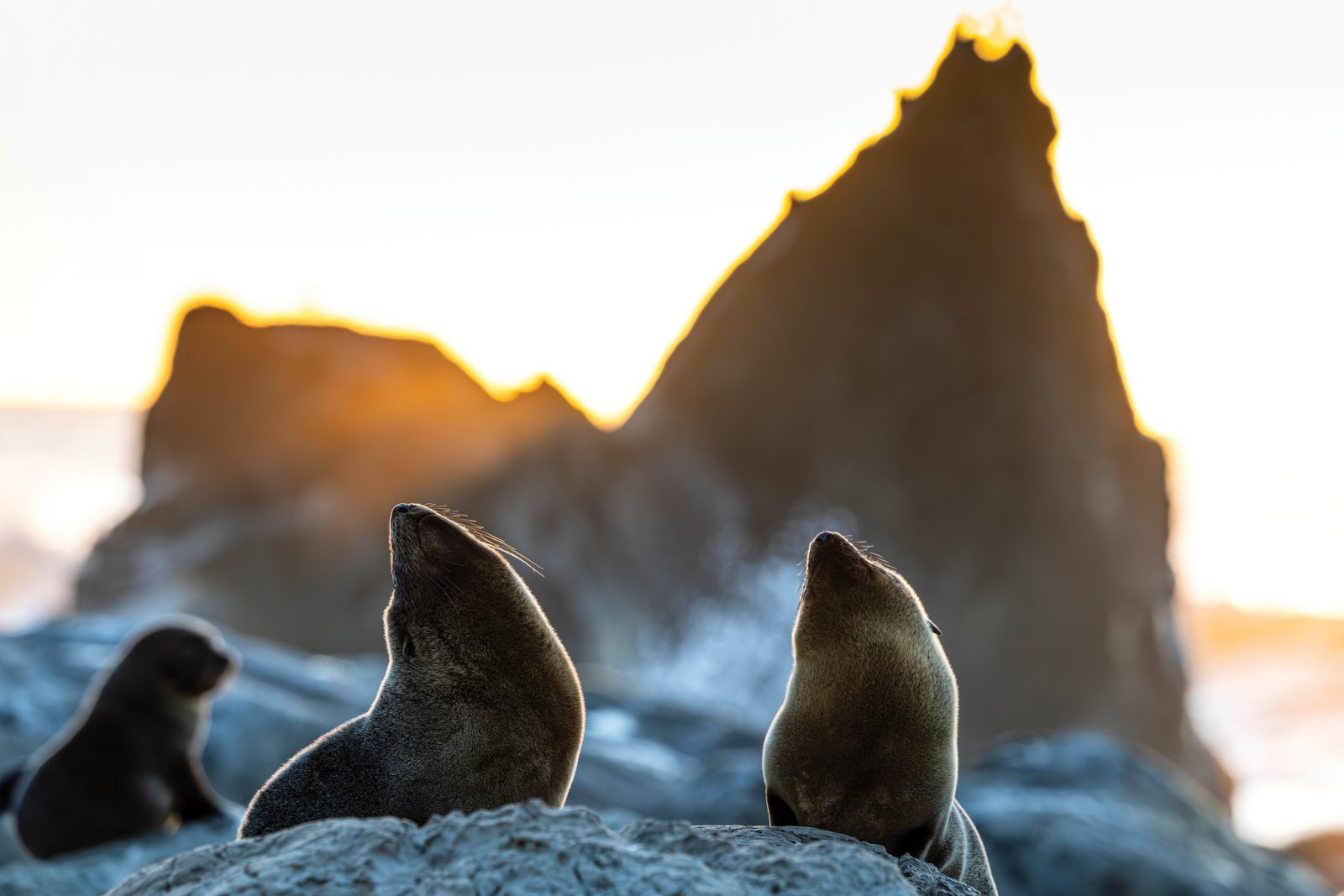
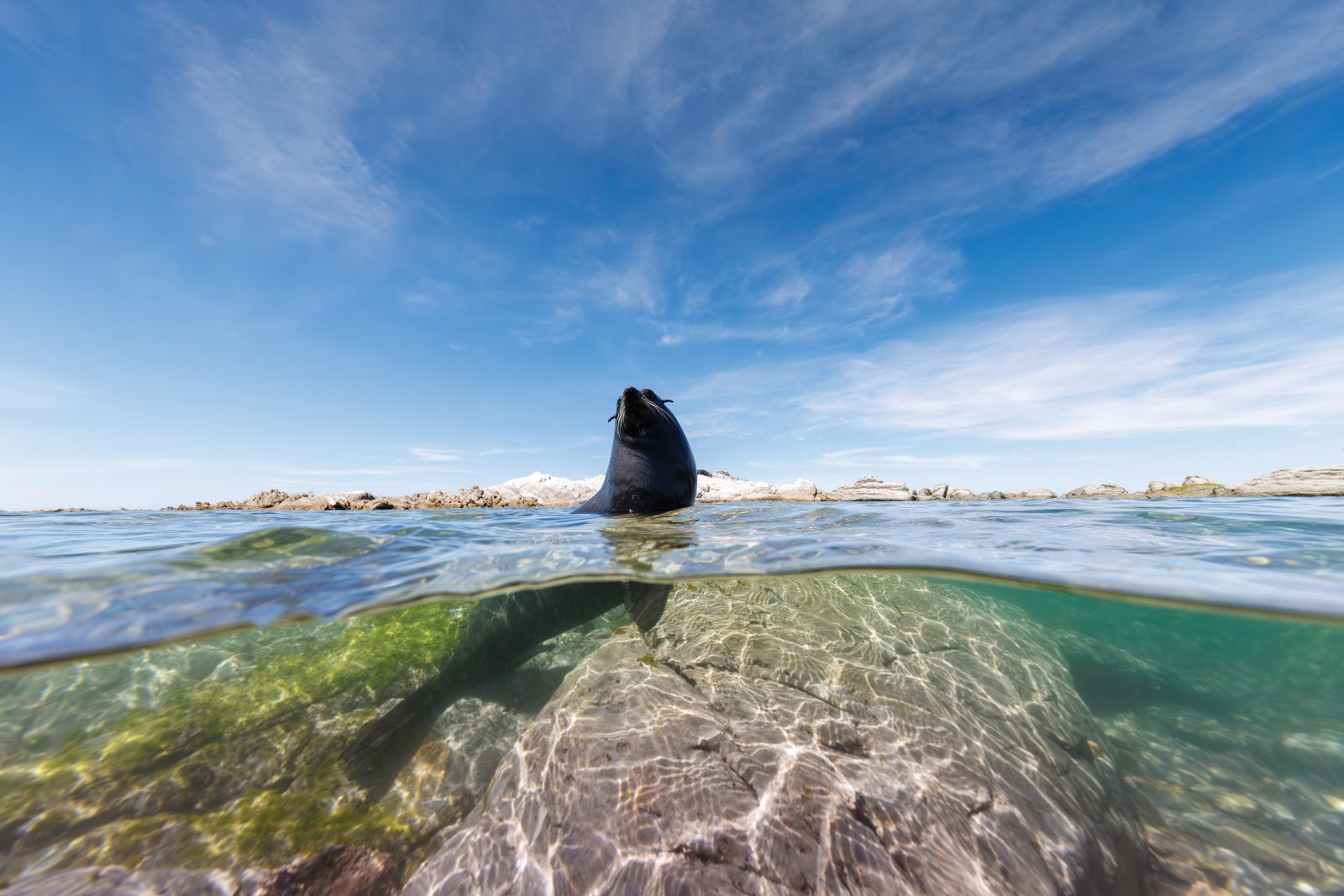
After the harvest ended in the late 19th century, kekeno started to recover, pushing back into some of their old haunts. Some people now view fur seals as overly numerous, pestlike, even dubbing them “the possum of the sea”.
But if this were a fishery, we’d call it collapsed. Kekeno have hauled their way back to barely 10 per cent of their original population. And, says Weir, “it could be a very different story in five years from now. We might be saying, ‘Oh, remember when there used to be heaps of fur seals around?’”
A fur seal can put up with a lot. But right now the species is facing a set of threats that tangle together and amplify one another. A diminishing food supply. Marine heatwaves and climate change. The nets and hooks of commercial fishing boats. Roads. Violence at the hands of humans and their dogs. The newly identified virus. And, brewing somewhere beyond the horizon, the especially vicious H5N1 strain of bird flu that has swept the globe, killing millions of animals—including tens of thousands of pinnipeds (see ‘Skyfall’ in Issue 190).
*
Jody Weir grew up in Ottawa, camping with her family among moose and bears in Canada, or manatees and alligators while on holiday in the Florida Everglades. Nicknamed “Jodyfish”, if there was water, she was in it: rivers, lakes, the ocean. She became a biologist, and went on to study lemurs in Madagascar, sea turtles in Barbados, wolves on Canada’s west coast and dusky dolphins in Kaikōura.
She has been working in New Zealand on and off for two decades, settling here in 2011, and has always felt drawn to the fur seals. She admires their hard-working tenacity—she can relate. One of her professors once described her as having “rose-coloured glasses and an iron-clad grip”.
Now, in Weir’s role as a science adviser on DOC’s national marine bycatch and threats team, she devotes some of that optimism and persistence to fur seals. It’s not just gathering data and writing scientific papers. She also brings her whole animal self to the work—her keen eyes, her senses of smell and hearing, her empathy. “It’s such an important thing, I feel, to actually be there amongst them and sense what’s going on.”
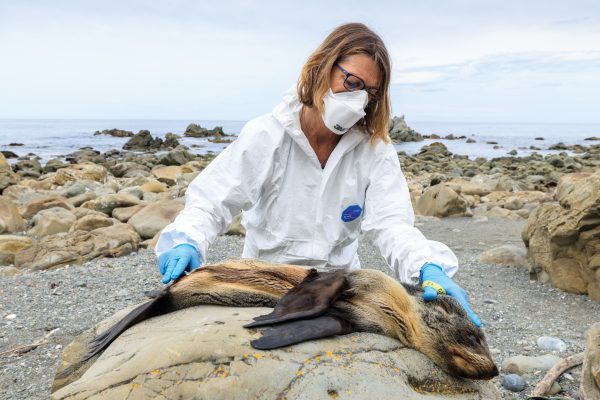
Two years ago, in September 2023, as Weir walked these same boulders at Ōhau, her intuition nagged at her. It was early in the season, too soon for hard data, but years of observation told her something wasn’t right. More pups than usual seemed to be dying. Along one 800-metre stretch, she counted dozens of dead. Many others looked skinny, their hip-bones hollowed and ribs showing.
She called Wendi Roe, a veterinary pathologist at Massey University who specialises in necropsies of endangered marine mammals. Roe often gets calls like this. “Well, they die every year,” she tells people. A few dead pups are no cause for alarm. “They’re probably just weanlings that can’t cope. But we really didn’t have good data on how much mortality was too much,” she says.
Because fur seals aren’t endangered, conservation budgets rarely stretch to include them.
“The perception is that they’re okay,” Roe says. “‘There are lots of them. We don’t need to worry.’” But in the spring of 2023, New Zealand authorities were starting to get concerned about the new strain of highly pathogenic bird flu.
Overseas, as well as killing millions of birds, the virus was taking down sea lions and elephant seals—tens of thousands of them along the coasts of Peru, Chile and Argentina. (Fifty-three thousand female elephant seals are now missing, presumed dead, from the subantarctic island of South Georgia.) The virus also had a clear pathway to New Zealand: it could hitch a ride on a migrating seabird.
With this in mind, Roe flew down from Palmerston North and showed Weir how to conduct post-mortems on the pups’ bodies. They found that the juvenile seals in Kaikōura, and others around the country, were indeed starving—pup after pup with almost no protective blubber. Their bodies were metabolising their own muscles and organs.
Why? Causation is hard to prove. Fishing could have something to do with it—seals rely on several species targeted by the deepwater fishing industry, including hoki—as could the severe marine heatwaves that peaked earlier in 2023. Warm water could have pushed important prey deeper, or further offshore. “So all of a sudden she’s got to go way further to the grocery store,” says Weir. “It’s not just one thing. Why are they starving? Well, they’re not getting enough energy to survive.”
*
There’s not much a scientist can do about starvation—it’s a systems problem. So in the spring of 2024, as the next breeding season rolled around, all Weir could do was watch. More dead pups littered the rocks at Ōhau. Again, she felt the death rate was unusually high. But this time, she noticed that not all of the bodies were skinny. When Roe carried out the necropsies, she found most hadn’t been starving. They’d died of something else.
Lab tests revealed the presence of a new virus—not the dreaded bird flu, but a never-before-seen type of canine distemper virus, variants of which cause respiratory disease in dogs, ferrets, elephants and other seals.
When that season’s pups were almost six months old, Weir found dozens of them dead and dying. It was May, an unusual time of year for such a lot of mortality. So Biosecurity New Zealand’s Harry Taylor went to Kaikōura with another pathologist to post-mortem the pups and collect samples. Taylor’s job is to investigate exotic or new diseases. At this stage, no-one knew whether the new virus was actually killing the seals or they just happened to have it on board when they died. Taylor sent slides of the damaged seal tissue to Roe up in Palmerston North. The virus was indeed responsible for the damage.
“Not necessarily all of these animals, but a significant number of them were dying of distemper,” Roe says—and not just at Kaikōura. A few weeks later, dead pups from Cape Palliser in Cook Strait also tested positive. Seven of the 12 pups tested also had salmonella, suggesting distemper suppresses their immunity, making them more vulnerable to other illnesses.
But is this a new disease? Where did it come from? How are the adults affected, if at all? For Weir, the mystery is galvanising. “It’s fired up all my scientific curiosity.” Most fur seal colonies have been growing over the past 30 years, but three on the West Coast have declined by an average of 72 per cent. Could this virus explain why, she wonders? Could we treat the seals, or vaccinate them? Might other animals—endangered sea lions, or domestic dogs—catch the disease from the seals?
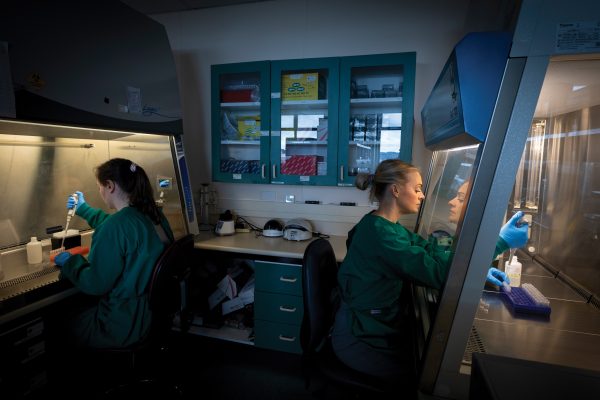
To narrow down how long the virus has been here, Jemma Geoghegan, a virologist at the University of Otago, tested frozen samples taken from a fur seal that had died in 2020. Tick: they were positive for the same distemper virus.
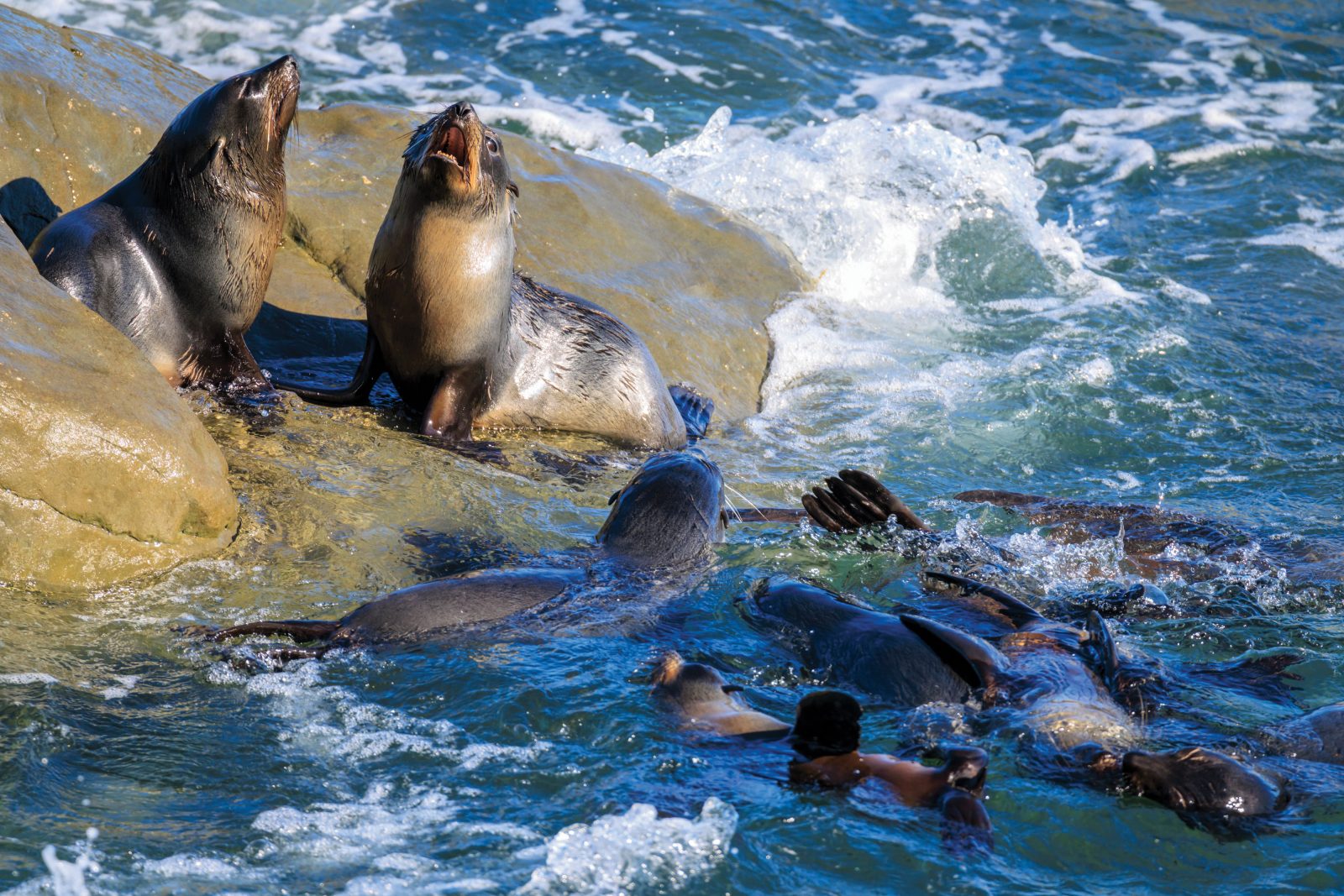
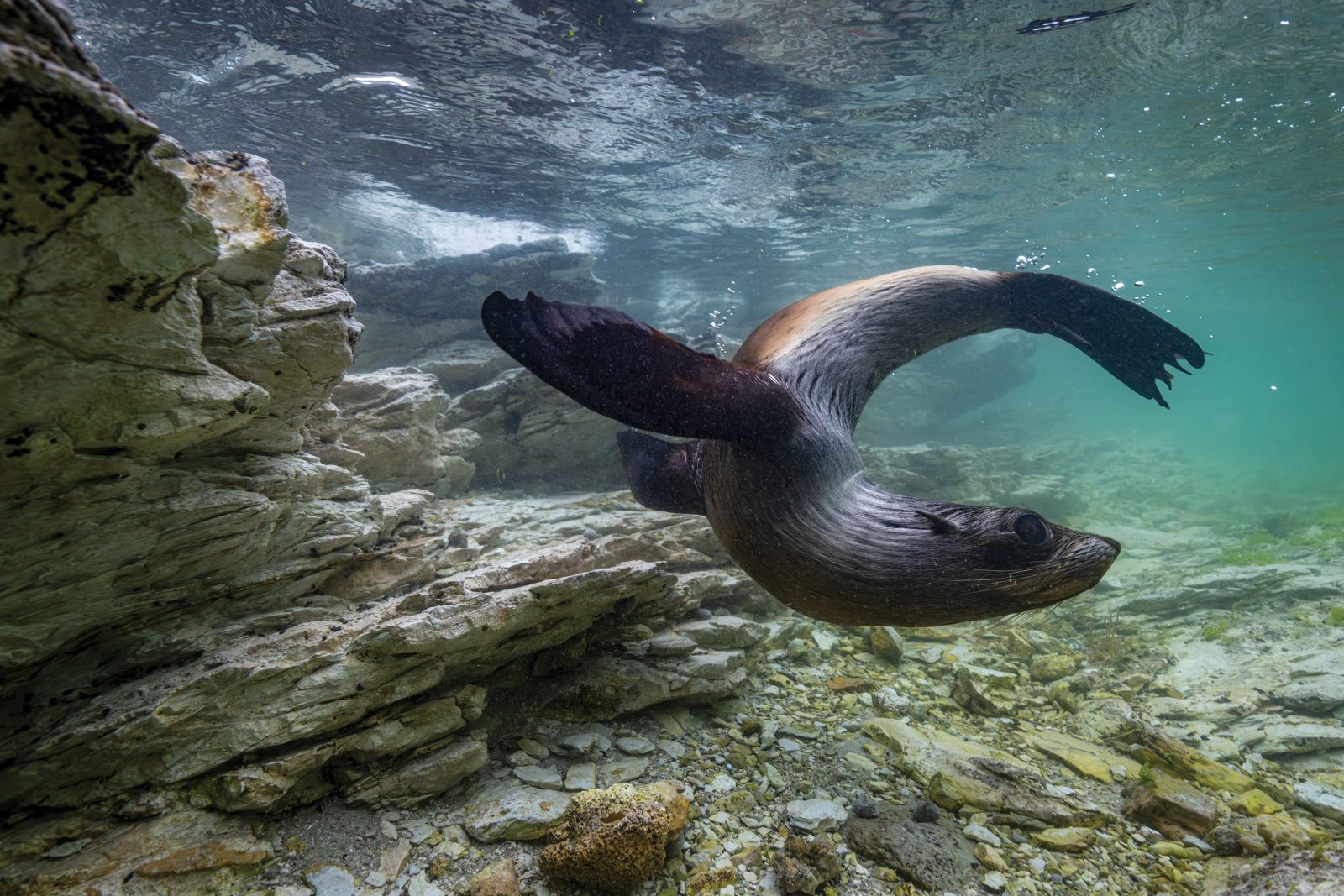
To Geoghegan, this means one of two things. Perhaps the virus is mostly percolating in some other host, and repeatedly spilling over to seals. That mystery host could be domestic dogs, but then we’d expect at least some pets to be getting sick, or it could be a mustelid, like stoats and ferrets, none of which are tested for anything. More likely, she thinks, the virus has been quietly circulating in fur seals for at least five years—but not killing enough of them for us to notice.
Taylor suspects the seals have harboured the virus for decades. Before our dogs were routinely vaccinated, starting in the 1980s, some did carry canine distemper virus. “What we think probably happened is back when people first arrived, a dog went down and had a fight with a seal,” says Taylor. The seal didn’t get too sick. But the virus had a foot in the door, and over the decades, it mutated.
Perhaps it’s only now gotten virulent enough to kill pups. Or maybe the disease is just harder for seals to shake off now their whole ecosystem is changing. Not only is it more difficult for sick animals to catch the food they need to survive, Roe points out—malnourished animals are also more susceptible to disease.
Roe’s business is understanding death. She is also anticipating it. For several years now, she has been poised for the arrival of the new bird flu—which, she knows, is likely to kill many, many more seals than distemper, with scientists able to do little more than “watch and wait and cross our fingers”.
Another “frightening thing” is that were it not for the extra funding floating around because of that bird flu, we might have missed the distemper entirely. Seals are not exactly hard to monitor. They’re large, they live alongside us, and spend plenty of time on land. “And yet, we weren’t noticing,” says Roe. “What are they telling us about what’s happening that we’re ignoring? Even the fact that we know what we do about the Ōhau Point animals is basically only because of Jody watching really closely.”
*
Weir’s close observations do have their joys. This early spring day, as we visit the Ōhau colony together, she beckons me over. She wants to show me something special.
There, huddled between the boulders just a few metres away, is an entirely ginger fur seal pup—honey-coloured fur and chunky rolls, pale pink-rimmed eyes screwed up against the light.
This “golden boy”, as Weir affectionately calls him, is an albino, and extremely rare. She discovered him in February, during the annual pup count. He’s now nine months old.
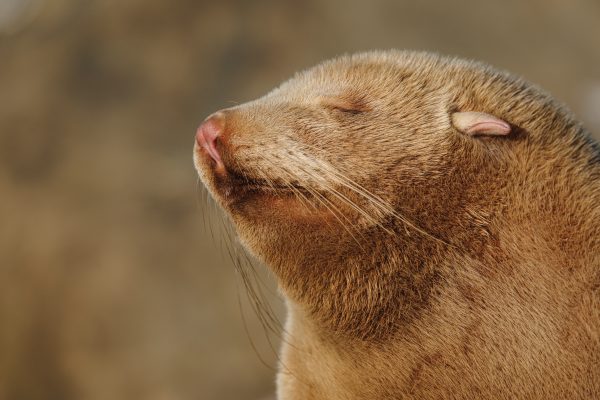
Also closely watching Golden Boy is Robyn Grant, a scientist visiting from Manchester Metropolitan University in the United Kingdom. Grant is a sensory biologist, and one of the world’s only whisker experts—a vibrissologist. New Zealand’s fur seals have some of the longest known whiskers in the animal kingdom—the tips tickle their shoulders—and until now, no-one has ever paid enough attention to scientifically describe what they do with them.
So Grant has spent the past three months sitting in the Ōhau colonies, recording hushed voice notes to herself. The seals, she says, are “really, really rich in tactile interactions”. She’s watched seals use whiskers in grooming, to find milk, in altercations and play-fights, and in nuzzling, reassuring touches between mothers and pups. Now, in September, the colony is a mums-and-bubs zone, but Grant expects that when the males come ashore, whiskers will have a role in male-female interactions, too. And underwater? Studies of other seals’ whiskers show they’re used in hunting, to detect the wakes of fish.
On land, lots of other pinnipeds galumph, like giant caterpillars. Fur seals have a marginally more dignified locomotion, holding their top half upright, and “walking” on their front and hind flippers. But instead of an efficient shuffle, they duck their head low to the ground with every step, making for a rolling gait that looks like very hard work. So why the duck? Grant thinks the seals are using their whiskers to sense the contours of the rocky, uneven surface.
This critical extra sense may turn out to be especially important for Golden Boy, right now soaking himself in the weak spring sunlight. Weir is convinced the “glowing golden fur baby” is blind, or at least visually impaired. It seems unlikely he will live beyond weaning—unless he can learn to hunt using only his whiskers.
*
We clamber out of the colony onto State Highway One, repaired at great expense after the 2016 Kaikōura earthquake, which buried the original Ōhau colony in rubble. It was impossible to count the dead. The rebuild, too, was hard on the fur seals: despite the best efforts of specially employed seal-shooers, more than 40 seals were killed.
Even now, seals—especially pups—often die in collisions with cars as they cross the road on the way to explore and play upstream, or to seek safety from big storm swells. The new road is closer to the ocean than the old one, forcing the seals to breed in a narrower, longer strip. “This is all their habitat, right? I mean, we put a road right next to a busy fur seal colony,” says Weir.
For once, the solution was beautifully simple: Put a second guardrail along the barrier at the edge of the road. Nice and low, so the seals can’t shimmy under. Authorities took some convincing; the day construction began, Weir brought the bemused workers a batch of homemade cupcakes. A year on, just 22 pups had died on the roads in the seal-proofed area, compared with 56 over the same period before the railings. “This is one of my biggest conservation wins,” she says.
Other deaths are more intractable. In 2021, someone strolled along the walkway here, shooting into the colony. At least eight fur seals died. Dogs attack and harass fur seals, too—sometimes with the encouragement of their owners.
But the toll of this sort of senseless violence is nothing compared to that caused by the commercial fishing industry, Weir points out. In the two decades up until 2023, more than 2000 kekeno were caught by trawlers, and more than 500 by surface longliners. This year, in the space of just three months, fishers reported catching 99 fur seals. About nine of every 10 seals caught by fishers will die, drowned in the nets or on the hooks.
Seals from Kaikōura fish as far afield as Cook Strait and often chase the same deepwater schools as trawlers. Unsurprisingly, they’re attracted to tuna on longlines, and to the fish handily bagged up in nets. So far, no one’s definitively solved the problem of how to keep seals away from fishing gear—and although a few deterrent methods have shown some degree of success, none are required in New Zealand.
*
In October, seven weeks after our first wander through the colony, I get a call from Weir. Last year’s pups—the almost-one-year-olds—aren’t looking so good. “There are definitely a lot more both dead but also dying,” she tells me. And their decline is heartbreakingly slow.
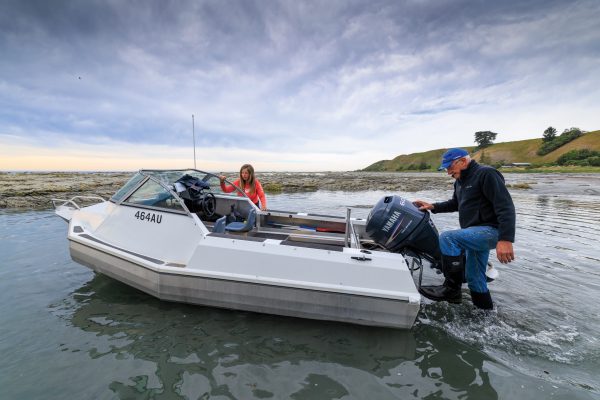
One emaciated pup seems to have lost its mother; for weeks, Weir has been watching it follow around a huge male, nuzzling and trying to suckle. Females won’t tolerate pups that aren’t their own, but this male—Weir calls him Jabba—looks to be putting up with it.
Weir has also observed a mother cradling her stillborn pup, and carrying it around by the nape of its tiny neck. Orca, belugas, and leopard seals have been observed caring for their deceased calves for weeks—thought to be a sign of mourning—but the behaviour has never before been documented in fur seals. “This was a disturbing and intense first for me,” Weir says.
It’s natural to want to help somehow. “I get a lot of people saying, ‘Why don’t you feed them? Why don’t you bring buckets of fish, or take them to rehab?’” she says.
But pups will never survive to adulthood without learning how to hunt, or if there isn’t enough wild food for them. Euthanasia isn’t the answer, either, she says—even if it might make us feel better. Maybe the best way to honour these lives is to pay attention.
“The fact that we’re uncomfortable seeing something—that’s our problem. Yes, it’s confronting, but fur seals are indicators of the health of our marine systems. It should be a sign, a wake-up call that the system is not healthy, it’s not well.”
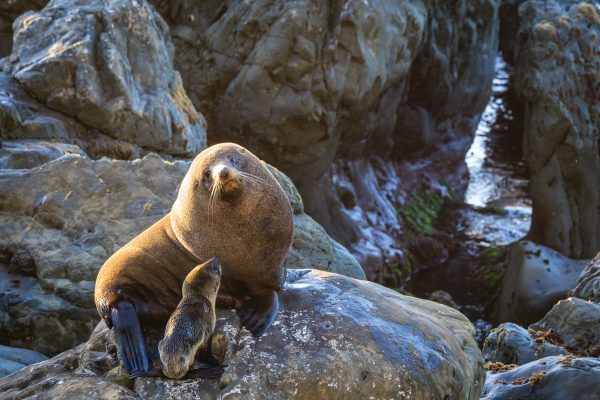
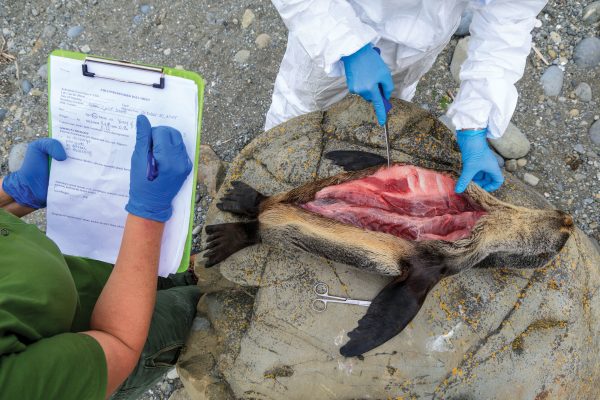
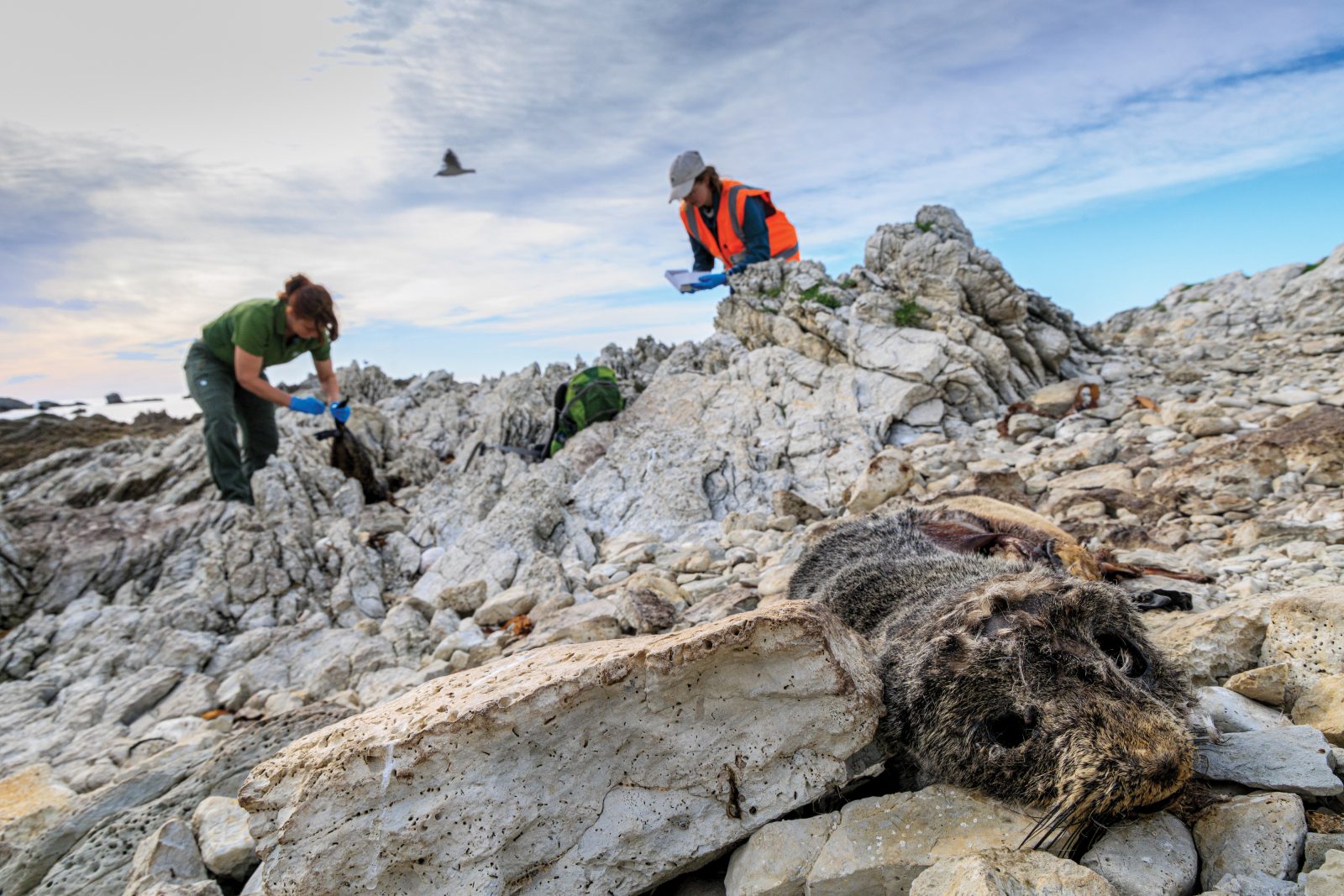
Weir has an ally in Roe, who makes another trip to Kaikōura to post-mortem another few pups. When they find a little body, they bring it to a flat rock out of the way of any grumpy males. Roe suits up in PPE, measures the animal, then opens it with a knife.
“It’s a step-by-step process of looking at everything, describing it, collecting things into various pottles, and taking photos—or someone else taking photos, because usually I’m a bit bloody and gutsy by then,” Roe says.
Though she’s been doing this for decades, she still feels a pang for the individual animal—especially the pups she sees still suffering. “But then my automatic part kicks in and I get interested in why. We can find out something. It’s not wasted.”
*
The first seal I see underwater is dead. The ghostly, ragged remains of its skin stretch like cobwebs along the bottom, with only the relatively intact flippers recognisable. The gap between my mask and neoprene hood is frigid, and my foot is cramping in my booties and flippers.
Spring has rolled on into November and I’m back in Kaikōura, snorkelling off the peninsula with Weir, Vanessa Chambers, and her nephew Ryan Collings. Chambers has been taking visitors to swim with seals since she was a child, tagging along to work with her dad. The family business, Seal Swim Kaikōura, stalled after the earthquake and COVID, but Chambers is aiming to reopen this summer. Visitors always leave captivated by the fur seals, she says. It’s the eye contact. “That’s what leaves the most impression on people.”
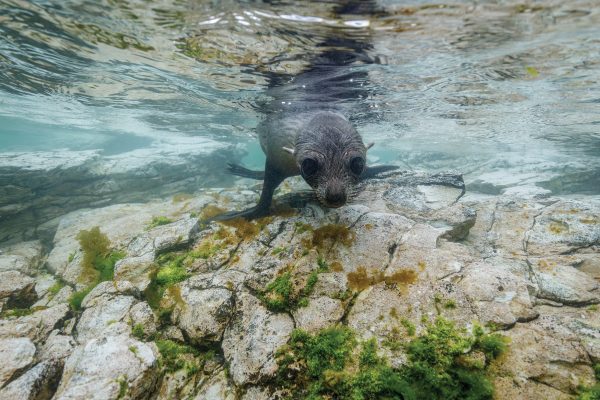
We swim further into the wind-ruffled bay, and 20 metres away, a fur seal slips into the water with the barest splash. Through my hood I hear a muffled guffaw, and at first I can’t tell if it’s Weir or the seal. “I’ll take that as a compliment,” she says, thrilled as ever to be among the animals. Chambers grabs my elbow and points me in the right direction. I duck my head under, and out of the gloom the seal appears—silver-dark, bullet-like, whiskers trailing, impossibly fast. Its body rolls and twists, sleek curves outlined against limpet-encrusted limestone.
Just a body length away, it locks its black, liquid eyes on mine—and yes, it’s affecting, some kind of mammalian recognition, one curious mind meeting another. Then, too quickly, it’s gone, leaving behind a soda stream of tiny bubbles.
More by Kate Evans
More by Richard Robinson
Over the next half-hour, a handful of other seals venture over to check us out. One follows Weir unseen as she snorkels near the shore. I’m especially in awe of their speed, and can appreciate for the first time what powerful and efficient predators these animals are.
“They’re our wolves,” says Weir as we splash ashore. And like wolves, fur seals are sentinels. “A healthy carnivore population is a sign of a healthy ecosystem.” Both species also have a patchy rep. Fishers sometimes see seals as competition, for instance.
But food webs are complex. Take out a big carnivore and you risk compromising the whole structure.
Our fur seals eat a vast range of animals—squid, octopus, hoki, anchovies, lanternfish, dogfish—and we’re still figuring out their exact roles in the ecosystem. Their nutrient-rich droppings, for instance, like those of whales, probably fire up primary production in the oceans, making more food available for everyone.
“It’s not as simple as a food chain,” says Weir. “We now know it’s a very complex web of interconnectedness.”
*
Weir and I drive back up to Ōhau, and pick our way over the boulders into the colony. The males have arrived. They’re big and healthy, muscles rippling beneath blubber. Weir points out Jabba, an extra-large dark brown male. But there’s no sign of his little shadow. Weir says the pup must have finally died.
She’s been thinking about Rachel Carson’s classic 1962 work of environmentalism Silent Spring, about the harm caused by pesticides. This spring just feels quieter, she says, gesturing at the mostly-chill seals around us. At this time of year, she’d expect more action, “males duking it out all over”. But it’s too early to say for sure how things will go this breeding season.
Official censuses of the Ōhau colony take place each February. Weir and her colleagues count the new season’s pups by giving some of them a haircut—trimming the top layer of fur from their heads with scissors, a punk look that makes them easy to recognise and recount. From that count they can infer total numbers.
In a normal year, about 2500 pups will be born. In the 2023-2024 breeding season, starvation cut the newborn numbers in half, and also killed more than 1000 of the older pups. Last season, the birth rate held firm, but by autumn, dozens of pups were dying of distemper.
*
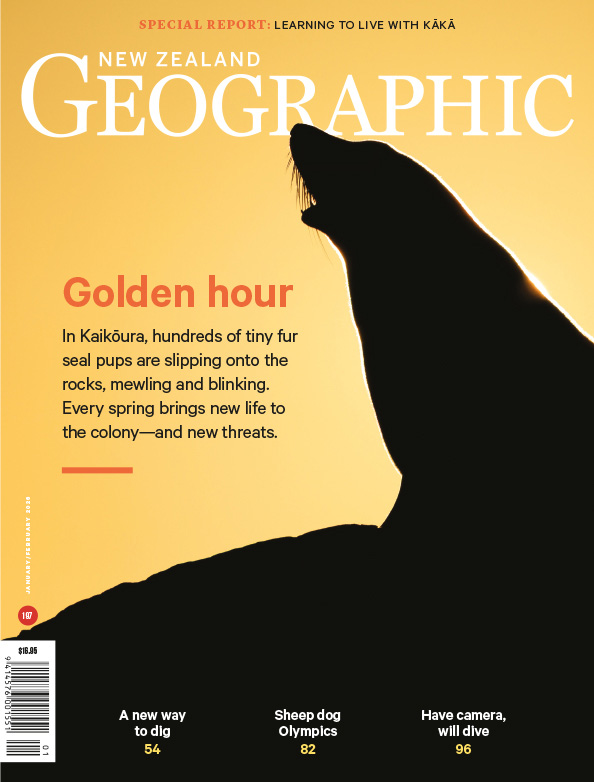
The week this magazine goes to press, brand-new seal pups are slipping onto the rocks at Kaikōura, mewling and blinking, rooting for milk. For the first year, their lives will unfold on this slender strip between roaring ocean and roaring road.
They will have the distemper virus to contend with—Roe’s latest necropsies confirm it is still circulating in the colony. They will have to stay away from hooks and nets, and find enough fish in our depleting oceans to keep their muscled, quicksilver bodies alive. They may well encounter the killing bird flu, if not this year, then the next, or the next. (The virus continues its march—in late October, scientists noticed an unusual number of dead and dying elephant seals on Heard Island, one of the subantarctic outposts that could act as lily pads for the virus to hop between Antarctica, Australia and New Zealand.)
Golden Boy, at least, is still thriving. And Weir is collating fragments of hope. Carrying out research for a scientific paper on the pup, she found newspaper reports from 2011 of an albino seal in Kaikōura that lived well past weaning. She has heard about other types of seals blinded in accidents, or stricken with cataracts, that can still hunt perfectly well. “So it’s possible he could survive.”
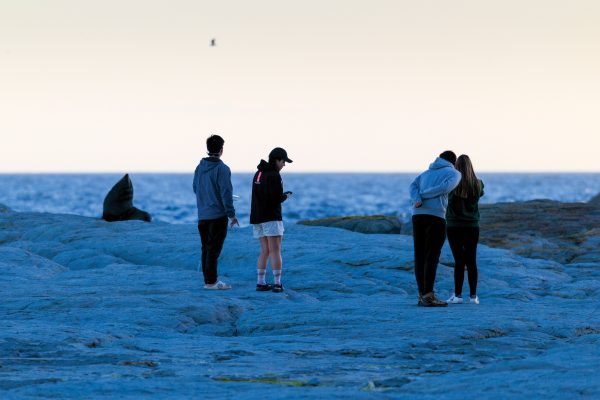
Weir has to go and collect her son from school, but I spend an hour on the sweeping new public walkway above the colony. I’m not alone; a constant stream of people pull off the highway to exclaim over the seals, photograph them with long lenses, film for their socials.
Down below, two adult fur seals race through a peeling wave. A swarthy male lets out a Chewbacca growl as he hefts his considerable weight over the rocks, and fans out his whiskers as he tussles with a female. A pup calls plaintively for its mother.