



This time last year, we were approached by a number of readers who had a subscription but wanted to do more to help.
I was nervous about accepting donations—we’re a private company, not a charity—but I also recognised what these readers recognised: With more resources we can do more work.
So I set some terms;
- We receive donations only into a clearing account set up for that purpose
- We spend donated funds only on journalism with strong public-interest values
- And never on stories that could be considered business-as-usual
- Then we report back to donors at year-end
We didn’t promote donations heavily, but nonetheless, 29 people made donations of different amounts, totalling just under $6500. Today I’m going to tell you how we spent that money and what it might mean for our future.
*
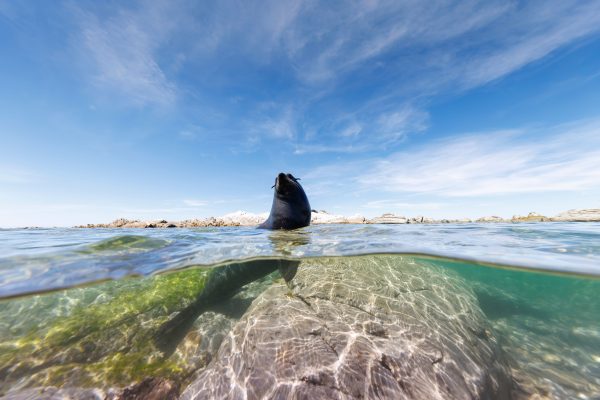
Early this year we began to worry about fur seals. Last year they were hit with a strange and deadly virus. The year before that, starvation. What would this breeding season bring for the thousands of New Zealand fur seals hauled up on our coasts?
Overlaying all this is the spectre of H5N1 bird flu arriving in New Zealand. Tens of thousands of seals succumbed to bird flu in recent years in Peru, Chile and Argentina, and as mammals, are a pathological springboard from avian species to humans. In 2025, the combination of factors was mounting up for our fur seals.

It was one of those stories that we sensed was both important and urgent, a story with nationwide significance, and a prism which would focus a number of environmental themes.
We needed to throw everything at it, and we needed more resource. This was the day that editor Catherine Woulfe decided to break open the donations piggy bank.
With support from readers, writer Kate Evans and photographer Richie Robinson were able to visit fur seal colonies on the Kaikōura coast a number of times across the breeding season, shadowing scientists doing the field work.
Being there is an important part of how New Zealand Geographic reports. Only when you visit can you describe a scene accurately or hear the unvarnished truth from the experts on the ground. It’s a journalism convention that is becoming increasingly expensive, and therefore, increasingly rare.
A preview from the first draft of Kate Evans’ story:
In the shallows, youngsters wave their dark flippers, the fins almost indistinguishable from the wide blades of bull kelp that writhe in the suck of the tide. Everywhere, there is a pungent carnivore smell: excrement laced with dried sea-creature. And in a few places, where a kekeno pup lies among the stones, sun-shrivelled and petrel-scavenged, there is also a whiff of death…
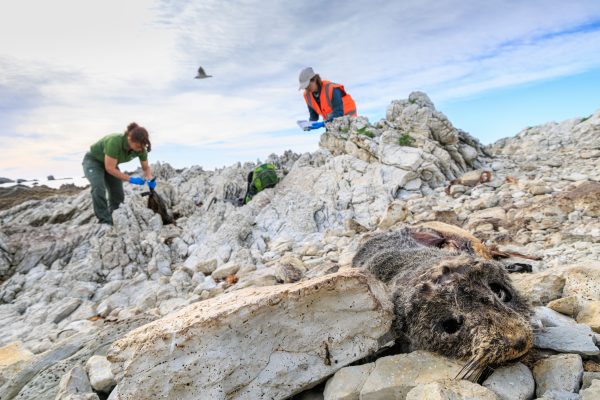
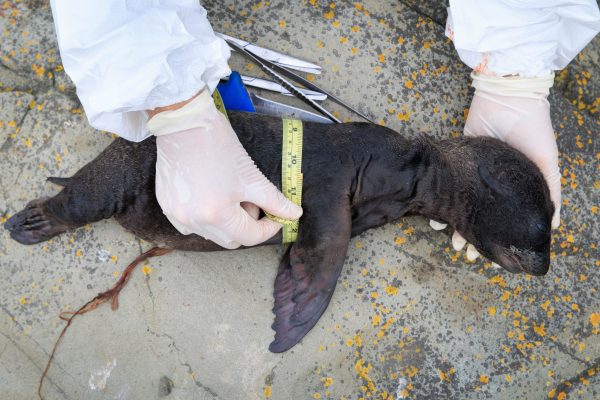
We understand that images like these can be confronting, but pretending this isn’t happening doesn’t make it go away. Only public attention will give researchers more resources or drive better public policy. This is the role of for-purpose journalism.
Department of Conservation ranger Jody Weir:
“The fact that we’re uncomfortable seeing something—that’s our problem. Yes, it’s confronting, but fur seals are indicators of the health of our marine systems. It should be a sign, a wake-up call that the system is not healthy, it’s not well.”
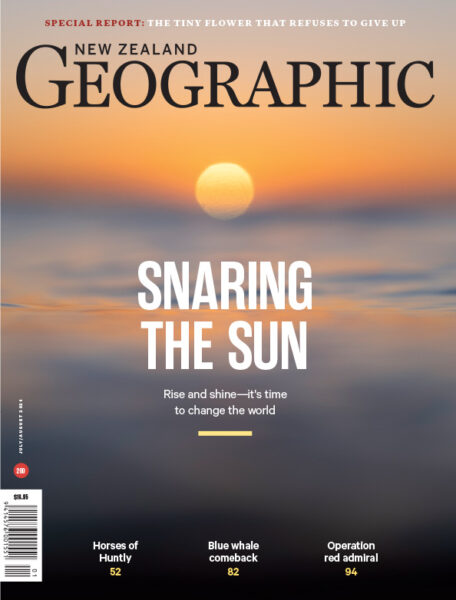
The story is both beautiful and sad. You will see it on the cover of the next New Zealand Geographic in your letterbox (or bookstore/supermarket) December 15.
You’re seeing these pictures, and will soon read this story, because these readers decided to go the extra mile and give NZGeo a whole new gear for an important story: Barry Scott, Blampied Family, Bruce Copeland, Charles & Marlene Anderson, Cheryl Broneck, Colleen Linnell, Dave Evans, David Ramm, Diane Newton, G Conroy, Grant Clayton, Harold Short, James Cordes, John & Kay Stewart, Kara Stones, Leigh Hyde, Loris Mills, Merv Robertson, P Sherrell, PD, Roger Hall, Simon Chiaroni and four donors who elected to remain anonymous.
*
The significance of this support isn’t lost on us. The observant among you will have noticed that the subscription thermometer graphic has been firmly stuck on 10,000. That means two things: Readers are renewing last year’s expiring subs like crazy—thank you—but we’re not winning enough new subscriptions to get us to 12,000, the notch on the thermometer that allows us to hire another journalist and double our story output.
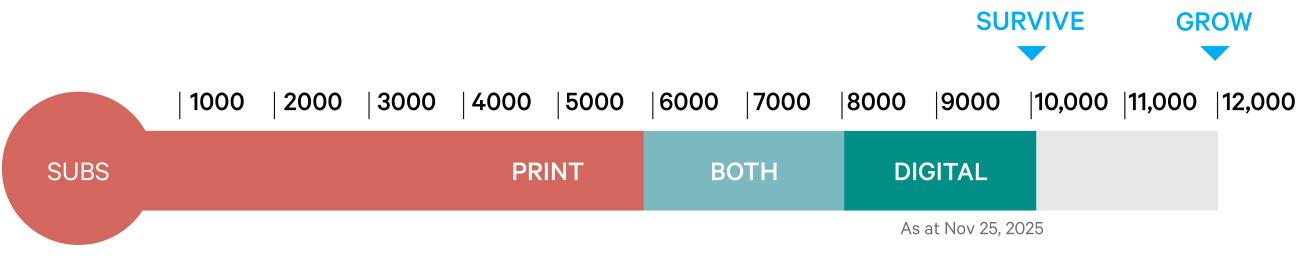
But now we know that there is another way we can get there—donations can make up the difference.
One of our donors has set up an automatic payment for $8 a month. Another dropped $2000 as a one-off. There isn’t a wrong amount. If you would like to donate, it’s as simple as paying into our dedicated donations bank account 12-3072-0812837-02 and sending an email to donations@nzgeographic.co.nz telling us your name, email, how much you sent and whether you would like to remain anonymous or not.
We have also been approached by readers who are considering a more substantial contribution as a legacy, creating a family of donors in a sort of patrons’ programme to support for-purpose journalism. If any of that sounds like you, please drop me a line. We’re putting some detail around what that would look like right now.
However, whether we grow our influence or remain small yet powerful, we’ll continue to tell the stories that matter. Thank you for reading, and thank you for your support.
More by James Frankham