






Kelsey Waghorn, HarperCollins
On December 9, 2019, Kelsey Waghorn was supposed to be off work. She was moving calves at her partner’s farm near Whakatāne when she got a call from her boss: cruise ship passengers were en route from Tauranga. Could she lead an extra tour to Whakaari/White Island?
The previous day had been Waghorn’s fifth anniversary at White Island Tours, and she’d made almost 900 trips there—including, six months earlier, guiding New Zealand Geographic when we filmed virtual-reality footage of the island volcano.
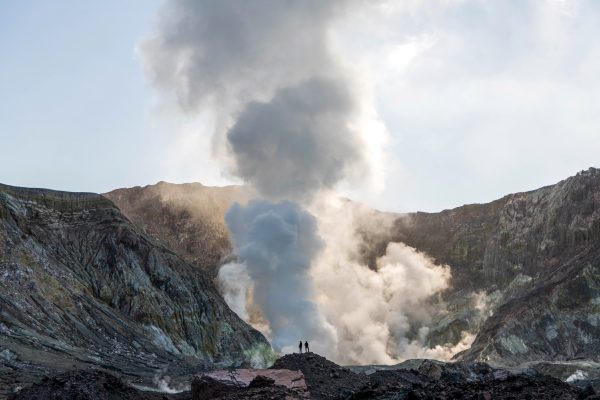
You probably know what happens next. Waghorn’s tour group was returning from the crater to the shore when Whakaari erupted, sending a black-and-grey plume into the sky. Then, that column of ash, steam and rock debris collapsed under its own weight, sending a pyroclastic surge rolling towards Waghorn.
She knew what she was looking at. Years earlier, she writes, she’d read a memoir by a volcanologist who’d survived a pyroclastic surge on a Colombian volcano, and knew her best chance of survival involved covering as much of her body as possible and holding her breath for as long as she could. And so she did.
This is just the opening of Waghorn’s own memoir, Surviving White Island, and this is the moment her story overtakes what’s already a matter of public record and becomes hers alone.
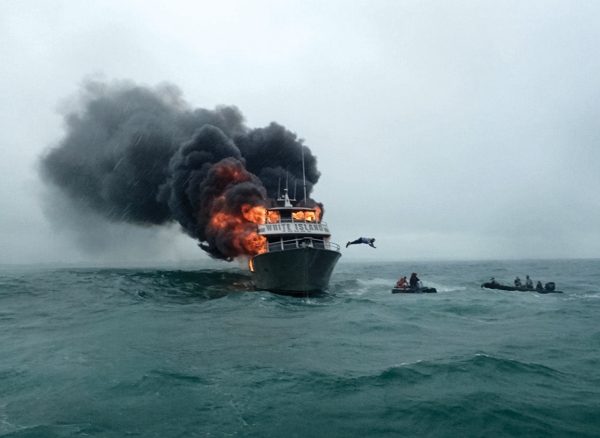
The surge flows over Waghorn and her group, and the air clears. Severely burned over half her body, she forces her group to get moving to the wharf.
Waghorn’s memories go right up until she’s loaded into an ambulance. Later, while she’s unconscious, first in an induced coma and then due to pain medication, her family take over as narrators: part two of the memoir comprises messages they exchange on Waghorn’s progress—a peek into the worst-ever group chat—as well as the text of a diary that the ICU nurses encouraged her family to fill out. Through footnotes, Waghorn annotates this section with her own fragments of memory. It’s horrible. She hallucinates disturbing images. Nurses leave her room crying because of how much pain they’re inflicting on her. Her family need a security escort to fend off media.
Waghorn is unsparing and funny. She tells us about some of her delusions: monkeys, a cheese waterfall, the band Slipknot playing in the next room, nurses kicking her out of hospital for being too much of a burden.
She nicknames her feeding line her “fish tube” and her catheter her “bag of gold”. Her arms and legs are zombie limbs, “black, bloody, swollen”. At first, touching things with the new skin on her hands makes her feel nauseous, but she gets accustomed to most textures—with a few notable exceptions: “Which I won’t mention, because Dad will read this and cover the house in them.”
When she’s discharged from hospital—66 days after the eruption—she thinks she’s on the home stretch. “It turned out the physical part was the easy part,” writes Waghorn. “Now it was my brain’s turn to start demanding some help.”
She isn’t able to talk freely with the other survivors due to the ongoing police investigation. “So while I wanted to have some kind of relationship with some of the very few people who knew what it was like to be swallowed whole by a volcano and spat out, I also felt like I couldn’t get too close,” she writes. “It was an awful, isolating position to be in.”
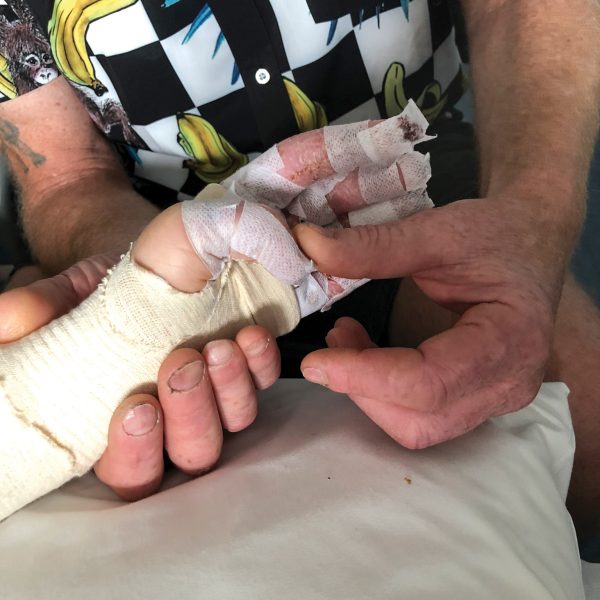
Back home, Waghorn becomes over-sensitive to sounds. Her resting heart rate rises from 64 beats per minute to 120. She has unpredictable flashes of anger. Her partner’s dad makes her a geologically accurate papier-mâché White Island so that she can set it on fire, but that doesn’t help, and neither does a diagnosis of post-traumatic stress disorder—not at first. It takes her several attempts at therapy before something begins to shift. “I would rather be burnt again than have PTSD,” she writes. “I’d thought it during the year before, and I still think it now.”
Waghorn’s investigation of her own mental state is courageous and revelatory, and underpins the most compelling parts of the book. At one point, we learn the clarity of her storytelling comes at a cost: she can’t forget the day that changed her life. “There was no single flashback moment where it all came flooding back,” she writes. “It was just there. Like any other vivid memory. Like it had always been there… Even after I was out of the coma, I kept repeating the same stories. I never forgot what happened, despite everything.”
More by Rebekah White