




Last week we reviewed how we had spent last year’s donations and the feature that had benefited from the extra spend.
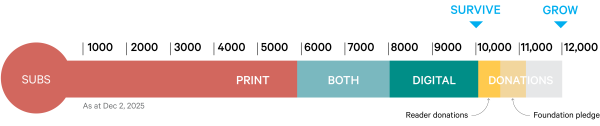
Other subscribers were spurred into action, and donations flooded in—some small ($5 from KD), some large ($5000 from JF). As of today the total stands just shy of $14,000, more than double last year.
Then a phone call with a foundation supporting environmental causes. They could see how reporting creates attention, and how public attention drives policy, science, awareness and change. They’re now considering a proposal to get us closer to our stretch goal.
With one week left to renew last year’s subscription surge, the subs-o-meter is still pegged out on 10,000. That means that we’ve lost a few, won a few and stacks of subscribers have renewed. We’re a week away from achieving goal 1, but along the way we’ve also found a new way to reach goal 2.
There are a ton of stories on the slate that we could do bigger or better with more support, and a number that we couldn’t contemplate without help. These are stories that are fiendishly complex, or require weeks of field time to do properly, or a month at a desk drilling into data or making phone calls—our feature on tuna, for instance, took seven years to produce.
“I would be most willing to donate or bequest if I knew it was going toward a specific role (to fund a field journalist or similar) as opposed to general operating expenses. Setting up a specific fund would appeal.” TT
*
Our style is to identify a window through which to tell a story. Looking at the rapid expansion of Centrostephanus urchins paints a vivid picture of the effect of warming water on range-expanding species. Looking at scallops allows us to tell the story of fisheries mismanagement that allowed the total collapse of a commercially and culturally valuable stock. Showing the plight of fur seals in Kaikōura shows how multiple threats—fishing, climate change and disease—can combine in unexpected ways to create a catastrophic mortality event. But these stories are also the most expensive and difficult to produce.
“I’d consider donating a bit extra to enable coverage of certain topics that are expensive to work on. While philanthropy is pretty meagre in NZ I wonder if there’s someone out there whose interests align with NZGeo.”
Likewise we are approaching the biggest rimu mast since the 1970s that could impact kākāpō, but just getting to Codfish Island is a Herculean trial, let alone staying there a week. We want to run a series on how New Zealand can plot a course to a net-zero carbon future, and sand-dredging, and there are at least two stories in Samoa that we just can’t get to.
If you run a foundation or have the means to contribute to our growing family of donors send an email to donations@nzgeographic.co.nz. We can do more together.
More by James Frankham