Unity. Discipline. Endless bobby pins. A story about what draws women to marching—and why they stay. (more…)
More by Connie Buchanan



In an empty carpark behind a hockey centre next to the Hamilton lake, the Madison Blues masters are warming up. Twelve women, aged between 32 and 67, get in the zone. They throw shoulders back, chests out, bodyweight forward, and lock eyes on middle distance. They’re in identical practice outfits: navy visors, pale blue polo shirts, navy trousers and those white leather boots that announce “marching”. On top of each head is a tightly wound bun gripped by a navy scrunchie.
“Are you Karyne?” I ask the woman with the whistle. “No, I’m the other Karen,” she says, eyes whisking to one side, “Step up, Cherie!” A portable speaker blasts brass-band music and they’re off. Heel toe, heel toe, steel rods for spines, piston arms, around and around the carpark.
Watching from a patch of shade, I’m aware of my slumped posture, the scruffy hem on my shorts.
The women have been up since dawn. They’ve travelled from Rotorua, Tauranga, Tokoroa, Morrinsville, Whakatāne, Te Kuiti and elsewhere, arriving loaded up with matching navy-blue hanger bags, and containers full of sausage rolls and biscuits neatly imprinted with the fork-tines of home baking.
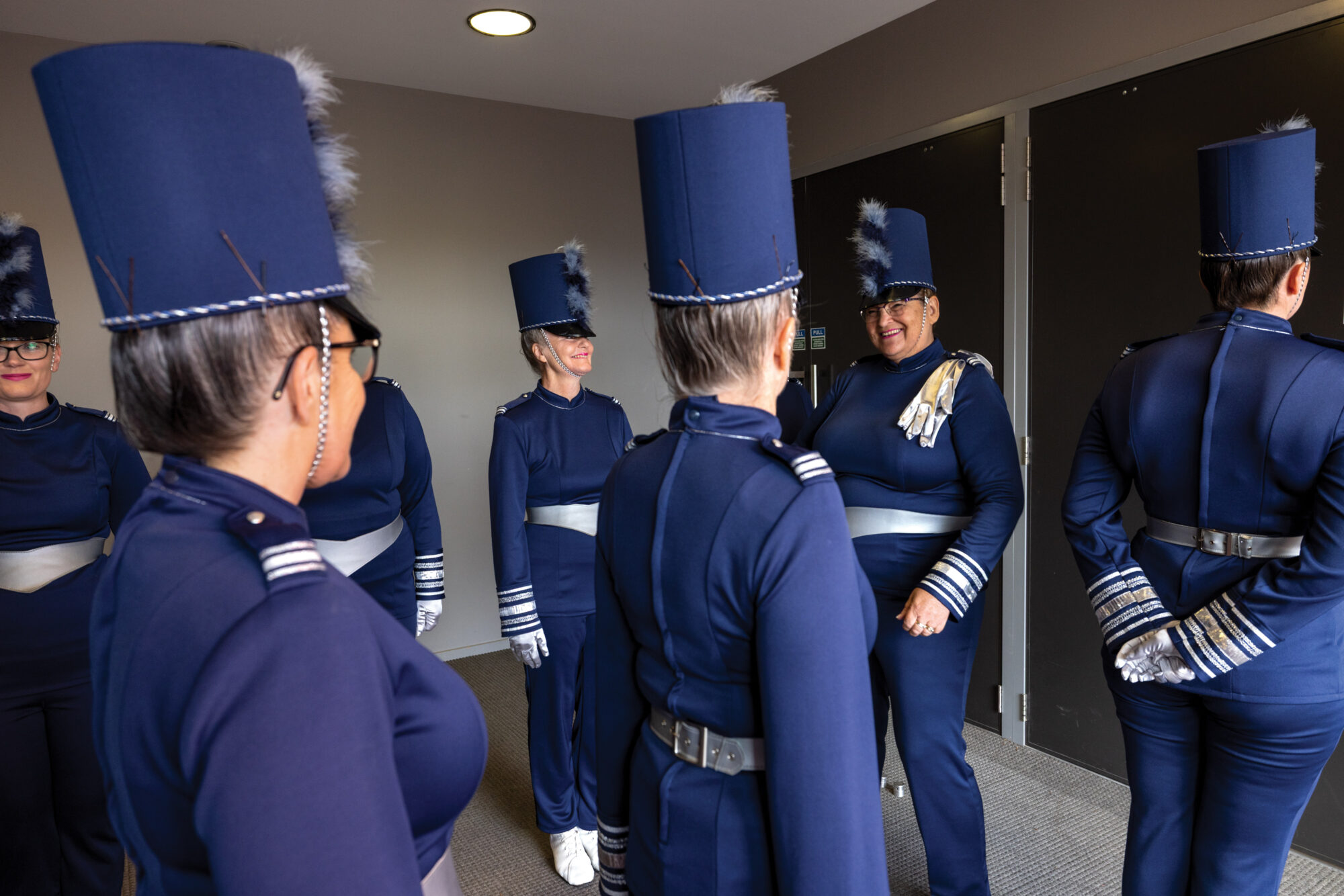
All teams must report to judges at 11.30am. The Madison Blues masters hustle out of the carpark and into the changing room. They re-lace the white boots, made to measure from stencils traced around each foot and sent to a shoe-maker in Christchurch. The sporty visors come off, to be replaced by tall navy pillbox hats with silver chain-link chinstraps. The hats are custom-made by Hills Hats in Wellington, who also supply the police force. The women urge me to inspect the similarities in detail, as if such specs are common knowledge.
Inside the hanger bags are long-sleeved navy jackets with braided silver cuffs. First, navy bodysuits are snapped on, then further secured with an over-knicker. It’s a lot of layers for a punishingly hot Hamilton day.
The other Karen, Karen Bedingfield, sews the uniforms herself, which explains the immaculate fit over a wide range of body sizes and shapes. The hats are jabbed into place with six bobby pins each, completely concealing the identical hair-dos and hand-made scrunchies. Unity is paramount—to march is to match—even in the bits that can’t be seen. Beneath the over-knickers and bodysuits are matching undies, black and high-waisted.
The call goes out, “Who needs lippy?”, and a tube of Max Factor Dazzling Fuchsia is passed around. Some sort of emergency erupts in the corner. A broken clasp. The best solution might be a paperclip but the industrial toolbox full of hairspray, bobby pins and the kitchen sink doesn’t have one.
“It’s 11.28 Karen!”
“Shit … then just sew her in, sew her in.”
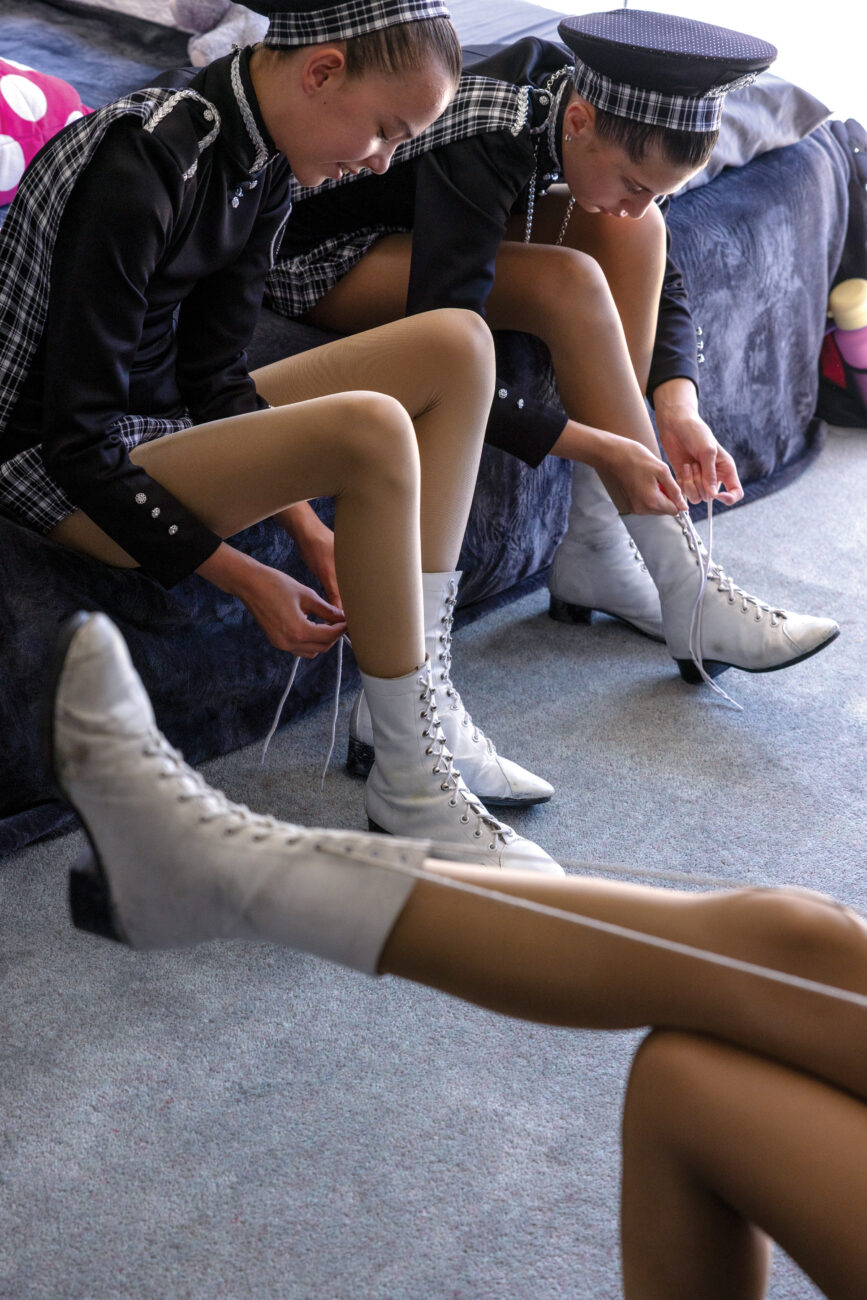
I’m surprised the navy trousers haven’t been swapped for a flippy pleated skirt and those shiny beige stockings which give everyone plastic Barbie legs. The trouser question unleashes a storm of comment.
“That’s controversial, very controversial.”
“Ooh, you can quote me. Go on, quote me, saying I want the skirts back.”
“It’s completely divided us.”
They laugh and hoot, all wanting their personal skirt position on the record, pointing the finger for the last, definitive word at—who else?—Bedingfield.
“Is everyone in marching this nice?” our photographer wonders, and is gleefully told,“No, some of them are total bitches.”
Silver belts are cinched over top of the tunics. Good luck to anyone who needs the toilet at this point. “I’ve already done my nervous wee,” reports Marieke Carson, one of the newest recruits. She dabs her sweating forehead with tissues one last time. Finally, a pair of silver gloves is tucked into each belt, awaiting the Display section when things will go off-piste in time to instrumental MC Hammer and Michael Jackson.
It’s 11.30am. The women are ready. All this prep is for a competition they’ve already won, just by turning up: the Madison Blues masters are the only ones competing in their grade.
*
In the 1950s and 60s, pretty much every town in New Zealand had a marching association.
“There’d have been 40 teams, easily, in Waikato, back in the day,” says Michelle Reid, the head judge in Hamilton. “Then the same number again in Auckland, Wellington, and Canterbury.”
The proof is on the trophy table. A tall silver cup, dating back to 1954 and sponsored by a Huntly fertiliser company, is engraved with a long list of provincial names. There are the Whitiora Supremes, Papatoetoe Brigadettes, Pukete Pioneers, Clendon Guards, and Frankton Railway Premiers. On other silverware are Legionettes, Militaires, Cavaliers. One outlier to the military tone—the Demons of Taupō—has their win engraved in a pointy, evil font.
Three of the top brass from Marching New Zealand are here today, including Karyne Cassells, who is national director of coaching. “I remember the days when, for a competition like this, the entire place would be packed with tents,” she says, looking out over an empty grass perimeter. “Whole families would bring their barbecues and they’d stay all day.”
Jodie McLuskie, the national technical manager, nods. “Now, most parents drop and run,” she says. “They might be working two jobs, with the cost of living. They don’t have time any more. The pace of everything is different, it’s changed.”
Marching emerged on the New Zealand sporting scene in the 1930s. Teams formed in factories, hospitals and workplaces as part of a concerted effort to keep the nation’s young women healthy and motivated during an economic depression.
At the end of WWII, marchers were inspired by returning soldiers to develop an even more rigid military style. In 1945, the New Zealand Marching Association formed and for two decades, membership soared.
People who hear that I’m writing about marching either say, “Oh, do they still do that?” or they throw names at me. “Your Aunty Mopsy was right into her marching.” “Emily’s mum at school loves her marching.” “You should talk to Trish.”
They’re mainly the names of older women, or dead relatives. These days, gymnastics, dance and cheerleading, plus a host of other sporting options, have demolished the ranks of young recruits.
“When I started out, girls weren’t allowed to play soccer. We had netball or marching and that was it,” says Bedingfield.
Today’s marchers tend to uphold a family connection. Nearly everyone mentions a mother, grandmother, older sister or aunt in whose footsteps they are following. In a wheelchair under a shady tree is Bedingfield’s 77-year-old mum, Shirley Wotton, the second of five generations to march. When coach Vickiee Hastings arrives to inspect the under-18s, Ruawai, she joins her two nieces in the changing room.
Meanwhile, the food truck hasn’t turned up. “Maybe they decided it’s not a big enough event?” someone suggests, scanning a loose crowd of no more than 30 spectators.
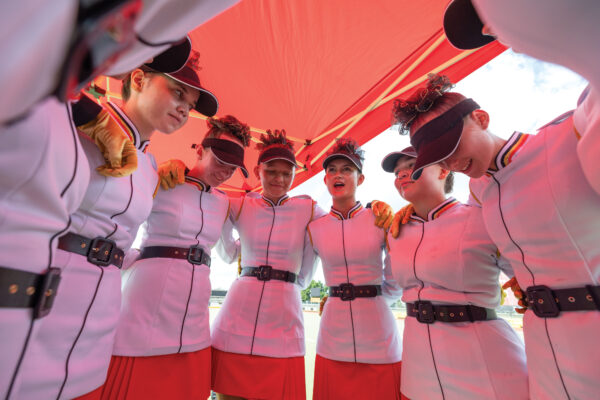
The reduced scale doesn’t affect the sense of anticipation. The Silverdettes under-13s stick long feathers into black pancake hats and scrutinise the placement. A limp row of 70-denier stockings wait like snakeskins on a bench. The girls drag them on and legs gleam iridescent in the sun.
A flock of four little girls in frothy pink tutus trots past, clucked into line by Ngapi Coffin (Ngāi Te Rangi and Ngāti Ranginui), whose daughter Nevaeh started marching to help correct a knock-kneed stance. “C’mon babies, it’s time to go, my babies. Arms in!” she calls, whizzing a drone up to capture the cuteness. In a sport reliant on small reserves of volunteers, Coffin has moved rapidly from involved parent to coach to president of the Waikato Marching Association, not to mention manager of the Madison Blues masters.
“Hā ki roto, hā ki waho,” she counsels a nervous teen. Breathe in, breathe out.
Coffin tells me the event won’t take long—the total number of teams competing in Waikato today, across all age groups, is five.
*
Marching in this manner is a uniquely New Zealand pursuit. Elsewhere in the world, it veers toward baton-twirling, drums, bugles, and gymnastic-style moves.
They march in Australia but over there it’s flashier, unorthodox. “Not real marching,” I’m told a few times, which even the Aussies appear to concede by calling it drill-dancing instead. Every second year, there’s an exchange, but with the two styles so different, the events are more showcase than competition.
Here, the strict military origins persist. Even a tiny event like the one in Hamilton requires seven judges. The seventh arrives in a mad dash from Taranaki after leaving her daughter’s baby shower early to make it on time. The panel sits in a row under umbrellas, eyes beady, clipboards erect. One assesses marchers from the hips up. One from the hips down. Another focuses only on the portions of movement that occur between whistle blasts. And so on. The judging sheets are an intricate mesh of categories and deductions. The ultimate aim is perfect unity and perfect precision.
The exacting requirements are part of the appeal. “What do you like about marching?” I ask again and again, and am often told: “The discipline.”
“Tino ōrite rawa atu ki te kapa haka,” says Coffin, explaining the similarities of marching with kapa haka. “Me tū pakari, he mana tō te hikoi.” You must stand strong; there’s mana in how you walk. She cites Taranaki, where the same group of women form both a marching team and a rōpū kapa haka.
“I wanted her to stand tall,” echoes Raelene Sirbu, a former coach, about one of her three marching daughters. Height runs in the Sirbu family and she didn’t want her 178-centimetre girl ashamed of it.
It was for reasons of discipline that a doctor prescribed marching for Vickiee Hastings when she was a tearaway child. “I’ve got five brothers and I’m the only girl, so perhaps I was a bit spoiled,” she says. “I started going down the wrong track. Plus, I’m one of those over-thinkers.”
The regimented approach helped to calm her. Hastings now works as an early childhood teacher and has noticed kids struggling to focus, much more easily distracted. She’s convinced the sport has something to offer them. “For kids with fast brains, marching slows their whole life down,” she says.
The focus required during a march, to the exclusion of all else, also draws many mature women back to the sport after years away raising families and working.
“It’s my time out from everything else,” says Sharon Rehu. She runs a mobile blinds and curtain business, driving a van back and forth all week to jobs in Whakatāne and Rotorua. “Marching is the one thing I do that’s just for me.”
*
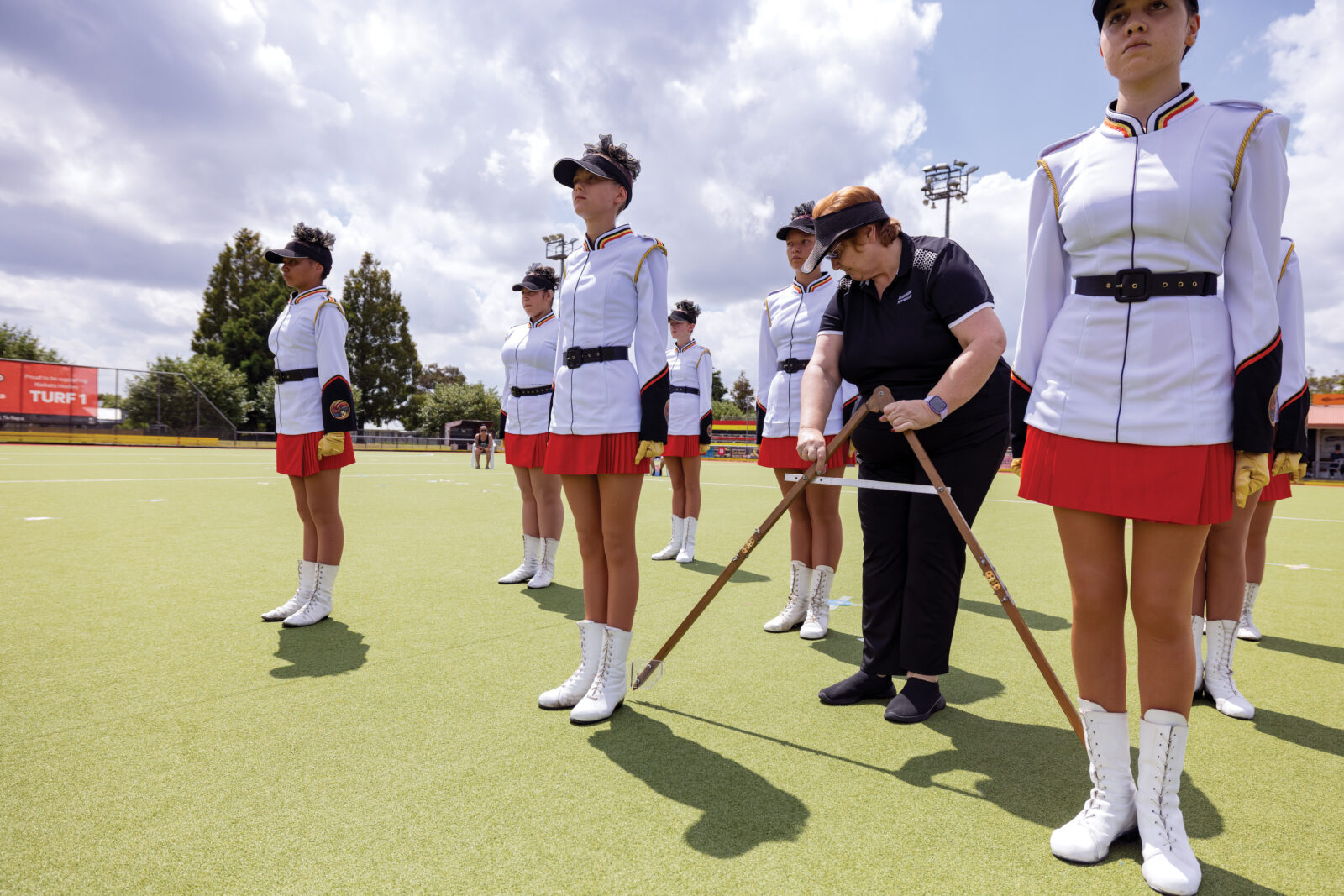
There’s a point in each technical section of a march when what looks like a set of giant chopsticks is carried onto the field. They’re callipers, I’m told, wielded by a judge to measure the pacing between marchers at a halt. “Two point five centimetres off and there’ll be points deducted,” says Sue Holmes. She’s been marching since 1972 and recalls when pace time was determined by either a live brass band or pipes. “I preferred the brass because they played at 120 beats per minute, while the pipes were 118.”
When the callipers appear, the whole thing—music, movement, even blinking, it seems—comes to a complete stop.
The 13 measurements and related clipboard action take a while. There’s time to ponder the art of standing still—a rare activity in a world where even a short lift ride or wait in a queue makes people twitchy enough to pick up their phones.
The mid-march stillness looks like a bit of a breather. Meditative. I think of monks. Trees. Corpse pose in yoga. Peace.
Holmes snorts. “Everything is clenched out there.”
*
The Madison Blues’ journey to the 2025 national championships begins with wake-up alarms at 2am. All the Waikato teams (except the littlies) are hitting the road: the Madison Blues masters and under-13s, the Ruawai under-18s and the Silverdettes under-13s. The team bus collects a group in Rotorua, then Hamilton, then it’s on to Auckland for a flight to Invercargill. The masters are reluctant to reveal their hopes, but Bedingfield eventually admits to being ambitious for a spot in the top three.
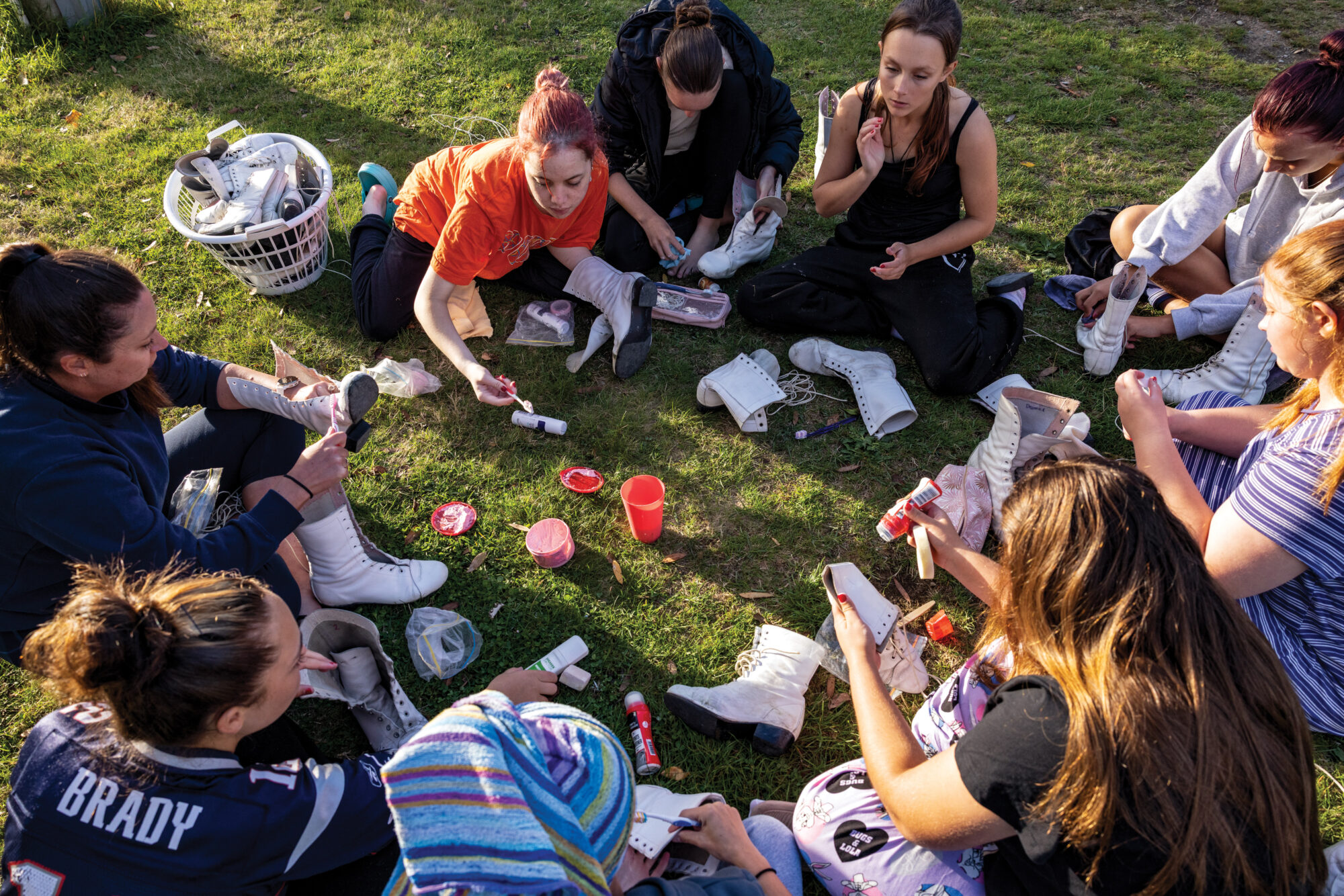
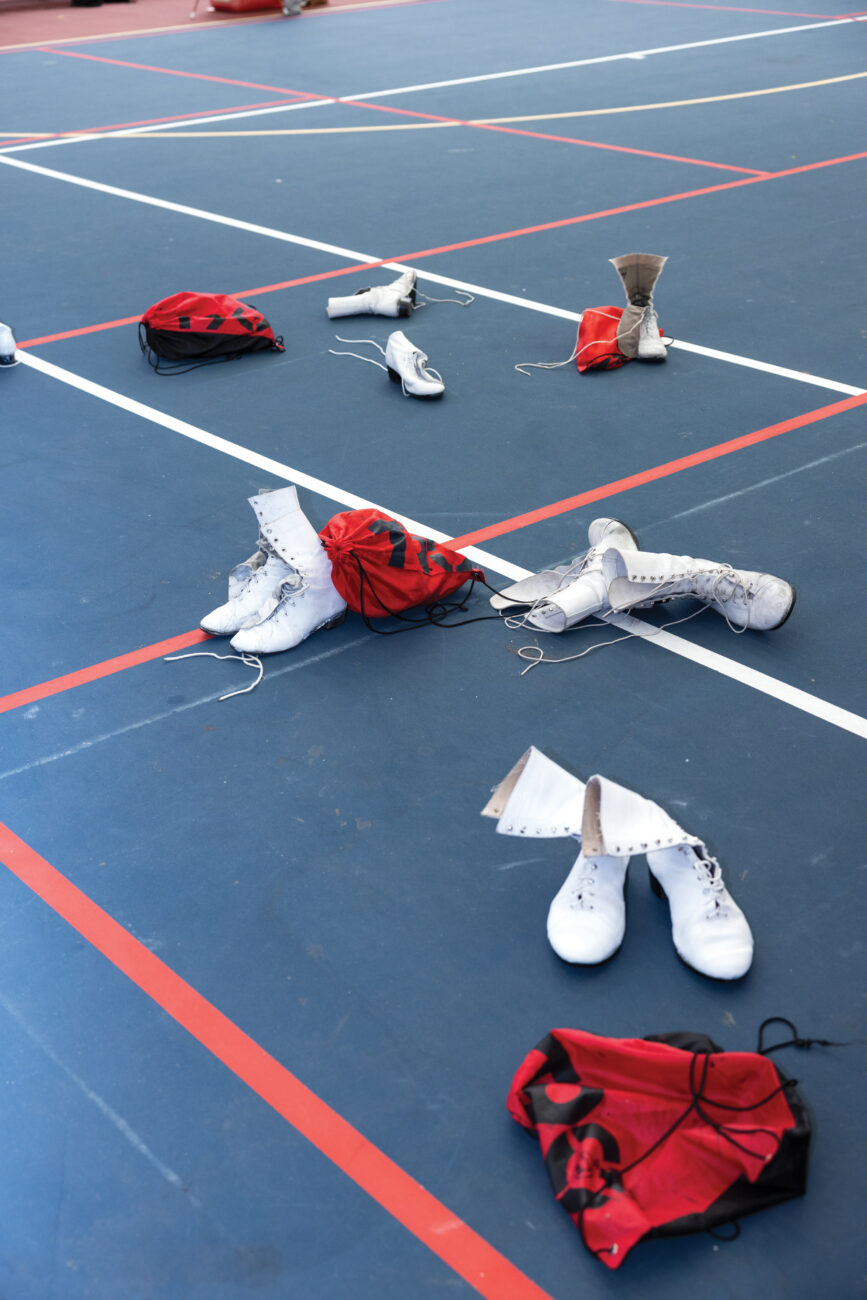
From the moment of arrival at the Beach Road Holiday Park, they follow a tight timetable of training and preparation. At 7pm sharp the night before competition begins, it’s Boot-cleaning and Reflection Time. The women sit outside the kitchen block in glorious Southland sunshine, the younger girls on grass nearby, using toothbrushes to scrub scuff marks from white leather. They seal fresh polish with beeswax, black the soles with paint, then re-lace every boot so all laces start under, not over.
“They take a hiding,” says Cherie Harpur about the boots. A new pair costs around $200 so the effort to keep them in good nick is worth it. Look after your boots properly and they’ll last for ages, says Lea Martindale. She’s worn the same pair for 22 years.
As young marchers, they would go through this cleaning rigmarole and then wreck the results by practising on wet grass in the local park. Harpur’s team solved that problem by putting bread bags over the boots. “You could tell who the rich girls were, because they used Vogel’s bags,” she says. “Then there was me, with a bag from the skinniest of skinny sliced white bread.”
*
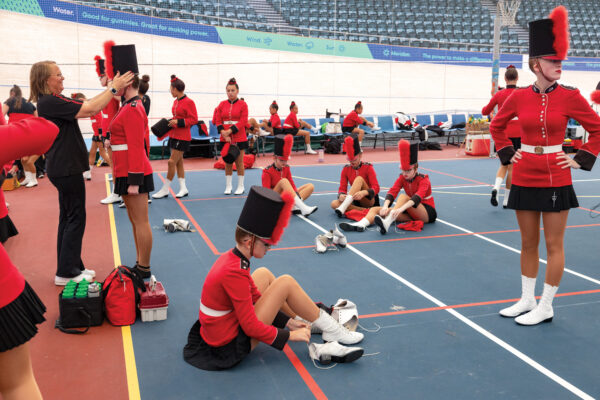
Inside the Invercargill stadium on day one of competition, there’s a sense of how it used to be. Team after team arrives in neat lines. Cries of “Quick, march!” and “Halt!” accompany any group movement, even from carpark to stadium door. Marchers fill the corridors and pack into curtained-off squash courts. Each team has two chaperones carrying toolboxes. The chaperones’ primary gig is to make sure everyone matches. They spray hair, apply lipstick, pin hats, stick on glitter and face gems, obsessively check every detail. “I can see her undies when she moves,” one worries, and points at a skirt. Visible undies are forbidden by the rule book.
Inside the main arena, one stand is nearly filled with spectators, another nearly filled with competitors. Fourteen judges rotate in sets of two, handing off score sheets to attendants in white gloves who march them away for collation. Even the helper who hobbles with a crutch still crisply swings her free arm.
The girls from Ruawai under-18s pace around a squash court waiting their turn. One stares at the wall, mouth moving mutely through the step count. “She’s freaking out,” says a teammate. They’re all full of nerves and excitement but managed to fuel up with a decent breakfast of leftover dinner mince on slices of fresh white bread.
To my untrained eye, the girls get through the technical section beautifully, but afterwards, many dissolve into tears. Vickiee Hastings and fellow coach Dayna Holloway move among them wiping cheeks, rubbing backs, dispensing hugs. Holloway locks eyes with the ones who are most upset. “Be proud of yourself. You showed strength and power. We love you,” she says.
Olivia Blackburn can’t stop crying. “We make mistakes,” Holloway tells her. “Then what do we do?”
“We recover?” Blackburn says shakily.
“We recover,” Holloway confirms. Another round of hugs, and they’re back in line, heading to Display.
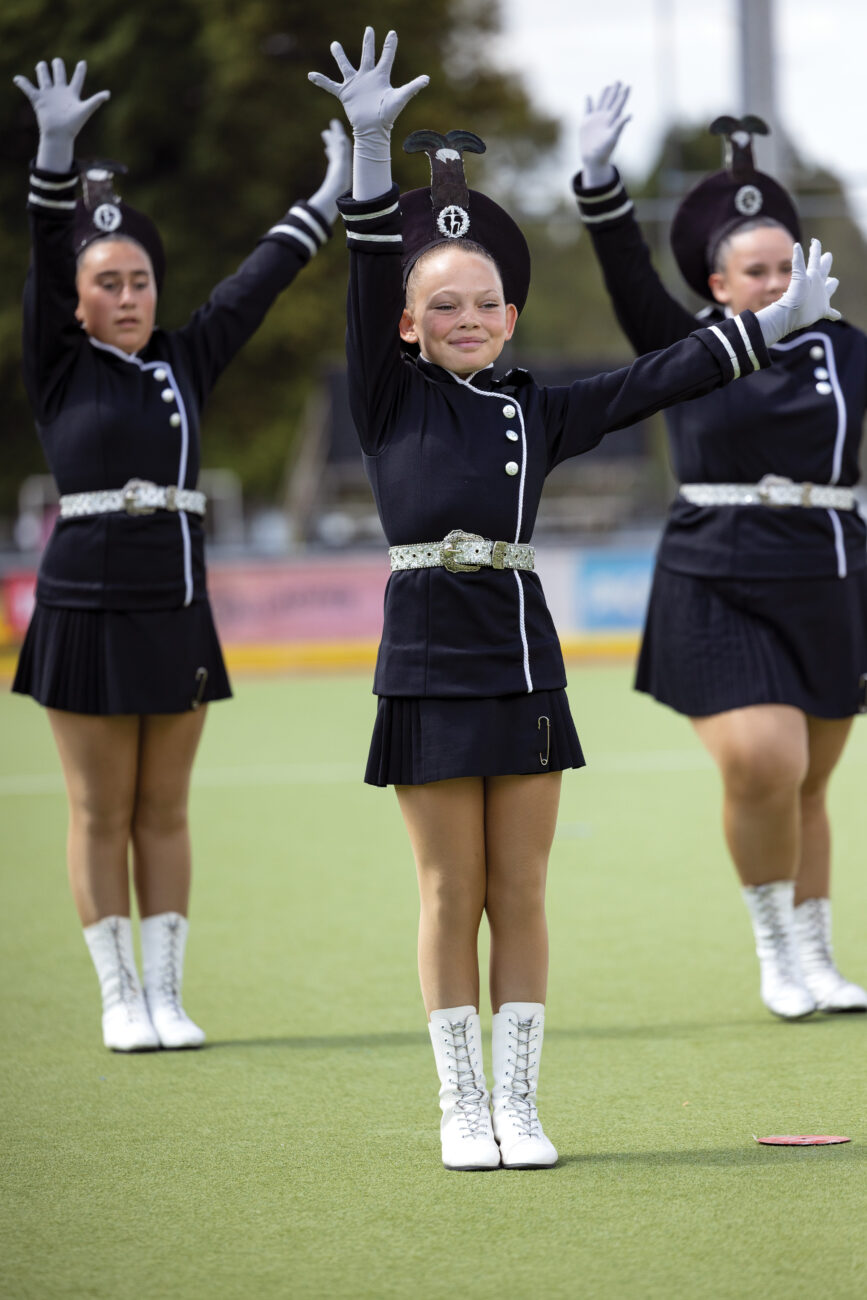
Display is a favourite with everyone. Gloves go on. The rules change. No more piston arms. No more callipers. No more brass band. Limbs are allowed to fling in any direction. Spines may bend, heads can dip, legs kick and squat. Anything goes, says the rule book, so long as “standards of Dignity, Modesty and Decency” are maintained. The goal remains unity at all times and “the creation of a seamless picture”.
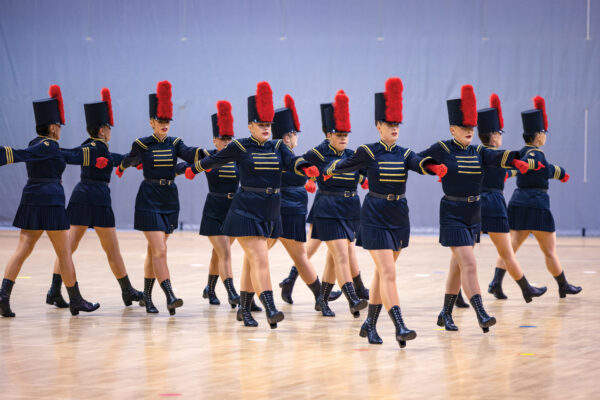
The speakers blast out chaotic medleys of pop. Teams ride fake horses, play air guitar, lasso invisible cattle, whip theatrical ass. The Canterbury Pioneers unholster bayonets and slash the air. A Southland team in tartan sashes whirl poi. The Taranaki Misfits stomp around in black boots and black pleather skirts to a heavy-metal cover of Simon and Garfunkel. Another Southland team, a popular pick for first place, shimmies to Missy Elliott—“Chubby waist, thick legs… in shape!”—and winks at the crowd.
A team strides out in black and red, jackets encrusted with gold brocade. “Kia rite!” their announcer calls. Hands rise and wiri to the haunting opening of a Stan Walker waiata. I do a double-take at the run-sheet. Yep, this team is “Empire” from Canterbury. In a seat above me, a woman holds a tino rangatiratanga flag and claps as the Buckingham Guards appear. The Guards spin their rifles then thrash in unison to Metallica.
Put marching on a plate and it’d be a full English breakfast with parāoa parai fry bread and a bourbon and Coke.
“Kei te pēwhea te kōrero ki a koe? He tangata tū ihu?” Coffin asks as we wait to watch the next Display team. She’s checking how my interviews are going, worried I’ll get the impression from the look of it all—the outfits, the team names, the immaculately made-up faces—that marching is a bit snobby.
“He ngākaunui rātou ki ngā tangata katoa,” I say. Everyone is so nice, so genuine, so keen to talk, so happy we’re here.
*
There are no men on the stadium floor, but they’re everywhere else. Husbands, dads, partners and sons get stuck in. They carry kit, set things up, mark boundaries with tape, put down the coloured dots on the floor that marchers must hit with a foot, find chairs for judges, vacuum glitter off carpets, ferry coffees. When competition is under way, they woo-hoo from the stands and shout, “Go girls, yes girls.”
We’re told about hams—Husbands Against Marching, the ones who are not so on-board with the time commitment and tight female camaraderie—but they’re brushed off like stray glitter. There’s no way a grumpy husband is enough to keep a marcher away from all this.
Suddenly, the Madison Blues masters are up. “Pride! Mana! Strength!” urges Bedingfield, and they’re through the double doors and onto the stadium floor.
Ten minutes later, they’re back, puffing, sweating, gulping down drinks of water, unzipping tunics at the back for more air, exposing tattoos and bra straps. They stand in a circle, waiting for Bedingfield’s verdict. “One of the better ones,” she declares. “But we can still do better.”
After two solid days of spectating, I start to think I’m getting an eye for the detail. I can now catch the occasional wrong pivot, missed mark, or head that’s a fraction too far forward. During lunch, I take a visit to the judges’ breakroom to be among peers.
Judge Jenny Cox has been on the marching scene “since Adam was a cowboy”. She’s a “Technical E” judge, the one who eyeballs the action in between whistle blasts, giving the others a chance to look down and mark their sheets for pacing and precision. “What’s a good example of a common Technical E mistake?” I ask.
She holds her wrist out at me the same way twice. The first way is the right way, the second way is the wrong way. She shows me again. I nod and lie: “Oh, yes, absolutely, I see.”
*
Back at the holiday park cabins that evening, the Ruawai teens collapse in a heap. They haven’t made the cut for tomorrow’s championship round. Instead, they’ll compete in the bottom group for a plate. They’re gutted.
The Madison Blues masters are tired, too. They could use a drink—“I’d kill for a bourbon and Coke,” says Harpur, while Holmes would like a cold beer—but there’s a strict alcohol ban till competition is over. June Norris rubs her heavily taped ankles and knees, full of arthritis after years of netball and basketball. She’s at retirement age but still works as a probation officer in Rotorua. The tape isn’t cheap, so she saves money by keeping it on as long as possible. Ahead of this weekend, she booked a leg-wax. Ripping off the old tape in preparation, she managed to save again: “The waxer charged me less, ’cause I’d already done half the job.”
By morning, after a heroic effort from the older women, Ruawai have been coached back into their usual smiles, loud enthusiasm and bottomless appetites. They return to the stadium and give the plate march everything they’ve got.
At plate prize-giving, the girls assemble on the floor in straight lines. Ruawai glow in white jackets between rows of black and navy on either side. The technical results are announced. They miss out on first. They miss out on second. They jump with joy to get third. Display results are next. The white line explodes. They’ve done it. First in the plate march for Display.
More by Connie Buchanan
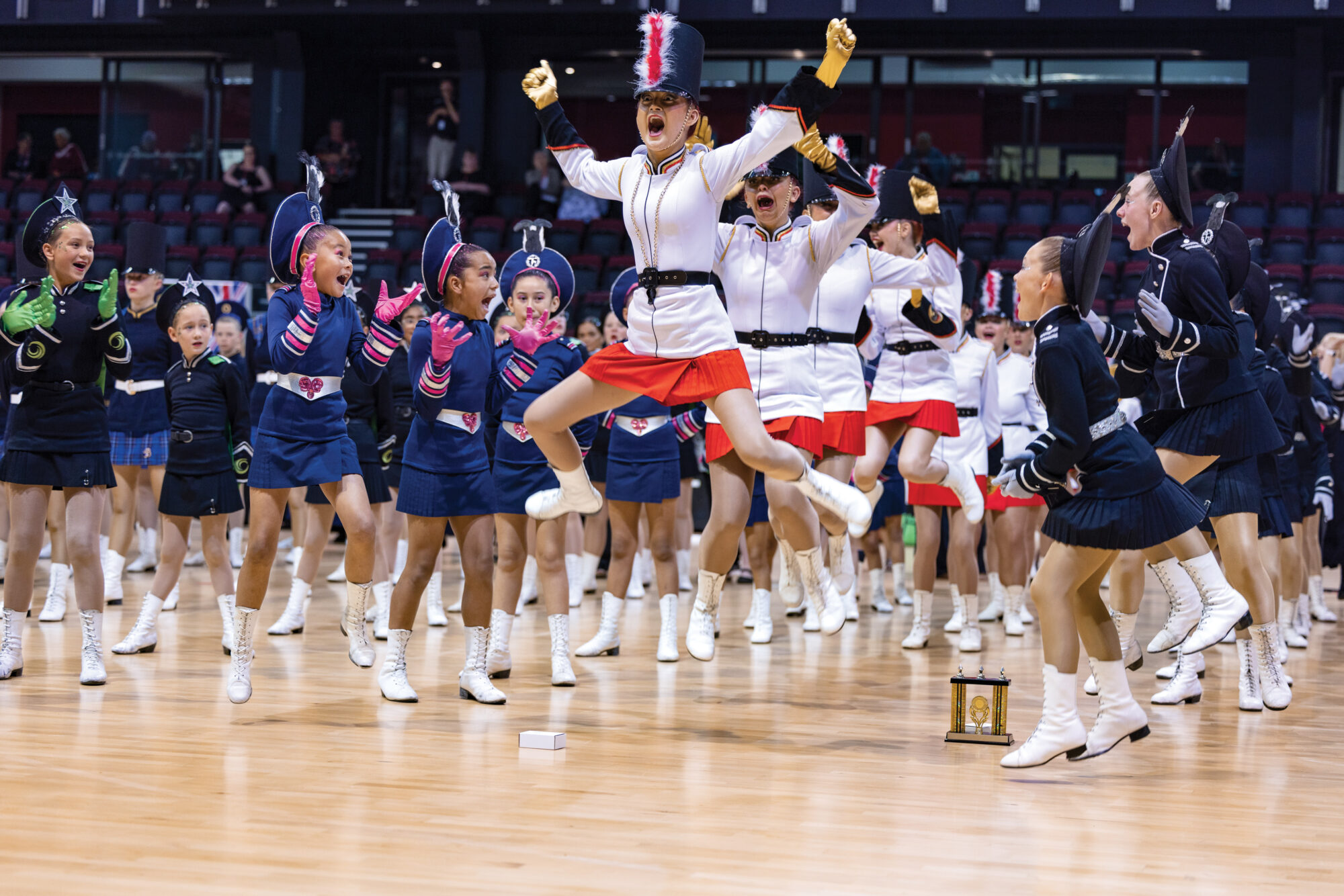
“I haven’t seen so much excitement for a plate in years,” says a delighted McLuskie. “How beautiful is that?”
There aren’t enough teams for a plate round in the masters division. All seven go straight through to the championship march. I spend some time sussing out the Madison Blues masters’ competition. Everyone rates the Canterbury contingent highly. I watch closely as one lot do their drill. A shambles, I decide, out of loyalty to my Waikato ladies. Wrists all over the show.
In the end, South Island and Wellington teams sweep the prizes. The ceremony is a chance for Ruawai to pay back the love; they shriek and chant from the stands at the steady line of tall navy pillbox hats below. Sitting with these young ones, going deaf from their supportive screams, it doesn’t seem to matter that the Madison Blues masters leave the floor empty-handed.
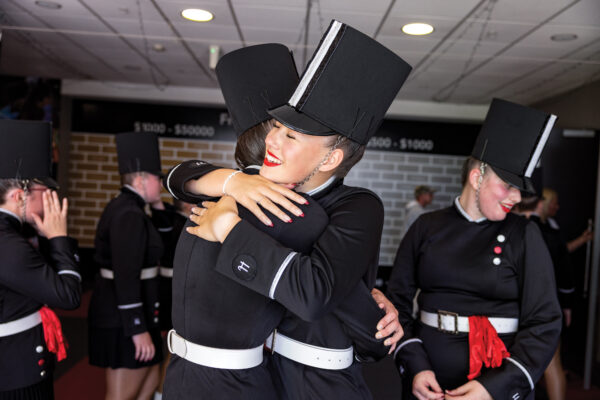
Later, over pizzas and Fanta, Bedingfield shares the final scoring sheets with the team. They managed fourth on points in Display. Second place was a tie, leaving third spot unawarded. The women take this news as a big win; they decide that fourth effectively puts them in the top three. There are tears and hugs across the top of the pizza boxes, followed by a short speech full of pride from Bedingfield.
*
At the end of each section of a march, there’s no gentle fade-out of the music. When the teams hit time, someone presses a button and the track stops dead, often mid-beat. To me, it feels like a portent for the sport as a whole.
But what does an outsider know? Two months before nationals in Invercargill, at the Waikato regional event on that sweltering Saturday by the Hamilton lake, the trophies from the table are dispatched. “Everyone is getting first place today because there’s only one team in each grade,” a woman explains to the child next to her.
The handful of spectators cheer during the ceremony as if the winners are a surprise, as if tents still line the grounds, bands play live, and dozens of teams throng the turf. There are no hams in sight—husbands and partners happily join the concluding “maze”, a free-form, anything-goes circle dance which follows the teams’ final stiff salute to the judges.
The tutu babies are playing a clapping game under the shady tree. The under-18s drape lanky arms around each other and pose for pictures. The masters fuss over a toddler, offering her snacks and a drink. They plan for the upcoming trip to Invercargill, where Holloway will soon counsel her tearful teens: “We can’t rewind, we can only move forward.”
After today’s event, the women will up their practice to three times a week to get ready for the nationals, going over and over routines until nightfall. On Saturdays, they will keep coming back to the hockey turf by the lake, and they will win by showing up.
Subscribe to our free newsletter for news and prizes
3
$1 trial for two weeks, thereafter $8.50 every two months, cancel any time
Signed in as . Sign out