The strange, beautiful lizard at the bottom of the world
The harlequin gecko does many things that seem high risk. It stays stock still whenever it’s cold. It lives in extreme slow motion. Somehow, it’s managed to survive on predator-ridden Rakiura/Stewart Island, but can it weather our plans for its stormy home?
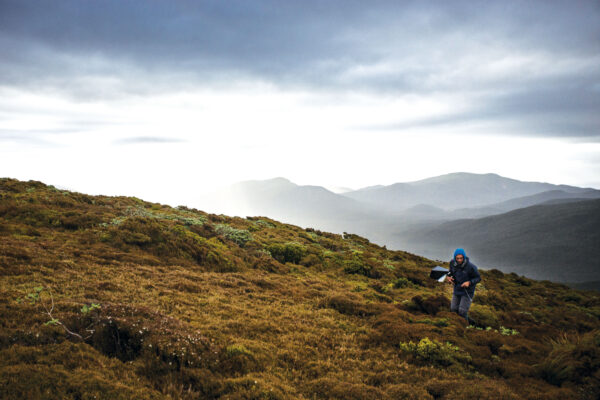
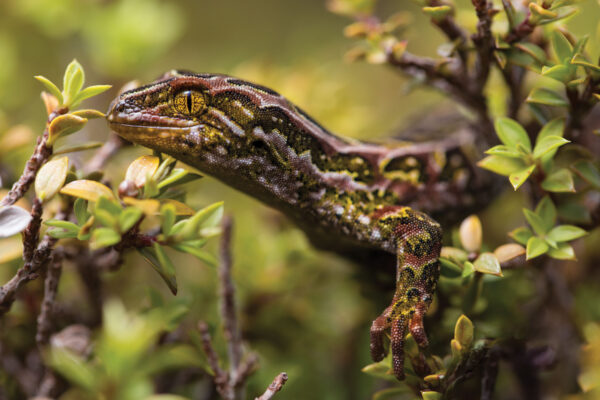
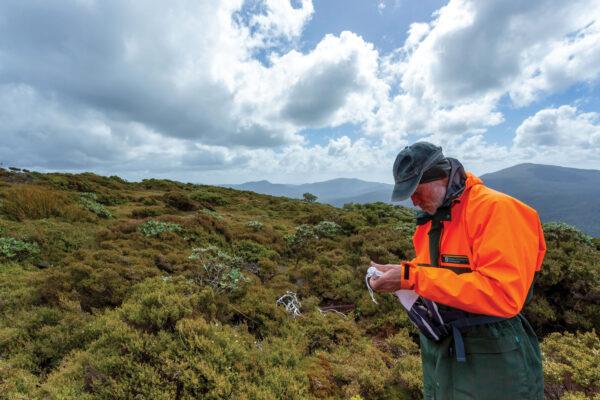
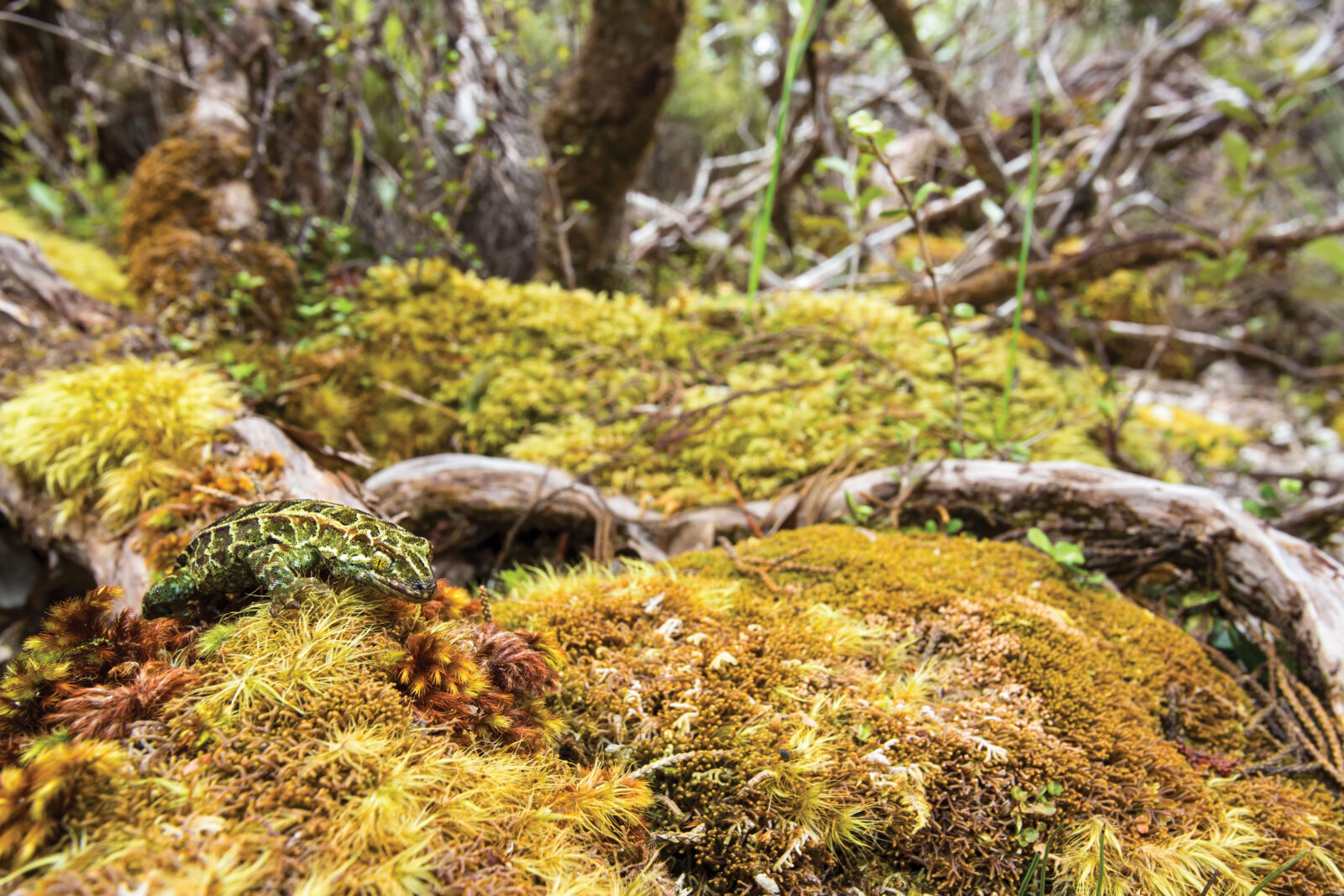
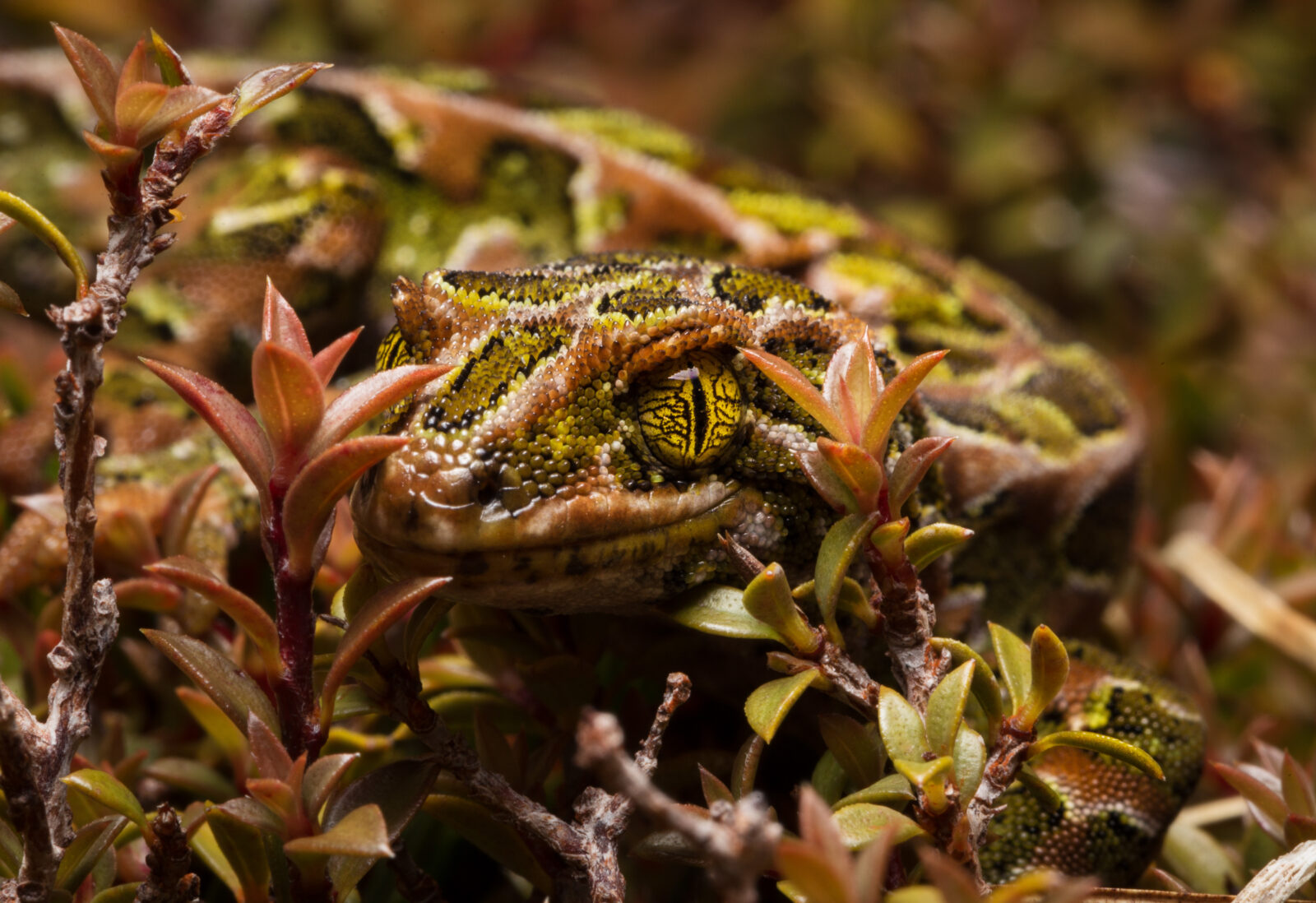
A cold wind whips through the mānuka as James Reardon, a Department of Conservation herpetologist, hurries up a ridgeline on southern Rakiura. Abruptly, he stops. In front of him on the track is a puddle, and poking out from the water is the head of a gecko. Reardon can see its looping herringbone patterning, ellipses of chocolate brown on the orange head, tracings of lime and white.
It’s a harlequin gecko, sitting perfectly still and almost completely submerged. Reardon watches the gecko, baffled, as the southerly wind tears at his parka. It doesn’t seem the kind of day for a lizard to be out at all, let alone sitting in water. The gecko watches him with golden eyes. After a while, Reardon heads on up the track for the afternoon’s work.
Five hours later, he comes back down the track. And in the puddle, in the same position, is the gecko. He watches it, worried it may be injured, but it’s breathing fine, if rather slowly. Reardon carries on to the hut, makes a coffee and grabs his camera, then returns to check on the gecko. This time, it’s gone. “I assumed the poor little thing would be moving slowly, because it was so, so cold,” says Reardon. He had a look in mānuka nearby, but no sign. He scurried back to the bivvy.
Herpetologist Dylan ‘Dingo’ van Winkel draws on years of experience as he scans the vegetation, looking for the lizards’ distinctive body shapes.In the windswept wetlands, shrubs and rocks of Rakiura, the geckos hunt for insects and snack on berries and nectar.
Most geckos live in the tropics, or nearby—latitude matters, because lizards get their warmth from the environment rather than generating their own. The harlequin gecko is an outlier. It’s one of the most southerly-living geckos in the world. “The environment they live in looks nothing like what you’d expect a gecko to live in; it’s extremely harsh and exposed,” says Reardon.
Temperatures on Rakiura are often in the single digits; the hillsides where the geckos live can get as cold as minus 10 degrees. Sunshine hours are low, and rainfall is high. “They’re just remarkable in every respect,” says Reardon, “The species is a real enigma.” To be surviving here, the geckos must be doing something differently.
*
The first harlequin gecko was discovered on this island by entomologist Peter Johns in 1969 while he was turning over rocks, looking for beetles near Pikihatiti/Port Pegasus. It was nearly a decade before the second one was found, this time by a Wildlife Service team searching the island for kākāpō.
The gecko specimens were sent to the Department of Scientific and Industrial Research office in Lower Hutt, where science technician Bruce Thomas and his colleague Tony Whitaker were becoming known for their interest in lizards. “It was early, early days,” says Thomas. “There was bugger all known about New Zealand’s lizards.” When the first harlequin arrived on his doorstep, Thomas was intrigued. By the time the second one came, he was hooked. He talked to his boss. “I really need to go to Stewart Island and follow this up. Could I have the money for a helicopter?” Rather to his surprise, the request was granted.
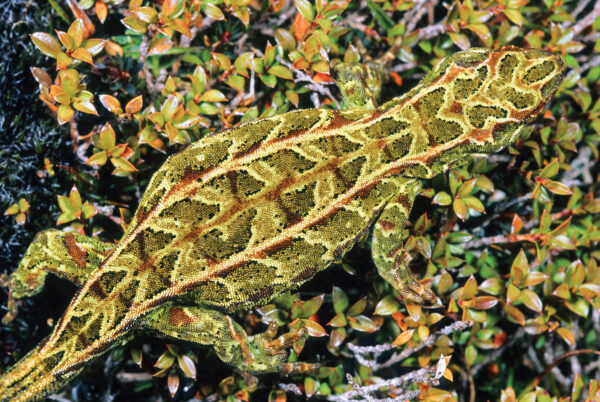
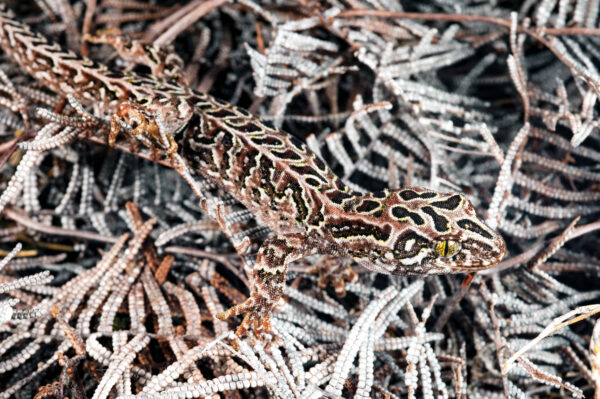
Thomas searched windswept shrubland and rock on the southern hills of the island. After hunting every day for a week—“they’re very bloody hard to see!”—he finally found two harlequin geckos at night. It was their eyes that gave them away, reflecting in the torchlight. Knitted with diamonds in orange and green, the small, solid-bodied geckos blended perfectly with the colourful vegetation they lived in. To confirm these gorgeously strange creatures as a new species, Thomas needed to make a full scientific description of the animal, so he took one back with him to Lower Hutt.
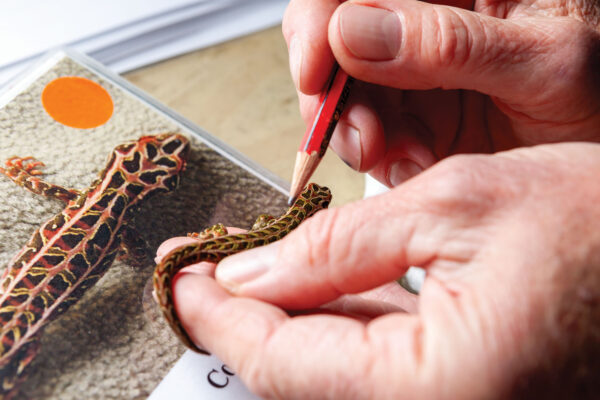
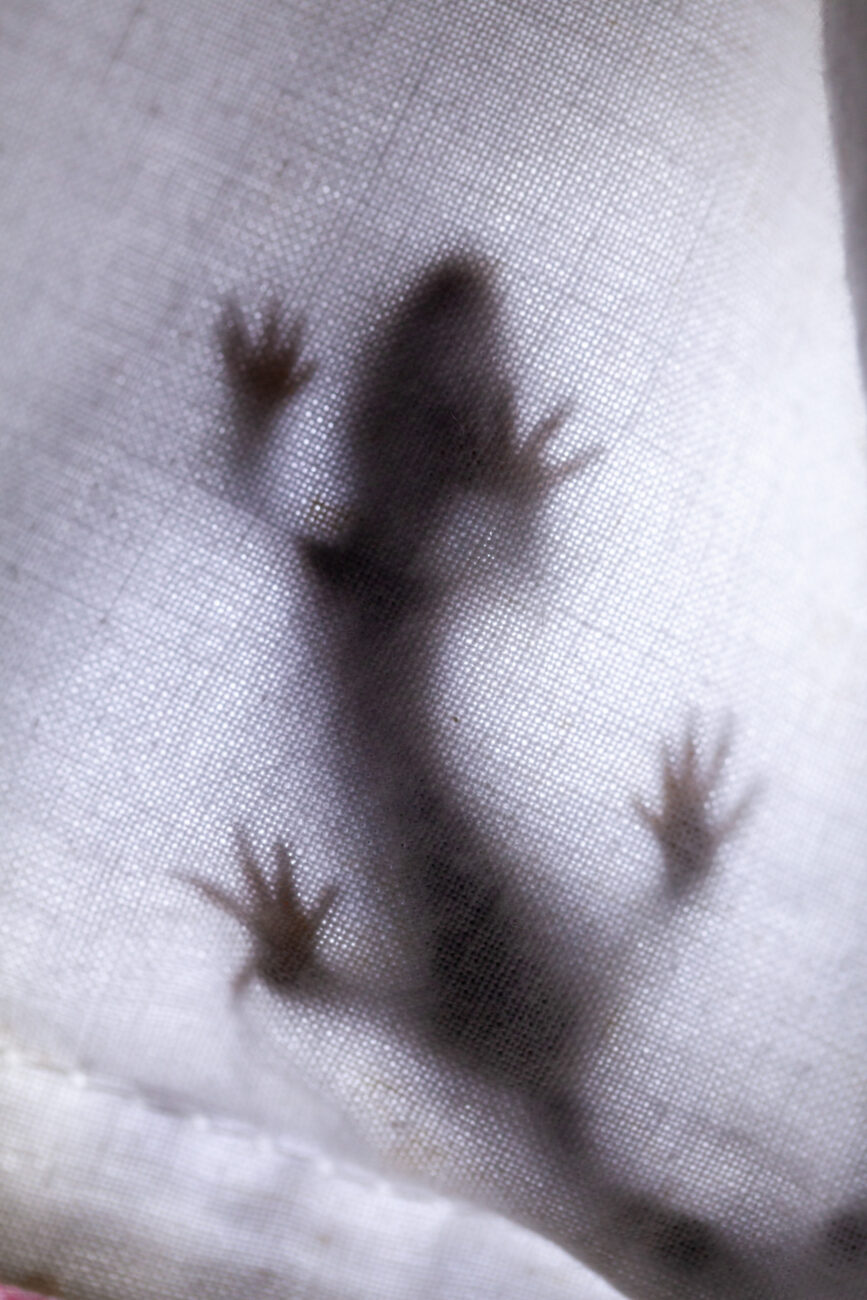
The patterns on a gecko’s back can be photographed and then used, like human fingerprints, to identify individuals.
At his desk with the live gecko in his hands, Thomas studied the interlocking lines of patterning, the layers, branches and highlights, the juxtaposition of colours. “I sat there thinking, ‘Where the hell do I start?’” says Thomas. Three hours later, he was still sitting there, his paper empty in front of him.
This creature was so starkly different from both the green gecko and brown gecko families that it was impossible to decide which it belonged to. Thomas tentatively grouped it with the browns, naming it Hoplodactylus rakiurae. Eventually, he put together a description, starting with, “The colour patterns of H. rakiurae are complex,” and describing shades ranging from cinnamon brown to amber to olive green.
Several decades later, scientists found that the gecko was genetically unusual enough to warrant its own genus, which they named Tukutuku, for the intricate latticework weavings used to decorate wharenui. The gecko’s full Latin name is Tukutuku rakiurae, and it’s the only lizard in New Zealand that has a genus all to itself. But although the name is now pinned down, very little else about it is known for certain. Except that it’s an oddity.
*
Stories of strange encounters abound. In 1997, Department of Conservation (DOC) ranger Phred Dobbins was looking for New Zealand dotterels on a hilltop when he noticed a harlequin in the vegetation beside the track. When he returned a year later, the gecko was there, sitting in the same spot. It was a female, with a distinctive curling shape in one of the lines across her back, so he named her Koru. For the next 15 years, Dobbins saw Koru whenever he visited the spot. She often looked to be pregnant.
There are half a dozen places across the island where harlequin geckos are found, all of them above the bushline. (We’re not being specific about these spots, for fear of tipping off poachers—see ‘The Reptile Smugglers,’ Issue 153.) While the harlequins’ camouflage makes them almost invisible, they can sometimes be heard rustling in the brush and grasses. When the sun comes out, the geckos make the most of it, seizing any opportunity to bask—when their bodies are warm, they move around a lot, weaving through the ferns and scrambling up into the shrubs. But when it gets cold, they simply… stop.
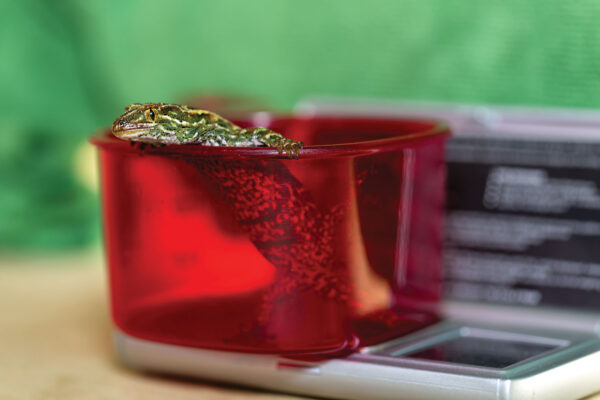
Les Moran weighs and measures every gecko he finds, keeping track of their growth and condition, and for the females, their pregnancy stage.
A cold lizard doesn’t have the energy to move quickly, which makes it very vulnerable to predators. So, usually when the temperature starts dropping, lizards retreat. Deep in shrubs or a rocky crevice, they can safely go into a semi-dormant state. But harlequin geckos don’t do this, at least not all the time.
Les Moran, a researcher for DOC, once watched a harlequin gecko sitting on a branch as a southerly storm swept in. The temperature plummeted but the gecko stayed put. It remained there, in exactly the same position, for several days while the cold snap lasted. Every four hours through the day and night, Moran pulled on his wet weather gear and battled the blizzard-like conditions to go and check if it was still there.
“I couldn’t believe it,” says Moran. “I thought, ‘Sooner or later, you’re rat tucker, mate!’” But that didn’t happen: when the weather warmed up, the gecko moved off.
*
Squalls of rain threaten to flatten the tents pitched on the shrubby Rakiura hillside. It’s 2005, and DOC scientist Mandy Tocher is leading a research project into the best techniques for monitoring geckos that live in shrubland. Days of stormy weather are keeping the team stuck inside the thrashing, sodden tents.
Lying on her bedroll, Tocher muses about the geckos. One of the biggest question marks is around their pregnancies, and Tocher, heavily pregnant herself, has been gathering some interesting data. New Zealand geckos are global oddities—not only because of where they live, but because they give birth to live young, rather than laying eggs. It’s an adaptation to our cool climate: eggs on their own will get too cold, but a mother gecko can at least move into patches of sunlight to keep herself and her embryos a little bit warmer. But in this regard, too, it seems the harlequin gecko might be taking things to the extreme.
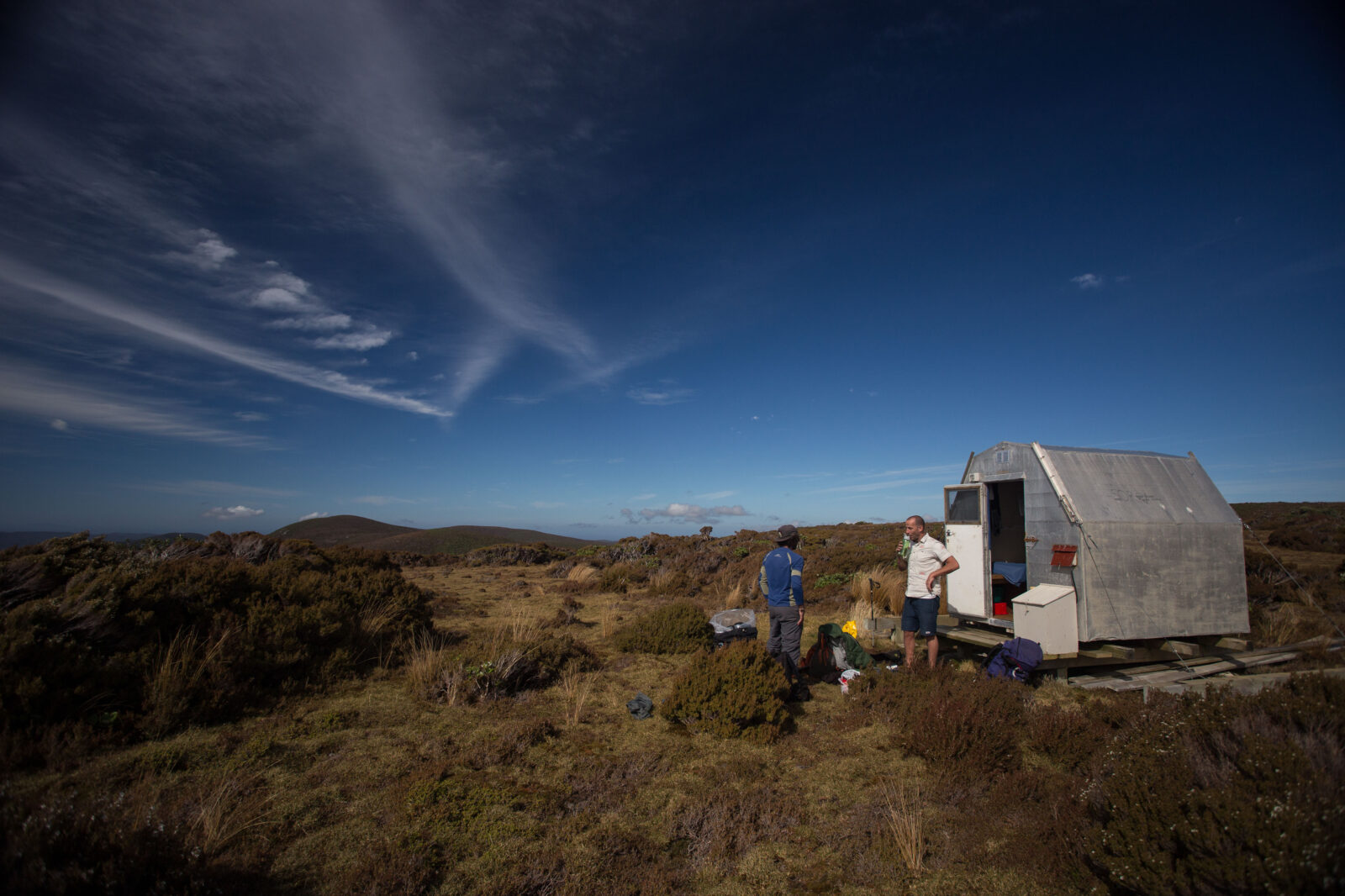
Most of the world’s geckos are nocturnal, but harlequins care not for the clock. Instead they follow the whims of the weather, and can be seen out at any time of day or night.Base camp for a summer of gecko hunting—a dream holiday for herpetologists Dylan van Winkel, left, and Ben Barr.
Most New Zealand geckos have pregnancies that last three or four months through spring and summer. The kōrero geckos at Macraes, Otago, have 14-month pregnancies, one of the longest documented for any lizard in the world. But observers of the harlequins suspect these geckos are carrying their young for much longer.
Tocher and Moran had found the same females carrying well-developed young several summers in a row. Was it possible their pregnancies stretched across three years?
“The amazing thing is, it fits with the information we have about these animals being slow in all aspects of their lifestyle,” says Moran. They were finding quite a few female geckos that weren’t pregnant, even during the summer, suggesting they might take a year or more off between pregnancies. It also looked like these geckos mightn’t start breeding until they were into their teens. These stretched-out time frames suggest the gecko might live to a very old age, possibly as long as a human, but it would take decades of tracking individual animals to establish that, and the oldest records were from only a few years earlier.
Over the years, the researchers got better at finding the well-camouflaged geckos, but the sites were remote and the weather famously unpredictable. On Tocher’s stormy 2005 trip, the weather never let up, so a helicopter was sent in to fly the team out. Eventually, DOC funding priorities changed; the project was terminated in 2011 before any of the questions could be conclusively answered.
*
The strange traits of the harlequin gecko become even stranger when they’re considered together. If an animal takes three years to produce one or two babies, and then takes a year or so off before its next pregnancy, that’s a very low reproductive rate. It’s exacerbated when reproduction can’t begin until a female has lived for 10 years or more. Result: a population that can’t handle losing many of its animals at all. Years of investment go into every single offspring.
Yet the harlequins do things that should make them especially easy to pick off, like staying out in the open and glued to the spot when they’re cold. How, then, have harlequin geckos survived? Feral cats and three species of rat have been living on Rakiura for decades. “It has most of us herpetologists scratching our heads as to how on Earth they aren’t extinct,” says Reardon.
Scientists have tentative suggestions: Maybe the geckos were once incredibly numerous, and now we’re just seeing the tail end of the population? There are no mice on Rakiura; maybe that helps? Perhaps the fact that harlequins live above the bushline, where there aren’t as many predators, has helped them to survive? Or possibly the geckos don’t give off a strong smell in the windy, wet conditions on the island, making it hard for mammals to sniff them out? There are weaknesses to all those hypotheses, and researchers are quick to admit that we just don’t know.
*
Despite all this uncertainty, we’re about to dramatically stir the pot. The most ambitious Predator Free plan yet is aiming squarely at Rakiura. (So far, Lord Howe Island is the biggest permanently inhabited island that’s been successfully cleared of rodents. Rakiura, at 175,000 hectares, is more than 100 times bigger.)
As early as next year, helicopters will start dropping 1080 across 11,000 hectares on the southern tip of the island, part of a multi-year project to eradicate rats, cats, possums and hedgehogs from the whole of Rakiura. The project is controversial—1080 always is, of course—but herpetologists have specific fears for the harlequins.
In New Zealand, we know a lot more about our birds than we do about our lizards; Predator Free, in the same vein, has focused on protecting birds. For lizards, this is a risk. Sometimes they benefit from the programmes—on islands such as Kāpiti, Maud and Stephens, lizards, like the birds, are doing really well. But in those places, all the rodent species have been eradicated.
One thing we know for certain about our native lizards is that mice decimate them. Take out only the bigger predators and mice can boom in response. Then the lizards suffer. For 11 years, researchers have been watching this play out in Fiordland’s Eglinton Valley: the population of southern grass skinks they’re monitoring is “see-sawing” in step with the mice, and overall ticking steadily down.There are few places in the world that mice haven’t colonised, but so far as we know, they’re not on Rakiura. Yet.
“There’s this kind of rule of thumb in New Zealand that all four rodent species don’t occur together,” says John Innes, a senior researcher at Manaaki Whenua—Landcare Research. The three rat species—Norway rats, ship rats and kiore—all live on Rakiura, so although the odd mouse does hitchhike into Halfmoon Bay, it’s likely the rats tamp them down.
Without the rats, how will we keep mice from taking off? (See ‘The Tale of the Hungry Mouse,’ Issue 173, for their astounding population dynamics.) Reardon, one of a group of experts helping guide eradication programmes on islands, knows how complex—and expensive—it is to stop mice reinvading.
He has an additional concern. If one rat species is harder to kill—and kiore, the smallest of the bunch, is the one we know least about—their numbers might climb when the other rats are removed. In general, the smaller predators are worse for lizards, because they can squeeze into the lizards’ hidey-holes, so more kiore could also mean trouble for harlequins.
“It’s not simple,” Reardon says. “The stakes are really high. But there’s also some really great potential in it.”
Say we manage to zap all the rats, all the cats, all those possums and hedgehogs—and, somehow, keep mice at bay—then, harlequins could mooch around in puddles to their slow hearts’ content.
Can we really do it? I ask Duncan Kay, the operations manager for Zero Invasive Predators (ZIP), which holds the contract for the Rakiura work. “I feel like it is within our reach,” he says, “if we give it all the effort that it needs.” That’s a big qualifier, especially in this funding environment.
ZIP’s pin-up project was rolled out in quite different country: the Perth Valley in South Westland, a boulder-strewn wedge of wilderness at the base of the Southern Alps, which they tackled in 2018. The predator population was different, too—unlike the rat bonanza of Rakiura, “we only [had] ship rats there, really,” Kay explains. Six years after the first 1080 drops, mice are increasing in the valley—“going through the roof”, says Reardon —but targeting them is not part of the Predator Free brief.
Pregnant females such as Koru, pictured here, can carry one baby in each of their two uteri.Camouflaged in tanglefern, a harlequin is reasonably safe from its native predators—birds, which hunt by sight. Mammals, however, hunt by smell.
The crux of any eradication is making sure you’ve got rid of the last stragglers. To do this on Rakiura, ZIP will put AI cameras across the southern trial area. Sensing an animal, a camera will snap a thermal picture, then determine whether it’s possum, rat or stoat. (To date, the cameras can’t tell the three rat species apart, but ZIP hope to train the AI to do this.) The cameras could also detect mice.
“The work we’ve done previously shows that if we haven’t had a detection after nine months, then we have a 99 per cent confidence that the area is rat free,” says Kay.
Darius Fagan, the general manager of Predator Free Rakiura, says they’re already planning for the pest-free future, when biosecurity will become all-important. Boat operators, he’s found, are “already doing a lot of things to protect themselves from rodents, which is helpful”. But for eradication to hold—and to stop the mice moving in—the system must be perfect. Chasing down just one enterprising mouse would chew through huge amounts of money and time.
*
If the imminent shock to the Rakiura ecosystem does hurt the harlequins, there will, at least, be someone watching.
Jon Rolfes, a PhD student from Germany, has just begun a project monitoring three lizard species on the island, including the harlequin gecko. He’s set up artificial lizard retreats on the windswept south of the island, and every month for the next three summers, he’ll drive down from Dunedin and cross Foveaux Strait to check on them. He hopes to keep the project going even after his PhD is finished: a long-lived study, as befits these creatures.
Rolfes hopes he’ll be watching the lizards increase. Either way, the study will be a valuable check on whether our pest-killing efforts are on the right track.
Eight years ago, Rolfes saw a picture of a harlequin gecko in a book, and since then he’s been—in his own words—obsessed. In Europe, he says, lizards are only out on warm, sunny days. “But harlequin geckos are active at, like, six degrees, which is just mind-blowing to me.” Several times in our conversation he says how privileged he feels to be working with these spectacular geckos.
He also knows how much is at stake. Even though the harlequins are so lovely, and so strange, they’re still lizards, which are not on the public radar. And these ones are tucked away at the bottom of the country. The harlequin geckos, says Rolfes, “could just disappear, and no one would notice”.
The harlequin gecko does many things that seem high risk. It stays stock still whenever it’s cold. It lives in extreme slow motion. Somehow, it’s managed to survive on predator-ridden Rakiura/Stewart Island, but can it weather our plans for its stormy home? (more…)
Issue 198
Mar - Apr 2026
Black-Backed Gulls
Meth & HIV in Fiji
Dung beetles
Centro
Rogaining