The enviable upsides of having something sticking out of your backside. (more…)
More by Kate Evans
More by Kay Lawson


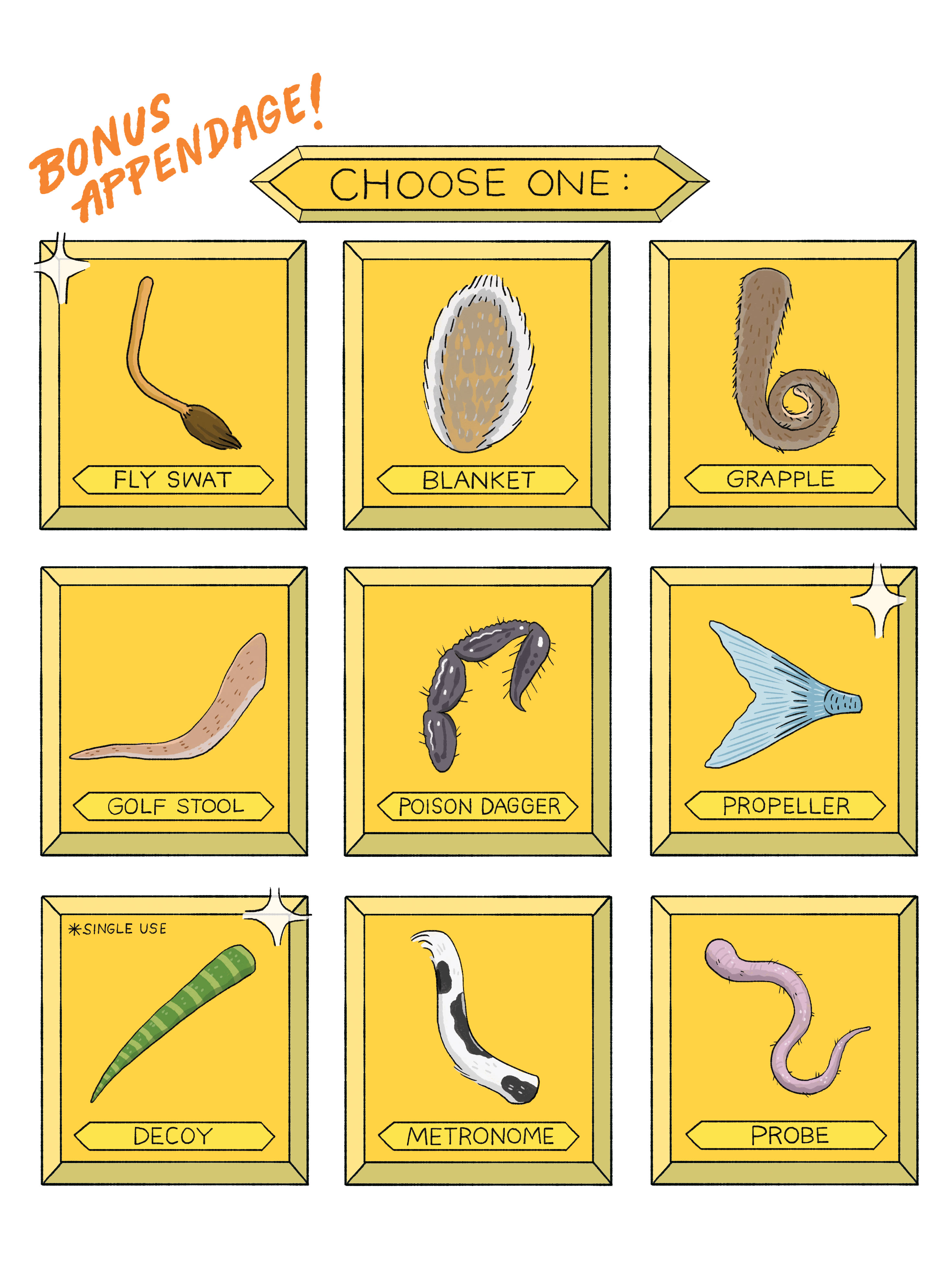
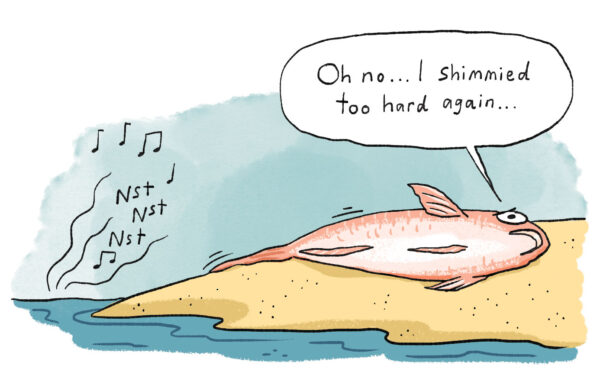
Cats use theirs for balance, canines for communication. The tails of marine creatures propel them through the water, while those of pīwakawaka help the birds to change direction mid-flight. Monkeys and possums use their prehensile appendages to swing through the trees. Foxes and squirrels wrap their fluffy, bushy tails around their bodies to keep warm, and kangaroos use their muscular ones as a kind of fifth leg to rest on as they graze, and to propel them when they walk. Some scientists theorise that tails even helped the first fish to colonise the land, via a rear-end shimmy that propelled them up sandy sloping shallows onto shore.
Cows, horses, bison and giraffes deploy their swatting tails against insects, while other animals are equipped with more aggressive weapons. Picture the bommy-knocker club of an ankylosaurus, or the venomous barbs embedded in a stingray or scorpion’s deadly tail.
More insulting than injurious, hippopotamuses spin their stubby tails like a whirligig while defecating, flinging poo in all directions. It seems to be about marking territory: in a recent study in Mozambique, hippos responded to recordings of the “wheeze honk” calls of strangers with this flamboyant signature move.
Female rats, on the other hand, use their tails during lovemaking—when scientists surgically removed them, they found that the lady rodents’ male partners “seemed to have trouble finding their way and completing the mating process”. Tails, in fact, have entwined with our thinking about animal sex all the way back to Charles Darwin.
The male peacock’s ostentatious yet impractical tail presented a real problem for the Father of Evolution. “The sight of a feather in a peacock’s tail, whenever I gaze at it, makes me sick!”, he wrote in 1860. His original theory, of evolution by natural selection, was all about survival of the fittest—traits that made animals more likely to evade predators and find food were passed down and refined from generation to generation.
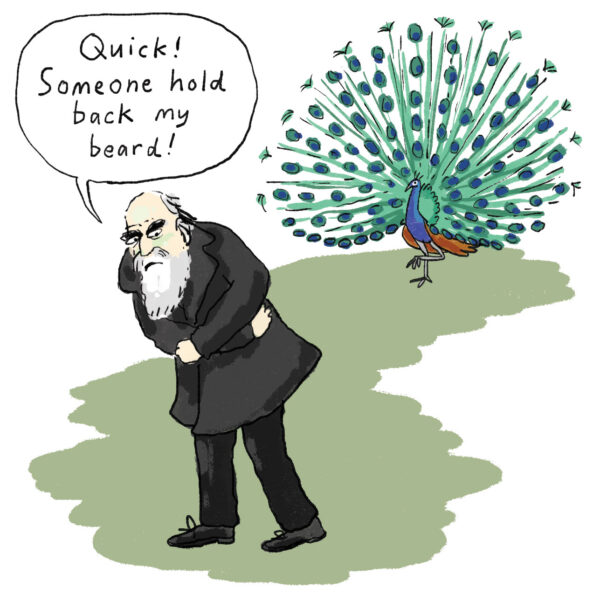
How, then, to explain the peacock’s unwieldy tail, and the dramatic differences in appearance between the species’ showy males and dull females? The knotty problem was “an awful stretcher”, Darwin wrote, but it eventually led him to the second key component of evolutionary theory.
In The Descent of Man, published in 1871, he outlined his theory of sexual selection: the idea that the struggle for mates also shapes animal appearance and behaviour—whether that’s through intimidating weaponry that allows males to defeat rivals, or ostentatious ornamentation that inspires females to choose one mate over another.
It took Darwin years to formulate and publish the controversial theory, writes Australian historian Evelleen Richards, in part because it went against the grain of his own Victorian notions of women as passive and inferior. But the truth was inescapable. In the case of the peacock, he wrote, “the tail has been increased in length merely by on the whole presenting a more gorgeous appearance”—not to us, but to the choosy, opinionated peahens.
*
Lizards use their tails for all kinds of things—signalling to each other, climbing trees, storing fat, and as an extreme predator-distraction strategy that comes with a guilt-laden occupational hazard for the scientists who study them.
During a research trip to Mauritius, herpetologist Sarah Herbert was amped for her first encounter with a Durrell’s night gecko, a critically endangered species endemic to one tiny islet.
When she found one, she gently picked it up and placed it on an inked card so she could make a record of its footprints. Immediately its tail detached from its body and lay convulsing beside it. “I just felt like such an arsehole,” says Herbert. “I took a photo, and then debated for the longest time, like, do I even show anyone this?”
All New Zealand’s 140-plus species of lizards, as well as tuatara, also have this uncanny ability to dump their tails when provoked, and grow them back again—scientists call the behaviour autotomy, or “self-amputation”. (It’s not limited to tails: spiders drop legs, crabs ditch claws, and some sea slugs can decapitate themselves in order to grow a new, parasite-free body.)
Some of our lizards, particularly those that live in trees and use their tails for climbing, can put up with a lot before they deploy the tail-drop. Others are a nightmare to work with, says Herbert, now a post-doctoral researcher at Te Herenga Waka/Victoria University of Wellington. “With Pacific geckos, it doesn’t matter how experienced you are—if you look at them wrong it’s just like ‘Pop!’, and the tail comes off.”
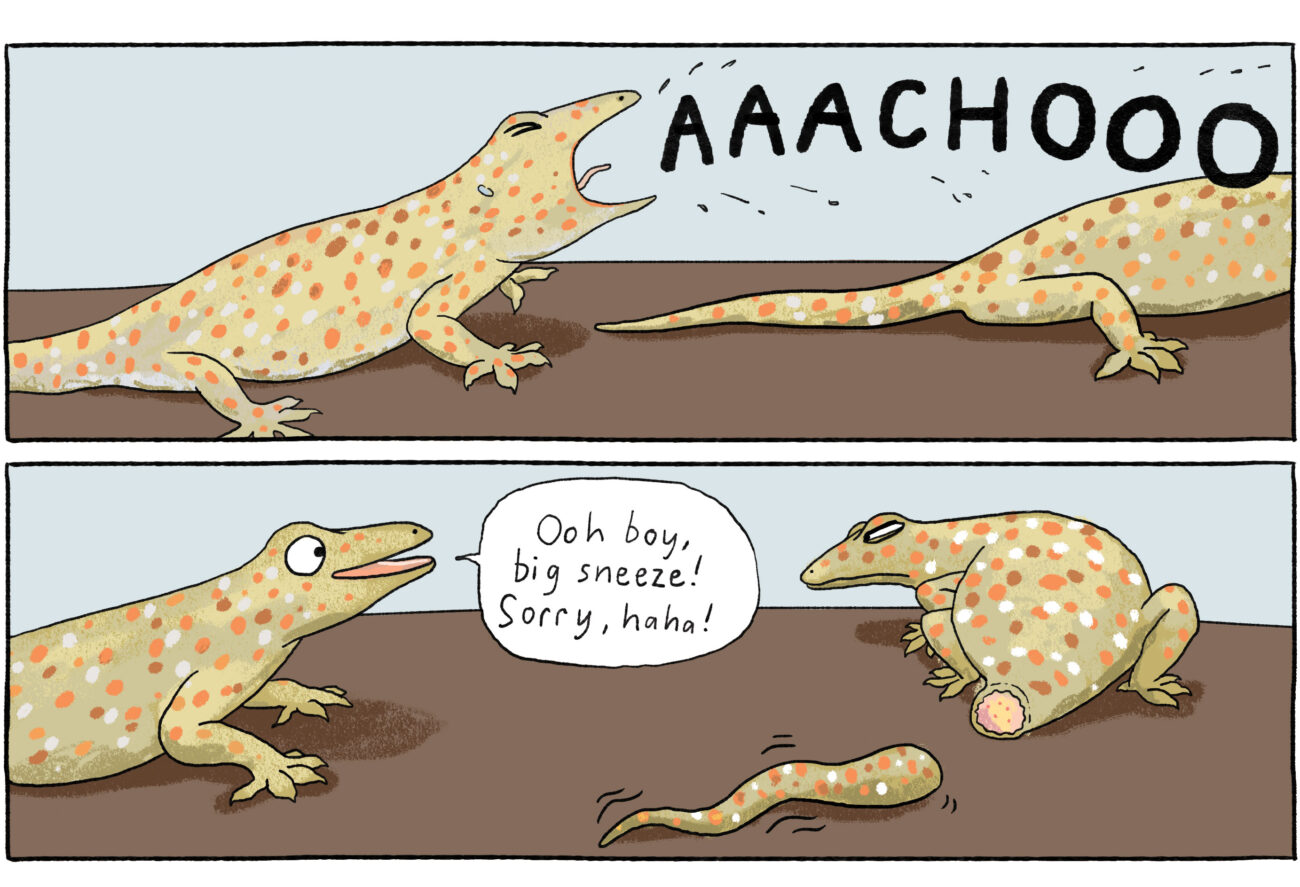
Slow-motion videos captured by scientists overseas suggest that lizards twist to deliberately throw off their tails, cleaving them along weakened planes within the bones of their vertebrae. The tissues around the wound immediately contract like the top of a drawstring bag—“it’s a sphincter, much like your butthole,” says Herbert. “It closes off all the blood vessels, so you do get a little bit of bleeding, but not nearly as much as you would expect.”
Meanwhile, the tail itself is going bananas, thrashing and wriggling and in some cases even squeaking, Herbert says. “It’s all done via anaerobic contraction of the muscles.” Some tails are more brightly coloured than the bodies, presumably to make them even more conspicuous when they go solo. As a life-saving distraction strategy, it’s genius—especially against highly visual predators such as birds. While the tail is grabbing a predator’s attention, the rest of the well-camouflaged lizard can freeze, or sneak away.
Still, says Herbert, self-amputation is “kind of like your one shot, your last resort”. Tails take energy and time to regrow, especially in winter when temperatures are cold and food scarce. Lizards can’t make new bones, so the new section of tail is made of cartilage instead—and though this hasn’t yet been properly studied, it seems likely a lizard can’t snap off this part of the tail a second time.
“It’s a really cool illustration of how everything in biology is a trade-off between two things,” Herbert says. “A lizard that has recently autotomised its tail and is in the process of growing it back has lost that predator defence strategy for that period of time.” Hence scientists’ feelings of guilt when they accidentally trigger the behaviour, and Department of Conservation regulations requiring permits for lizard-handlers.
You’ve been warned: never grab a lizard by the tail.
*
A dog bounds up with dopey enthusiasm, tail wagging furiously. Your spirits lift in response. She’s happy, right? We’re so attuned to the positive vibes conveyed by this behaviour that when engineers stuck a fluffy, wagging, dog-like tail onto a cleaning robot, people became more attached to it—and felt it was “sad” when its tail stopped moving.
But is a waggy doggy really happy? Silvia Leonetti and her collaborators discovered that science has surprisingly little to say on this question. Even though domestic dogs are perhaps our closest animal companions—we’ve shared our lives and our homes with them for 35,000 years—many dog behaviours “remain scientific enigmas”, says Leonetti, a doctoral student at the University of Turin in Italy. “We have only fragmented answers.”
Dogs wag their tails in all sorts of ways—side to side, up and down, round and round—as well as up high or down low. They use them to communicate, says Leonetti, wagging during “aggressive interactions, in front of inanimate objects, in front of known and unknown people—it’s a complex behaviour”.
One emerging finding is that wagging towards the right side generally indicates a desire to approach something, while left-ish wagging is associated with withdrawal. Leonetti encourages dog owners to observe their own animals and see whether this bears out.
It’s also been shown that domestic dogs wag their tails earlier in life, more often and in more contexts than other canids (the group that also includes wolves, dingoes, jackals and foxes). There are two possible explanations for that, Leonetti says.
One is that tail wagging emerged accidentally, as a by-product of domestication. In a famous experiment starting in 1959—and continuing today—scientists in Russia have been domesticating silver foxes in real time, selecting and breeding from the animals that showed the most docility and friendliness.
Though they were chosen only for tameness, within six generations the foxes had also gotten cuter and happier—they had floppy ears, curly tails, lower stress and higher serotonin levels. They licked the hands of experimenters, whined when the humans left them—and wagged their tails when the scientists returned.
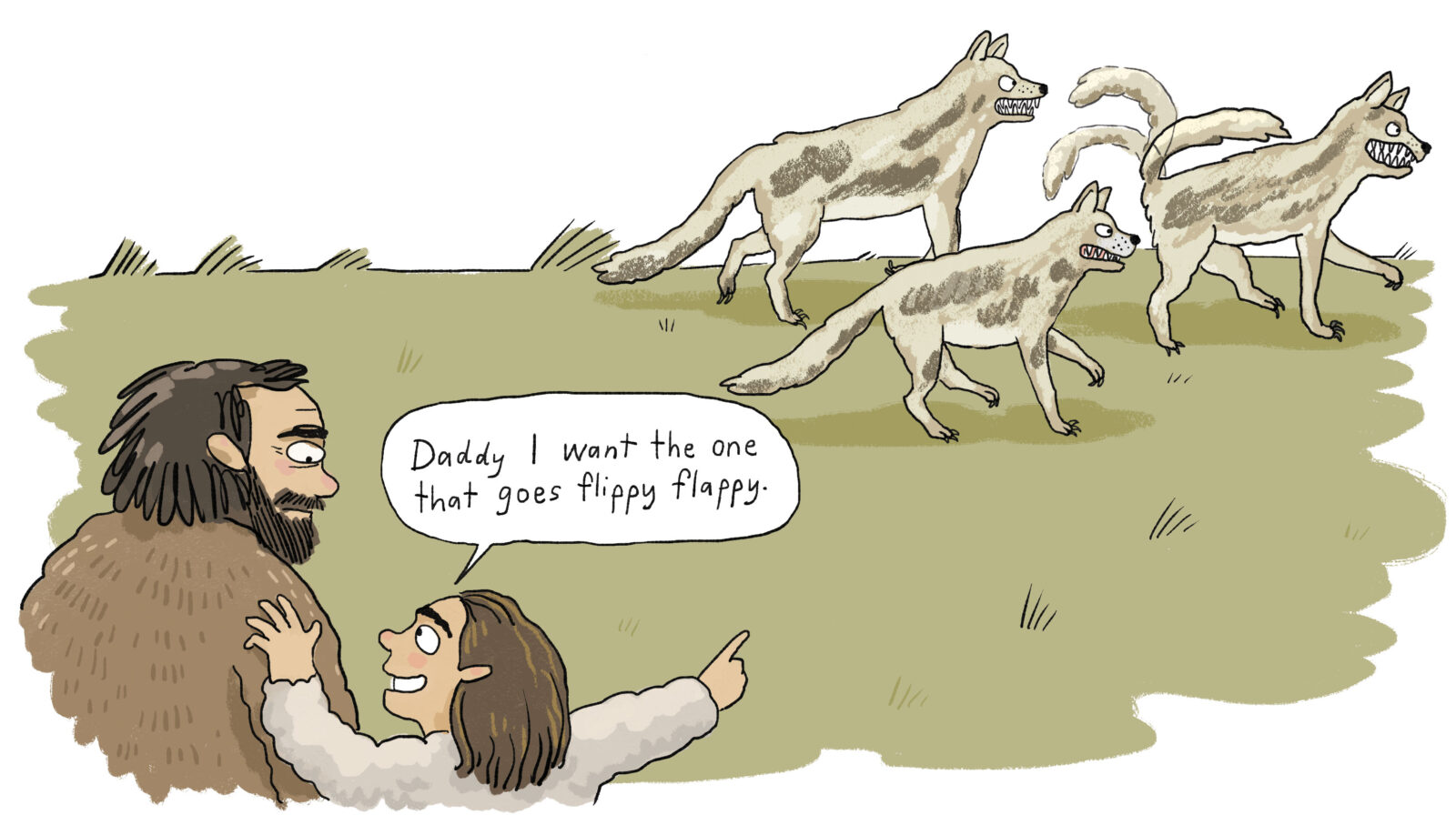
It’s possible, then, that wagging has evolved by chance because it’s genetically linked to tameness. But there’s another prospect. Maybe early humans preferred waggy wolves.
In this scenario, your pet’s flip-flopping tail is actually a kind of “living fossil”, Leonetti says—a portal into human psychology, into what our ancient ancestors thought, desired and valued.
She proposes a new hypothesis she hopes scientists will now test: that humans selected waggier dogs because of our deep and abiding interest in rhythm.
Several studies have shown that humans are attracted to repetitive and rhythmic visual and auditory stimuli that echo our own heartbeats, she points out. Flashing lights and Morse code, sirens and semaphore, drumbeats and dancing—all these get our attention, and we imbue them with meaning. Perhaps it was the same with the regular back-and-forth of a dog’s wagging tail.
*
As a child growing up in the countryside in Sichuan Province in China, Bo Xia looked at the dogs, cats, water buffalo and pigs around him and wondered what it would be like to have a tail of his own. “All of them seemed to have a tail—but not me.” Many of us have shared similar whimsies, imagining the possibilities and complications for furniture, fashion design, sports (monkey bars!)—and mischief. But the perfect skill set combined with an unfortunate incident in the back of a car led Xia to take the question seriously—and scientifically.
In 2019, when Xia was a graduate student in computational biology at the New York University School of Medicine, he slid along the back seat of an Uber to make room for someone else and severely bruised his tailbone on the seatbelt buckle. For months afterwards, he couldn’t sit down without feeling pain or pressure on this otherwise invisible part of the body. “That reminded me of my childhood curiosity,” says Xia, who is now based at the Broad Institute of MIT and Harvard.
All of us have once had a tail of sorts—for a couple of weeks, anyway. Around five weeks after conception, a human embryo sprouts a tail-like structure made up of a neural tube, an early form of spinal cord, and up to 12 vertebrae. By eight weeks, in most cases, the tail is gone. It’s reabsorbed into the body, and three to five vertebrae fuse together to become the bruise-prone tailbone or coccyx.
Very rarely, a baby is born with a boneless, fleshy tail-like appendage. These “pseudotails” are sometimes associated with neural tube defects like spina bifida.
Scientists since Darwin have debated whether anomalies like these are a kind of evolutionary flashback to an ancient ancestor—perhaps the reversal of a mutation that caused us to lose our tails in the first place. Until Xia started looking, no-one had any idea of what that mutation could be.
The first primates all had tails—our short-lived embryonic tails preserve a developmental memory of that history. Around 20-25 million years ago, the ancestors of humans and apes diverged from the monkeys. Most monkeys kept their tails, but humans, chimps, gibbons, gorillas and the rest of the apes did not.
Why? “In biology, ‘why’ questions are very hard to really answer,” says Xia. The loss of our tails is especially baffling, though. “We need one very powerful tool to investigate this question,” he says, “and it’s called a time machine.”
So Xia took on the more approachable problem of how—what was the genetic basis for the loss of our tails?
Because mice are such excellent lab animals, we know more about their genomes than those of any non-human mammal (we share 85 per cent of our DNA). Xia looked up a database of mouse genetics and found 140 genes related to stunted or absent tails. Then he trawled through the corresponding parts of human, ape and monkey genomes.
Eventually, he found something interesting. In many mammals, a gene called TBXT is responsible for making a protein that helps tails to form. In the human and ape genomes—but not in the monkey’s—there was a mutation in that gene, so it pumped out less of the tail-making protein. Xia turned to the lab, using CRISPR gene-editing technology to modify the genomes of mouse embryos so they wouldn’t make the protein properly either.
When the mice were born—voilà!—some had stunted tails, while others had no tails at all.
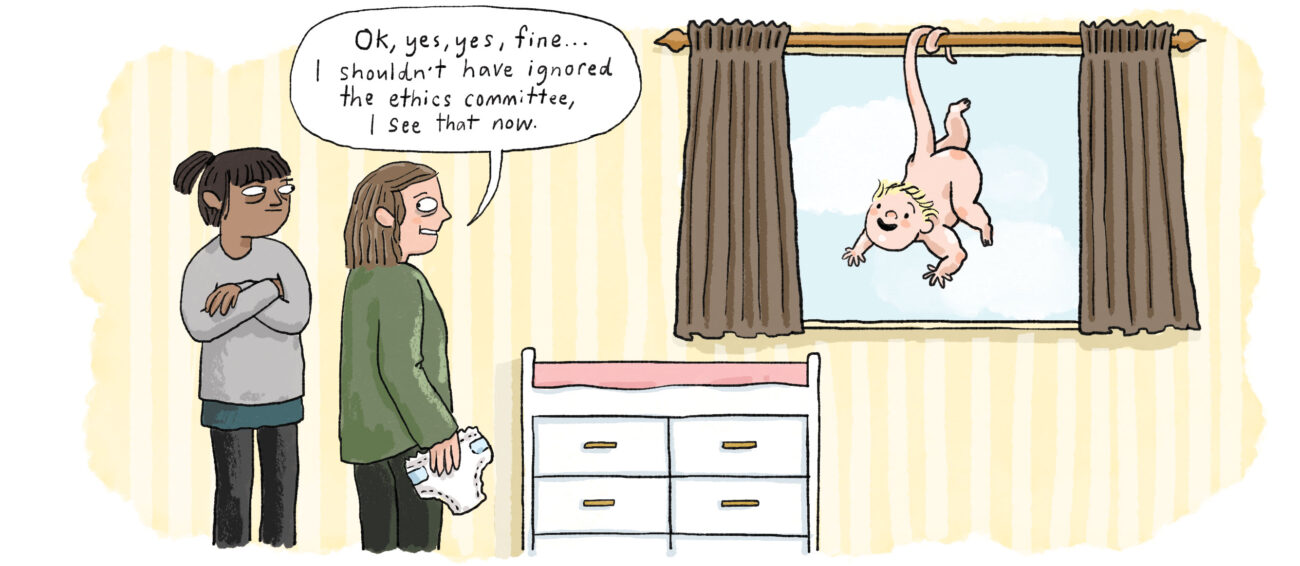
Could we just reverse this mutation, then, and grow a human baby with a tail? Ethics aside, it’s not that simple. Over millennia, other mutations would have reinforced the initial tail loss and ensured (almost) all of us grow a uniform coccyx.
Picture a car, Xia says. It can break down in many ways—a flat tyre, empty petrol tank, a snapped cam belt, a malfunctioning engine. If you pop a flat and then abandon the vehicle for a decade, changing the tyre probably won’t be enough to get it moving again. “In a similar way, when we repair this mutation, it’s very unlikely that we will grow a tail.”
Perhaps it’s more sensible, then, to sit with our loss—and appreciate the wild world of tails flaring and wagging and wiggling all around us.
More by Kate Evans
More by Kay Lawson
Subscribe to our free newsletter for news and prizes
3
$1 trial for two weeks, thereafter $8.50 every two months, cancel any time
Signed in as . Sign out