Cook Strait was Adam Walker’s sixth marathon swim, and a quarter of the way in, he was struggling. The water was much colder than during his previous swims, the choppy waves were making him seasick, and he was bone tired. He prayed for something good to happen—a change in the weather, perhaps, or a burst of energy.
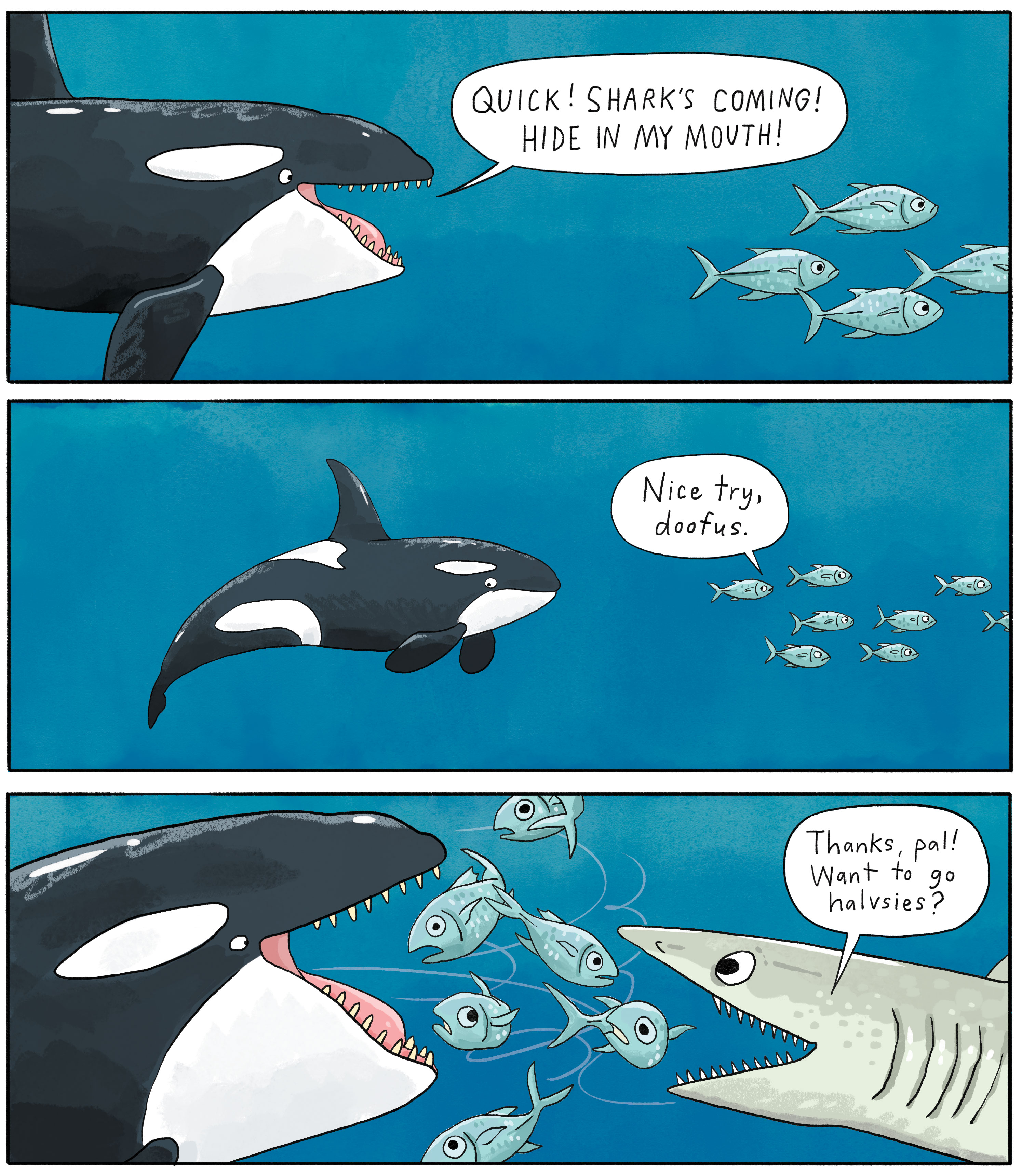
What he got was dolphins. Twelve dolphins, which appeared out of nowhere and fell into a diamond formation around him, close enough that he could have reached out and touched them. One dolphin swam around him in slow, constant circles. Eventually, Walker realised he was hurting his neck trying to watch them, so he adjusted his head to ease the strain and looked down.
It was a terrific shock. Directly underneath him, also keeping pace, was a large shark.
Walker immediately forgot about the pain in his neck. His support boat wouldn’t be able to see the shark, he knew; should he flag them, or would that just alert the shark? He decided to ignore it and turn his attention to the dolphins. The pod seemed to help him do so, putting on a show of somersaults and flips. The next time Walker looked down, the shark was gone.
“I can’t say whether the dolphins came as a pod to my aid,” said Walker at the time, “as they can’t speak to me.” But he felt very strongly that they had protected him.
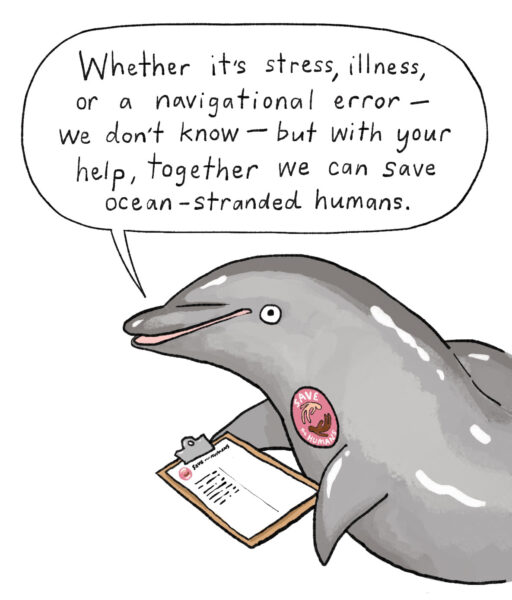
It’s not the only documented instance of dolphins shielding humans from sharks. In 2004, 10 years before Walker’s swim, a pod of dolphins at a beach near Whangārei herded a group of four swimmers into a tight knot, looping in circles around them. One of the people, Rob Howes, felt uneasy about the dolphins’ behaviour—until he glimpsed the distinctive silhouette of a great white shark beyond them. The dolphins kept circling the group until the shark disappeared.
Similarly, humpback whales have been spotted saving other species from predators. In 2016, orcas hunting a seal were foiled when two humpbacks arrived on the scene. One of the whales rolled onto its back and pushed the seal up onto its belly with a flipper, lifting it out of the water. When the seal started to slip, the whale nudged it back on.
In the animal world, there’s a lot of what looks like kindness. Northern hemisphere songbirds share information about where to find food with birds who are much worse at scouting than they are. (In these bird social networks, tits are usually a “leader” species, locating and broadcasting new food sources, while nuthatches are usually a “follower” species, turning up just to eat.) Australian magpies help each other to remove scientific trackers, as though the whole group is protesting surveillance. In the Red Sea, groupers and giant moray eels work together to hunt. To kick things off, groupers stop by a moray eel lair and wiggle their heads right in the moray’s face; the two swim off together. Only one of them will end up with a full belly—both swallow their prey whole, no divvying it up first—but they trust the partnership will even out in the long run.
Since the time of Charles Darwin, evolutionary biologists have been trying to figure out why some animals are altruistic—why they might sacrifice or disadvantage themselves to benefit others.
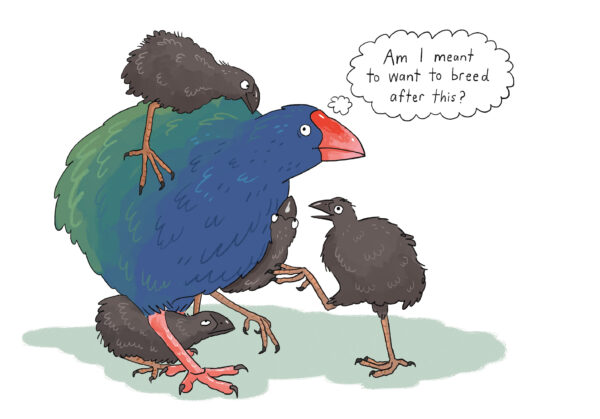
According to evolution, being nice just doesn’t make sense. For starters, helping another animal usually comes with risk. A meerkat that spots a jackal and pops up to sound the alarm for her whole community draws the predator’s attention. Takahē that devote themselves to raising other takahē’s chicks postpone starting a family.
So, if nice animals are more likely to get killed putting themselves in danger, or to miss out on finding a mate, wouldn’t that eventually wipe out the genes for kindness?
*
For Darwin, the main problem was bees. They didn’t fit into his theory of evolution. Most honeybees never reproduce: rather, they spend their lives foraging, building, and cleaning their nest, even sacrificing themselves in its defence. Yet Darwin had written a whole book about how animals who don’t pass on their genes disappear from existence. For the fittest to survive, they have to have kids. How were bees possible?
Eventually, Darwin decided that a honeybee colony should be considered as a single animal. Worker bees weren’t so much individuals as the million arms and legs of their queen. Besides, perhaps this kind of thing was just something insects did.
If Darwin had known about naked mole rats, they’d probably have given him nightmares. Naked mole rats are the colour of raw chicken and wrinklier than a toe after a long bath—and they act like honeybees, even though they’re mammals. In a colony of several hundred mole rats, only one female reproduces, while the others never breed at all, instead foraging and digging for the benefit of their queen and colony.
In 1964, the British evolutionary theorist William Donald Hamilton came up with a different idea about the origins of altruism. Perhaps generosity is spread by animals helping their close relatives. After all, relatives share genes, so it’s a way of passing some of your DNA onto the next generation.
If you have siblings, you share roughly half your genes with your brothers or sisters—and the same goes for most mammals. Bees, however, reproduce differently; sisters share three-quarters of their genes.
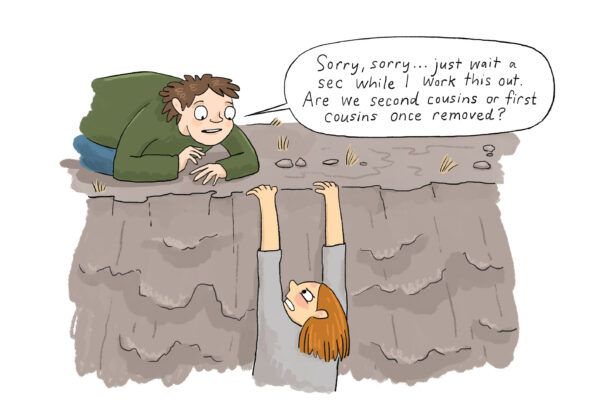
Hamilton came up with a mathematical equation for predicting altruistic behaviour. It involved three factors: benefit, cost, and genetic closeness. Some acts are very expensive, such as an ant dying to protect the colony, while others are cheap, like lionesses sharing childcare. The closer the relative, Hamilton figured, the more expensive an act an animal would perform. (As the British biologist JBS Haldane quipped, he would lay down his life for “two brothers or eight cousins”.)
And Hamilton’s rule held true: the closer the relative, the greater the sacrifice. Takahē will help only immediate family members raise chicks, because this delays them finding a mate of their own and so decreases the chance they will have their own family. Ending your own genetic line, in evolutionary terms, is death—no matter how long you live. Meerkats will sound the predator alarm to help out the whole group, because it’s comparatively low-cost: chances are they won’t get killed doing it. A study of 36 cooperative-breeding bird species found that birds’ helpfulness increased the more closely related they were. Nepotism babies, in other words, are a thing in the animal world, too.
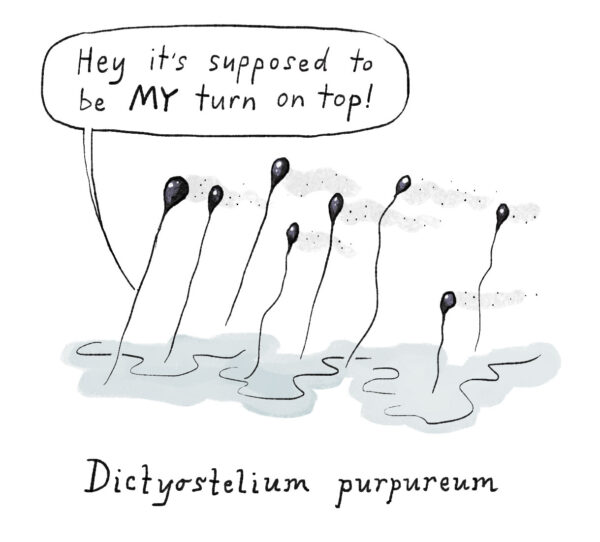
This type of behaviour, called “kin selection”, takes place even in brainless animals like amoebas, writes evolutionary biologist Olivia Judson. Take the slime mould Dictyostelium purpureum, which eats bacteria, reproduces by cloning itself, and usually lives as individual single cells. “When times get tough—when there’s a bacteria shortage—thousands of individuals join together into a single entity known as a slug,” she writes.
The slug travels around looking for a feast of bacteria, and when it finds one, it transforms into a sorocarp, which looks like a tiny mushroom. The cells that form the cap of the mushroom get to reproduce: they create spores that are carried away by the breeze or animals. The cells that form the stalk, lifting the spores aloft, die without getting a chance to clone themselves. What prompts this sacrifice? Kinship, again. “Amoebas with the same genes tend to join the same slugs,” writes Judson. “They avoid mixing with genetic strangers and sacrifice themselves only for their clones.”
Even viruses have been shown to cooperate altruistically to overwhelm a host’s immune system, though this is considerably less endearing than, say, the rhesus macaque who was filmed resuscitating a fellow macaque in 2014. The unconscious monkey had been electrocuted by a live wire at a train station in India; the rescuer macaque examined it, shook it, and dunked it in a pool of water until it came around.
*
When Jo Carpenter let the ship rat out of its trap, she wasn’t expecting to think it was cute. After all, rats in traps are usually dead. But Carpenter was trapping live rats—797 rats, to be exact—in order to tag and release them back into the wild. That meant she had to lure them in alive.
Setting rats free isn’t normally what conservation looks like, but Carpenter, a biologist at Manaaki Whenua—Landcare Research, was hoping to find out how far the rats would roam and how long they’d survive at high altitude over winter. Could rats invade the largely rat-free alpine zone?
The rats were sedated so that they could be microchipped and tagged, and Carpenter would hold them in her palm until they started to wake up. Seeing them up close changed her view of the species. Working in conservation, it was easy to regard them as evil. Now, she felt they had their own kind of dignity.
“They are really cute,” she says. “I really like them. Our ship rats have three different colour morphs. You can get black ones, which are called the rattus morph. You get these ones that are kind of like a rusty brown grey; that’s called alexandrinus. And then you can get frugivorous, and they have a beautiful sort of lemony, creamy belly. Where we were working in Fiordland, the lemony-belly ones were really rare. So you’d be like, ‘Oh, this is exciting. I’ve got a cute frugivorous rat.’”
The word “rat” has such negative connotations—it means a traitor, a liar, a snitch—that it’s hard to see them in a different light. But in a special issue of the journal Science dedicated to rats, the editors pointed out that rats are highly empathetic, cooperative, and—yes—altruistic.
Given a choice between eating chocolate and saving a fellow rat from drowning, most rats choose to rescue the other rat and forgo the snack. Rats will free other rats from cages without being prompted or receiving any kind of reward. Similarly, rats can be taught generous behaviour—they’re more likely to share food with other rats if they’ve had food shared with them in the past. This isn’t kin selection at play, because relatedness doesn’t matter to rats. But familiarity does. Rats will help rats they already know, but are much less likely to help strangers.
“I guess as humans we would like to think we’ll help people no matter what, but of course, the emotional stakes will feel higher if it’s someone we’re really close to,” says Carpenter. “It seems like it’s the same for the rats.”
*
In the complex social hierarchy of superb fairy wrens (not to be confused with splendid fairy wrens), a bird knows where he stands based on two important calls: “Go away!” and “Help!” Superb fairy wrens live in south-eastern Australia, where the vivid blue head feathers of males in breeding season stand out against the muted colours of the bush. Females are brown, with a tinge of orange around the eye, as though they’ve gone haute-couture with eyeshadow.
Over the warm months, fairy wrens live in little groups in specific territories, and they defend their patch with song, harassing any fairy wrens from other groups who attempt to enter. During the colder seasons, though, they drop their defences and their aggression, and merge groups to form large cooperative communities. Winter is a tough time for superb fairy wrens. They go into torpor—like a less intense form of hibernation—which makes them vulnerable.
Evolutionary biologist Ettore Camerlenghi wanted to find out if this meant superb fairy wrens would help each other out more during the winter than at other times of year. He decided to introduce a threat and see which birds flew in to offer assistance.
That’s how Camerlenghi found himself placing a stuffed kookaburra in the bush while playing fairy wren “Help!” calls that he’d recorded.
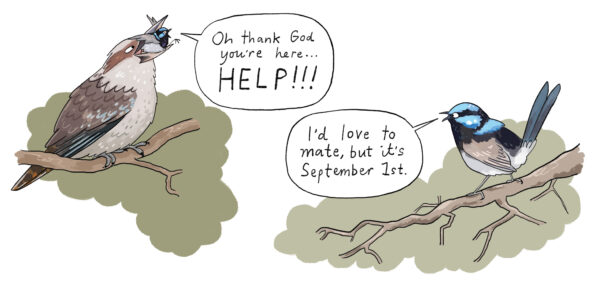
During winter, he found, other birds usually arrived to offer assistance, spreading the alarm or attempting to distract the predator by racing around headfirst, feathers fluffed up, in a move called a “rodent run”. In spring, however, distress calls were met with “Go away!” songs in return, or outright aggression. “It was as if there was a ‘cooperation switch’ that was turned on and off,” writes Camerlenghi. Less fair-weather friend, more terrible-weather friend.
It was long thought that birds weren’t intellectually sophisticated enough to form these complex social circles, says Camerlenghi. It takes a lot of brainpower: fairy wrens have to be able to recognise other individual birds, and then remember every bird’s place in a series of interlocking groups. Yet Camerlenghi’s work shows they’re capable of it.
When animals help each other out with raising their young, that’s called cooperative breeding. In bird families, it usually involves last season’s chick sticking around to help out with the new brood. Cooperative breeding is pretty rare in birds—about nine per cent of bird species, globally—but disproportionately common in Australia, and no one’s yet figured out why. In New Zealand, mohua/yellowheads, titipounamu/riflemen, weka and skua all indulge in a spot of breeding-season altruism. Some bird species take it a step further into cooperative polygamy: overseas, the acorn woodpecker shares mates as well as childrearing duties, as does the pūkeko in New Zealand.
*
In the end, what looks like altruism usually turns out to involve some kind of benefit to the generous animal, like passing some of their genes on, or a fifty-fifty chance of dinner, or the opportunity to receive help again in future. But some benefits are long term: Australian social flower spiders who share their kills with other spiders are healthier and live longer than spiders who cheat and take others’ food. (Also, males are more likely to cooperate than females.)
But this doesn’t explain every act of animal altruism—what turns a humpback into a vigilante rescuer, for instance?
And it doesn’t explain why altruism emerges in super-young humans, either. Multiple studies have found that toddlers are highly altruistic: that they can perceive others’ distress and will attempt to help them. In one study of 19-month-olds, they’d share food with an adult who indicated they wanted some, even when the toddlers were hungry.
In 2023, researchers decided to find out whether toddlers would help animals in the same way. They put 97 toddlers to the test: the children watched a dog trying to get a toy that it couldn’t reach. Most of the toddlers picked up the toy and gave it to the dog.
Theories abound as to why this is the case. Do toddlers learn care from their parents—a kind of moral conditioning—and repeat it? Is the distress of others more intolerable than hunger? Is this a habit left over from when humans lived in small groups, and everyone was related to each other?
Dolphins, once again, complicate the answer—or expand it. Their behaviour suggests that there’s something ineffable and unquantifiable in all of this. Likewise, perhaps there’s something in the way that humpbacks relate to seals, or in the way that we relate to each other, that goes beyond reason.