What happens to the psyche when a person walks and walks, starving and alone? (more…)
More by John Summers



I went to see the Yeti in Palmerston North. He lived at the end of a cul-de-sac in a 1970s split-level. I brought biscuits.
“What are they?” he said.
“Chit Chats,” I told him.
“They’ll be okay,” he said.
Sitting down, I laid them on the carpet, giving them a little nudge so they slid to sit between us. There they would stay, untouched, an offering, for as long as we spoke.
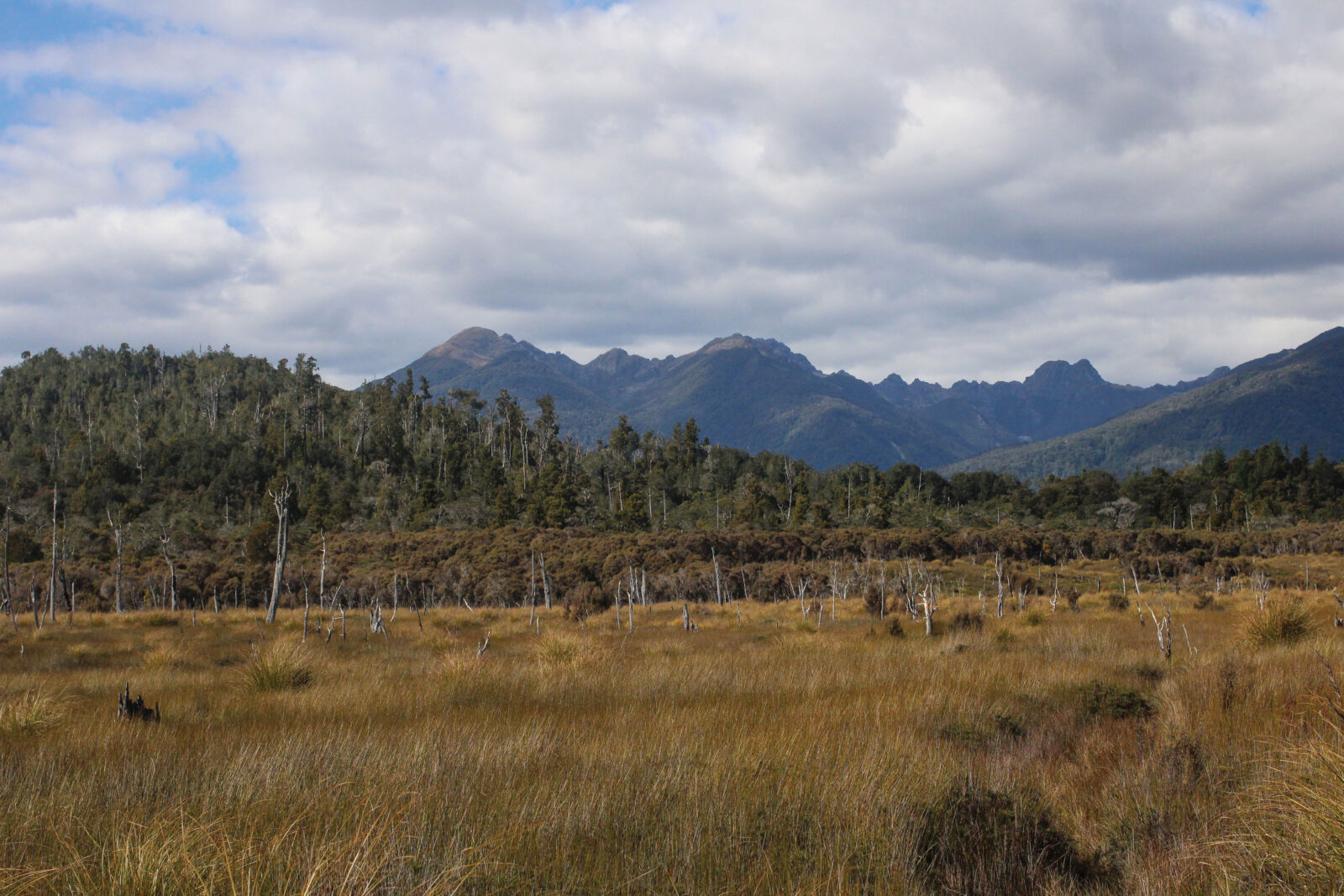
Peter Le Fleming was his name, but he’d been called that, the Yeti, in his youth for his beard and long hair. He was in his 60s now, the beard and hair grey, both cropped short. Wrinkles splayed at the edge of each eye. Still he was spry. He wore a tiny pair of shorts, and his bared legs were lithe, suntanned. He had played and refereed rugby as a young man, and he remained a diligent fan, attending all the local games. Rugby almanacs sat in a tidy row on a bookshelf. He had also been a tramper, walking the Ruahine and Tararua Ranges. But it was the Heaphy Track that I had come to talk to him about. Its 78 kilometres, from Golden Bay to the beaches of the upper West Coast, takes in beech and podocarp forest—standard tramping fare—but also plains of tussock, sandy coastal tracks and groves of nīkau palm.
Le Fleming had attempted it at age 21, walking the length to arrive at the West Coast, and then doubling back so he might emerge where he started. It was January 1980—one of the wettest Januaries recorded in the region. The track was churned boggy by trampers’ boots, and, about 37 kilometres into the return trip, Le Fleming had to spend an extra day holed up in a hut waiting for bad weather to pass. The next day, as he was crossing a stretch of open ground, the marsh-like Gouland Downs, he fell into a deep pool of water and was soaked through. Even the matches he kept in a plastic bag became damp from condensation. But it was the last leg of his trip. When he left Gouland Downs Hut early on the morning of January 19, the plan was to walk all the way out. He made it first to Perry Saddle Hut, six and a half kilometres to the east, and noted his plans in the hut’s intentions book. He set off again, with a final 15 kilometres to go. It was soon afterwards that something happened. This something has never been clearly defined.
“I reckon I had a fall but it could have been a trip or whatever,” he told me. The most likely location of this trip or fall was a wide and consistent stretch of track. Somehow, Le Fleming banged his head severely, cut his back and thighs, and tore a chunk out of the sole of his tramping boot. Whatever happened sent him off the track, disorientated, out into the unmarked spaces of bush. There he wandered for 29 days, a record for as long as we’ve been counting. He remains New Zealand’s longest lost.
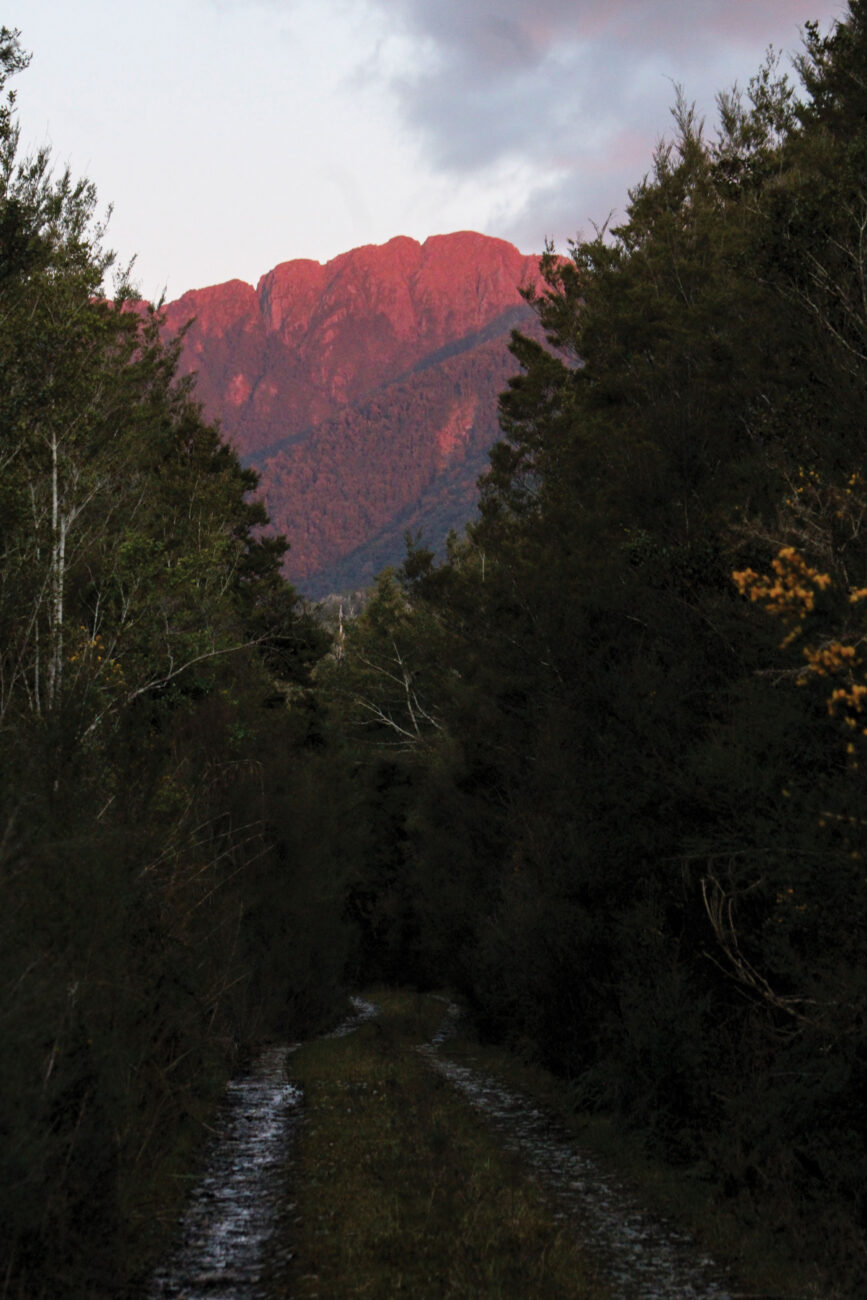
In the hazy first days of his ordeal, Le Fleming walked to Shakespeare Flat on the banks of the Aorere River, leaving the Heaphy Track and the beech forest that surrounded it for an area of podocarp. Those old giants, rimu, tōtara, mataī, that shelter dense undergrowth in their shadows. There he pitched his tent on the river bank. He ate the last of what little food he had left. He piled up stones to form the word HELP, each letter a metre high, carefully scooping out the negative space within the P with his plastic plate.
There was a day that week, January 25, in which the rain stopped, and a group of trampers on the Heaphy heard a distant sound coming through the quiet of those rare still hours, something like a gong, resonant and metallic. They stopped to listen. The sound repeated, over and over. They talked about what it might mean, deciding that it was too regular to be any kind of call for help, and so carried on their way.
It’s likely that Le Fleming had been banging on an old tin drum somewhere out there in the hope of rousing someone. But this was another detail of which his own memories were vague.
The rain kept coming and Le Fleming passed the time in his tent sorting cards in games of patience. He passed several dreamy hours carving Yeti into the trunk of a tree, and he sat about playing a word association game, looking at his boots, for instance, and then running through everything else you might put on your feet: sandals, jandals, sand shoes…
Not surprisingly, Le Fleming tired of all this and moved on. It’s thought that it was the first of February when he broke camp to follow the Aorere River. Had he followed it downstream, he would have come to the end of the Heaphy and the beginning of the road to town. Instead, he followed it upstream, pushing deeper into the interior, into wilderness, further and further from tracks and other trampers. Back at Shakespeare Flat, he had found a trout wallowing in a pool and devoured it raw, eating even the bones. For the rest of his days lost, his only sustenance would be fern shoots and the occasional earthworm which he seasoned with salt, a remnant of his tramping supplies.
“Did you think about food?” I said. “Were you feeling hungry the whole time?”
“Not really, no.” he said. “You got to that stage where…” He shook his head.
“It switches off?”
“Off, yeah.”
Our conversation followed this pattern for almost two hours, “not really” or “yeah” the most he offered to most of my questions. He was happy to let silences hang, or almost silences—he had the radio tuned to The Sound; classic rock played throughout. And so, for the detail of his time lost I’ve relied on a 2017 recounting by writer Gerald Hindmarsh and a Listener article by David Young, who had interviewed him not long after his rescue. Le Fleming warned me he had barely remembered much, but even at the time, details were scarce. “His shyness is like a mask, and the interview is not easy for him,” wrote Young back in 1980.
So much, then, for my hope we might revisit those 29 days and understand something of what it felt like to be lost for so long, of how the many hours passed, the mood of those days. Le Fleming was uninterested in this question, not prone to ruminate. The house was neat to the point of starkness. Baseball caps had been arranged in rows on a table in the entrance way, a shelf held the books of childhood—Uncle Tom’s Cabin, Robinson Crusoe—as well as gardening books, all in tidy formation. Retired now, he’d always worked as a gardener. The carpet was clean, the lawn mowed within an inch of its life. The events of 1980 had been similarly squared away. It was, he said, just a thing that happened.
Just a thing that had landed him on the news around the world, that had his parents thinking him dead. A fair assumption. There had been snow on the Heaphy that month, and the rain just kept coming. A flash flood killed two kayakers in the Aorere. Eight years earlier, an American tourist, Roselyn Tilbury, had attempted the same track ill prepared, a hippie in homemade moccasins. She walked so slowly that her tramping companion pushed on without her, then waited further along the track for her to catch up, playing a wooden flute to pass the time. But Tilbury never appeared, and has never been seen again despite much searching.
“Don’t you think there was something,” I said to Le Fleming. “Some reason you survived longer than anyone else?”
“Pure luck,” he said immediately, making these words sound final, definitive.
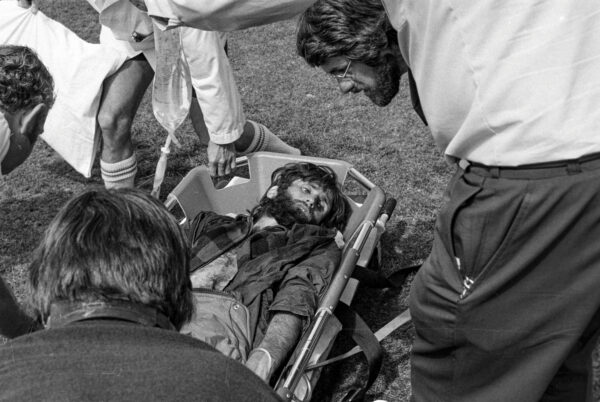
On the first of February, 1980, Le Fleming’s parents waited for his plane at Palmerston North’s little airport. They watched passengers emerge, greet their people and go on their way. They watched until all had passed. No Peter. His mother suddenly felt cold.
Only then did the rest of the world know something had gone wrong. A search began, led by the local police constable. Searchers soon found signs of that camp at Shakespeare Flat, strange signs: Le Fleming’s airline ticket was neatly folded and tucked under a rock. There was his HELP in river stones and, more usefully, a large arrow formed from ponga logs pointing upstream. But then there was another. Le Fleming had hedged his bets and made a second arrow, this one pointing downstream, the more logical direction of travel. The searchers went looking that way.
Meanwhile, Le Fleming was moving in the opposite direction, battling his way up the Aorere, crossing and recrossing as the days passed. He made it to the junction of the Burgoo Stream, a tributary of the Aorere and an area where few would go, its strange name a reference to the stew cooked up by the old gold miners, a relic of those days and likely the last time it received anyone’s serious attention. Le Fleming turned away from the river, to follow the Burgoo now, making his route all the more illogical to his searchers. He abandoned his tent, his pack, his groundsheet. He slept on the banks of the Burgoo throughout the day, walking around as it grew cold at night. All the while weakening. Two hawks flew over him each morning and evening, waiting, it seemed, like vultures.
Searchers scoured both sides of the Aorere River, focusing on areas not far from the Heaphy Track. They put wetsuits on and floated down the river on tractor inner tubes, peering into pools for the body of a drowned tramper. They searched from dawn to dusk without finding a thing, so stopped. Only by helicopter would they continue to look, passing over the riverbed. The police spoke to the papers, attempting to lower expectations.
On a dairy farm near Palmerston North, Le Fleming’s mother jumped whenever the phone rang. She listened to the Nelson weather reports on the radio. In Tākaka, Tony Cunningham, the local constable in charge of the search, considered calling it off. He conferred with his district commander and they instead agreed to one last pass with the helicopter, a final effort. For this, Cunningham’s team took a different route to get to the area they planned to search, a short cut to save fuel, one which would pass over the Burgoo Stream.
Le Fleming lay on a rock on those last days, just two metres from the stream but two metres too far. Unable to move now, he sucked moisture from a piece of moss. The pain and cold no longer reached him. His body had consumed almost a third of its weight.
Survival was a matter of hours when a helicopter hovered above him, something he would later admit to thinking was a hallucination.
A man in a Swanndri came walking over the rocks. “Gidday,” the man said. “How the hell are you?”
*
While Le Fleming was called the Yeti for his appearance, it wasn’t a bad fit for his time lost, either. He had been a lone figure out there stalking the wilderness but never seen. He left clues; he’d even been heard, just as stories of yeti cries, a high whistling, have been reported, together with supposed sightings of the creature or, more often, its tracks, by travellers in the mountain valleys of the Himalayas.
The yeti, too, has been the subject of extensive searches. Even Sir Edmund Hillary had a go. In 1960, Hillary led an expedition sponsored by an encyclopaedia company into the valleys of Rolwaling and Solu Khumbu, his men laden with tripwire cameras, dart guns, teargas pistols and rifles (the latter only for self-defence, as the Nepali government had banned the unprovoked killing of yeti). In a monastery, Hillary’s team found a mysterious, conical scalp—a kind of yeti toupee—and a bony hand of unknown origin. Testing revealed the scalp to be the pelt of the goat-like serow. The hand was human. Hillary returned empty handed. “There is precious little in civilisation to appeal to a yeti,” he would say, although he was unconvinced it existed. No matter. There are others who tell yeti stories, have produced photographs of footprints sunk deep in snow, and tufts of hair found at altitude. Believers persist, holders of a kind of Schrödinger’s cat-style logic: until the yeti is found, there is no proof of its nonexistence, either.
If nothing else, those yeti stories were proof of wild places that leave us feeling they hold more than we can see. And bear with me here, but I think that’s where the real overlap of the Heaphy Track yeti and the abominable snowman of the mountains lay. Le Fleming had been a mystery of the bush back in 1980 and he was one still. I was sure there must be things that only a man lost for 29 days could know. This is what had got me in the car driving to Palmerston North, but despite all my prodding, there was little he would reveal.
And so I began to wrap up my visit by asking him some other things, about his rugby, his interests. Where was that surname, Le Fleming, from? Was it French?
More by John Summers
“Some of it, yeah.”
I was scratching, reluctant to move in case he suddenly decided to share some secret. Putting away my pen and notebook, I asked if many people had been in touch to hear his story about his time lost. This time I wasn’t stalling. Giving up, I was curious whether there had been writers better than I was at prising something from him.
“You get people ringing up every month or so,” he said.
Reporters? I asked.
But Le Fleming told me it was others who had been lost who contacted him. They found him, as I had, and called to talk about what they had been through. The lost and the survivors, hoping they might have something in common, looking for a connection, maybe, with a fellow traveller.
“Some have the religious sort of thing,” Le Fleming said. “I’m not into that.”
I asked a little more, but never did learn what he was into or what he told them. We sat listening to The Sound for a little longer until finally I did leave, the Chit Chats on the carpet still.
*
Even before talking to Le Fleming, I knew that those who’d been lost could be reluctant to talk about it. Embarrassment is one reason. Humiliation is among the emotions that come with losing your way. And anything that involves intensity of feeling makes for a hard topic to share. It is where privacy lies. “I keep that pretty close to my chest,” said a young woman who had spent 19 days lost in Kahurangi National Park, when I called her. But that people sought out Le Fleming to talk to suggested there was something about the experience that made us, the not-lost, unsuitable confidants. Was there something that only others who’d been lost would understand?
Another who had been lost for days, Aritra Basu, a young man from India originally, was at first as taciturn as Le Fleming, telling me how he’d set out on a short walk on the West Coast. The plan was to take photos of the surrounding mountains and to be back three hours later. The track is flat and considered undemanding, but at some point he inadvertently strayed from it and found himself walking in a swamp, the mud up to his knees. “That is the point where I turned back and I saw that there were actually many tracks leading everywhere. That’s when I got lost.”
But as his story took us further and further into the bush, Basu opened up and began to share more, considering aloud how best to describe what he’d seen and felt, correcting himself, sometimes correcting me. This was a phone call—no video—but more than once I pictured dark brows furrowed in thought. It was important we got it right.
Basu walked every track or path he could find, trying to find his way out. He walked and walked, walked through the nights, sleeping only for 30 minutes at a time. He was dressed for a city street in a denim jacket, T-shirt and jeans. He had no food, was feeling a little hungry even when he started, and had no coat, no tent, nothing then to protect him from the cold or the heavy rain that would fall over those days. “I took shelter under roots. There were huge trees with roots. But I was scared, like some tree might fall on me. There were really heavy rains and thunderstorms and lots of trees got shaken.”
What he had was his camera, which he continued to use, taking pictures even after his situation became hopeless. He also had a phone. On that first day, he tried calling his friends for help. He was out of reception. By night, the battery was flat and no one had heard him. “That’s when I realised I was totally isolated,” he said. “I kept pushing on.”
On the second day, he saw a stream that he thought might lead him somewhere and he followed that. “Then from a distance I saw the main road, the main road from which I came, the starting point of the track. I thought the main road was near me so I started walking towards the main road, but actually that led me further and further away.”
Like Le Fleming, Basu drank from streams. But he didn’t waste his energies looking for food. There was no possibility, he said. He just walked, his wet shoes working against his skin and causing a painful sore—a “shoe bite”, he called it. He took his shoes off and later threw them away. His socks were soaked with blood and he peeled those off, too. He walked on barefoot.
It was day three when the hallucinations began. He saw his friends out there in the bush. He saw houses among the trees. What did these houses look like? I asked. Were they New Zealand houses or perhaps the type of houses he would have seen in India?
“I can’t tell you; like, it didn’t have a very distinctive architecture. It’s something out of nowhere, like I saw the structure, the silhouette. I didn’t really see the house too well. Then I saw boats; I didn’t [actually] see but I know they were in there. And I couldn’t tell if I was awake or asleep.”
The two states blurred together. There were small dots of light in the trees which moved toward him. At one point he heard music. It was maybe Hindi music, he said, or maybe Moroccan. You couldn’t pinpoint a specific song or even recognise it as a song. Like the houses, like the things in dreams, it was both familiar and not.
I had told Le Fleming about Basu’s hallucinations. Given these had occurred after three days of hunger and exhaustion, I assumed he would have experienced something similar, if not more extreme, in his 29 days of wandering.
“Probably, yeah,” Le Fleming said. But at that our conversation turned baffling. He couldn’t remember the hallucinations. “It’s afterwards, when I was found, that I had those.”
“In hospital?”
“No, when people talked about it. Then you think about it.”
“And then you’d remember?”
“No, I’d remember what they said rather than the actual event.”
“Oh, okay. Right,” I said, confused—others had told him what he’d hallucinated?—but I was at a loss, too, as to what to ask to clarify. Later, I read that Listener article by David Young, who quotes Le Fleming’s words to the policeman who found him: “Man, you get some way-out visions here.” To Young himself, Le Fleming wouldn’t elaborate, except to note that this happened at night, and was scary sometimes, too.
“How did you see to walk at night?” I asked Basu.
“That was a strange experience. One day, like, there was this half-moon, crescent moon, and I’ve actually never seen the moon that beautiful. And there was so much light that I could see the shadows of the trees. And as I kept walking and walking, I saw many beautiful things. I even saw snakes, small snakes.”
“Do you think these were real or a hallucination?”
“Could be a hallucination but I think I saw snakes.”
“There are no snakes in New Zealand, so maybe it was a gecko or something like that, do you think?”
“I don’t know. The nights were really beautiful and I hallucinated more during the night.”
He became aware of someone else, a man standing behind him in the bush and in the rain. He heard a voice, and he walked back and spoke to this man, explained that he was lost and hungry. But no one was there. Basu was alone.
*
In 1914, Ernest Shackleton embarked on a journey that would become one of the great feats of survival. He and his men were sailing to Antarctica with the intention of crossing it overland when their ship was wedged stuck in pack ice. They were forced to abandon it and walk on across the floating ice, hauling their supplies and lifeboats, camping at times, before setting off in those lifeboats for an uninhabited island. There they created a rudimentary camp, before a small group, including Shackleton himself, took to one of those open lifeboats and sailed more than 1000 kilometres to South Georgia Island, where they could seek help at a whaling station.
Summarised, it’s easy to overlook the fact that all this took many months in that frozen place. Even the very last leg, arriving on the coast of South Georgia Island and travelling overland to the whaling station, required Shackleton and two of his men, Frank Worsley and Tom Crean, to scale mountains and glaciers, a 36-hour slog over unexplored terrain. A “long and racking march”, Shackleton wrote, and on it something strange had occurred, something beyond tiredness and struggle: often he felt that there was another member of his party, that they were a group of four, not three.
Later, unprompted, Worsley confessed to the same. “Boss, I had a curious feeling on the march that there was another person with us.”
Shackleton notes this. He moves on. Justifying both choices, he writes (using words from Keats’ ‘Endymion’), “One feels ‘the dearth of human words, the roughness of mortal speech’ in trying to describe things intangible, but a record of our journeys would be incomplete without a reference to a subject very near to our hearts.”
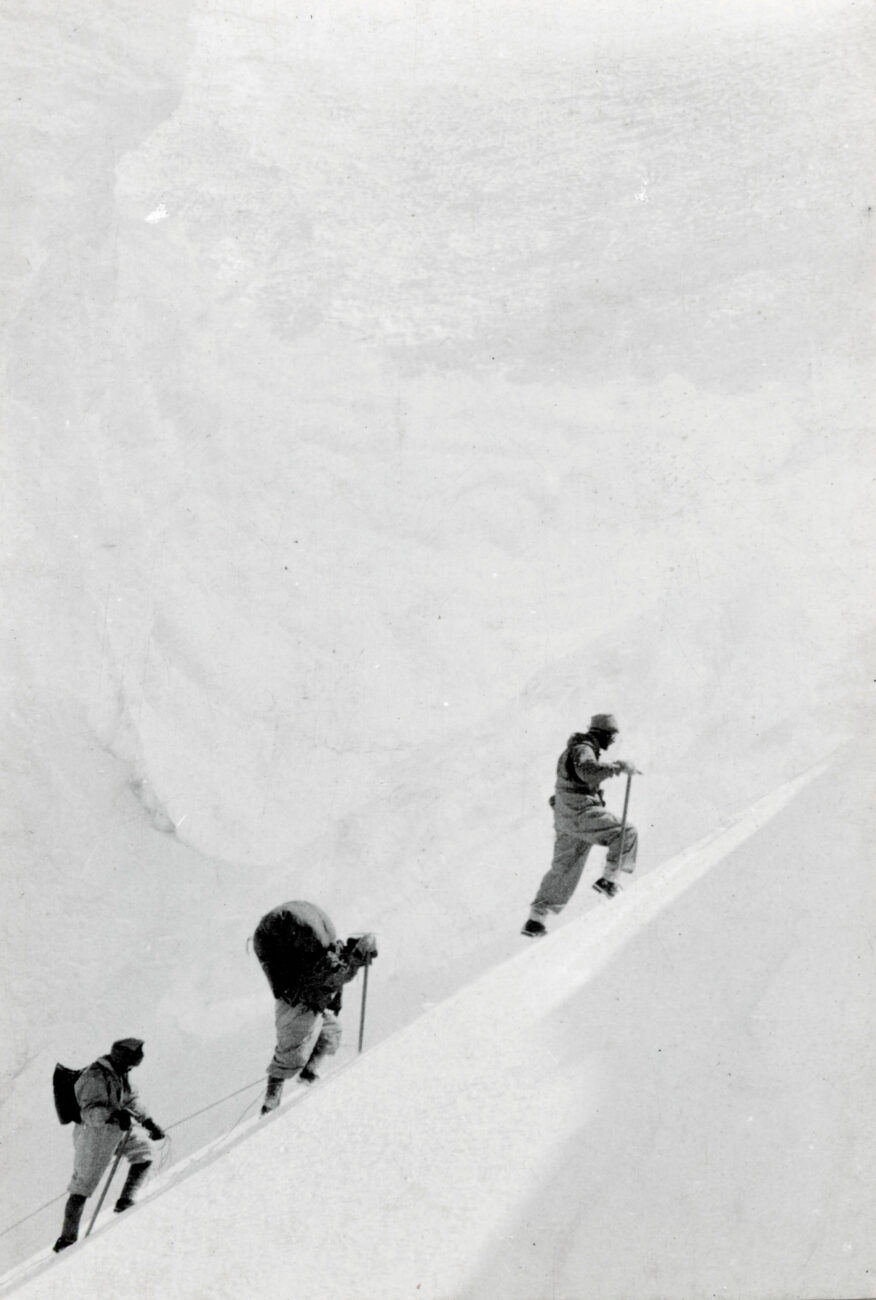
In 1933, Frank Smythe approached the summit of Mount Everest, well within what is known as the Death Zone, the altitude at which the air is too thin for life. Smythe was part of a British expedition attempting to conquer Everest. They climbed without bottled oxygen, relying only on what their lungs could extract from that weak air. Gradually, others had given up, retreated to their tents, leaving Smythe to struggle on. His feet sank into powder snow; the lack of oxygen sapped what energy he still had. He moved like a drunk, slipping, only his ice axe keeping him upright. Finally, with only three hundred metres to go, he conceded. Everest would remain unconquered.
Smythe began his descent, stopping at a ledge to rest. There he took a block of Kendal Mint Cake from his pocket. He broke it in two and passed half to his climbing companion, only to remember that he was alone. Until that moment, Smythe had felt the presence of another, a second climber close behind him.
Shackleton and Smythe’s stories are examples of what is called third man factor or third man syndrome, sometimes “sensed presence” and occasionally, and most vividly, “illusionary shadow person”. As the multiplicity of names suggests, it is a phenomenon that has been well documented. Both stories appear in a book by John Geiger on the subject, as do stories shared by shipwrecked sailors, astronauts, POWs on the run and a survivor of 9/11. For some, the presence is just that, the strong sense of company. For others, it manifests as someone vivid enough that they can later describe the appearance of this mysterious “other”: mountaineers Lou and Ingrid Whittaker believed they had been joined in their tent by a Nepali woman; Joshua Slocum, while on his mission to be the first person to sail single-handedly around the world, succumbed to exhaustion and allowed his boat to be steered for a time by a man with an “ancient cast of visage”, a person who did not exist. A common feature regardless is that this presence provides a comfort, a support during this time of struggle.
So many stories. Geiger found himself with too many to choose from, and his website shares the overflow. And yet, for all that, there are few instances of this recorded earlier than the late 19th century. The phenomenon only really received attention when Shackleton published his account in 1919, something he had deliberated about. In interviews, he refused to elaborate. “There are some things which can never be spoken of,” he told a reporter. “Almost to hint about them comes perilously close to sacrilege.” Still, through those brief details, the mysterious “other” burst into the world. He made front pages. T.S. Eliot took notice. His poem ‘The Waste Land’ includes lines about a “third” who always walks beside. In the poem’s notes, Eliot explained this was a reference to a polar explorer, although he admits to forgetting exactly which one.
In the decades that followed, those many stories would emerge, Smythe’s among them. It was as if Shackleton had revealed something about the experience of survival that was previously unspoken, perhaps too strange, too hard to explain. He had allowed others to speak of it. It is now an accepted if not fully understood symptom of surviving in extremes.
Basu’s experience of another presence doesn’t entirely fit the common description of third man factor. His “other” was neither good nor bad, and didn’t seem to have provided him any support, but then he would also tell me that he had felt that some kind of “strange powers” had been at work, a strange presence. “I don’t know how to describe it. Like it was there when no one else is present any more.” He knew that he had hallucinated, that exhaustion, hunger and cold had tricked his brain. And yet, he believed there was something supernatural at play, too; you just couldn’t see it, he said. Logic was too small a net to hold all he had gone through.
His time lost hadn’t done any “damage to my psyche”, he said, but he thought about it often. I don’t believe he had ever called Peter Le Fleming looking for connection, but he wasn’t unlike the people who did, in that he had sought out stories of others being lost. He said he watched I Shouldn’t Be Alive, a TV show that breathlessly recreates stories of real survival, looking for points of comparison. He told me some story he’d come across from ancient Arabia, in which a merchant lost in the desert believed himself to be guided by God. A story I recognise now as one of third man factor.
*
“On the last few days, what happened is, I was losing my mind,” Basu said, and in this I also caught the echo of another, older story. One from the West Coast 160 years ago, when a man named James Hammett wandered looking for the bodies of his three companions. They had been hired to cut a track from Lake Brunner to the coast, and the three left Hammett at camp one day, setting off to catch eels in the lake. They were never seen again, most likely drowned. After a week of fruitless searching, Hammett sat in that constant feature of the Coast, the rain, without a fire, his only sustenance some flour, sugar and cold water. “If it should please God that I become insane, what will become of me?” he wrote in his diary. In this, in Basu’s story, in many others, this feeling crops up, the belief that to be alone, cold and hungry in the bush, was too much for the mind to take. For some that third man was an antidote to this, offering the assurance of another in the impassive wild. Not so for Hammett, whose only vision was a maddening one: he imagined his dead companions walking through the rain toward him.
But Hammett did make it out, his mind intact. Basu, too. There is a particular horror, it seemed to me, in feeling so close to the edge and then simply staying there, never tipping over to the other side. In Basu’s case this feeling was, thankfully, brief. It was in those last days that his walking brought him to somewhere familiar, the marshlands where his problems had begun. He crossed them and found the track that he had walked in on. It was raining heavily, but he had a way out. This gave him the energy to keep going, and it was on day five when a dog came running up the track toward him. A real dog, not a hallucination, he knew that. Behind it, hurrying toward him, was a policeman and a search and rescue volunteer. It was over.
Basu’s story had terrified me, but not just me. I told a friend about that imagined “other” following in the dark, and he shuddered, imagining it to be death itself in pursuit.
Fear had most certainly been a part of the experience. “Panicky” was the word Basu used. The realisation he was lost was the first time he felt this. Discovering his cellphone battery had drained was another. Only once did it occur to him that he could die out there. This came at a point at which he was exhausted, ready to pass out. “Pass off”, he said, a misphrase, although maybe not. “At that time, I did feel that I might die.” He told himself to keep walking; only that way would he survive.
But listening to his story meant training my ears to hear beyond that one note of fear. It was a part of those days, but only a part. There was more to it, a something else he spoke about, the words circling without ever naming it, but which sounded to me
like wonder.
*
Basu liked to read, enjoyed a drink with friends. Tomorrow, he’d go to work at his factory job. I went to wish him well. But there was one last thing he needed to tell me.
“When I got lost, I experienced the most prominent colours of all, like I’d never seen before in my normal life,” he said. “The most prominent colours in the sunset. The moon was extremely beautiful, like a jewel, and I’ve never seen so much light coming from the moon on a normal day when the street lights are on.
“That’s all I want to say.”
Subscribe to our free newsletter for news and prizes
3
$1 trial for two weeks, thereafter $8.50 every two months, cancel any time
Signed in as . Sign out