For decades, New Zealand has been insulated from highly pathogenic avian flu—the disease that has devastated poultry flocks and waterfowl around the world. But now, the virus has evolved to take down mammals and seabirds, and that dramatically raises the chances of it reaching us. For some of our native species, this virus could be the greatest threat since the arrival of humans. Are we ready for it?
For decades, New Zealand has been insulated from highly pathogenic avian flu—the disease that has devastated poultry flocks and waterfowl around the world. But now, the virus has evolved to take down mammals and seabirds, and that dramatically raises the chances of it reaching us. For some of our native species, this virus could be […]
I’m hanging by a thread in the light of the falling sun, suspended 80 metres over the seething Pacific, anchored to the cliff by a rope the width of my finger. Lowering myself onto a narrow sandstone ledge, I land amid a tiny village of wooden nest boxes. This is Dunedin’s secret fairy prion town, a hidden bird colony biologist Graeme Loh has studied for nearly three decades.
The lifetime conservationist has abseiled over this ledge nearly 2000 times. He’s brought hundreds of other people along, too, patiently training them to use the gear, tolerating their clumsiness when they stand in burrows or get stuck on the way back up the rope, usually at about 2am.
As Loh unpacks, I listen to the waves tearing at the base of the stack, grinding caves into its pancake softness. At dusk, handfuls of white-silver fluff flicker out of the dark to land at our feet. Soon, the ledge is covered in dozens of the small birds. They warble and coo, a soft cacophony against the rushing sea below.
The prions spend some time socialising on the ledge before the urgency of their lives kicks in and they retreat into their burrows, or the nest boxes Loh has carried in, to get on with the business of breeding.
Loh moves through the colony, reaching into the boxes to pull out birds, checking the bands on their matchstick legs. He greets them like the old friends they are—he’s known some of these birds for 25 years.
The birds seem unbothered. “They’re very easy to get along with,” he says.
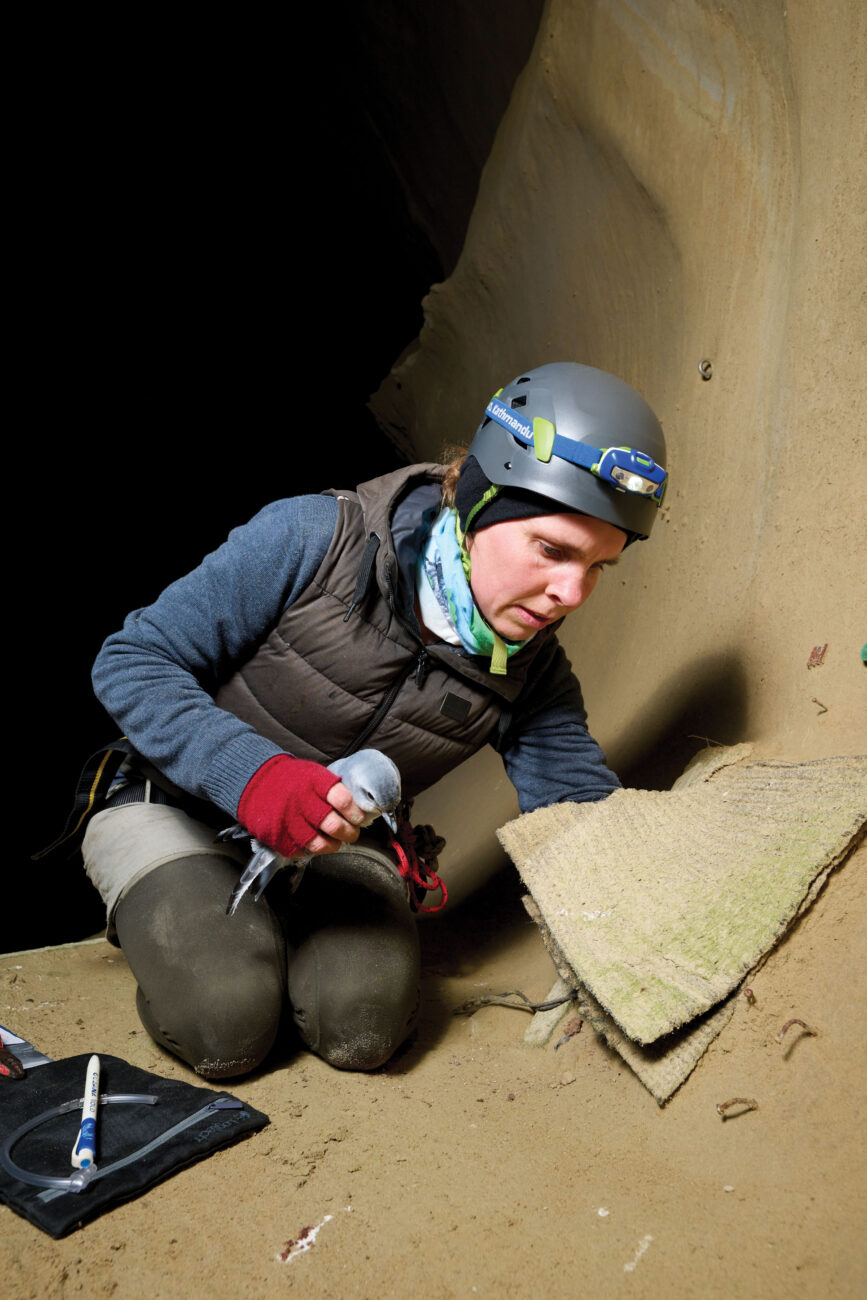
Francesca Cunninghame records bands at a fairy prion colony near Dunedin.
A few years back, Loh put trackers on a few of these prions and recorded their extraordinary migrations. The birds, he discovered, fly far into the Southern Ocean to upwellings of cold, nutrient-rich water, where they spend weeks feeding alongside throngs of seabirds from around the hemisphere. En masse, the birds dive and fight and excrete and gulp, churning the patch of ocean into an organic soup. Then, the prions return to these cliffs, just a few streets and a golf course away from Loh’s home, to breed.
It’s springtime in Otago. Nearby, a predator-proof fence Loh raised money to build protects tītī burrows that will soon be full of fat chicks. Further up the Otago Peninsula at Sandfly Bay, male sea lions are gathering, having swum 400 kilometres from the Auckland Islands in search of females. At Pukekura/Taiaroa Head, the first northern royal albatrosses are returning from their epic planetary wanderings.
With the first touchdown, celebratory bells peal out in schools, churches, and public buildings all across Dunedin city. But this year, somewhere on that restless sea, H5N1—a highly pathogenic avian influenza—is on the wing.
*
Bird flu has probably always been in bird populations. We’ve known about it since 1878. Many wild birds, notably mallard ducks in New Zealand, carry relatively harmless forms of the disease.
Like any virus, however, it is constantly evolving. Occasionally, a link between genes mutates, unleashing the disease, once contained to the respiratory system, across the entire body. That’s when it becomes deadly. Around 2020, a particularly virulent form of H5N1 began cutting a new and terrifying path through both farmed and wild birds. For the first time, too, it was able to infect migratory seabirds; it spread quickly across Asia, Africa, Europe and the Americas.
As this flu reached poultry farms, authorities tried to contain it via mass culling, submerging birds in toxic foam, using gas chambers, or shutting down barn ventilation systems and pumping in hot air.
To date, the Guardian newspaper reports, around 280 million birds have died or been culled as a result of the outbreak. As well as poultry, it has devastated wild birds, and killed mammals: foxes, polar bears, cats, hedgehogs, bears, mice. Last month, in two Vietnamese zoos, 47 tigers, three lions and a panther died, likely after being fed infected chicken.
This variant reached Scotland at the end of the 2021 bird breeding season, which meant its initial impact on the country’s offshore bird colonies was relatively minor. For Ellie Owen, senior seabird officer for the National Trust for Scotland, it was a nervous winter. “We were hoping that it was just a blip,” she tells me.
It wasn’t. In the summer of 2022, the new flu took hold with a vengeance, destroying three-quarters of the UK’s great skua population and tens of thousands of gannets, terns, and other breeding seabirds.
“The whole of Scotland were seeing dead birds on the beach,” says Owen. “It was soul destroying.” Wildlife rangers found themselves stumbling through an apocalyptic nightmare. “The way the birds die is terrible,” says Owen. “They have these neurological symptoms, so their heads can be all limp and they’re just circling around. It’s otherworldly.”
Colonies that had been a noisy onslaught of sound and smell were reduced to desolate wastelands. Where previously rangers would risk a painful nip if they got too close to nesting birds, they could now move freely among lethargic, sick animals. The birds, says Owen, “didn’t really care who was going to the colony. They were dying by their thousands. It was just empty nests and mud.”
By midsummer, beaches in Ireland, too, were awash with dead gannets. With influenza scrambling their brains, seabirds veered wildly off course, crashing to their deaths in gardens and schools, where their infected carcasses posed a risk to human health.
Without clear guidance from government departments, Stephen Newton, senior seabird conservation officer with BirdWatch Ireland, contacted wildlife managers across Europe. The advice on what to do with the dead birds was stark: “stack them up, throw petrol on them, and burn them.”
So, dressed in full body protective clothing, Newton and his team wandered through the devastated colonies, scooping up carcasses and putting them in barrels to be incinerated. “You’re just sweating buckets and scrambling around the cliffs, collecting birds, trying not to touch anything,” he recalls. “It was horrendous for the staff. It was very demoralising.
“We did that for a month and then I pulled everyone off. I said, ‘We need a break from this.’”
*
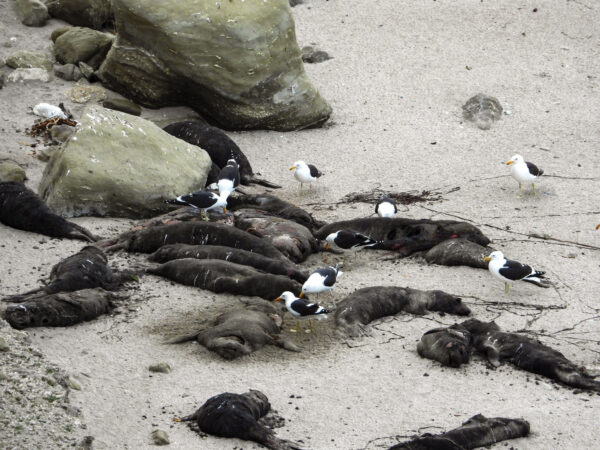
Few marine mammals were affected in Europe, so no one was prepared for what happened when the disease made its way into South America in 2023. In Peru and Chile, it killed an estimated 24,000 sea lions. Pregnant females stumbled ashore to abort their fetuses before dying themselves. The beaches were littered with corpses.
By June of 2023, the disease had reached the southern tip of the continent. In August, it started moving up the other side, killing thousands more sea lions on the Argentinian coast.
Marcela Uhart, an Argentinian veterinarian with the University of California, watched in horror, knowing that tens of thousands of elephant seals were just weeks away from coming ashore to breed on Península Valdés.
The first she heard of the disease’s arrival on the peninsula was from a colleague who called her in tears, describing beaches strewn with dead and dying seals and sea lions. At first, Uhart thought the reports were exaggerated, until she visited the colonies herself. “It’s one of those things that you can’t even describe,” she tells me. “It was just devastating. It took a while to take it in.
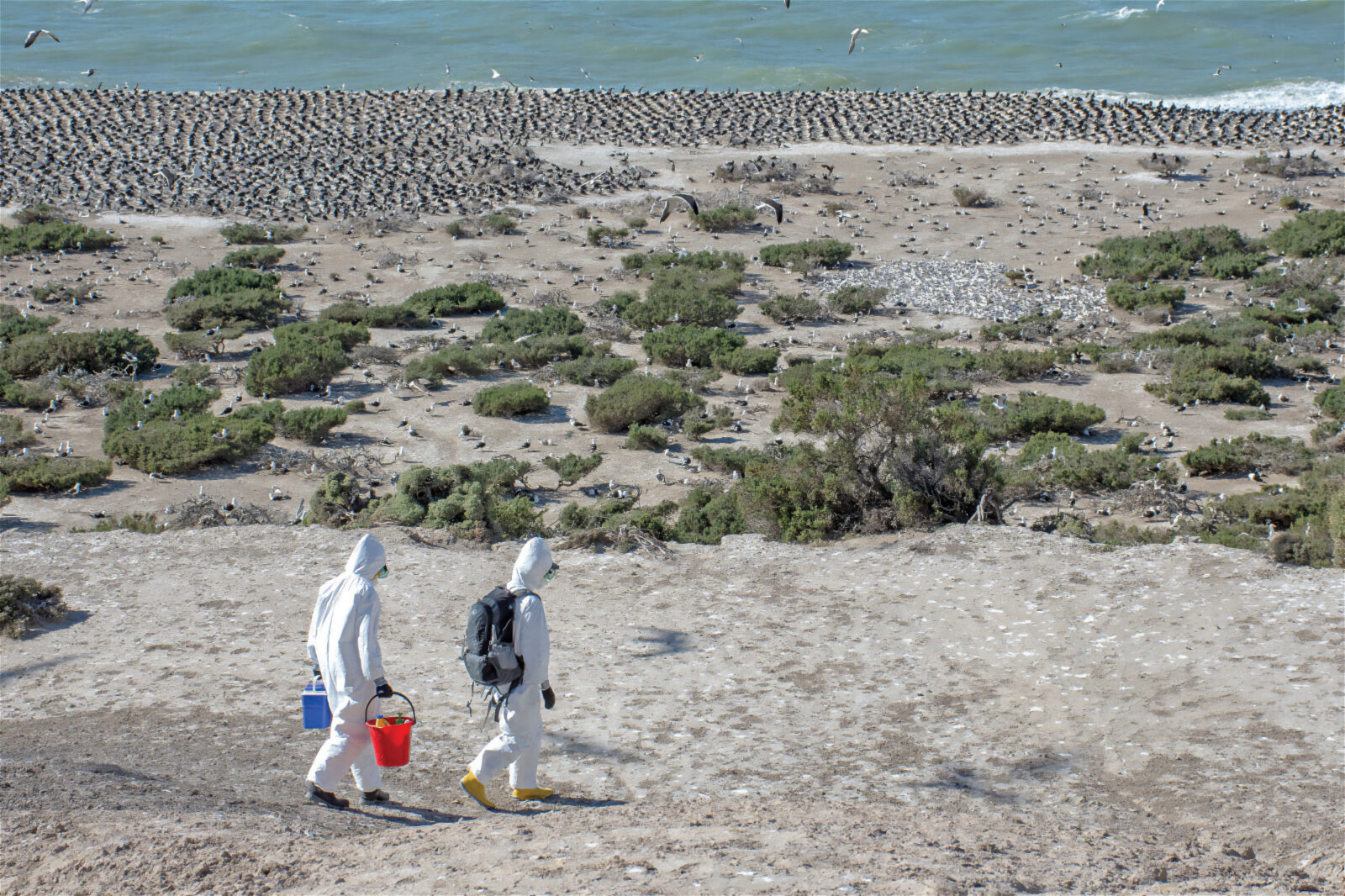
The tern colony—the cluster of white birds in the greenery—was later wiped out by the disease, as were thousands of the country’s elephant seals.
“It’s really rare to see a dead elephant seal on a beach, but there were 35 or more dead on each beach. All the females and the big males were gone.”
Usually, the big males run harems, protecting females and suckling pups from other marauding males. But that system had collapsed, leaving handfuls of young, unruly males to dominate the beaches. “All these males were just fighting each other. There’s no protection for the females that way,” says Uhart.
Surviving sea lions and elephant seals started interacting in bizarre, unhinged ways.
“We saw sea lions coming into the colonies and fighting with the [elephant seal] females,” recalls Uhart. “One male sea lion was trying to mate a poor little baby elephant seal.”
Uhart and her colleagues watched thousands of seals, sea lions and birds die lingering, painful deaths. The animals had seizures, and the birds seemed to lose control of their functions, Uhart says—they’d fall backwards, flop to one side then the other, eventually dying in “weird positions”.
Some species were usually very scared of people. Now, the team could walk right up to them. “You could see in their eyes they were horrified that you were that close, but they had no way of moving.”
One vision in particular lingers for Uhart—a seal pup floundering in the incoming tide. “Elephant seals don’t drown,” she says. “But he was drowning.”
Uhart finished up her field season and went home. “I cried for a week,” she tells me. “I think I still have post-traumatic syndrome.”
The best current estimate is that bird flu claimed 20,000 elephant seals that year, but the number may be far higher, as it’s feared many adults died out at sea. Ninety per cent of the pups died. Modelling suggests it may take half a century for the population to fully recover—that’s if the disease doesn’t come back this summer.
*
In Europe, the disease did return for a second round, again decimating seabird colonies. And it has now crossed from South America into the Antarctic region. On the island of South Georgia, hundreds of elephant seals died in the summer of 2023/24, while scavenging birds such as skua were also badly hit.
Mercifully, South Georgia’s penguin species, including the half a million king penguins that crowd the beaches, appeared to get off lightly. “Many species didn’t seem to be impacted at all,” says Mark Belchier, a marine ecologist with the British Antarctic Survey. “I think it’s a bit of a lottery, and what we don’t know is, if it comes back to South Georgia, whether it’ll be the same species that were impacted last year, or a different suite.” Belchier and his colleagues are expecting another outbreak, but hoping some immunity has built up.
The arrival of bird flu in Antarctica puts New Zealand in the firing line. Once, it was thought we’d never get these deadly flus here, as we have no wildfowl migrating from overseas, but the disease’s jump to seabirds flipped the game for us. We have more species of seabirds moving through our territorial waters than anywhere else on Earth.
At the time of writing, 20 million sooty shearwaters, along with many other burrowing seabirds, are winging their way back from the North Pacific. Countless albatrosses, petrels and prions have been busy circling the southern hemisphere, and are now returning to our subantarctic islands and the mainland.
At Punta Leon in Argentina, scientist Luciana Gallo and veterinarian Marcela Uhart test seabirds for bird flu.
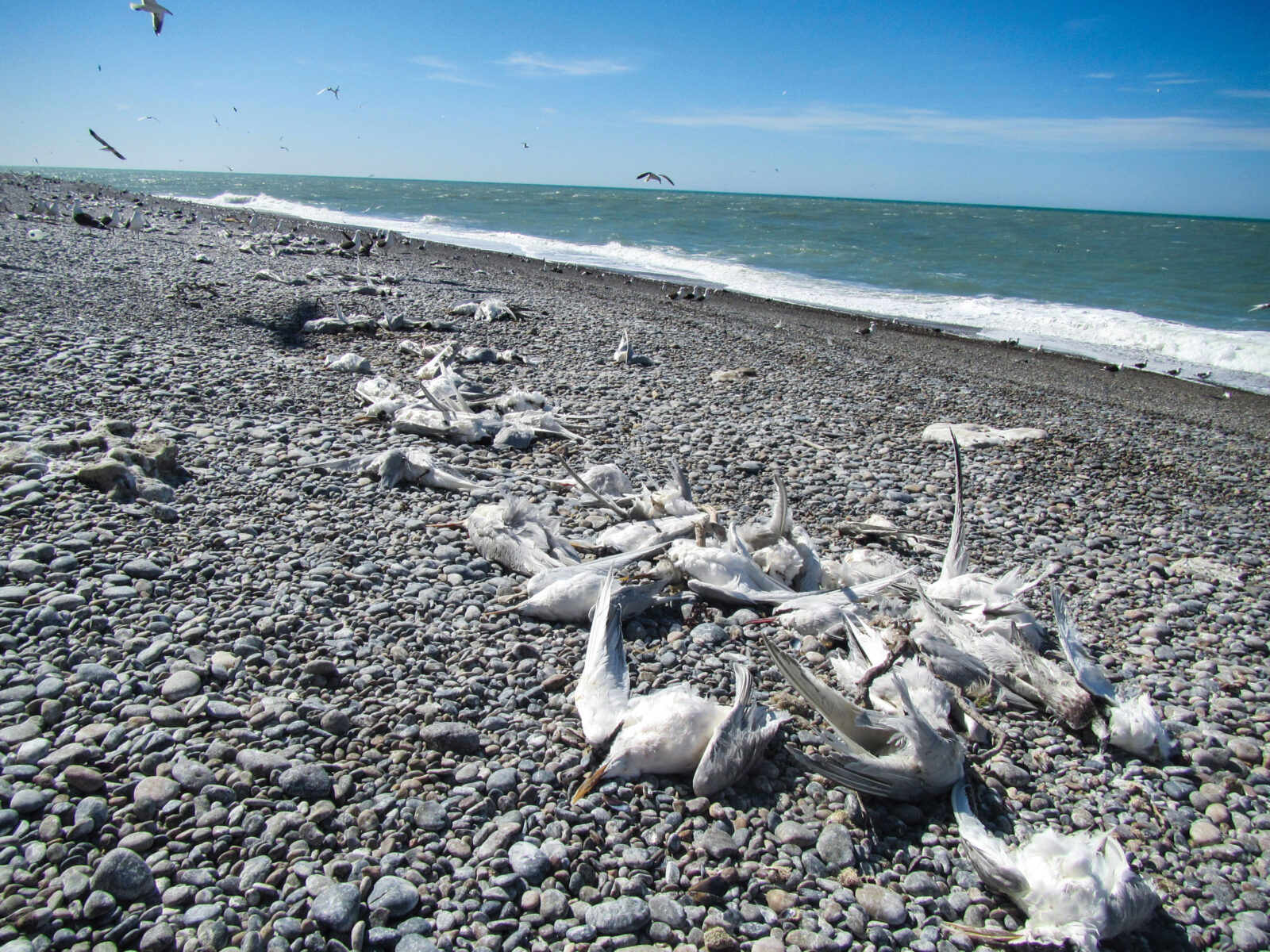
It’s not known how long the virus lingers in carcasses. So last year, when Marcela Uhart saw seagulls tearing into these dead terns, she worried. “What if they still have the virus? As soon as [the gulls] start mingling with other species, we might have an outbreak again.”At the same time, shorebirds like godwits and red knots are angling in from Alaska, Asia and Australia. Soon, the Firth of Thames, Farewell Spit and other important sites will be thick with them.
“It’s looking more and more likely that this will get here at some point,” says Massey University wildlife veterinarian Brett Gartrell. “I’m really concerned about what the impact is going to be on some of our more threatened species when it does arrive.” I note the “when”.
“The theory has always been that migratory birds that have the virus are too sick to complete the long migration needed to get to New Zealand,” says Gartrell. But now, he says, because the virus can infect so many species, it can “leapfrog” over huge distances.
So our bird flu story might start like this: A seal dies on the Antarctic Peninsula. A giant petrel scavenges the carcass, up to its eyeballs in blood and gore. The petrel limps across the sea to another island before dying itself. Gulls peck at that carcass, then carry the disease into a nearby fur seal colony.
If our story stars a wandering albatross, it could be much shorter. The species is capable of clocking the entire six-day trip in one stretch.
*
When Louise Chilvers heard avian influenza had crossed to the Antarctic Peninsula, her first response was, well, unprintable.
“Anyone who’s not concerned should be,” she says now. Chilvers, a wildlife ecologist at Massey University, has devoted much of her career to studying the New Zealand sea lion, which breeds mostly in the subantarctic Auckland and Campbell Islands.
She was in the Auckland Islands in the early 2000s when a deadly disease, thought to be caused by a bacterium called Klebsiella pneumoniae, repeatedly ripped through the population. Then, terrified female sea lions fled the beach, abandoning their offspring.
While that disease was devastating for pups, it claimed very few adults. That’s important, because sea lions as a species can cope with lots of pups dying. Indeed, a high proportion of pups die of natural causes anyway.
Adult mortality is much more devastating. If the adults keep dying, or a lot die all at once—especially breeding females—a pinniped population can quickly crash. For our endangered sea lions, the flu could be an existential threat.
Jordana Whyte of the New Zealand Sea Lion Trust tells me she is “really, really worried”. “There’s just not that much we can do about it, which is the frustrating part.”
The carnage in South America and that awful figure—24,000 dead sea lions—stick in her mind. She points out that those sea lions were spread out over a huge stretch of coastline—something like 8000 kilometres. We have a fraction of that number of sea lions, and most of them breed in two colonies that are just 10 kilometres apart, often popping back and forth between the two.
Our rarest birds also face horrific odds. “If we lose 30 per cent of the population of some of our critically endangered birds like southern dotterels, shore plovers or fairy terns,” says Gartrell, “that might be enough to tip these species into extinction.”
Equally at risk might be yellow-eyed penguins, or hoiho, of which only a few thousand breeding pairs remain.
Thomas Mattern, an ecologist with the University of Otago, recently returned from a conference in Chile, where he was shocked to see hundreds of dead seabirds washing up on the beaches—most likely victims of bird flu. When I first talk to him, his prognosis for hoiho is dire. “It could be curtains for them,” he says.
When we catch up again a week later, however, his concerns have been somewhat allayed by recent reports showing the disease has not yet had a major impact on penguins elsewhere.
Such is the uncertainty of bird flu. In the UK, some seabirds were hit hard, while other species nesting in the same area escaped relatively unscathed. On one island with 17 species of seabird nesting, nine were affected and eight were not.
“We don’t know if there’s some genetic difference or ecological difference,” says Kate McInnes, Department of Conservation (DOC) science adviser. “There’s so much uncertainty. You can’t predict where it’s going to come from and when it’s going to come, which birds are going to be affected, how they’re going to be affected, how long it’s going to last. Until it gets here, we won’t know for sure what it will do.”
One thing, says McInnes, is clear. “If you congregate, you’re at risk.” Overseas, birds that nest in tightly packed colonies, in which they are constantly fighting, stepping, and defecating on each other, have been worst affected.
That actually offers a few glimmers of hope for us. Many of our penguin species, including hoiho, prefer to breed in privacy, tucked away in dense forest. Most of our burrowing seabirds also retain a degree of isolation from their neighbours. Some albatrosses, too, opt for solitude as they nest.
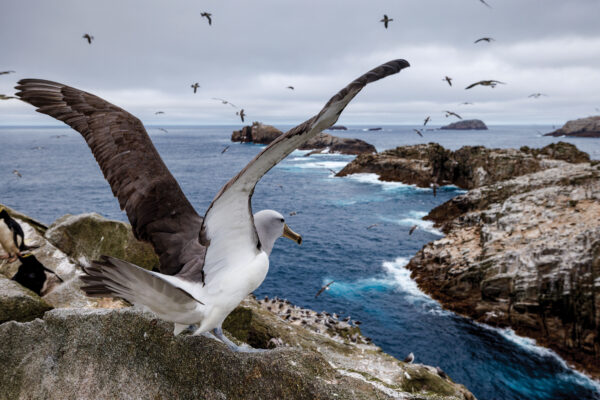
Tens of thousands of albatrosses, penguins and seals breed on the Bounty Islands. The close quarters are perfect for avian influenza to spread—then take flight to the mainland.
At higher risk are colony-nesting penguins, such as rockhoppers on the Antipodes Islands. Or the erect-crested penguins on the Bounty Islands: something like 50,000 of them, jam-packed into a shrieking menagerie alongside 60,000 Salvin’s albatrosses and thousands of fur seals.
On the mainland, vulnerable colony-nesting birds include numerous rare shags and two endangered gulls. Gannets, which breed in large numbers at several locations around New Zealand, were among the worst-affected species in the northern hemisphere.
*
If, or as some experts fear, when, avian influenza gets here, it’s likely to spread around mainland New Zealand pretty quickly. Australasian shovelers, a common duck species, can cover the length of the country in the space of a week, and would be prime candidates for carrying the disease. Waders like oystercatchers and banded dotterels also cover large distances overland at certain times of the year.
Because bird flu is classed as an unwanted organism, New Zealand’s response to the threat is led by the biosecurity unit of the Ministry for Primary Industries (MPI), a fact that concerns some of the researchers I talk to. They fear MPI’s priorities are heavily weighted towards agriculture and people, with wildlife coming a very distant third—the worry is that in the event of an outbreak, poultry, pig and dairy farms will get more attention and resourcing than our native species.
Mary van Andel, a veterinary epidemiologist with MPI who is leading the response effort, takes exception to this view. She tells me her team have been watching the trajectory of the flu overseas and learning from their counterparts in those places “about what they wish they’d done differently”. Working with other agencies to get organised before the disease hits has been one big lesson; MPI is working with DOC and the Ministry of Health.
“What we’re asking everyone to do is to keep an eye out for sick or dead wild birds,” says van Andel. “We’ve got sampling kits with our scientists at Scott Base. We’ve got sampling kits on the subantarctic islands. We’ve got reports coming in from the public. We’re doing more work with veterinarians about what to look out for.”
Almost certainly, the first ping will come from MPI’s National Animal Health Laboratory in Upper Hutt. Whenever multiple birds are found dead, they’re sent to this lab—it’s already testing two to three dead birds a week.
If a test comes back positive, officials will rush to get signs up where the birds died, to stop people wandering through the area. Then they’ll take stock: which species are sick; numbers of dead and dying; how mobile any potential carriers might be. DOC is putting together detailed response plans for each district.
From there, “the hands-off, keep-people-and-pets-away approach might be the only option in some locations”, says McInnes. “In others, it might be that you need to get in and get your hands dirty because the birds are going to wash up on a public beach, or it’s in the middle of a place where someone lives.” In that case, getting the virus-laced carcasses out of the environment will be important. Like their colleagues overseas, our conservationists could well find themselves climbing into personal protective equipment and slinging dead birds into sacks.
*
Jemma Geoghegan, a virologist with the University of Otago, was at the forefront of our response to COVID-19.
“We weren’t well equipped to deal with a human pandemic, and I think we’re really not well prepared for this,” she tells me.
The most important thing in the early stages, says Geoghegan, is being right on the button when it arrives. “The first sign that we have it will be a bunch of dead birds, so it’ll be how we respond to that—the rapidity at which we can get samples and test them.”
It’s not enough, says Geoghegan, to simply know a bird has died of bird flu. It’s crucial to understand which strain of the disease it died of, and where it’s come from. COVID-19, she says, taught us how useful sequencing the genomes of a virus can be—it can help us track spread and predict it, meaning limited resources can be allocated wisely. It worries Geoghegan that we’re not ready to do this for bird flu.
During the early stages of the COVID-19 pandemic, genomic testing was handled by the Institute of Environmental Science and Research. But because bird flu is currently classed as an animal disease, MPI is having to set up entirely new systems from scratch.
That, says Geoghegan, is inefficient. “When something new emerges, we don’t know if it’s just a human or just an animal disease. It could be both.”
Geoghegan argues that rather than pulling in agencies that are geared around health, or conservation, or industry, New Zealand should follow the lead of the US and Europe in having a central agency dedicated solely to responding to pathogenic threats, regardless of whether they’re in humans or animals—because often, diseases learn to jump.
In North America, H5N1 has infected the national dairy herd, slowly creeping from cow to cow across the continent. If it gets into pigs, says Geoghegan, people could be in real trouble. [Two weeks after this story went to press, the US Department of Agriculture reported that a pig had tested positive for the virus.]
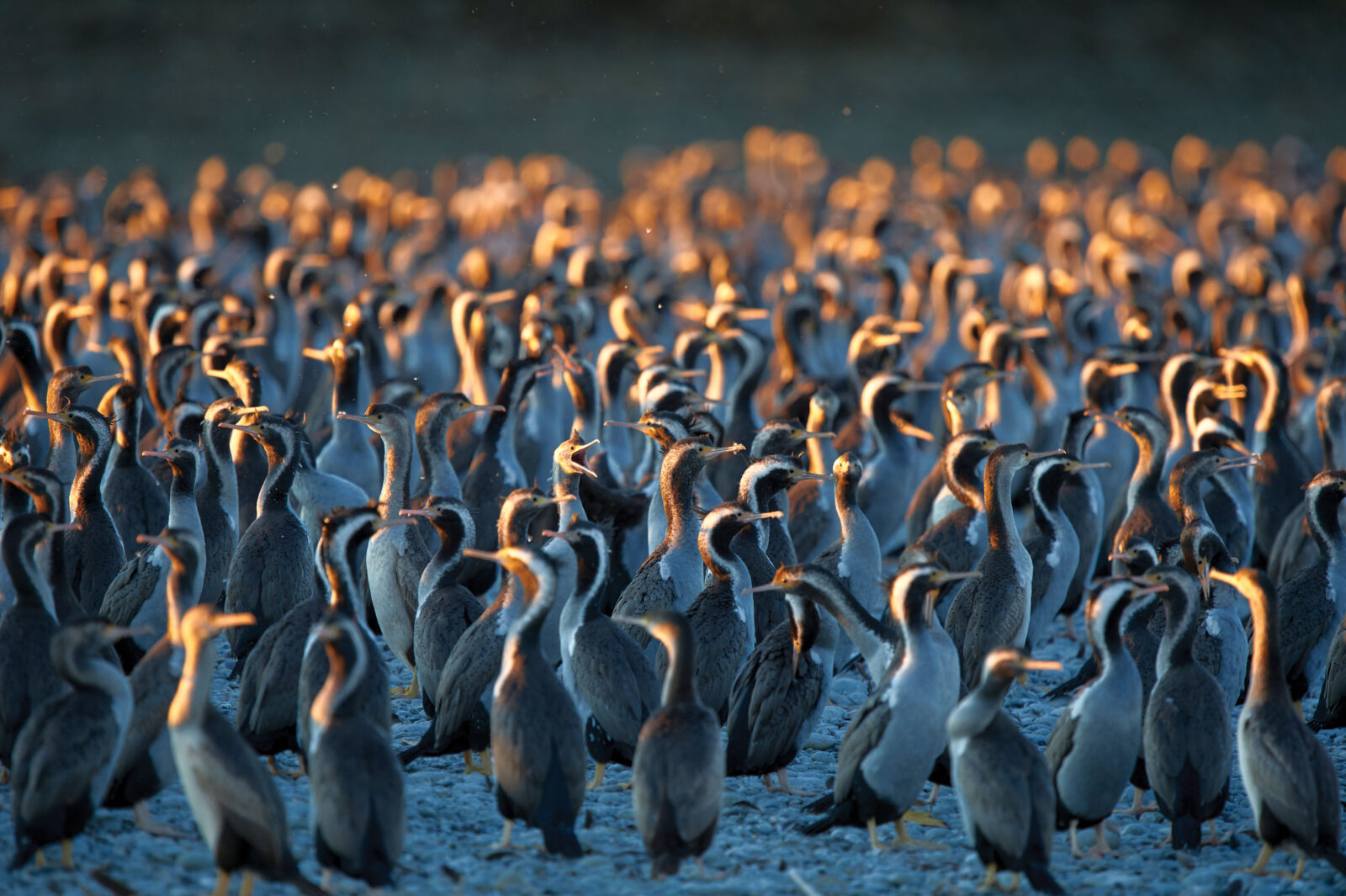
At certain times of the year, rare spotted shags, or kawau tikitiki, gather in their thousands at the mouth of the Hakatere/Ashburton River. Overseas, such cormorants have been hit hard by bird flu—likely because they favour such crowded nesting conditions.
That’s because pigs have a very similar respiratory system to ours, and that makes them the perfect vehicle for the virus to stew a new strain that could rapidly, catastrophically, spread from human to human. Of the 896 humans known to have been infected by H5N1 bird flu since 2003, almost half have died. (In early September, the US reported the world’s first known case of a person infected with bird flu despite having no known exposure to animals—the implication is that the disease could already be transmitting between humans.)
“There’s probably not the capability and capacity to deal with a really large outbreak here,” says Geoghegan. Remember when COVID-19 first arrived in New Zealand and thousands of us queued in our cars for PCR tests? Those swabs were sent to diagnostic labs all over the country. In contrast, MPI’s animal health lab is the only one authorised to deal with tests for avian influenza.
Geoghegan says: “We need to start looking at alternatives, like supplying farmers, backyard chicken farmers and environmental rangers with rapid antigen tests. We don’t want to wait until we’ve already got [bird flu here] to buy them and distribute them and tell people what to do and how to report these things. All this infrastructure, we could be getting ready now.”
Van Andel says MPI is not planning to buy and distribute rapid tests. She says the tests wouldn’t tell us whether we were dealing with old-school bird flus—the less deadly ones—or the new one. “There would be a risk of false positives.”
I ask van Andel if we’re prepared for bird flu. “Yes,” she says. “We’re working together. We’re learning from people overseas. We’re working together across agencies. We’re working with industry.
“We know that we’re going to be protecting biodiversity, human health, industry, and making sure that we keep up the supply chain for things on shelves as well.”
McInnes, at DOC, is more circumspect. “I can guarantee we won’t get everything right,” she says. “And I can guarantee we’ll get a lot of criticism. Hopefully we can highlight the things we do get right, and we’ll learn from the things that we can improve on.”
*
In a barren, stony landscape, two low buildings made of metal and mesh stand like something from a science fiction movie. A Martian colony perhaps, or a post-apocalyptic future in which only the siloed survive.
These are DOC’s kakī/black stilt breeding enclosures near Twizel, in the Mackenzie Basin. As I drive down to the site, the first thing I notice are two Canada geese resting on a pond right by the gate. If bird flu was spreading around the country, these introduced migratory geese, so close to one of the world’s rarest and most vulnerable birds, would present a huge risk.
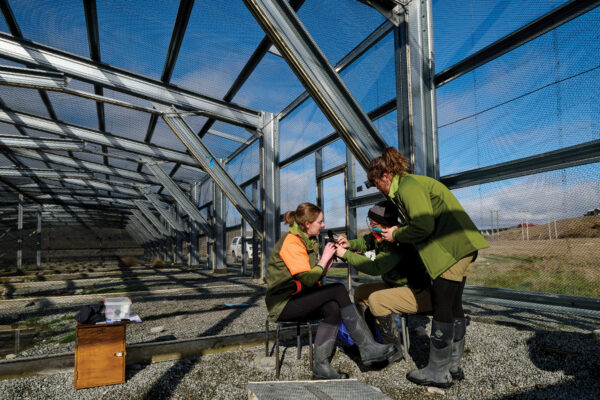
Inside, McInnes and colleagues from the Twizel DOC team are pulling on gumboots and preparing to go into the enclosures. If bird flu was here, they tell me, the procedure would be very different, involving full-body protective equipment and lots of scrubbing.
DOC staff Liz Brown, Kate McInnes and Taleigha Tuer take blood samples from a vaccinated kakī at a breeding facility.
McInnes has come here to conduct the second round of efficacy tests for a vaccine trial being carried out on five of our most at-risk bird species. The vaccine comes from the poultry industry, where it has been effective against influenza.
Vaccinating native birds is only feasible in a few very special cases. Each bird must be injected twice, which means it has to be caught twice—so right now it’s only an option for birds such as kākāpō and kakī, where groups are held in closely managed captivity.
The vaccine is also being trialled on captive takahē, tuturuatu (shore plover) and red-fronted kākāriki (as a surrogate for the much rarer orange-fronted kākāriki, which are very hard to catch).
As we enter the enclosure, the kakī inside take to the air and circle in a mad dash to get away from us. The rangers wait for them to settle, then trap them beneath a soft net. Catching these birds on the wing is not allowed, due to the fragility of their long beaks and slender legs. “Things are pretty breakable,” DOC kakī project lead Liz Brown explains.
A few moments in the enclosure with these birds is a glimpse into the precariousness of their life at extinction’s edge. Of the 150 kakī that will be raised here this summer, the rangers tell me, only 30 per cent will survive to adulthood.
McInnes takes blood samples to add to the others she’s gathered from around the country. They’ll be tested for antibodies to see if the vaccine is working as it should. Vaccinating birds might be a lifeline for a few species. It’s been trialled in only one other species—the California condor—and early results indicate that if these birds get sick, they’ll have a better shot at survival.
Now, overseas researchers are watching how our vaccination programme plays out. In grappling with this global threat, says McInnes, “everyone in the world is watching everyone else”.
*
As this magazine goes to press, teams of researchers are preparing to tackle the waves of the Southern Ocean, en route to subantarctic islands to conduct their field research and conservation work.
This season, they’ll be carrying full protective equipment and taking enormous precautions. They’ll also be collecting samples from healthy birds—swabbing the cloaca, the vent used for urine, feces, mating and egg-laying. Back at the University of Otago, the swabs will be screened in Jemma Geoghegan’s laboratory.
Kalinka Rexer-Huber has spent her career rockhopping around remote islands in the Southern Ocean, studying the seabirds that make these unlikely spots their strongholds. Now, she is gearing up for her 17th trip to “the subs”. She’ll be carrying on a long-running study of the Antipodean albatross, a species which breeds only on those islands (see ‘Summer 33’, Issue 182). It’s birds such as these that she’s most worried about—endemics found only on scraps of land in a vast ocean, already under massive pressure from other threats, especially fisheries bycatch.
Rexer-Huber and her team are all too aware that this visit might be their last for some time. The thing that scares her the most is the prospect of the disease hitting and the subantarctic being closed to scientists. It’s anathema to her, the idea of sitting at home and not knowing what’s happening to the birds, hundreds of kilometres across the sea.
Vaccination is not practical for most birds, and if, or when, the flu gets here, nowhere will be safe for wild flocks. Even home gardens may soon harbour the disease.
In New Zealand, we have the huge benefit of a head start: for three years, we’ve been able to watch and learn as the virus has streaked across other parts of the world. The big lesson that’s been learned overseas, Rexer-Huber says, is not to “lock places up”.
“Throwing up your hands, backing out, closing the zone and not obtaining any further information is actually really damaging, compared to a measured response of gathering a little bit of data,” she tells me. It may be possible to vaccinate nesting birds. At least, clearing colonies of carcasses might help contain the spread of the virus—it has been of some benefit overseas.
Rexer-Huber and her team will sail for several days to get to the Antipodes. When they arrive, it’ll be the first time any scientist has clapped eyes on those islands for many months.
They’ll likely hang out to sea for the first day or two, glued to binoculars, scanning the cliffs for dead animals. For birds flopping and lurching, or seals acting strangely.
Only if everything looks normal will they lower the dinghies.
For decades, New Zealand has been insulated from highly pathogenic avian flu—the disease that has devastated poultry flocks and waterfowl around the world. But now, the virus has evolved to take down mammals and seabirds, and that dramatically raises the chances of it reaching us. For some of our native species, this virus could be the greatest threat since the arrival of humans. Are we ready for it? (more…)