“We think in generations, not in quarterly reports.”
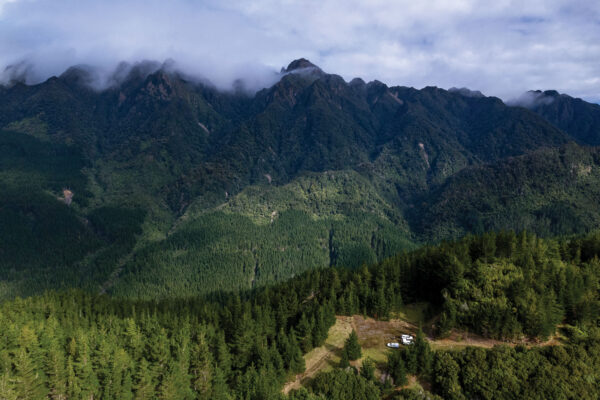
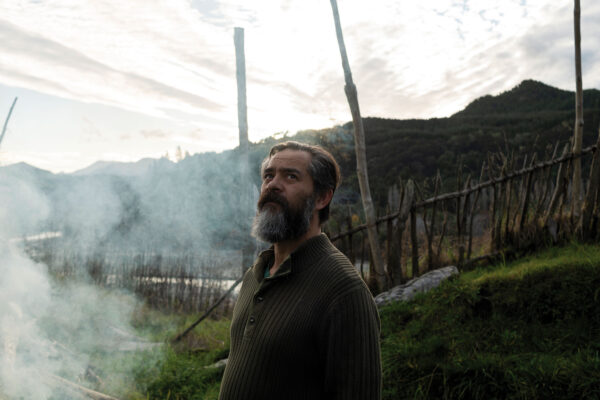
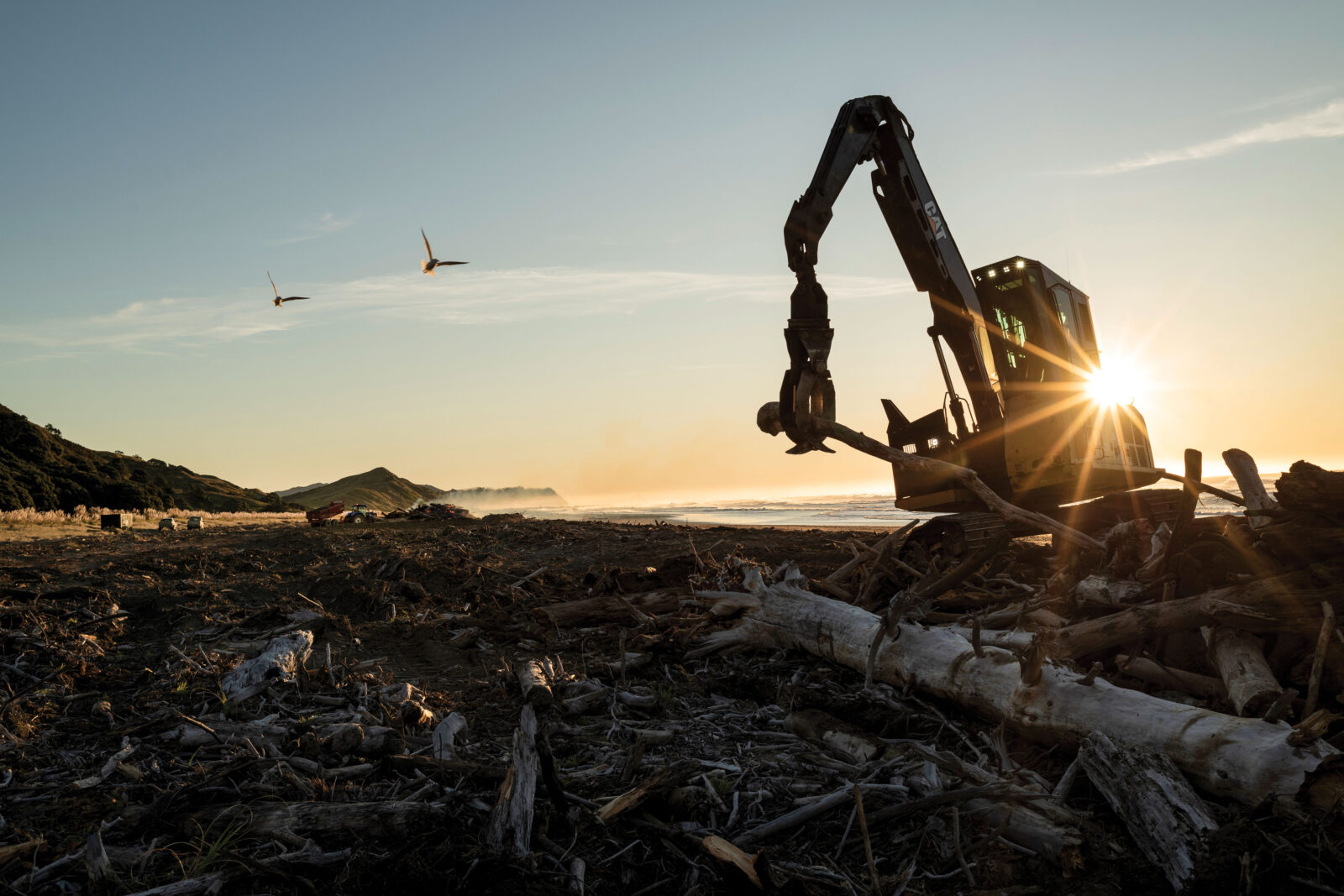
That isn’t a cheerful bonfire, it’s a massive cleanup operation. In Tairāwhiti the beaches are smothered in dead wood. Mountains are sliding into rivers; forests swarm with possums. While officials demur, transfixed by the bottom line, the people who belong to this land are moving home—and working to repair it.
That isn’t a cheerful bonfire, it’s a massive cleanup operation. In Tairāwhiti the beaches are smothered in dead wood. Mountains are sliding into rivers; forests swarm with possums. While officials demur, transfixed by the bottom line, the people who belong to this land are moving home—and working to repair it.
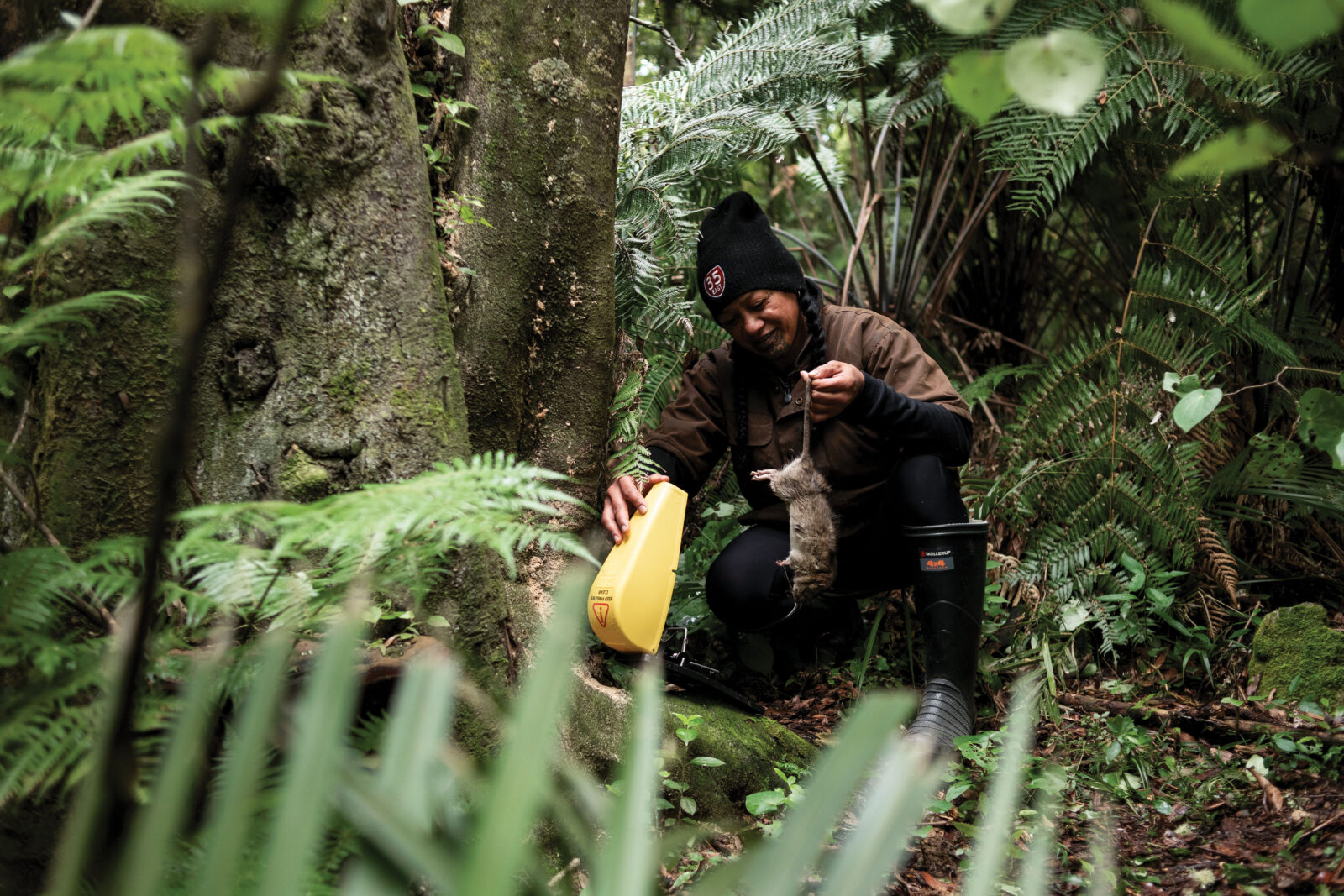
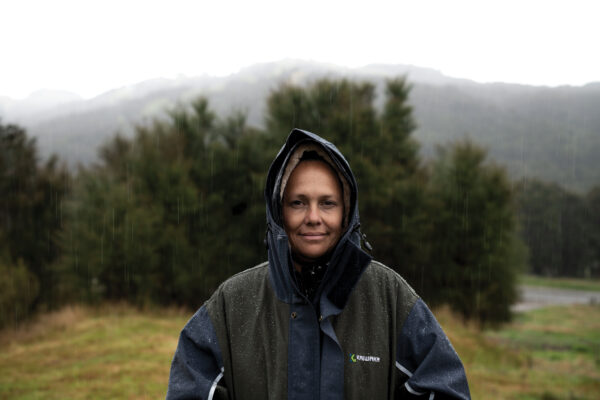
The joy of ridding her ngahere of another pest—a Norway rat—is part of what keeps Raukūmara Pae Maunga field worker Lisa Beach motivated. This type of trap, a D-trap, is laid every 50 metres in this intensively-managed, 125-hectare site.
Lisa Beach may be the most enthusiastic wāhine ever to hold a dead possum. It’s a big one, too—at least five kilograms, a trophy of bristly tail and matted fur. She holds it aloft, grinning. “Check out this beast,” she says to her team, deep in the Ruatōria bush. At the next trap, the carcass of a Norway rat elicits a hearty cheer that, if there were birds in this native forest, would have scared them from their perches.
Beach is a Ngāti Porou-famous horticulturalist. She works as ground crew for the iwi’s conservation project, Raukūmara Pae Maunga, helping to get the community on board. Even before this morning’s haul she was on the hunt for a taxidermist.
“It can’t be that hard, right?” says her colleague Ario Rewi. “Just gut it, stuff it, Mum can sew.”
The group cracks up, but Beach is serious: it’s not enough for her to catch the rodents multiplying in her mountains. She wants to display the pests for local kura, show the littlies what’s running wild in the undergrowth, killing birds, slurping eggs, stripping the ancient trees. She wants every East Coast schoolkid bugging their parents to set a trap in their backyard.
“Every pest I kill, that’s 10 live birds for me, and 10 trees that can live a bit longer,” she says from the passenger seat of the four-wheel-drive her colleague Iain Grant is muscling up a muddy slope. We are joined today by a four-strong team from Te Whānau-ā-Apanui (who jointly lead the project with Ngāti Porou and the Department of Conservation) on a mission to check and set traps. Beach wills the vehicle forward like it’s one of the horses so suited to this steep, remote whenua. “Come on, hōiho,” she says, patting the dash.
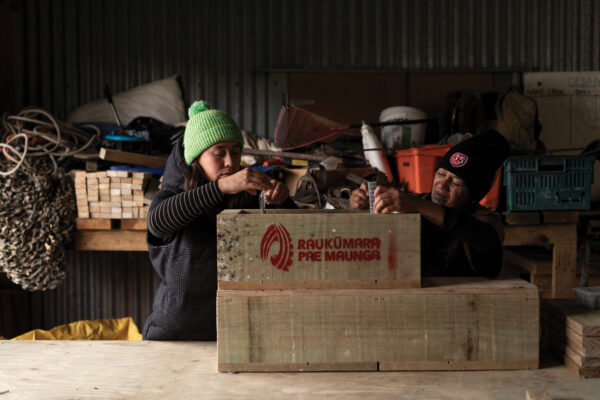
Raiha Blane (Ngāti Porou) can name almost every native plant in the Raukūmara, along with every introduced one. Here, the biodiversity ambassador works with colleague Lisa Beach, right, to build a DOC200 trap, used to take out stoats and weasels.
As recently as two decades ago, anyone heading into this wilderness had to cut their way through dense native bush, sinking up to their knees in a mossy carpet. You would be attended by an escort of birds—kererū and korimako, kākāriki and miromiro—fluttering around your head, calling to one another along the path.
On a trip Beach took into the heart of the bush in 2018, the absence of sound was crushing. “Did you know people didn’t believe us?” she says. “They said, ‘You’re lying.’ It was eerie, it was sad, it was devastating, and I had to stand there and have my own little karakia and bless myself.”
Today, we are in the Raukūmara for about four hours. In that time there is one bird call, a tūī. When I get home to Wellington, I hear more birdsong in four minutes standing in my city backyard, sandwiched between concrete and fencepost, next to a busy international airport.
*
It’s not only the birds. Vast stands of giant tōtara are dead, munched by possums and ringbarked by goats and deer. Young saplings, emerging kawakawa, shrubs, everything within reach in the understorey of the bush has been stripped, leaving a gap where this integral layer—food for insects, birds and lizards—used to be. When it rains, sediment that would once have been caught by that undergrowth runs straight down the mountain into the Waiapu River. There, it mixes with forestry slash—dangerous tangles of logs and branches—and huge dumps of silt from slips. Snarled, choking, the river makes a destructive journey, carving through bridges, roads and paddocks on its way to the sea.
Everything is connected. In the small settlement of Rangitukia, Rewi is related to everyone on the winding road she’s lived on her whole life. The water where she used to catch tuna, or eels, is murky, as is the ocean, an intergenerational fishing ground. Ngāti Pōrou rely on nature, she says—for food, but also for emotional and mental wellbeing. When the land and the waterways are broken and dying, the people suffer. Diving for kaimoana, Beach says, is a minefield. “It’s just like pinecone, pinecone, pinecone, kina,” she says.
It’s the same story for hundreds of kilometres, from Te Araroa in the north to Te Karaka in the south. Generations of money-oriented land use has pushed Tairāwhiti to the point where the beaches are covered in dead trees and vast chunks of coast are sliding into the sea.
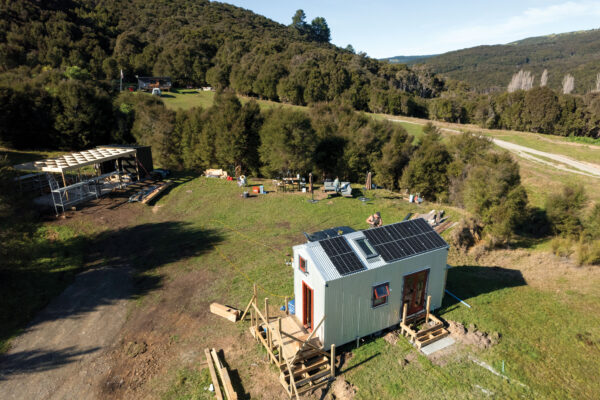
Meanwhile, in the Whareponga Valley, whānau are moving home: this housing development hinges on kānuka, and is led by Nuka Charitable Trust.
From 1865, the government acquired hundreds of thousands of hectares of Tairāwhiti land by force. When Ngāti Porou resisted land sales, officials used the Native Lands Act to confiscate vast chunks of land—by splitting it into individual titles, or tying it up in complicated leases. Since then, permissive land use legislation and targeted subsidies have centred profits for landowners or leaseholders—mainly Pākehā or overseas investors in farming or forestry. In the early 1900s the land was burnt off for farming. When the pasture slipped off the hills it was replanted in pine. But this is some of the softest, steepest land in the world. Every few decades, when the pine is harvested, it’s like pushing on a wound. Clocking that cycle, as well as poor official oversight and increasingly severe storms driven by the climate crisis, many locals were not surprised when Cyclone Gabrielle tore strips off bare hillsides in February last year, pulling swathes of pine plantation down with it.
Afterwards, former National minister Hekia Parata, herself Ngāti Porou, led a ministerial inquiry into land use in Tairāwhiti. Her report calls the use of land here an “environmental disaster, hiding in plain sight”.
The report recommends a credit system to incentivise native forests, investment in climate adaptation, tighter forestry legislation and support for Māori to use their land. Transition to more sustainable land use, it says, is urgent; the list of ills reads almost like a post-mortem. “Sedimentation from more than a thousand untreated gullies, trees, logs and slash off hills that should never be plantation planted or clear felled, waterways choked with debris flows, riverbeds aggraded, coastlines suffocated and dangerous, roads and bridges unfit, unpassable, and many broken. Ngāti Porou tangata whenua, the people of this land, are in peril.”
But in one of the most economically deprived areas of the country, the way forward is not simple. Rewi, a Ngāti Porou rugby star, has worked for Raukūmara Pae Maunga since early 2023. The project was awarded $34 million in Jobs for Nature funding in 2020, after a prolonged campaign for attention. This money runs out in 2026, after which there’s no job security for Rewi or the programme’s 36 other fulltimers.
After dinner at the family home, Rewi’s partner, Tiahomai Nepia (Ngāti Porou), who is employed in forestry, tells us about the intricacies of the machinery he uses to harvest pine, which sounds, to my untrained ears, terrifying. “I don’t like what it does to the land, but I do like the work,” he says. As Rewi supervises their son, Ngarongotoa, whipping the cream for the sponge, her mum, Agnes—who might still be fielding a request to stuff a dead possum later—tells me how their log transport company, Rewi Haulage, has been picking up work clearing debris along the beaches, lighting early-morning scrub fires for the Gisborne District Council.
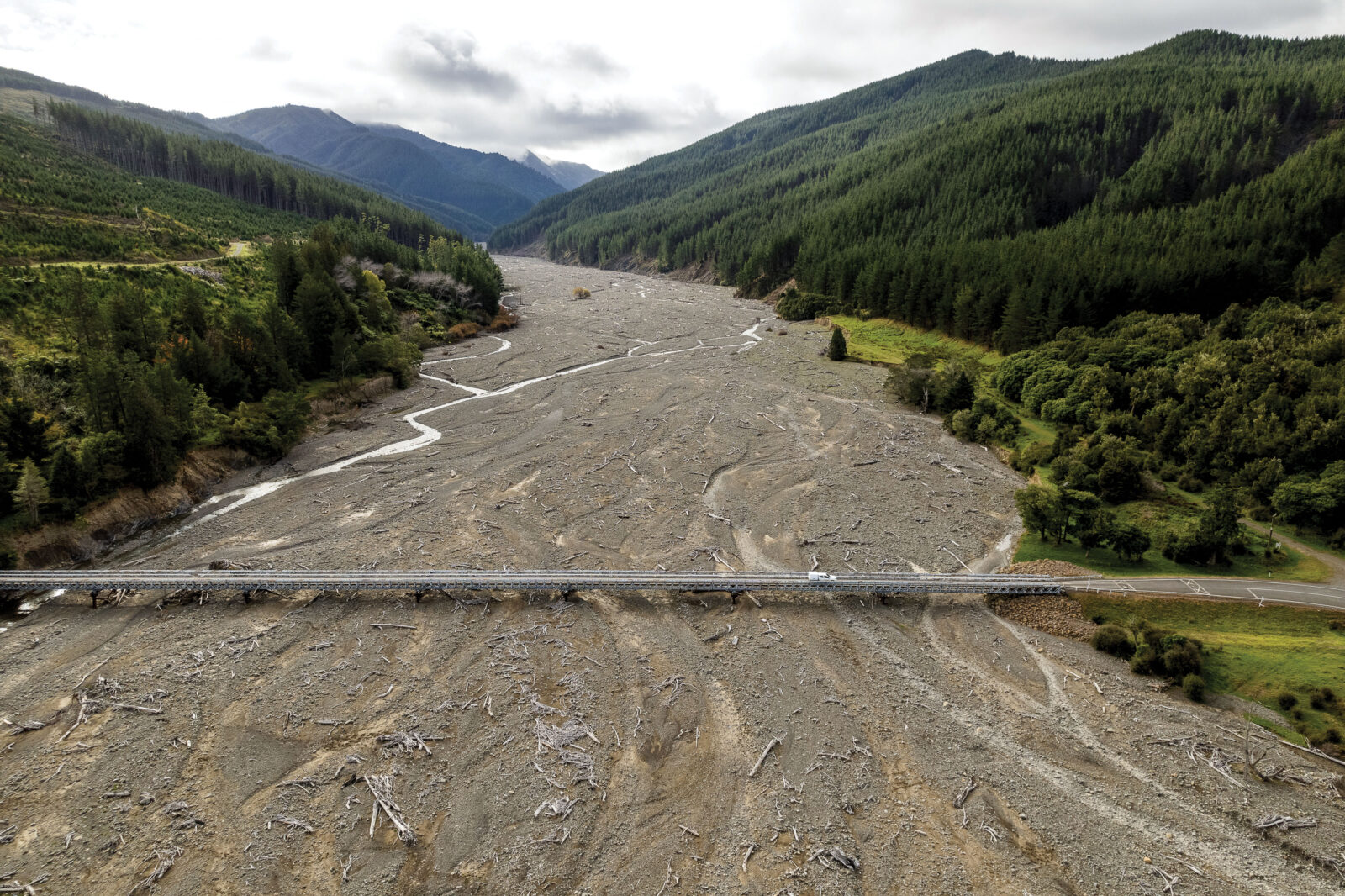
The original riverbed underneath Tapuaeroa Road is long buried by silt and slash; locals estimate it’s 30 metres under now, with more debris constantly building up. Every year, an estimated 35 tonnes of sediment is lost from the mountains, pouring down rivers and into the ocean.
After the floods comes the flush of official money. Fifty-one million from the council, for emergency roading, and scraping sediment and slash from the beaches. Twice that from the government, for the clean-up after Gabrielle. A further $250 million was just announced in the May Budget, for rebuilding roads in Tairāwhiti as well as Hawke’s Bay.
But there’s little official appetite to change the way people are using the land—to stem the mess, in other words, rather than throw cash at cleanup after cleanup. The environmental group that pushed for the ministerial inquiry, Mana Taiao Tairāwhiti, is now calling for a United Nations special rapporteur to investigate. Many on the coast, whose lives are entwined with the geology of this place, are angry. Others live with sadness buried just under the skin, breaking out into anxiety with the sound of raindrops—another week cut off from town, another paddock lost. There are conflicting views on who bears the most responsibility, but one thing is clear; trust in officialdom has eroded with the land. In March, a series of mysterious, destructive fires started in the slash on East Coast beaches. At Tikapa, it spread quickly into stands of pōhutukawa. Longtime DOC ranger Graeme Atkins (Ngāti Porou, Rongomaiwahine) says young people, sick of empty promises, decided to clear the beach themselves.
Atkins, and others, say this is why it’s so important iwi-led projects are supported. In the Raukūmara more than three-quarters of the ngahere is on steep slopes. Applying 1080 from choppers is the only way of dealing with pests here, but that prospect met with staunch opposition: staff received death threats, and some even considered leaving the district. Rewi was bailed up by her own friends and whānau, but says anti-1080 activism has now died down as people see the results.
After a series of treatments, carefully timed around weather windows, rats and possums are pretty much wiped out. Whio are coming back to the water, hammered plants are pushing out new leaves, and kiwi have been seen snuffling past night-cams for the first time.
The rats and possums will be back, of course, given half a chance. Funding for more pest control here is still uncertain (a spokesman for Conservation Minister Tama Potaka says he has been to visit). The only reason the 1080 programme is working, Rewi says, is that it’s been led by those who live and breathe this community; former schoolteachers and nurses, gardeners, those who are trusted and who know this place.
“It had to be iwi, it had to be Māori, and it could not happen any other way. It’s not someone else saying, ‘You need to do this at this place to fix your home.’ It has to be us or no-one.”
*
Kiri Dell warms her hands by the kettle, the hillside a green blanket sloping away from the window. Storm clouds have broken, and rain patters on the tin roof, and pools in muddy gouges across the clearing. The rain brings a hush to this valley, and it’s cosy in Dell’s tiny house, which is the centrepiece of a sapling papakāinga: a few tents, a gas cooker, some camping chairs around a fire pit. It doesn’t look like much yet, but getting to this point—Dell calls it “activating our lands”—has taken years of work for her and her Ngāti Porou whānau.
Several years ago, Dell, a senior lecturer at the University of Auckland’s business school, was driving through her hometown of Ruatōria and noticed a young girl walking home barefoot, looking downcast. “I knew she was from a family that was dysfunctional, and I just felt sad. I went home and I was looking out my window, and I just was like, ‘We’ve got vast tracts of Māori land, why isn’t it working for us?’ There’s something really wrong here, something really incongruent, that we have all this land and a child going without these basic necessities.”
Dell went further than most to figure it out, completing a PhD thesis on how to realise Māori land aspirations in the wake of colonial theft and displacement. Wherever there is a lot of Māori land, Dell says, there’s also likely to be deprivation: poor housing, low employment, sometimes not even running water. This is due to a legacy of unfit legislation and crown neglect, with multiple whānau or hapū often having to sign off on decisions about how to use the land. Moving past these barriers requires care, time, and diplomacy. “It’s shifting to different ways of thinking about the land,” she says. “The way our parents or grandparents might have thought about it [was] to protect it at all costs from being taken. To go into development is a big change for them.”
Kānuka cloaks many East Coast hills in abundance.Kiri Dell is one of those working to create a sustainable economy from it. As well as jobs, that means “good homes, good relationships, and doing progressive work for our lands—because we love them.”
This valley, called Whareponga, is cloaked in kānuka. About 20,000 hectares of it are available for harvest. Dell’s tīpuna used the tree as firewood, for cooking and warmth. After the land was burnt off for farming, kānuka became a nuisance—teenagers picked up holiday jobs cutting it. But kānuka has a special place in the ecosystem. It is a hardy tree that grips to the soil and helps protect other plants, acting like a nursery for regenerating natives. As sheep and beef farming was abandoned due to becoming uneconomical, kānuka sprang back to life. “It’s being offered to us,” says Dell. “The land is giving us this rākau [gift]. So we went on a journey to find out how we could modernise these old ways of thinking and being with this tree.”
Dell and her whānau worked with the University of Auckland and chemical engineer Saeid Baroutian to test ideas. Perhaps kānuka could be used as fertiliser? Or yield an essential oil? “I was adamant we had to make something work with this resource,” Dell says. They hit gold by going gourmet: turning kānuka wood chips into a liquid smoke that could be used to flavour and preserve food. Dell got more than a dozen of her whānau up to Auckland to begin learning the laboratory process, tooling them up to get back to the land.
Last year, the project secured a $1.9 million government grant. This, along with investment from Māori landowners and the University of Auckland, will go towards building a processing plant in Ruatōria, set to open in October and provide jobs for 15 staff.
Meanwhile, among the tents, the bones of houses are starting to emerge. More than a dozen homes are planned here, Dell says. “This has been born out of necessity—there are no homes around here. Even if people want to come home, they can’t.”
Dell’s earliest memories are connected to this spot. She grew up in Invercargill, but spent long summer holidays here with her cousins. They’d set up tents, build huts in the scrub, get muddy and swim in the river, tumble inside for kai then back out to sit around the fire. “It was one of the most nourishing and freeing experiences a child can ever have,” she says. “I feel that any Māori that has not had that experience of being deeply tied to whānau and whenua has been ripped off.”
*
For now, though, it’s pine—not kānuka—that pays. Our Emissions Trading Scheme incentivises owners or leaseholders to plant crumbling hillsides with this exotic monoculture for carbon credits, while plantation forests are harvested, over and over. As well as Parata’s ministerial inquiry, the Human Rights Commission and the Climate Change Commission have insisted this gearing has to change, saying the impact on Māori is disproportionate and that failure to intervene is a breach of Te Tiriti o Waitangi. The previous government had started to walk the talk; its moves away from oil and gas exploration included establishing a Just Transitions Unit within the Ministry of Business, Innovation and Employment (MBIE) to create and support new industry.
In May, this unit was quietly closed and everything removed from its website. Seven contracts were cancelled and 13 staff redeployed, with the government citing “other priorities”.
Local officials have tried to take matters into their own hands, hauling those responsible for eight different forests through the Environment Court. Recently, the council tried to tighten the region’s forestry regulations beyond what national standards require. The proposal was met with predictable kick-back from industry. More surprising was the government response.
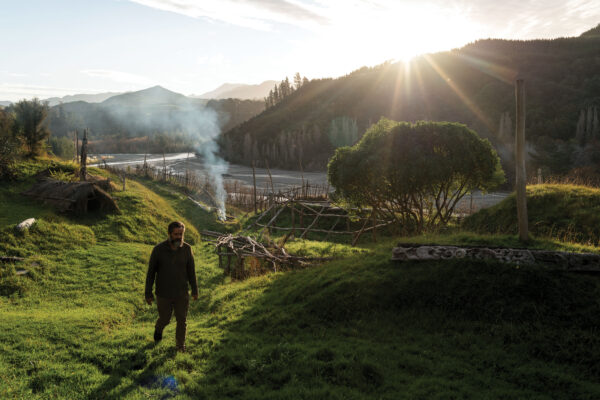
A pīwakawaka flits around Matawhero Lloyd as he talks. When he stills, so does the bird. Since returning home he has been reigniting his home fires, living and breathing this land in Mangatū.
In an interview with Waatea News in February 2023, Regional Development Minister Shane Jones, then in opposition, condemned forestry practices and said the industry no longer held “social licence” for its activities. Fifteen months and a change of government later, when the council moved to tighten regulations, he told the National Business Review he’d be visiting to “sort things out”.
And now? The minister tells me he is “deeply concerned” with the long-term future of Tairāwhiti, but rejects his own previously held view that forestry’s social licence is over. “I’ve had a gutsful of the stigmatisation and trivialisation of this industry,” he says. “This issue now is about a growing number of voices pressuring the council to drive forestry out of the Tairāwhiti. Well, that’s just never gonna happen while I’m a parliamentarian.”
Jones says the push to change regulations showed an element of “economic naivete”, and while he agreed there needed to be a regime to control slash, it couldn’t be so extreme as to limit production.
“Councils are struggling to get on the same song sheet as the government… I don’t want to be overbearing on any council but I want the civic leadership to make sure they don’t disembowel the forestry economy in their area.” His focus would be on asking MBIE to look at ways to meet the Prime Minister’s goal to double exports. I tell him that ministry had already been doing work on the East Coast, looking at Just Transitions. Jones had not heard of it. “I presume there’s climate change work going on, but I just go to a region and I look at who’s making money.”
As I write this story, floodwaters are again pushing into hundreds of homes. Hillsides have slumped, closing dozens of roads. Schools are shut, communities cut off. A fresh, smothering blanket of woody debris is spreading across the land, rendering clean-up efforts invisible. Civil Defence is again helping to evacuate the 700 people living in Te Karaka, a river-valley settlement, as the second storm in 18 months puts their lives at risk.
*
In Whatatutu, a half-hour drive north of Gisborne, Matawhero Lloyd couldn’t care less about the latest political squall. Nothing the government has done since the 1800s has helped him and his whānau. “Left wing, right wing, it’s all part of the same bird,” he says, placing his hand on the roof of his ancestral wharenui as he talks.
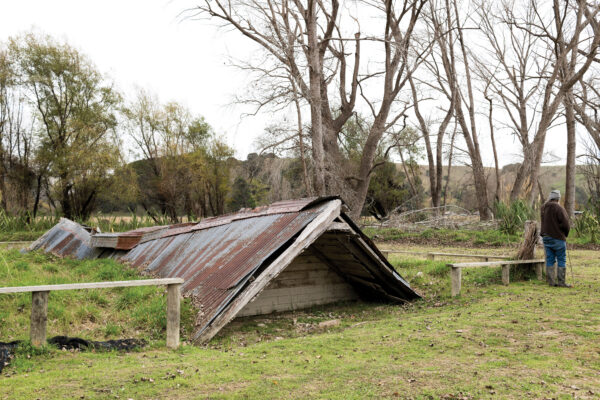
It is warped where he touches it, at elbow height, the once-straight beams of the meeting house bending upwards as if trying to take flight. When the rain began to sweep the mountains down into this valley, the people who lived here were able to flee, but Te Ngāwari didn’t make it. It’s been trapped here for going on 40 years, the earth now almost up to its eaves, its floorboards buried deeper than the worms. “This is a living testament to the effects that the silt is having on us,” Lloyd says. “This used to be a safe place, a sacred place. Once everyone left, it became derelict, and no-one wanted to come here.”
Te Ngāwari, the buried wharenui of Ngā Ariki Kaipūtahi.
The settlement, named Pākōwhai, was once the main pā for Ngā Ariki Kaipūtahi. They used to have pā sites further up the Mangatū River, but were pushed off these during the New Zealand Land Wars. At that time, Ringatū prophet Te Kooti made a prediction about the future of the Mangatū lands: “I see your land drifting, drifting to the sea. And you will not be able to retain it.”
“Come this way,” Lloyd says. We follow him across dirt and scrub to the riverbank, where the water cuts a wide, slow trail just a couple of metres below our feet. Lloyd’s uncle, Sid Hirini-Tamanui, tells us he remembers running around here when he was young. One of his cousins died after falling from a cliff face, trying to stop the littlies from getting too close. Before the land was cleared for farming and the wood carted off to build cities, “the river was much lower, and clean. My mum remembers,” Hirini-Tamanui says, sweeping his arm as if to conjure clear waters and abundant native bush. Using tōtara from their plentiful forest, his ancestors made waka to travel along the fast-flowing river. The prospect of flooding would have been unimaginable.
The iwi gave evidence to the Waitangi Tribunal of the wai once flowing 50 metres below the current bank. “It was beautiful. It must have been beautiful then,” Lloyd says.
About 30 muddy kilometres upstream, at the headwaters of the Mangatū and Waipaoa rivers, a monster slouches towards the sea. At 60 hectares, Tarndale is the largest slip in the southern hemisphere. It has been depositing soil at its base since 1915, after settlers cut down and burnt off the native forests. After Cyclone Giselle in 1968, the government planted pines to try to keep the land in place. The same was done up and down the coast 20 years later, after Cyclone Bola. But when these trees grew to maturity, entire stands of trees were harvested—leaving hillsides bare. A landowner built a stopbank on his farm opposite, which exacerbated flooding on the Pākōwhai side of the river. Two years before Bola, the elders picked up the pou tokomanawa of this wharenui and drove the carved meeting post to higher ground at Whatatutu, where a new marae was established.
For decades, no-one returned to Pākōwhai. Many younger Māori, including Lloyd, left for the cities. He was working as an IT consultant in Auckland when, around 2004, he began hearing nannies calling to him in his sleep. When his five-year-old daughter started having the same dreams, he decided to listen. “I couldn’t resist the urge. I needed to come home,” Lloyd says. We get back in his truck and begin to climb through the valley, passing a fence where floral tributes sway gently. A drowned urupā lies beyond, now unreachable. Mist shrouds the hills as we wind up to the old Tarndale Road, closed for good in 2002 when the slip eroded the ridgeline. “Once I came here,” Lloyd says, “I began to see the effects of the pine forests, the farming, and associating it with the health of our people. My heart started to burst.”
We stop at the forestry track, looking down into the gully. Earthen scars streak through the canopies. “That’s all filled up with mountains. Our mountains.” The sediment in Gisborne, in the sea, he says, “comes from up here”.
For more than half a century the land here has been slammed through pine’s 30-year production cycle: plant, harvest, repeat. But change is in the wind. A treaty settlement under negotiation now is likely to see the forest returned to Ngā Ariki Kaipūtahi, alongside local hapū Te Aitanga a Māhaki and Te Whānau a Kai.
Once contractors working to clear slash on Tikapa Beach get down to sand, they find yet more wood under the surface. “This job is bigger than anyone dreamed,” says Johnny Dewes. He used to camp here as a child, before access was restricted because of debris.
When that happens, Lloyd, an iwi trustee and negotiator, wants the pine gone. While it has provided employment for some, he says, it’s come at a cost. “I’ve had two friends killed out here in the last 10 years. One fell off the back of a cliff and didn’t die straight away, another had a tree fall on him.”
The Mangatū forest is owned by the crown and leased by Ernslaw One, a company owned by the Malaysia-based Tiong family, New Zealand’s second-largest landowners. Practices have been questionable; in February, Ernslaw One had its accreditation suspended over Tolaga Bay storm damage in 2018. The company has also been taken to the Environment Court by the Gisborne District Council and fined $355,000. (Ernslaw One told us it was working to get re-accredited. It was using aerial assessment around farms with “challenging geology” to make better decisions about future harvesting and planting, and identifying high-risk areas to create woody debris traps during rain events. The Mangatū forest had been “relatively successful” in stabilising the land over several decades, the company said, but it would be revising whether pines were appropriate in some areas. Harvesting safety procedures had been tightened for its 127 staff and contractors in the East Coast, and it had spent $4 million to date on clean-up operations. Its parent company generated $528 million in revenue in 2023.)
The industry’s watchdog, too, has been found wanting: in February, an audit of the New Zealand arm of the Forestry Stewardship Council, which is meant to hold forestry companies to account, found “serious shortcomings” in its processes.
Since Cyclone Gabrielle, the iwi has been illegally occupying Ernslaw One’s forestry office. “We cut the lock and we’ve moved in there permanently, just observing,” says Lloyd. “They’ve been proven to be negligent, then the cyclone happened and all the consequences of these policies and mismanagement become real; they’re not just hidden in the back hills any more.
As a tribe, we got a little pissed off no-one was taking care of our lands, so we re-assert our right to take responsibility for everything that exists here. We’ve had enough. We’re not asking. We got to do something.”
This is far from a gung-ho operation. Lloyd spent three years with forestry research giant Scion, developing a plan to transition away from pine. It’s the iwi’s vision, he says, “a perspective we want to provide to council, the crown, the Waitangi Tribunal, the forestry entities, to say, ‘This is where we want to head.’” Treaty negotiations could take years, and the crown must give 35 years’ notice to the current leaseholders—but Lloyd says the transition can begin well before then. “It gives us a chance to say, ‘Let’s create our own economy around what we’re doing here—restoration of the environment, biodiversity, research.’ We don’t believe in destructive industries like pine. There’s no place for it any more. We think in generations, not in quarterly reports.”
Lloyd is rebuilding Te Pakepake o Whirikoka, an ancestral pā site where his tīpuna last lived in the 1800s, before they were decimated by influenza and war. The whānau have replanted mānuka, kānuka, akeake, kahikatea, karo, ngaio and tōtara. “To restore our forests, we have to restore ourselves—our tradition and our history,” Lloyd says.
He looks at these hills and foresees the steepest hillsides planted in native trees for erosion control and ecosystem conservation. This forest would be left to flourish, untouched. Other areas could be used for research and harvesting, but over the much longer timespans required for natives. The iwi would also look to the forest floor as a site for exploring commercial medical, or rongoā, plantations. Premium, sustainable products, he says, “building on the knowledge of our ancestors”.
Lloyd has begun by building his own working marae on the family land at Whatatutu. They have planted 60,000 natives, and reconstructed a pā site. Before we leave the river, Hirini-Tamanui, Lloyd’s uncle, bends to pick up a rock and hands it to me. It’s white quartz, coughed up regularly here; a mauri stone, he says, carrying the life force of this place. Lloyd tells me to keep it. “You can’t plant a forest without first healing the mauri, and this is the heart of the people, the history, and the whenua.
“We are the generation of hope.”
That isn’t a cheerful bonfire, it’s a massive cleanup operation. In Tairāwhiti the beaches are smothered in dead wood. Mountains are sliding into rivers; forests swarm with possums. While officials demur, transfixed by the bottom line, the people who belong to this land are moving home—and working to repair it. (more…)