Terressa Shandley Kollat’s a star on TikTok—but she’s much more at home in the water. (more…)
More by Bill Morris



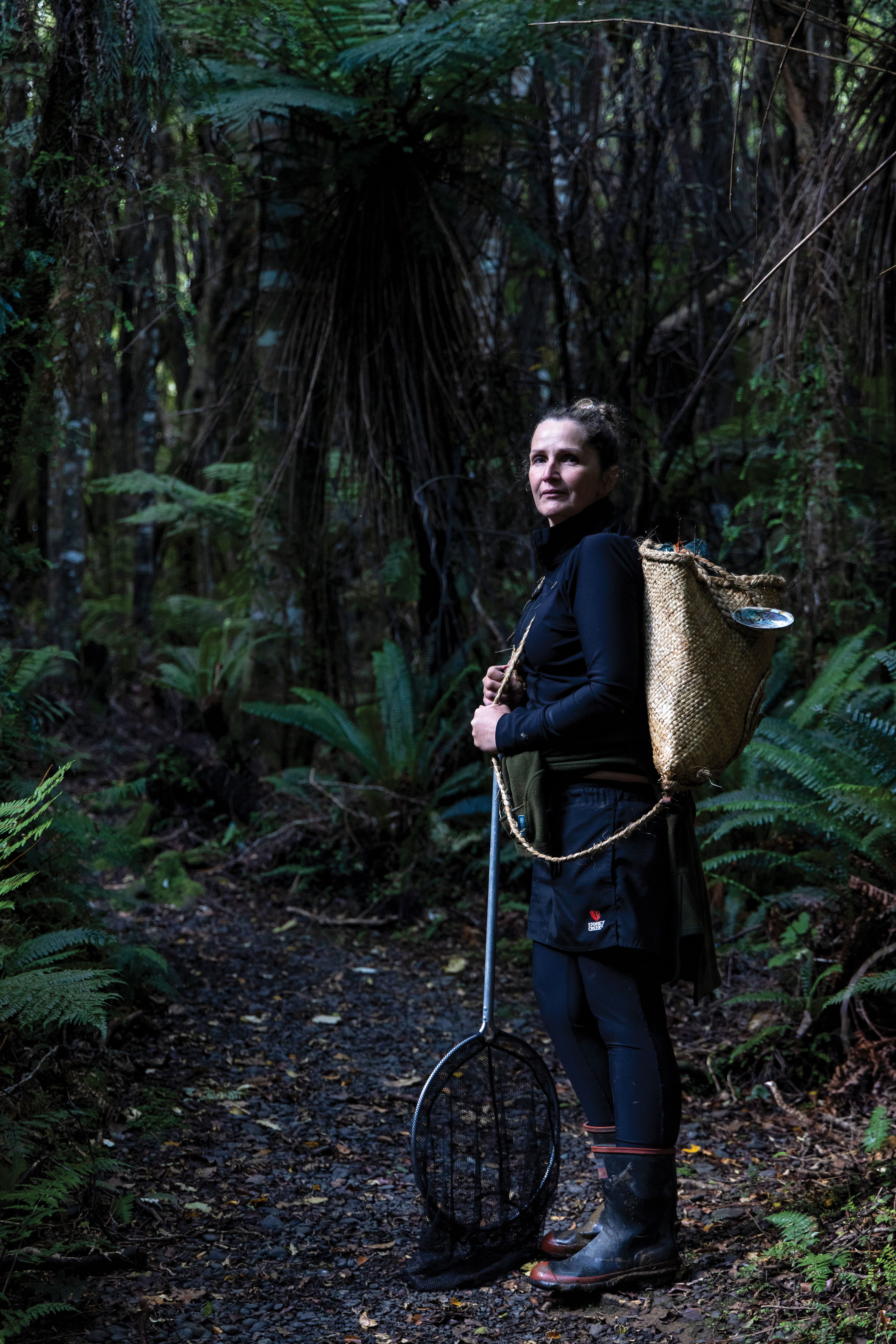
Terressa Shandley Kollat has always been connected to the ocean. Her parents were lighthouse keepers on Burgess Island/Pokohinu in the Hauraki Gulf. Her mother went into labour in a storm, and her father had to follow the instructions of a mainland doctor, transmitted over marine radio, to bring little Terressa into the world.
She was in breech position, coming out feet first, limp and quiet. Her father resuscitated her with breath that, to her mother’s horror, smelled of whisky. Terressa’s first cry, broadcast across the gulf, raised cheers from the boatloads of fishermen sheltering in the bay below, all gathered nervously around their radios as the drama unfolded.
In the years that followed, the family moved from Pokohinu to Tiritiri Matangi, then to Centre Island in Foveaux Strait and finally to wind-scoured, remote Puysegur Point on the southwestern tip of Fiordland. Kollat grew up a knotty-haired bush kid, diving for crayfish and pāua and foraging edible shoots and roots.
From her Ngāti Porou mother she learned ancient Māori ways of gathering and storing kai. From her Irish father she inherited a deep knowledge of the food that could be found in the streams, rivers and bush. And, she jokes, the inherent love of a free meal.
“When I think of the seasons, I think of what’s available in them,” she says. “In August, it’s whitebait and kanakana [lampreys]. In February, it’s mushrooms.”
When computer automation put an end to lighthouse keeping, the family shifted to the mainland. On the first day of school in Riverton, young Terressa sat among kids eating their neatly cut sandwiches.
“In my lunchbox was a muttonbird and a piece of crayfish,” she recalls. “I knew then that I was a wee bit different.”
Kollat studied textiles at university and wound up with a high-paying job in the Sydney wool industry. When she had her son, Jack, she was faced with a dilemma—work in the big smoke, or give Jack something of the childhood she had enjoyed. “I thought, he’s never going to know what it’s like to gut an eel, or fish, or dive, or hunt.”
She came home, working at the Tīwai Point aluminium smelter. Every other day, she was out with Jack, hunting, fishing, diving or gathering kai from the land.
She started taking others, too—friends, whānau, anyone interested—and saw how the connection with nature helped them.
She and Jack started hosting people in their home and taking them fishing and hunting. Kollat worked them hard: mornings were for catching and shucking pāua; afternoons for hauling deer carcasses out of the bush. She got them to skin animals by torchlight and clean up in the wee hours. She watched them build a new sense of confidence.
She recalls a wayward teenager who, after hunting with her, decided not to follow his mates to a robbery—he knew he’d never get a firearms licence if he got caught.
Another time, she and Jack took an ex-gang member out diving. A few days later, the man stood in the doorway of his teenage son’s bedroom, trembling with rage, ready to give the kid a hiding. Then he recalled the sense of peace he’d felt out in the waves. Instead of beating his son, the man later told Kollat, he took him fishing. “We might have saved a life,” Kollat told Jack that day.
Kollat always filmed her hunting and fishing trips, and one day, her nephew suggested she put a video up on social media platform TikTok. (“What’s that?” was her first response.) He uploaded the video for her and it attracted tens of thousands of views.
Since then, Kollat has shared more than 200 videos; the most-watched has 12.5 million hits. She has more than 200,000 followers, most of them women. She’s noticed that those overseas are fascinated—most of the world simply doesn’t have access to such resources any more.
She keeps making videos because she sees too many people here plundering fish stocks and mistreating the land and sea. She promotes sustainable harvesting—never taking more than you need, never hammering one spot too hard. “I’m very aware that what I’m doing, we might not be doing in 10 years’ time,” she says.
One perk of social media stardom is that some of her outdoor clothing and dive gear is now provided by sponsors. That, though, is about as much financial gain as she gets from it.
Her fame has led to countless requests to join her for a fish or hunt. The need she has tapped into—the hunger for natural connection—is bottomless. She takes as many as she can—scarred men who never had a role model in their life; women battling deep anxiety or severe trauma; police officers, radiologists, anyone. “They come away feeling calmer, more confident and rebalanced,” she says.
At Kollat’s home near Invercargill, the windowsills are crowded with greeting cards and gifts from people whose lives she’s touched.
In a kitchen full of steam she magics up a spread of marinated venison, seafood chowder, smoked fish and freshly caught kōura (see feature, page 34). She rarely visits a supermarket. What she can’t shoot, catch, or forage, others give in exchange for wild food.
These days, Kollat can’t go far without being stopped by fans for a photograph. When it gets too much, she disappears to her hut in the bush. “I was brought up in solitude,” she says. “So if I didn’t have that balance, I wouldn’t be able to do it.”
More by Bill Morris
Subscribe to our free newsletter for news and prizes
3
$1 trial for two weeks, thereafter $8.50 every two months, cancel any time
Signed in as . Sign out