When Jennifer Bannister was growing up, girls were secretaries, or teachers, or nurses. She persevered. (more…)
More by Bill Morris



“Jennifer will want to see that one.” This, overheard while elbow-deep in 23-million-year-old mud, was the first I heard of Jennifer Bannister, one of New Zealand’s few practising palaeobotanists.
I was with a group of geologists at Otago’s Hindon Maar, prising apart sheets of dark mudstone. Most of the fossils we found inside were leaves, and the best were taken to Bannister’s house to be studied, identified and prepared.
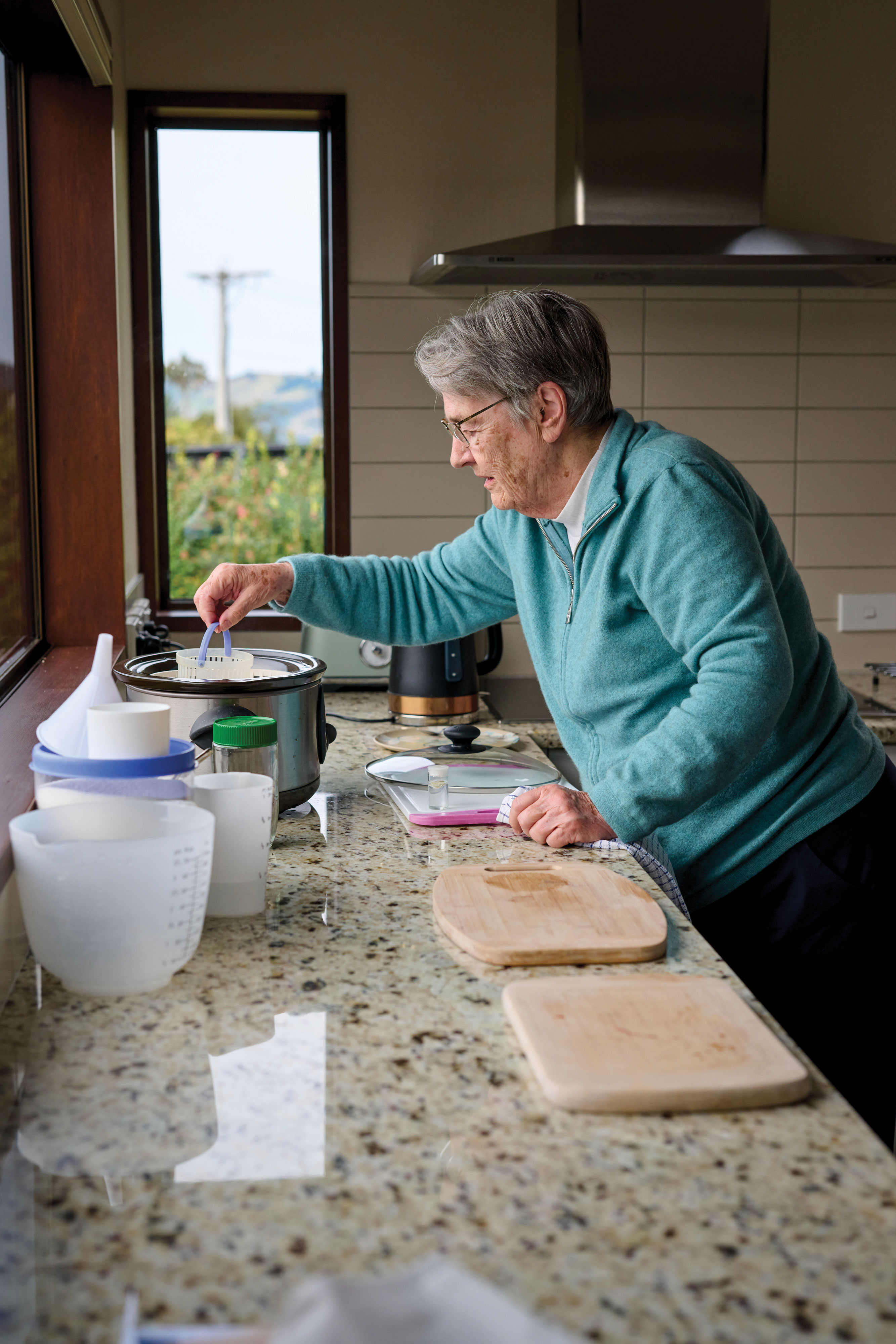
A week later, I follow the fossils to the 84-year-old’s home in the Dunedin suburb of Māori Hill. She leads me into her kitchen, where her slow cooker is emitting a soft chemical smell. She opens it up and pulls from it a small plastic basket saved from a “posh mozzarella” she once bought. It’s the perfect receptacle for leaf samples, which she’s gently warming in glass vials of hydrogen peroxide.
Today, Bannister is preparing leaves from a modern-day plant for study. The hydrogen peroxide is used to lift the cuticle—the waxy outer layer of the leaf—so the impressions left in it by the cells below can be studied.
Bannister brings the leaf samples, bleached perfect white, into her study, where, amid a small citadel of high-powered microscopes, she transfers the cuticles to dishes. She stains the samples purple, to make the cell architecture more vivid under the microscope. She uses the pointed tips of very fine paint brushes to delicately lift one of the cuticles onto a glass slide.
At first touch, it crumples like a wet sheet. She lays it on melted glycerine jelly and very carefully smooths it out until it sits flat against the glass. Bannister positions another piece of glass on top, sandwiching the cuticle in jelly.
When it’s set, we look through the microscope at a purple otherworld, a universe contained in a single cell.
Bannister nurtured a love of botany from a young age—not that there were many opportunities in post-war northern England: no botanical societies, no club field trips. “You did what you could on your own,” she says.
Even in the classroom, science was not a given. As a teenager, Bannister was at a school that did not teach the subject. Then her father, a clergyman, moved to a new position—and at her new school, she had to teach herself botany and zoology in order to pass her A-levels.
“I must have done quite well,” she says, “Because I got an exhibition [scholarship] to go to Nottingham University.”
Already, Bannister was an outlier: at the time, less than five per cent of the British population attended university.
“Girls in my time went into teaching, nursing, or they were a secretary.”
Her botany degree led to teaching jobs in Malta and the UK. Fossil plants—the mysteries of the deep past—intrigued her. Outside of her demanding teaching schedule, Bannister took evening and weekend classes to learn palaeobotany.
She came to New Zealand in her 50s, in 1994, after marrying University of Otago botany professor Peter Bannister. The couple travelled the country doing plant and lichen research. With a UK pension and savings, she was able to buy some high-quality scientific instruments and continue her passion for botany from home.
Peter died in 2008. Far from friends and family back in England, Bannister poured herself into her botanical passion. She had been enlisted by Daphne Lee, a palaeontologist at the university, who needed someone to describe fossil leaves from the extinct volcanic crater lake Foulden Maar. There was only one person in town with the necessary skills and equipment. Bannister “jumped at the chance.”
There was one problem, though—she only knew how to prepare living plants. Working with delicate fossil leaves was another thing entirely. Bannister taught herself, poring over books and papers. “I wasn’t shown by anybody,” she tells me, “because [in New Zealand] there isn’t anybody.”
To work out the taxonomy of the plants coming out of the maar, Bannister needed to compare fossil leaves with living examples. But no one had ever examined the living plants, let alone the fossils, in much detail, so Bannister had to go back to square one, creating a set of reference slides, with her trusty slow cooker doing the prep work. “I don’t use it for food any more,” she says.
Finally, she was able to start describing the fossils. “From the type of trees and the families of trees,” she explains, “you get a picture of what the whole forest might have been like.”
Bannister, says Lee, has been critical to the Foulden Maar research. “She understands plants, leaves, flowers, and their anatomy in a way that very few people now are trained to do. She will be by far the best palaeobotanist in New Zealand, without a doubt.”
Bannister has always worked from home, and mostly on a voluntary basis. She likes it that way. “I’m self-sufficient,” she says. And: “As I’ve gotten older I can’t sit in the laboratory all day.”
Her latest challenge is figuring out how to use photo-editing software to clean up her microscope images—she’s learning, just as she always has, by herself (with the help of YouTube videos). She’d be delighted to pass on her hard-won skills to younger people, but few are interested. “There’s no money in it,” she explains.
That’s a shame, because as Bannister points out, plant research is fundamental to understanding ancient worlds. “Plants are the basis of the food chain, so everything else hinges on them. The only way you’ll get a full picture of what the ecology of the site is like is if you’ve got the plants.”
More by Bill Morris
Subscribe to our free newsletter for news and prizes
3
$1 trial for two weeks, thereafter $8.50 every two months, cancel any time
Signed in as . Sign out