


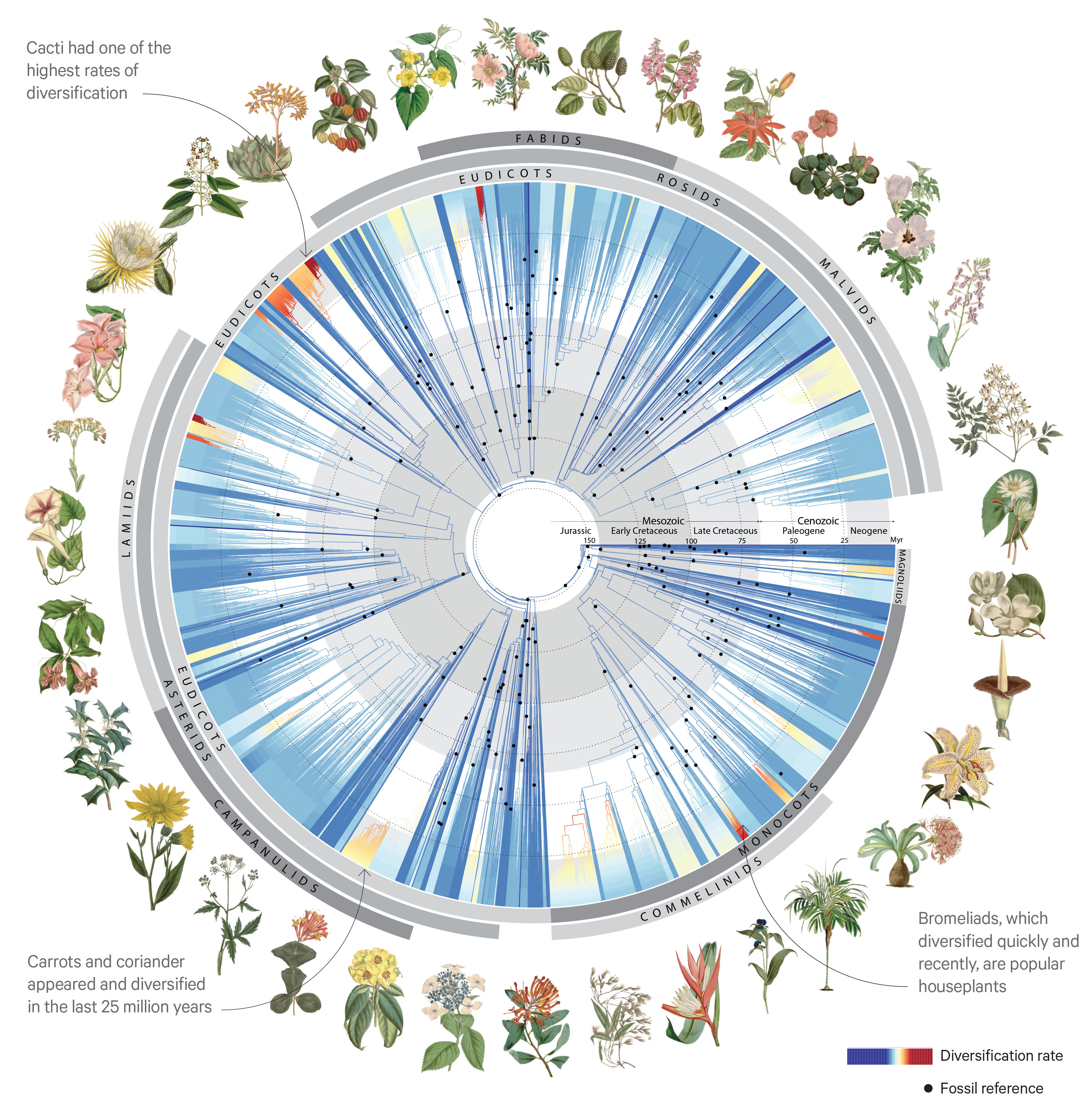
Behold the evolution of flowering plants, painstakingly put together by gene sequencing thousands of species, including some 200 from New Zealand.
Scientists published the “tree of life” in Nature and say it can be used as a sort of periodic table for plants, or a roadmap for researchers working on conservation or new medicines, for example.
“It’s like peering through a window across 150 million years of history,” says Kew Gardens’ William Baker, an evolutionary biologist who led the international project. “A kind of ‘family photo’ across the ages, made possible by the amazing molecular fossil record.”
The scientists note a burst of “explosive diversification” early in the Mesozoic Era. Reptiles were on the rise and so were flowering plants, becoming drivers of large-scale planetary cycles such as climate and water.
A second surge, in the Cenozoic, was possibly caused by a drop in global temperature, or by feedback loops between plants and insects, which were also diversifying rapidly.
Even with close to 200 scientists working on this project, including all 330,000 species was out of reach. So the team plucked one per genus, leaving a bouquet of “only” 13,600 to work with. After eight years they’re about two-thirds of the way through.
More by Catherine Woulfe