In 2024, Naomi Arnold slogged her way up Te Araroa, walking from Bluff to Cape Reinga over about nine months. Here, 100 kilometres into her odyssey and deeply unsure about her capacity to finish it, she tackles Southland’s notoriously boggy Longwood Range.
In 2024, Naomi Arnold slogged her way up Te Araroa, walking from Bluff to Cape Reinga over about nine months. Here, 100 kilometres into her odyssey and deeply unsure about her capacity to finish it, she tackles Southland’s notoriously boggy Longwood Range.
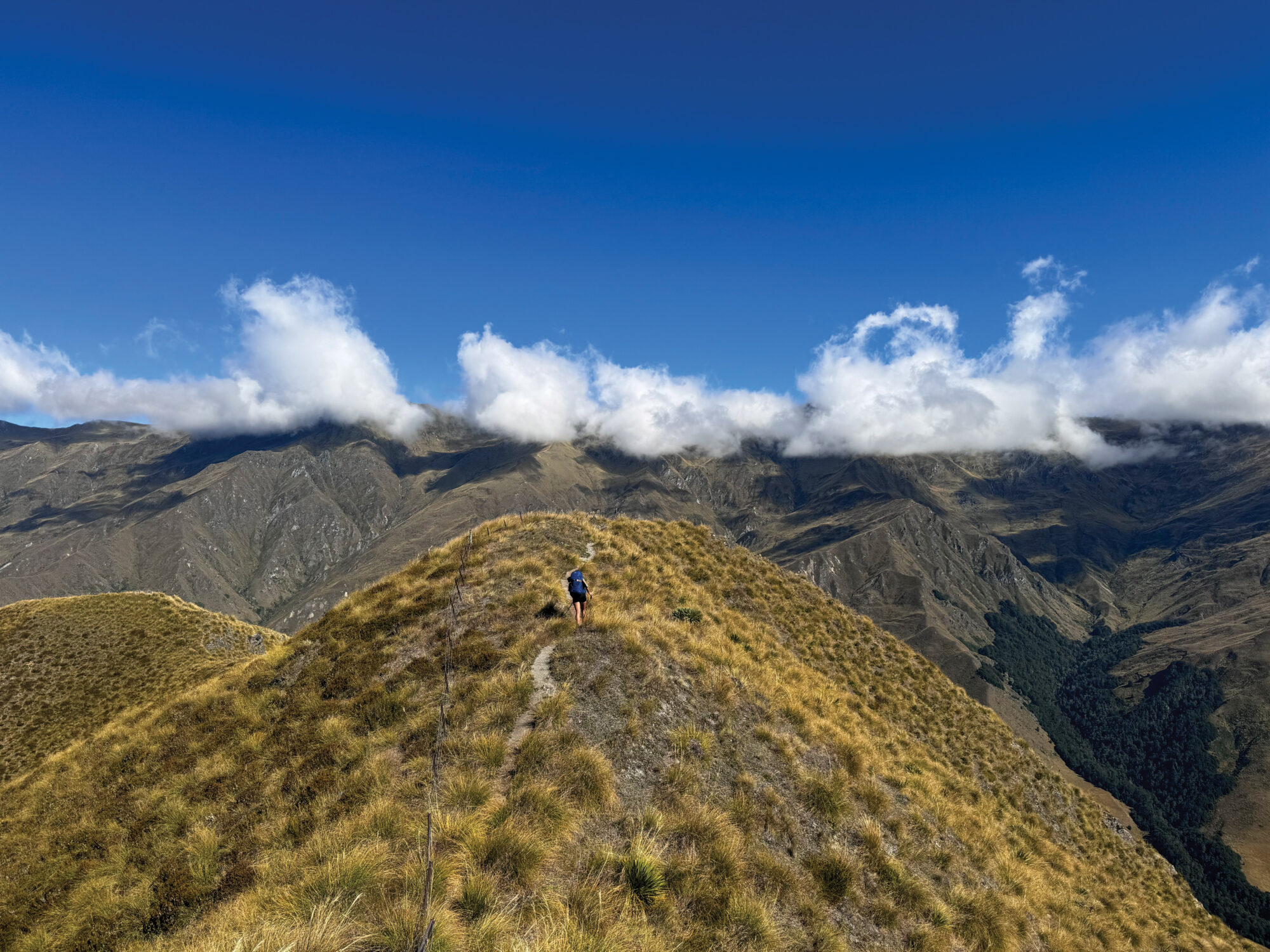
The 49-kilometre Motatapu Track between Macetown and Wānaka sends walkers up four mountains; while Arnold slogged through the mud she dreamed of reaching these open tops.
In the campground kitchen at the Colac Bay Tavern and Holiday Park I meet Sean, an Irish hiker who is walking south and nearly finished with the trail. He tramped 46 kilometres over the tough Longwood Range the day before, which astonishes me; my first biggish day, 27 kilometres along the flat Ōreti Beach, had completely destroyed me.
“I’m ruined,” he says. “Are you headed north?”
“Yup.”
He indicates my hiking pants and says, “You don’t want to wear those in the Longwoods.”
“Why not?”
“They’ll be wrecked,” he says. “Wear shorts. You’ll be two days in mud up to your knees and there’s no avoiding it. You try to edge around the outside and realise it’s just wall-to-wall mud. You just have to go straight through. But it’s good craic. When else are you going to be doing that?”
I leave the campground around nine the next day, wearing shorts as instructed. I walk along State Highway 99 towards the ranges, which are covered halfway in a band of heavy white cloud. The village is silent. A dog is rummaging through a bin on the corner, pulling out fish’n’chip wrappers and snuffling into them. He looks up as I approach and skulks off across the road to a dilapidated shed.
A Fonterra truck changes lanes to avoid rushing me and, grateful, I wave and the driver toots. Cattle gather at the fence to watch me. Little socks of spiderwebs cover stems of kānuka. I feel good; I can move quickly on the asphalt. In fact, it is lovely. So many hikers complain about all the road-walking on Te Araroa; is it really so bad? I turn into Round Hill Road and admire a massive spreading macrocarpa, then greet a man working in front of his tidy black cottage.
“I hope you like the mud!” he calls with real glee. He has Radio New Zealand going and looks like he’s been in the garden. “I don’t bloody go up there any more.”
“Probably because you’ve got too much to do around here, eh?” I say, not without a note of hope.
“No, no, no—it’s too bloody muddy,” he says. “Mud! Up to here!” His hand chops his abdomen. “Up to my waist!”
He hands me two freshly dug radishes as big as peaches, and I’m touched; I thank him as though they are bars of gold.
*
At the entrance to the Longwood Range track, I sit down on an old water pipe that had once served goldminers and eat some fruit leather. Tart as hell; I’d put in too much passionfruit. I’d be eating it for months.
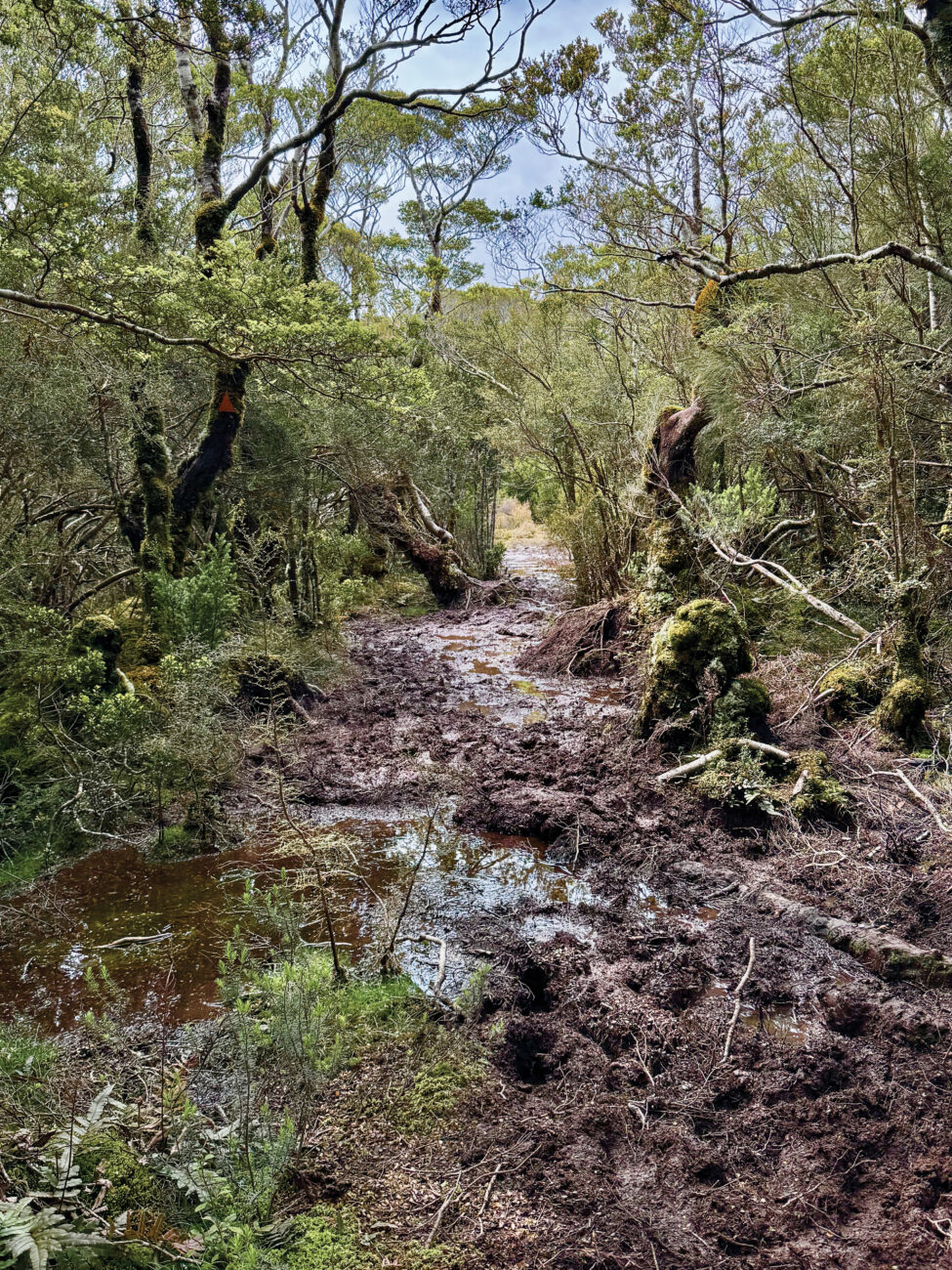
Leaving the manicured daywalker tracks, I see almost immediately the first pool of ankle-deep mud, oiled on its surface by microbes breaking down vegetation. I pause for a second before plunging in, taking a moment to honour the death of my new socks. Your choice of sock could make or break your trip. Mine are aqua, calf-length, skin-tight compression toe socks from Injinji, chosen for blister prevention, and a success so far. They are about to be defiled forever.
I notice that all the boot prints heading north edge around the outside of the mud, while the ones headed south go straight into the middle; the southbound walkers had clearly given up trying to stay clean. “Well, here goes,” I say, and step straight into the pool as instructed, giggling with delight as mud fills my shoes.
But I am not ready. I could never have been ready for what is to come that day, and the next, and the next. The delight soon fades to astonishment, then betrayal, then rage, then despair.
For the rest of the Longwood Range I can think only of the thick, grey, exhausting, 19th-century New Zealand mud from The Piano, so biblical in scale that it was essentially a supporting cast member, so much a part of that film that I thought of it even though I’d been 11 when the movie was released and had never actually seen it.
This patch of the Longwoods is the last remnant of a huge beech forest that has been heavily logged, though protests stopped the last of it from disappearing in the 1980s. I am soon fervently wishing they’d cut the whole thing down and paved it instead.
*
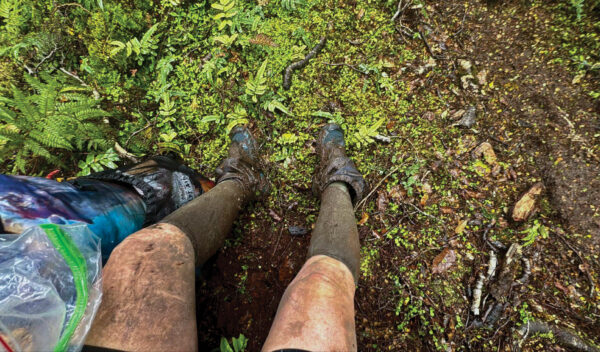
I would say I waded through the mud, but that would imply forward movement. You wade through liquid, and this mud is more like hardening cement. It immediately fills my gaiters and drags them down; they pool around my ankles like stockings on a toddler, so that each time I pull my shoe out of the mud an extra kilo in weight is added. I should take the gaiters off, but the sight of the muck and filth is so demoralising I can’t face putting my hands into it. I soon get over that, however, because my hands and arms are quickly coated anyway.
There is no way to wash it off. There is no running water. I can only wipe my hands on moss, and despair.
I sink up to my knees, then try to step over a mossed-green fallen trunk. Long minutes go by as I try to extricate myself. I can’t move my front or back leg, and have to try to wrench up each thigh with my hands. I lean forward slowly and lever up my back foot; it comes loose with a pop, and water seeps into the thick hole left behind. My shoe has come off and is now buried. I try to turn around to find it, but I fall over, the muck coating my leg, shoulder, side and half my pack. I raise my head to the trees and scream so violently I hurt my throat, and I grab at it, worried I’ve split the flesh. Now there is mud on my neck, too. I have been going for two hours.
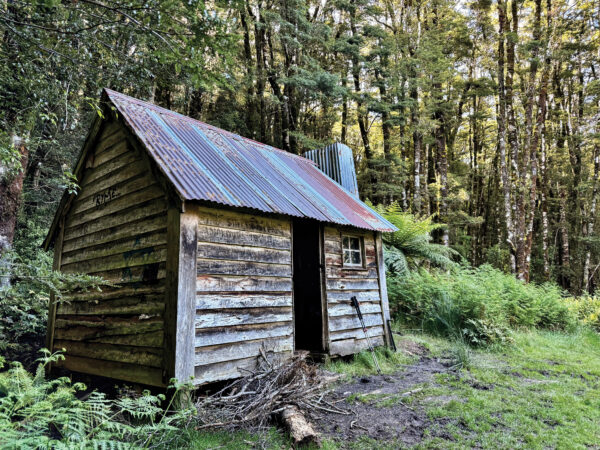
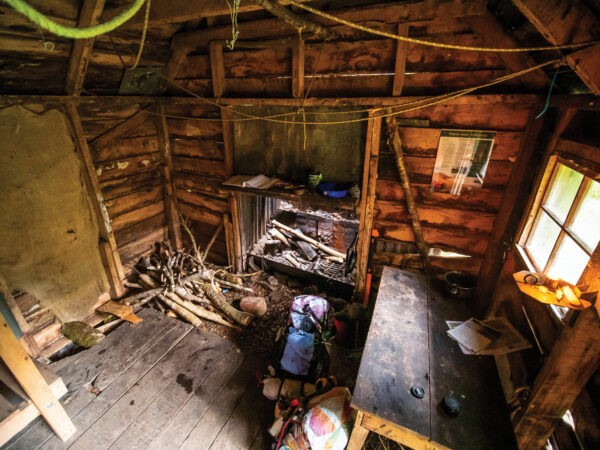
Since Arnold’s visit, Martin’s Hut, built in 1905, has had a makeover. The hut now has a deck, new exterior walls and floor, and a tidied-up fireplace—a welcome refuge from the mud, which can be hip-deep at times.
The mud stinks like rot. It stinks like shit. I lever myself out of the mud pool and dig into it for my shoe. For the rest of the day, I step into pool after pool of deep, sucking mud, pulling out one leg, then another, and I do that for eight kilometres.
In the worst of it, when each foot and knee gets stuck and twisted so much that I worry I’ll fall sideways and tear ligaments, each step takes about 20 seconds. Drops of sweat roll down my brow and off my nose and into the mud. I crawl over logs and under logs, and for balance grab on to the same trees as all the other hikers—I can see where their grasping hands have worn off the moss and bark. I flounder and cry, and hang over my hiking poles in exhaustion.
Eventually I travel through hysteria to mute acceptance. I didn’t think it would be as bad as this. How is it so bad? How is this even allowed?
I get to the decrepit Turnbull’s Hut at 3pm. I look down at my legs; I have transformed into a swamp thing. I write my name in a DOC hut book for the first time on trail. Many of the comments simply say Mud. I push on.
Three hours later I reach Martin’s Hut. A plank of wood is missing from the floor; in fact, a third of the hut does not even have a floor, but is simply bare dirt. Te Araroa hikers have left behind rubbish crammed into the fire bucket: food packets and a broken pole and empty tuna tins. There is a top bunk left, so I commandeer it; it means my face will be close to the rafters and their rats, but today, I do not care.
“Be careful,” a German woman says. “There’s not much tank water left. So you shouldn’t use it for washing.”
*
I have another late start the next morning. I am still struggling with how to organise everything in my pack; I seem to need to take everything out and look at it, then repack it, every day, while others appear to obtain items from their packs by osmosis and take a mere 20 minutes from waking to leaving. I have 26 kilometres to walk today to a farm called Merrivale, which has a private hut called Merriview. It sounds agreeably Tolkien.
I am surprised to feel energetic, and walk up to the ridge through glistening cities of spiderwebs nestled into ancient, twisted, moss-covered beech trees. The ground is soggy but less mucky than yesterday, and as I ascend to the tops, the vegetation thins to spindly, sharp alpine plants, with tidy white cups of gentians and snowberries. The dark brown tarns are full of wriggling tadpoles. I pass my first 100-kilometre mark and reach the Longwood summit. I congratulate myself. Just 2900 kilometres to go.
I sit on a sunny set of rocks and eat plump dried apricots, some more of my fruit leather, cashews damp from dried fruit, carrots, a protein bar, and almond butter on crackers with cheese. Soon a spry woman in a pink top arrives. Her name is Judy, and she is a local tramper and pest-trapper. I notice she’s been picking up rubbish along the way, and she says she’s already found someone’s knickers with a safety pin through them, lost from their pack.
She eats her tidy cut lunch with me. She is section-hiking Te Araroa, and we gripe over the TA hikers despoiling our huts with their rubbish.
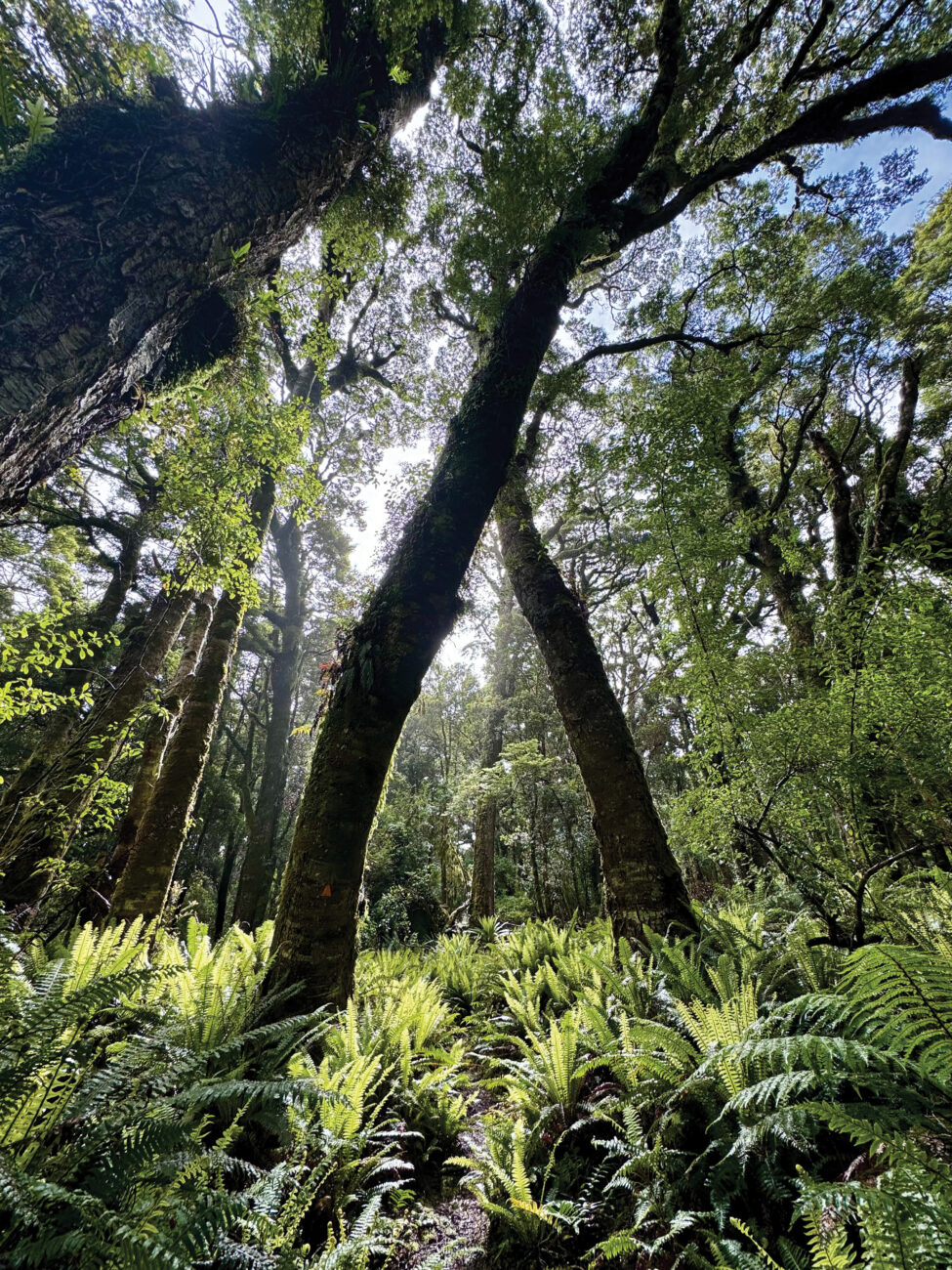
The saturated forest is a mix of beech and podocarp, with trees covered in mosses and epiphytes, and carpets of damp-loving ferns.
I tell her how much I liked the tomtits on Bluff Hill and she says: “I do a pest line on Bluff Hill. One of the long ones. It takes me a full day.” When her group started five years ago, they had to regularly empty their traps of possums and rats. Now they are getting hardly any.
I farewell her and set off for Merrivale. But I am soon fading. The ground is treacherous; every footstep comes down unevenly on the twisted clumps of tussock. Finally, I step badly and roll my ankle, falling heavily to the ground. My pack slams on my back like a sack of wet sand, and I groan. I lie there, thinking how nice it is to lie down. My face is resting in cool mud. I kick out my twisted legs and feet and relax. The pack feels pleasantly heavy now, a comforting weight, and I turn my head and move it a little to a patch of grass, silky under my cheek. I lie there watching grasshoppers hop around me, clicking. Then I remember spiders that might bite, so I get onto my knees and lever myself up. I look down; I am caked in wet dirt again.
That afternoon, I come off the tops and back into the mud. Underfoot, the beech roots twist into an uneven lattice with water pooling in each gnarled wooden triangle, an oily sheen glistening on top. I step into one and sink up to my knee.
With every footfall I break small dams, and a torrent of muddy water dashes down behind me. I see the traces of other hikers ahead of me: alternate routes around the worst sludge pits, deep holes where they’ve sunk, too, and what look like knee holes where they’ve fallen. Holes from their hiking poles scatter the firmer ground at the edges of the mud pools. I push my sweating, red face into a mossy ball covering a dead trunk and roll it back and forth, groaning with relief at the cool, moist, enveloping pillow.
I come to a small drop, beyond which looks like a long swimming pool of mud, and carefully step down. I immediately sink to the tops of my thighs and feel my last shred of control fray. This is a sensory nightmare, to be honest. What is on the bottom? What’s clinging to my legs? I stagger through the slimy soup, dragging each leg forward, go through another pool, then edge downhill through more puddles.
“This. Is. A. SLOPE!” I hiss. “Why. Doesn’t. It. DRAIN?!”
A slug, or a leech, or something, attaches itself to my hand and I flick it off, disgusted. It is driving me insane to move so slowly, and as the afternoon wanes, my mood begins to plummet, then explode. I start to swear viciously, try to run through the mud, try to edge around it. I bend one of the poles I need for my tent, so stow them and try to swing along the edges of the mud, hanging off the trees. When that doesn’t work, I begin to race through the forest wildly, throwing myself over soaking, rotting logs, my pack pulling me off-balance. I rake my shins. My body contorts itself against the mud, screaming at the limits of my ligaments, my tendons. I twist my knee, nearly rip my shoulder out of its socket. Branches gouge my face. My shoes threaten to pop off my feet, but if I tie the laces any tighter an ache starts in my arches. Each puddle could be up to my calf, or my crotch; you can’t tell. Some pools are cold, and some are warm, which is unnerving. It feels like wading through molten shit.
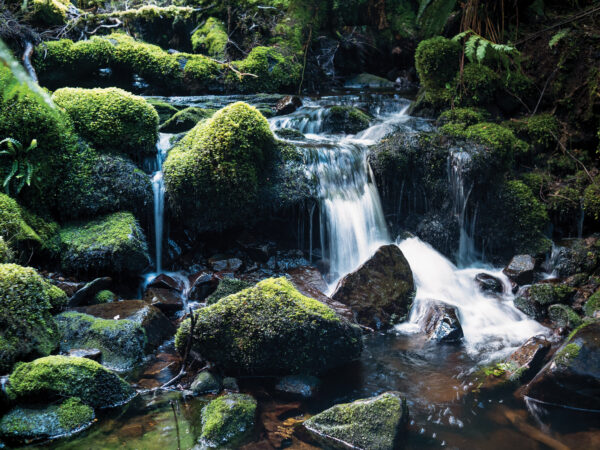
The filth began to accumulate just a couple of hours into the Longwood track, with fresh water scarce but welcome.
I know I am in danger of getting injured, but I am too angry to stop. I am stuck in here, this close, dense, green hell, and there is no way out but through this bullshit for hours, and I’ve put myself here. I attack the forest, try to bend it to my energy, my will, and rage at it when it won’t. A hidden, jagged branch in the mud stabs into my shin, and I throw my head back and roar, then stand still in the pit of sludge, tears threatening again.
Then a clear little voice drops into my head.
Stop fighting it.
And it is so loud and calm, so separate from the raging torrent of the rest of my thoughts, that I stop to listen, panting, sweating, thunderstruck.
Stop fighting it, the voice repeats. Stop resisting. You’re only making this harder.
Resisting is the story of my life; so much so that my mother joked about it in her speech at my 21st. “Baths. Dresses. Hugs. Haircuts. Sleep. Homework. You never walked into anything easily,” she’d said. “Life was hard for you. The dental clinic aged two. Didn’t want to be seen by a doctor. Didn’t want to go to Brownies. The first day of kindy. The first day of school. The first day of intermediate. The first day of high school. You hated the sight of certain people. Jenny next door. The witchy-looking woman at the Historic Village when you were 14 months old. I knew everything was going to be a drama and it always was.”
It was funny at the time; the punchline was that I’d been so eager to escape home as a teen that I’d sailed off to university and not looked back. But poor Mum—that was the 1980s, when kids like me were simply labelled attention-seeking, oversensitive, and dramatic. These days, I would have been diagnosed with something when I was young, and probably been helped. But I resisted. And I continue to today. I resist anything new or that I think I can’t do. Or anything I have to do, or am told to do, and then I get pissed off about it.
Now here I am, the only one making myself do this stuff.
There is no one else to take it out on. I am taking it out on the forest, but it is indifferent. I will probably end up hurting myself, making me cut the trip short at 100 kilometres. Is being venomous to myself doing any good? I look about me at the interminable trees and the impossible path, and down at my mud-caked body, my feet entirely hidden in muck. You arewasting energy, the voice says. Calm the f*** down and walk on.
Is it my mother? Is it God? Does God swear? My God probably does. But it works.
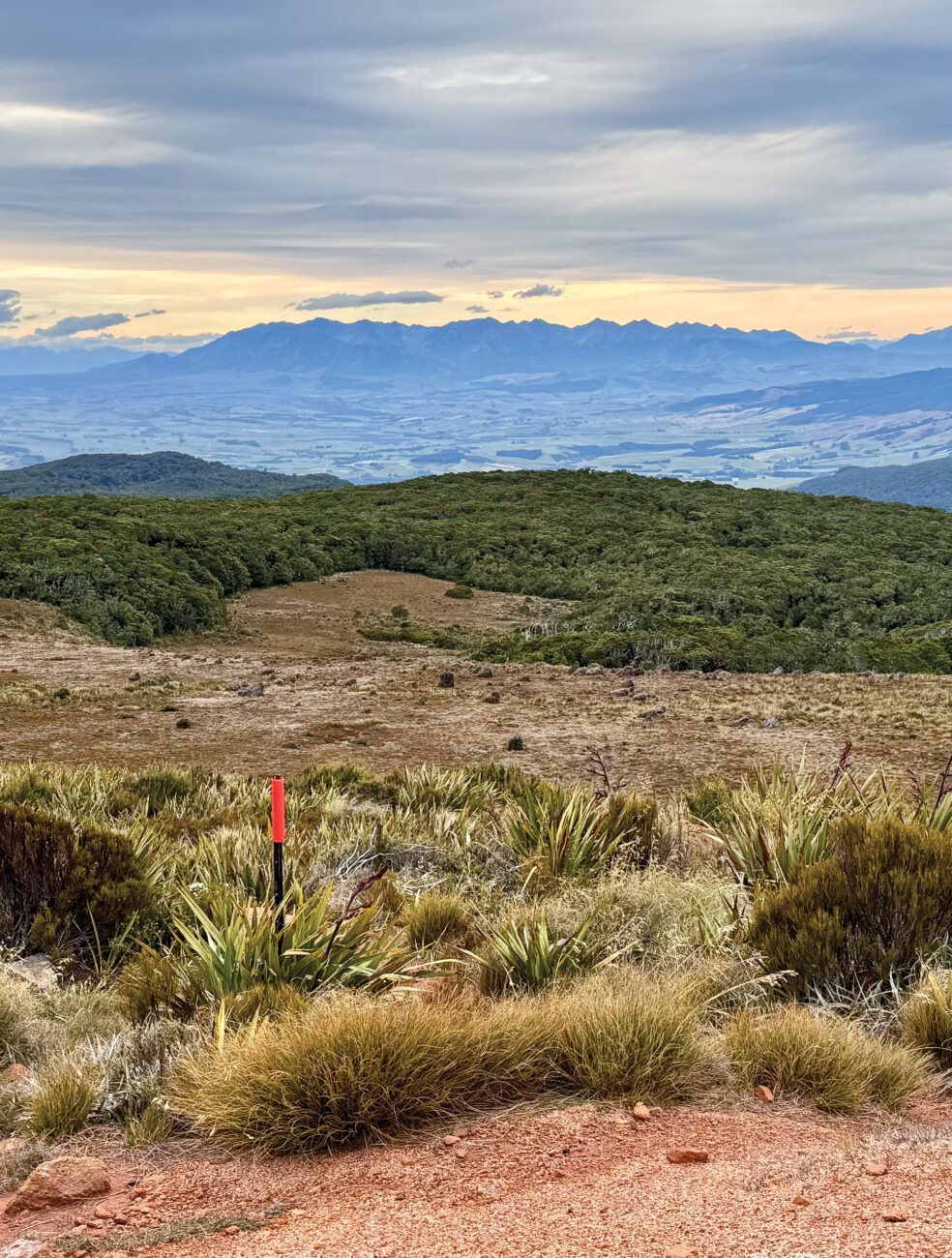
The next challenge: Takitimu Range, photographed from Bald Hill in Southland.
I am stunned by this visitation; I haven’t had one like that before. But I listen, and I do calm down. I accept the bullshit, and sink each foot steadily through the mud. It is slow, but I am moving forward without snapping an ankle or puncturing my femoral artery on a broken branch. When the forest peters out into an old quarry with a burned-out car rusting away in the middle it is 6.20pm and I still have 15 kilometres through the bush to go.
It has taken me all day, from 9.30am to 4pm, to walk 11 kilometres. How am I going to make Merriview Hut tonight? At this rate I will be getting there at 10pm, just as the last of the light is fading from the Southland sky. I’m not going to make it, I realise. I am too tired. I feel as rusted out as that old car. I begin to cry.
I wash my face and body and fill my bottles at a waterfall pool on the side of the quarry road, then drink a litre of water and fill the bottle again. The forest has been largely dry, despite the mud, and the three litres I’d carried are long gone. This is the first chance to refill all day.
I eat peanuts and a protein bar as I walk up the road and over Bald Hill, which has an expansive sweep of views across the paddocks of Southland and out to the coast. To the south, Rakiura and Whenua Hou are rising out of the sea, and there is the wide white curve of Ōreti Beach, too, and Bluff Hill, far behind me now. I walked that. I stare at it, astonished. While I was raging over every step in the forest, I had actually been making progress.
In 2024, Naomi Arnold slogged her way up Te Araroa, walking from Bluff to Cape Reinga over about nine months. Here, 100 kilometres into her odyssey and deeply unsure about her capacity to finish it, she tackles Southland’s notoriously boggy Longwood Range. (more…)