From retirement, David Bimler has embarked on a second career: exposing fraudulent research. (more…)
More by Rebekah White



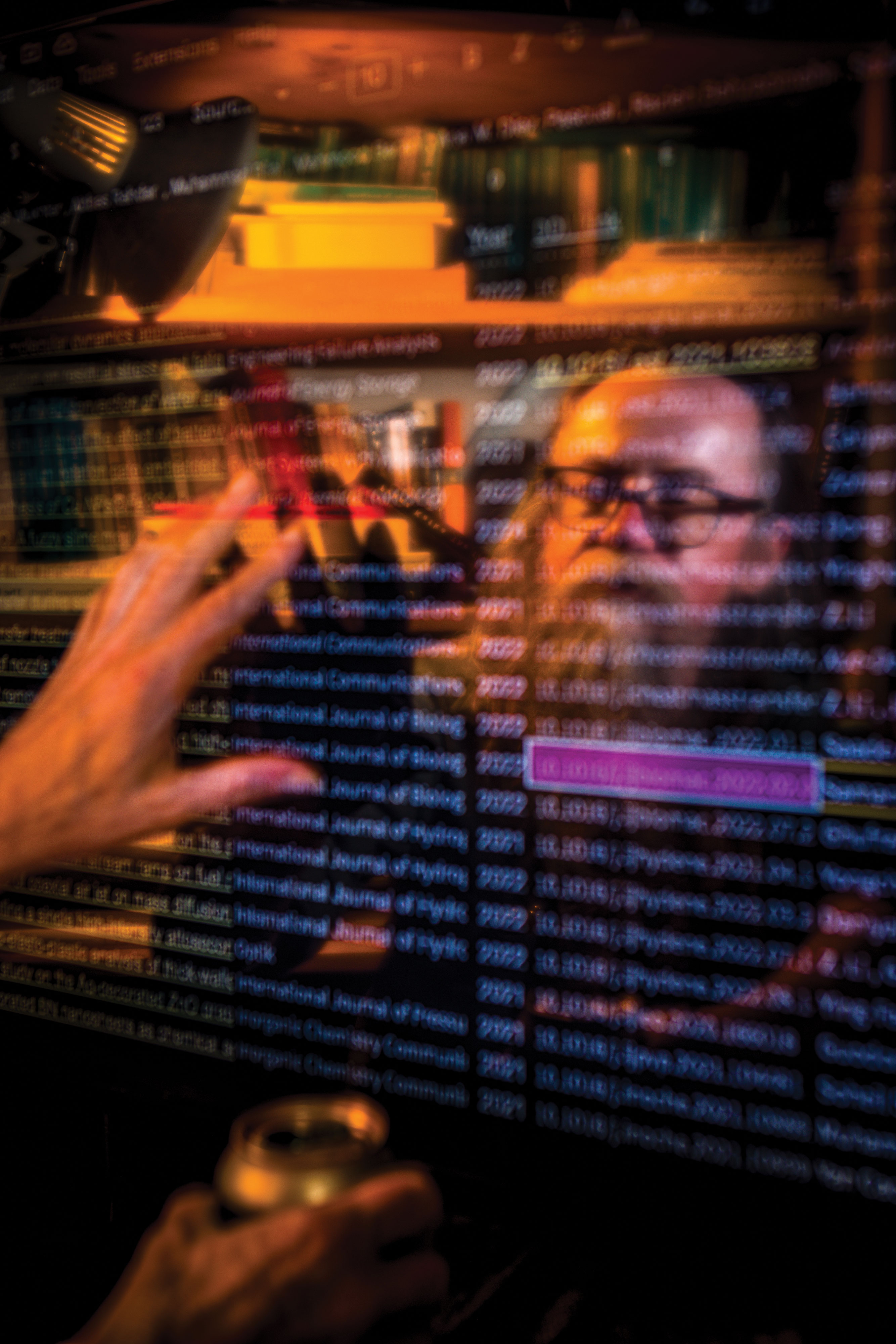
David Bimler is on his way to Paris when we video call, his destination an invite-only symposium of scientific sleuths from around the world. He’s a member of a small community working to expose fake scientific papers—work important enough that the French government is sponsoring their meet-up.
Over the past decade, Bimler’s work has led to at least a thousand papers being retracted: removed, for good, from the body of global scientific knowledge. Like research itself, these investigations are collaborative. Most of Bimler’s fellow sleuths know him only by his online pseudonym, Smut Clyde: the result of a name generator which suggested combining the name of a pet (Mrs Smut the cat, sadly deceased) with a childhood street (Clyde Road, Wairoa). Binomial nomenclature: the silly version.
Bimler grew up on a Hawke’s Bay farm, and at university, he gravitated towards physics, embarking on a PhD “in the esoteric intricacies of lattice-gauge field theory”, he says, at the University of Canterbury. He became overwhelmed by the feeling that his PhD thesis would make little contribution to human understanding, dropped out, and went travelling. Eventually, he ended up back in a PhD programme—this time in the field of perceptual psychology, investigating how the brain processes various stimuli. His supervisor particularly wanted him to study the cries of babies. “Soon I realised that evolution has designed them not to be very pleasant to listen to,” he says, “and I got more interested in how other people perceive baby cries, rather than listening to them myself.”
After that, Bimler moved into the broader field of perception and colour vision—“the mechanics of what goes on in our brains, and how we see colours”.
In the 1990s, he worked part-time for the Government Communications Security Bureau, better known as the GCSB, and though he cannot say what he was doing, he describes his current detective work as “a natural continuation” of it, “an outlet for all of this training I got”.
In 2009, back full-time in academia, he started blogging, and hit his stride writing about the dingy corners of science: flimsy research, quack medical treatments, fake conferences, and sham scientific journals that looked legitimate at a glance, but would publish anything you paid them to, even if you made a joke research paper by cobbling together phrases from an online surrealism generator. Which a couple of frustrated psychology academics did. The paper’s first paragraph contained the line, “Neither cognitive neuropsychiatry nor cognitive neuropsychology is remotely informative when it comes to breaking the ice with buxom grapefruits.” Four journals accepted it for publication.
The silliness of it all appealed to Bimler—“It was, ‘Ho, ho, here’s some really weird, flaky science for readers to laugh at’”—but it didn’t last. The field of bad science was changing, and a more subtle form of cheating was taking place.
This new wave of fraud wasn’t as funny. It took place in complex, niche fields, like non-coding RNA or coordination polymers. From 2013 onwards, sham papers were being mass-produced—there seemed to be factories, called paper mills, producing them on an industrial scale.
One way of creating fraudulent scientific papers is to take parts of existing papers, rewrite them using synonyms, and Frankenstein them together. Then, steal an image from another person’s work.
Some papers are run through software that changes all the words to synonyms, so that they can’t be identified in a plagiarism search. If you’re reading a paper that describes “breast cancer” as “bosom peril”, says Bimler, then it’s probably a good idea to be suspicious.
Bimler discovered he had a talent for spotting fraudulent images, especially Western blots, which show how proteins in a sample of blood or tissue have been separated and identified. A Western blot looks like a series of monochrome stripes, or, in Bimler’s description, “as if Mondrian hurt his head falling downstairs but continued to paint while experiencing temporal-lobe seizures”. Bimler and other sleuths were constantly finding Western blots that had been copied and pasted from one paper to the next. “It’s kind of like art,” says Bimler. “You learn to recognise the style of a particular artist. And so, after a while, you start recognising a particular style of Western blot.”
Do these images matter, in the context of a scientific paper? “If you haven’t got the right images, you haven’t got the data that your whole experiment is based on.”
In 2022, Bimler published an investigation that traced 800 papers about medical applications of crystallography back to one paper mill. His detective work had “crossed the boundary of being a hobby and become an obsession”, he says.
Bimler is wizardly in both appearance and humour: his critiques usually appear in the form of jokes, or at least extremely colourful insults.
He’ll use the word “eleemosynary” as though everybody knows what it means, just as he’ll describe a scammer as a “clueless wazzcock”. To him, scientific fraud is “shenanigans”. (“Definitely, shenanigans had occurred,” he’ll say. Or: “There was strong evidence of shenanigans.”)
Bimler lives with his partner in Wellington, where he’s a fixture at the local live-music bar. Since his retirement, he’s appeared in both Science and Nature, the world’s pre-eminent journals, as a fraud detection expert. It doesn’t escape his notice that he’s contributing to science by removing papers from the world—as well as by adding his own research to it. (A new paper about colour vision is in the works.)
Behind the humour, Bimler is terribly serious. Paper mills seem to be targeting biomedical science, especially cancer research, with significant human costs. “The whole field is becoming contaminated by paper-mill production,” he says. “People are dying because of fake papers, because these fake results get laundered into clinical advice. That means that legitimate cancer researchers are wasting money trying to extend results that were never true in the first place.” In other words, Bimler’s work—this whole thing—is much more than either a hobby or an obsession.
More by Rebekah White
Subscribe to our free newsletter for news and prizes
3
$1 trial for two weeks, thereafter $8.50 every two months, cancel any time
Signed in as . Sign out