One hundred years ago, we thought IQ tests could predict the future. (more…)
More by Una Cruickshank



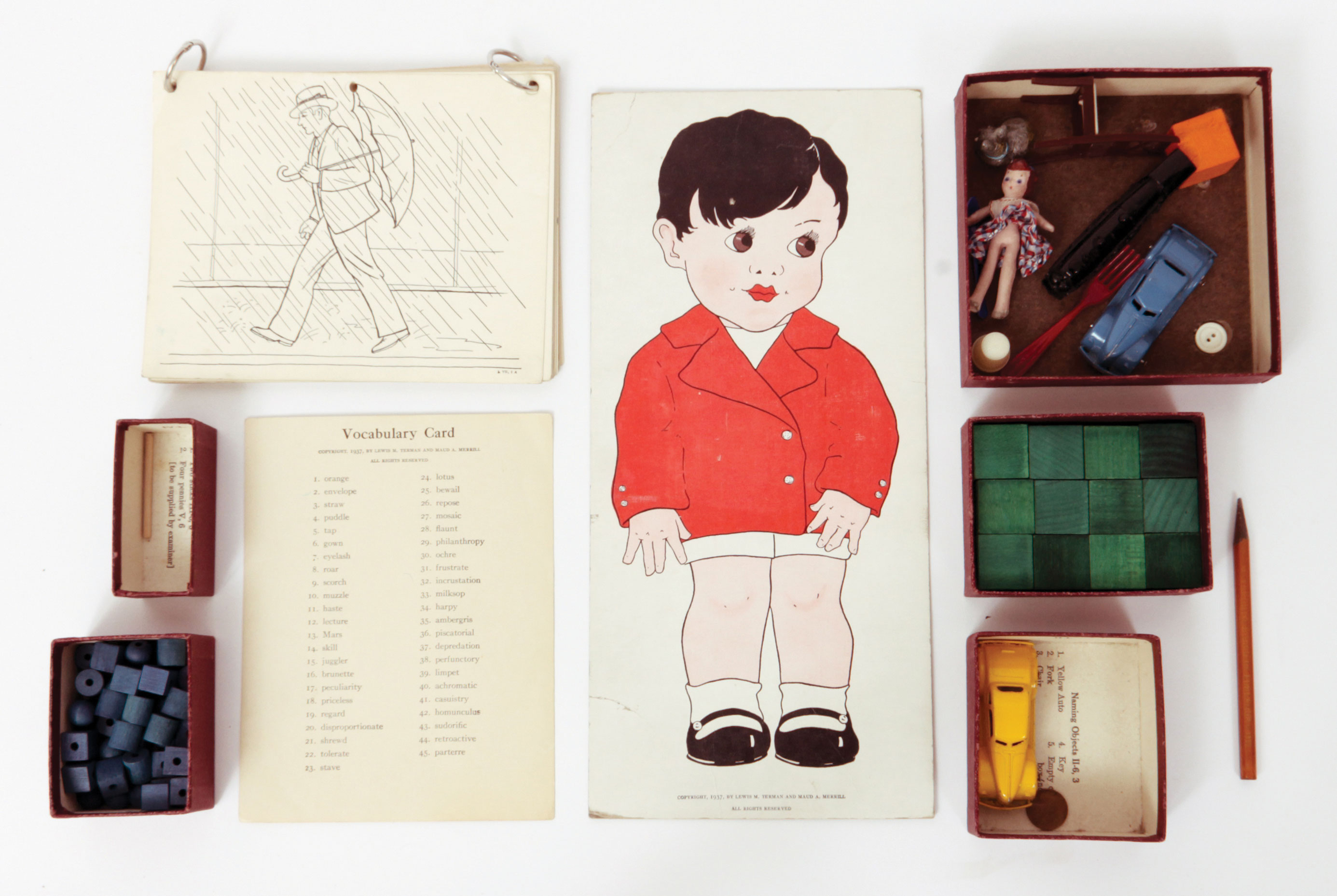
When schools opened in the summer of 1924, thousands of tweens around New Zealand were faced with an exotic and potentially life-defining new hurdle. The Education Department, caught up in the international vogue for intelligence testing, had adopted the Terman Group Test of Mental Ability, an American conception. All first-year post-primary students were required to sit the test: half an hour, 240 questions, covering such areas as maths and logic, reading comprehension and general knowledge. This was the first time any such test had been rolled out to a whole country.
Light-hearted newspaper articles suggested that our politicians should also be tested. A rather spiteful opinion piece in the Wanganui Chronicle claimed that intelligence testing had proved America was a nation of morons. Sample questions were printed in the papers, so that adult readers could play along. For example: As a monk is to a man, a is to a soldier. (The answer, frustratingly, was not supplied.)
It was all very modern and amusing, but a lot could hinge on Terman tests. They were intended to predict whether a student, aged around 12, could succeed in a professional career, or whether they should instead be trained in a trade.
At first glance, the idea of standardised testing seemed fair—what could be more equalising than every child, regardless of sex, race or class, sitting the same test?
But the driving force behind the regime was not fairness, but eugenics, the pseudoscience of improving the human race through selective breeding, and the sterilisation or euthanasia of unhealthy people.
Stanford University psychologist Lewis Terman, who helped to create both the written tests and hands-on equipment such as the kit pictured here, was a committed eugenicist. His interest in intelligence testing was not about identifying which students needed extra help, or improving schools whose pupils were testing badly, but in cherry-picking children who seemed destined to be successful. Those children could be streamed into accelerated learning paths and given extra attention, further cementing their advantages. “Stupid” children—Terman’s word—were not of interest. (Although, he wrote in 1916, “from a eugenic point of view” such children constituted “a grave problem”—not only were they “dull”, but they tended toward “unusually prolific breeding”.)
In truth, of course, intelligence is an abstraction that doesn’t lend itself to being measured. A lot of factors can affect a child’s score, including health, family wealth, parental literacy and even being hungry or distracted during the test. The same person can score differently on different days, and it’s completely possible to train for an IQ test if you can afford a tutor. The tests are standardised, but the lives of the children taking them are not, a problem that was already recognised by some educators and commentators in 1924. “In my opinion the tests are useless,” wrote one teacher to the Auckland Star, having administered the first batch of tests to his students. A Star editorial said the test was “fundamentally defective and fallacious”, claiming that several prominent American businessmen had recently flunked a similar test.
Yet the Terman Group Test hung on in New Zealand until 1936—when it was replaced by another American import, the Otis Intermediate Intelligence Test. This was “a fearsome document”, reported the Manawatu Standard: 75 questions, covering such topics as the month of Thanksgiving, or the US state best known for production of anthracite coal, requiring answer in just half an hour. That first year, only nine of 312 students at Grey Lynn School in Auckland were able to finish.
The test stuck around until the 1960s. Bitter arguments over the validity and morality of standardised testing, of course, continue.
More by Una Cruickshank
Subscribe to our free newsletter for news and prizes
3
$1 trial for two weeks, thereafter $8.50 every two months, cancel any time
Signed in as . Sign out