How do you say goodbye to a life’s work? (more…)
More by John Summers



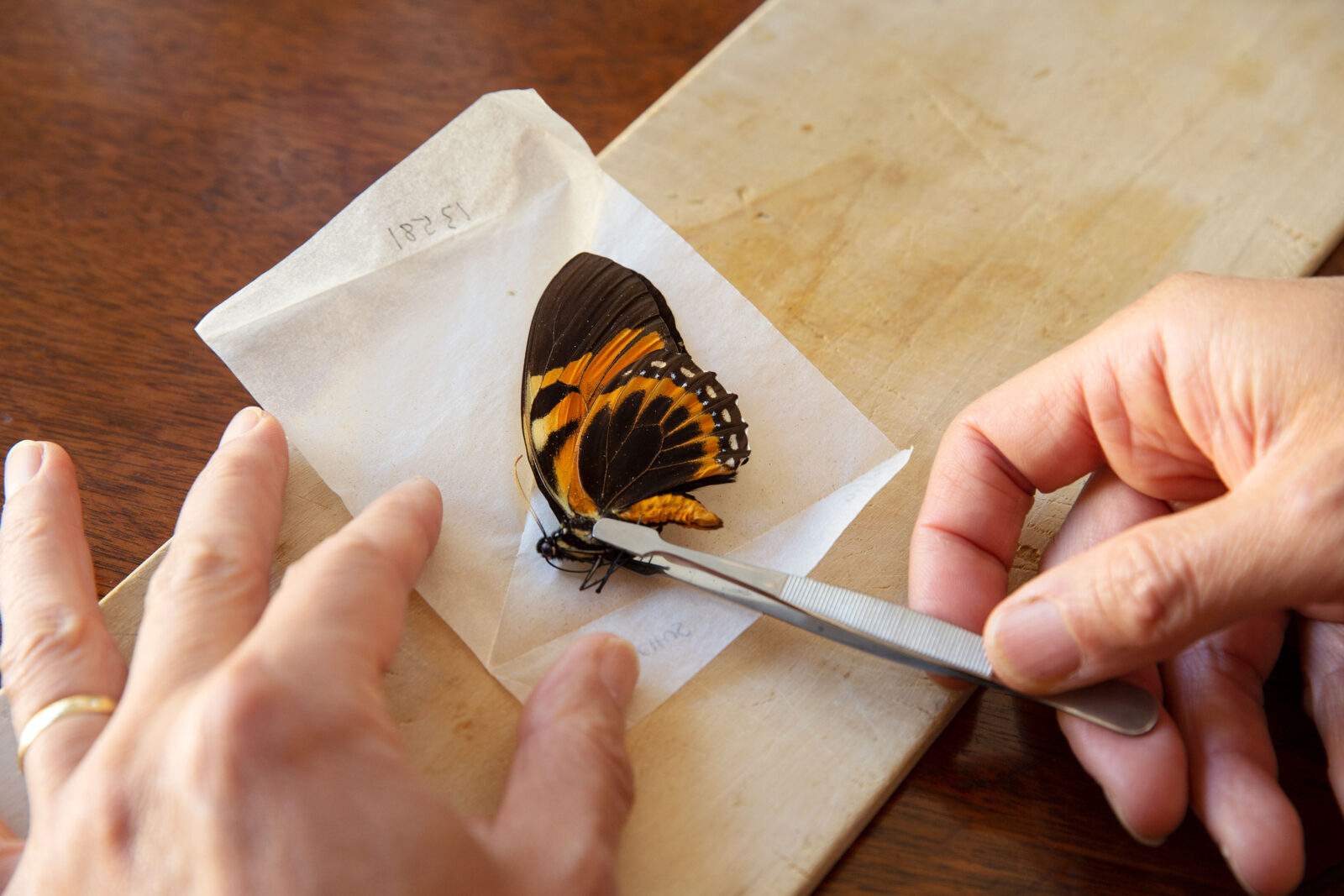
John McArthur caught a butterfly with his bare hands when he was 10, but it all really started a year or so later when his family moved to Rome. They holidayed in the Alps when the hayfields were in flower and so were the wild tulips, soapworts and rock roses. There were bright blue gentians, edelweiss and orchids that smelt like vanilla. All attracted butterflies. The boy and his father made a net out of a coat hanger, a stick and a piece of fishing net, and he went catching. It was 1968. “I can quite honestly say,” he tells me, “that since then I have spent every single day of my life doing something with butterflies.”
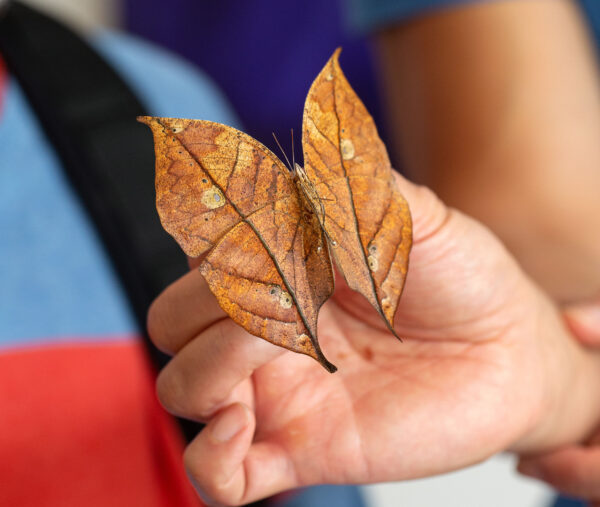
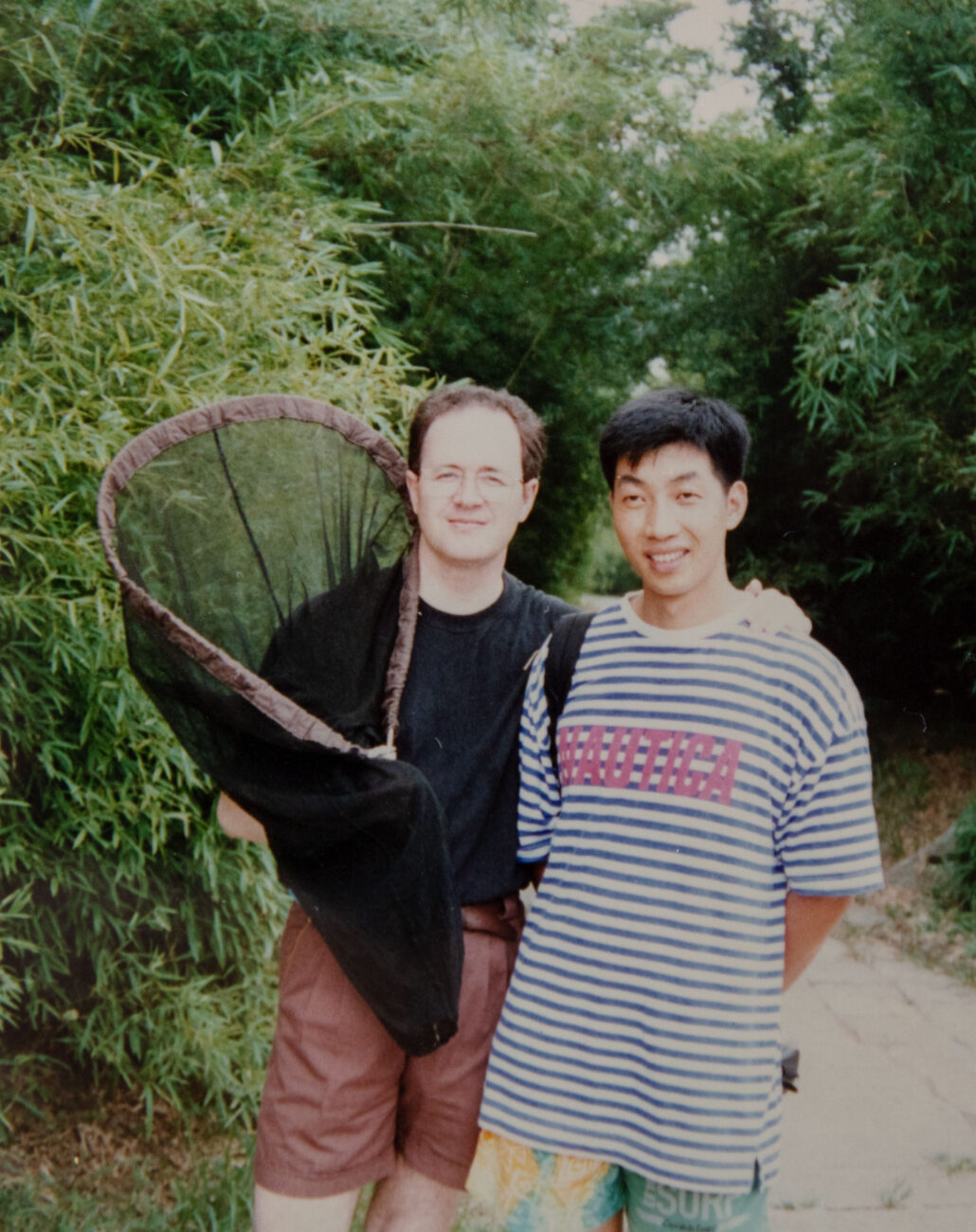
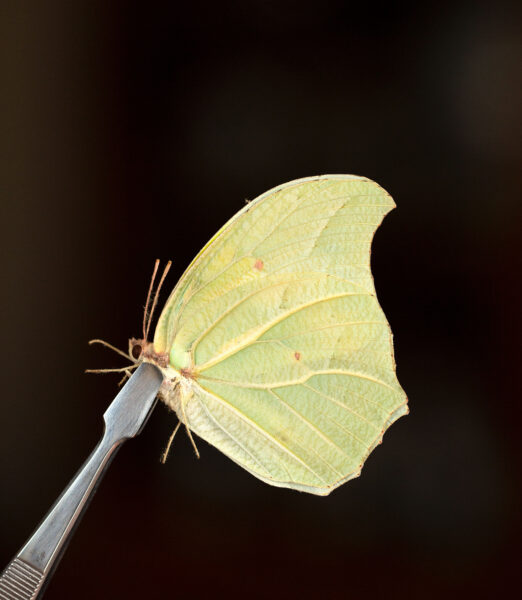
McArthur has netted thousands of specimens, many rare, in China, Japan, south-east Asia, France, Italy, Switzerland, the USA, and the Amazonian regions of South America. In Tingo María, Peru, he smeared the trunks of trees with a mixture of blood, alcohol, shrimp and rotten fruit—a method for luring Agrias claudina. In a jungle in Taiwan in 1995, he checked the ground for cobras before kneeling and gently popping his net over a Kallima inachus, a dead-leaf butterfly. The name is not hyperbole. The insect looks exactly like a dried-up leaf, down to the veins and even, on some, what appears to be mould or moss.
In 2006, McArthur made a final swish of the net. That year, he was diagnosed with multiple sclerosis. With his husband, James Hu, and a friend, McArthur made one last trip, walking with a stick in Nelson’s Cobb Valley. The group emerged into a clearing to see 10 boulder coppers, a dainty endemic species. They were on the ground—this butterfly likes to soak up the heat of sun-baked stones and shingle. McArthur dropped to hands and knees and crawling, he caught one, his last.
*
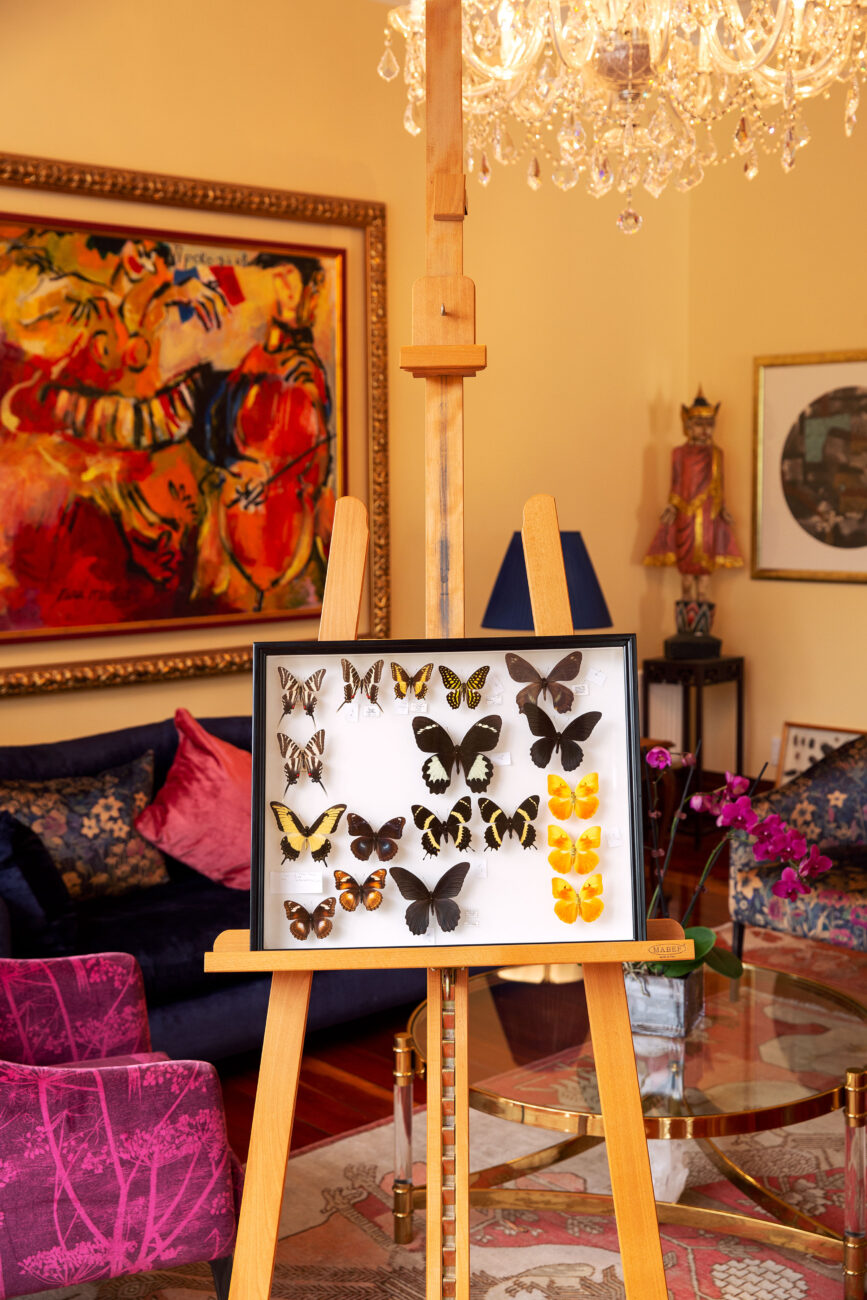
McArthur is 67 now. He lost all ability to walk only six months after the Nelson trip and when I spend a day at his home in Wellington, he sits strapped into a wheel chair, dressed sensibly in merino wool. Hu joins us at times to talk, at others to bring McArthur a glass of water, or medicine. He’s in his 60s, too, but I know this only because he tells me—he is a youthful presence in bright sneakers and bright socks. The two share a grand old house: wide halls, antiques, chandeliers and everywhere paintings by McArthur’s mother, Piera McArthur, rich with colour, many in gold frames. But where are the butterflies?

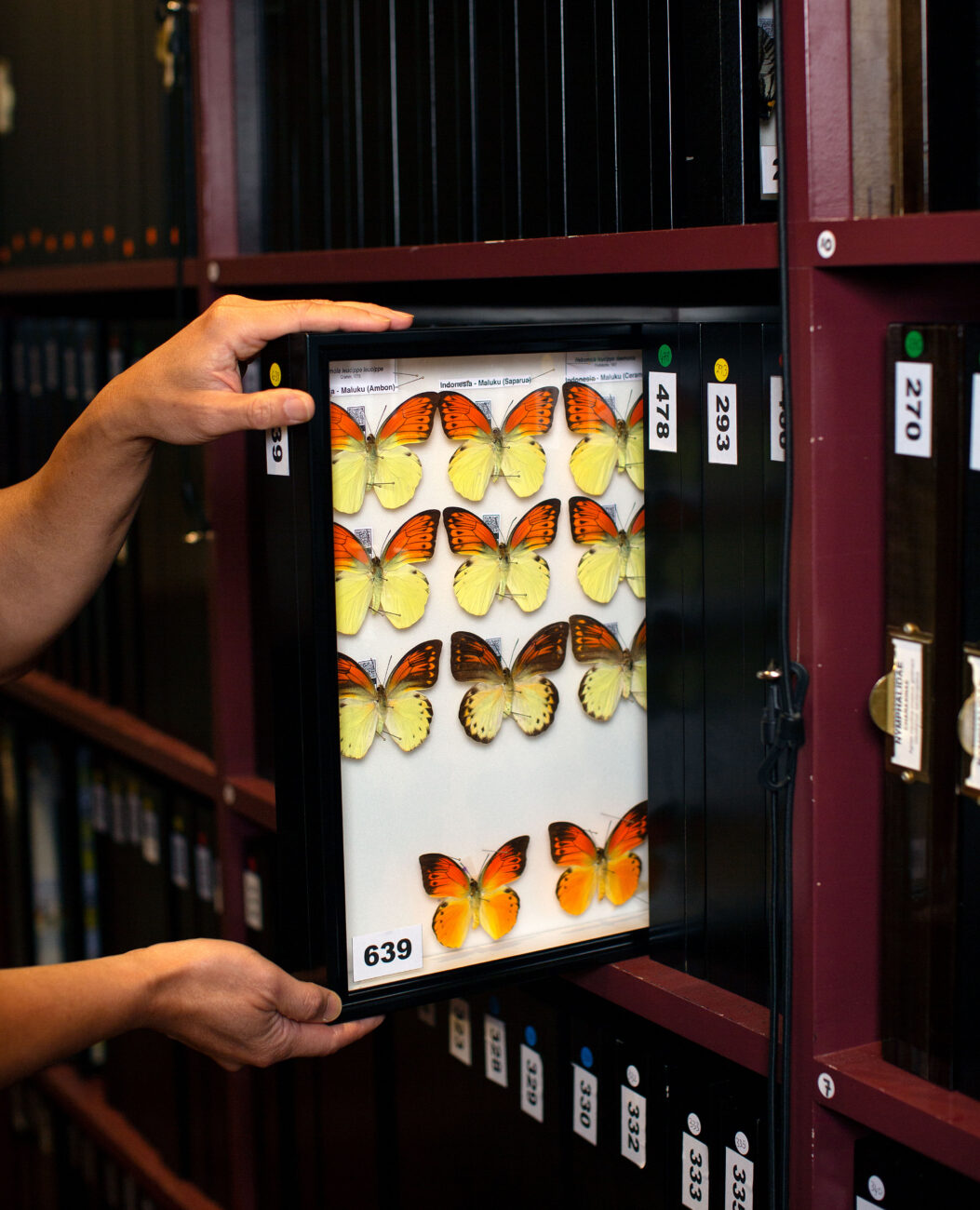
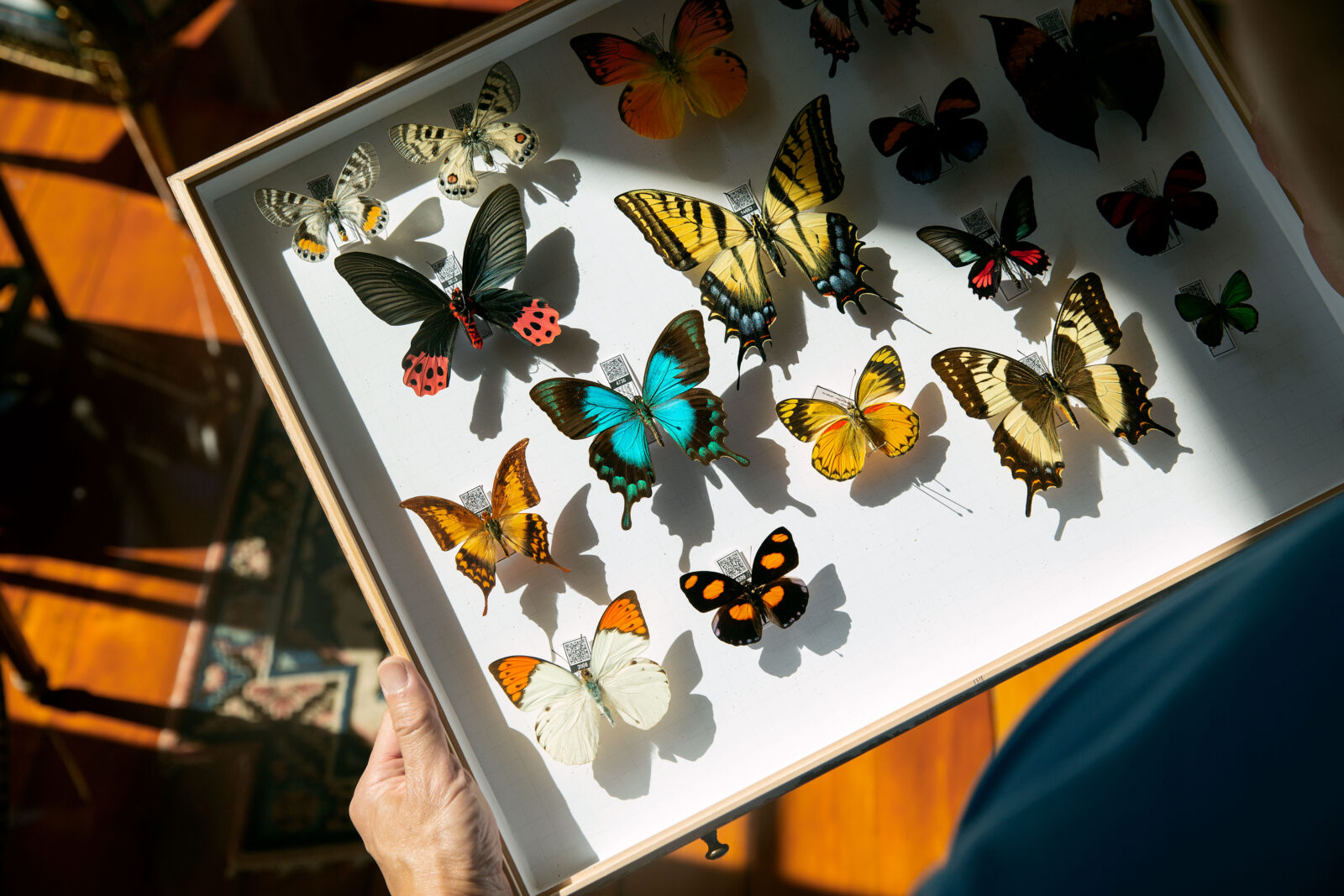
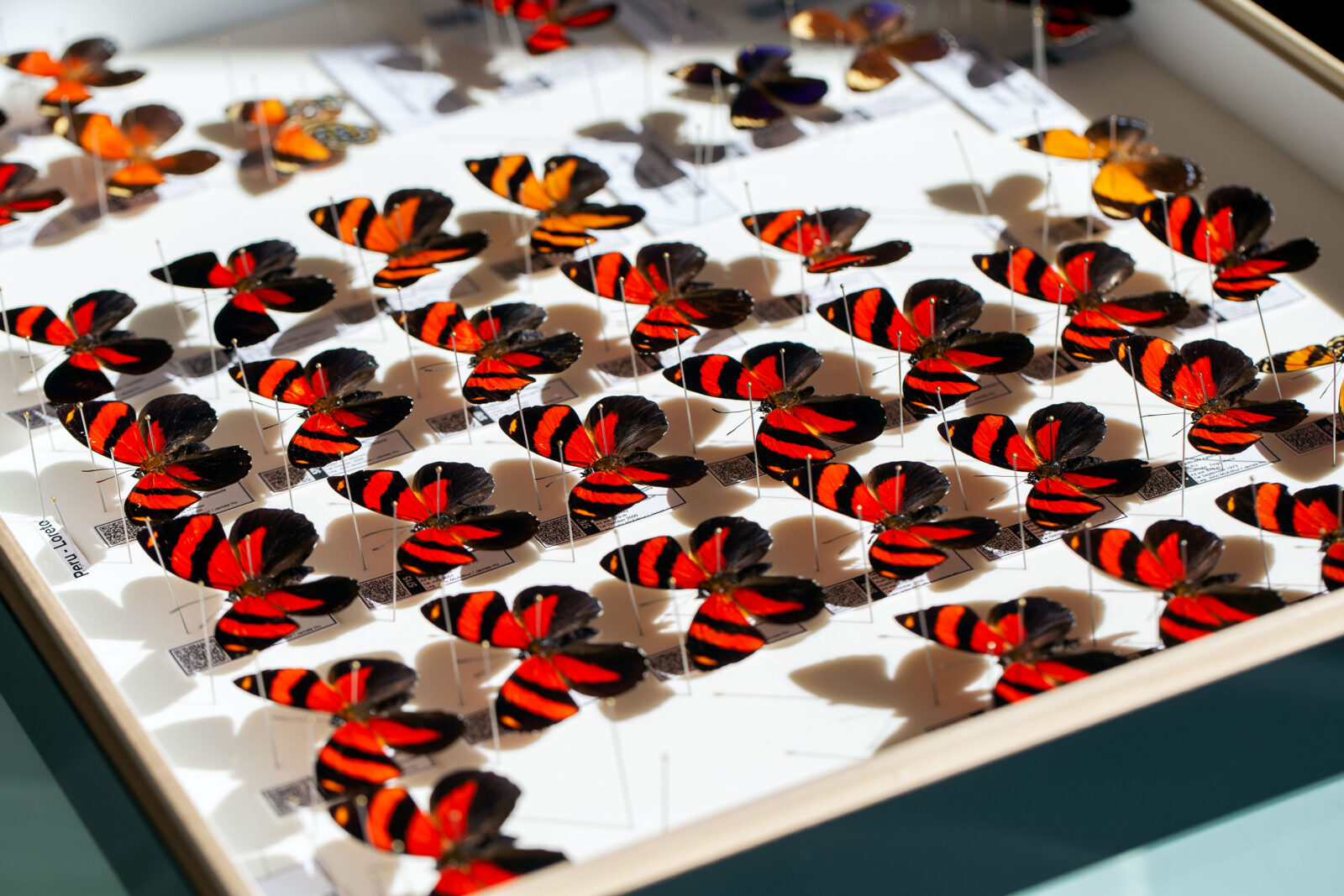
Hu leads me out of the lounge, through the kitchen, and opens a door to a narrow room. Within are shelves from floor to ceiling and on each is case after case of butterflies, stacked on their sides like books. Hu slides one out. I catch a flash of orange and iridescent blue wings and the word Ecuador, before he slides it back into place. Hu only knew the room was being added to the house, he says, when he spotted it on the architect’s plans. But there was a clear need. McArthur has collected more than 20,000 butterflies—around a third of which are his own catches, the rest swapped or bought—and almost half are mounted in these glass-and-timber cases. It is a life’s work, and I am here for its final fortnight. McArthur has decided to donate his butterflies to the Natural History Museum in London. Already he has sent 1500 South American blue morphos, and soon the rest will go, too.
*
It is not easy to have a collection accepted by the Natural History Museum. McArthur has been discussing the possibility with them for a decade. Once there, the collection will be dispersed, each case added to the relevant holding, no longer together as a single collection. The end of something, but also a kind of immortality. The museum vaults are fireproof steel, McArthur says approvingly. He and Hu have been to see them for themselves. The vaults were built to hold these tiny, fragile things for as long as we can conceive. As proof, both men speak to me about the oldest butterflies in the museum’s collection, insects whose wings last fluttered when Charles II was on the throne.
This permanence is part of McArthur’s decision. The other motivation is obvious. MS is a disease in which the body’s defences turn on its own nervous system, and it is a thief. Not only has it taken McArthur’s ability to walk, this year it took his hands. They lie in his lap, one sitting palm up, incapable of setting and pinning, let alone netting another butterfly. He feels tired, and he is often in pain. “But I am lucky,” he says, because the disease has spared his brain. This is evident. His memory is cast iron, his knowledge of butterflies undimmed. McArthur has help from his sister and from Hu in managing his collection, but he is the expert. Donating now allows him some agency over its future and means his expertise will not be lost.
His voice is hoarse. “I don’t know how much longer I’ll last,” he says. “Probably a few years. So it’s time to get this show on the road.”
*
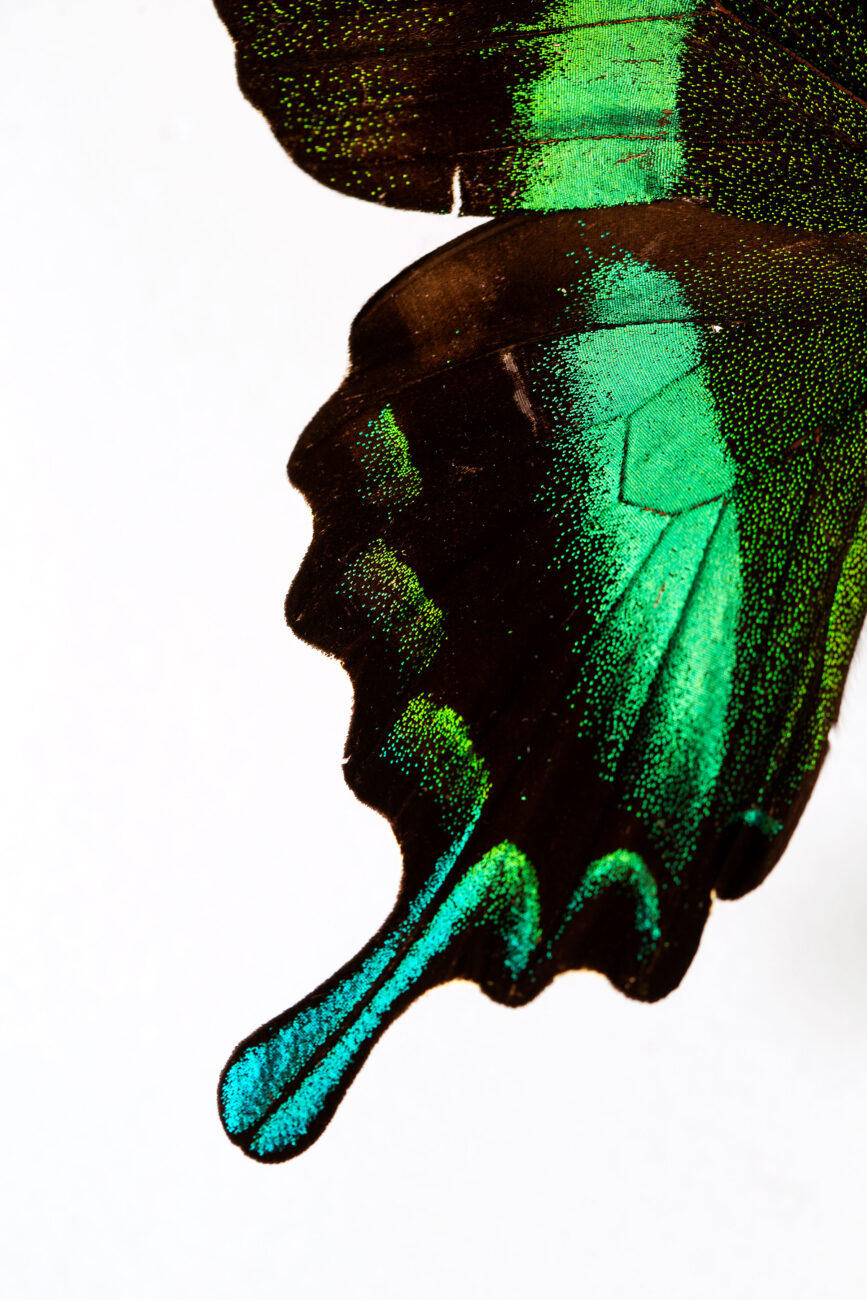
There are swallowtail butterflies with hindwings that come down in long, fat tear drops, or in thin tags that resemble extra legs. There are butterflies with wings that look like sunsets, like deep ponds, or like nothing at all but colour and shape. But the rarest in McArthur’s collection is one of the plainest, white with black veins, like a monarch that has yet to have the orange added.
In 1973, he took two buses and rode in a truck from Santiago, Chile, to a village of three homes high up in the mountains. He spent his first two days acclimatising to the thinner air, staying with a llama farmer. He saw lakes crowded with pink flamingos. More importantly, he saw butterflies, their white wings catching the light, a contrast to the barren brown mountain slopes. He caught some “on the wing”, and back in town, he learnt that among those catches was a first, the only known female specimen of Hypsochila peñai.
This particular catch is not in his collection. His father convinced him to donate it to a Chilean museum, and in gratitude they gave him a male of the species, almost as rare, one of only seven in the world, and this is the plain white butterfly that sits in a case on an armchair beside me. The collection is one of time and place as much as it is one of insects pinned in boxes.
When I ask McArthur for the names of various butterflies—using him as a Google search; not once does he resort to a book or computer—he spells them out, savouring them, it seems to me, saying those names the way people talk of somewhere they’ve had a life-changing holiday.
Mostly, though, he speaks carefully. He was a diplomat for most of his working life, with service including New Zealand ambassador to Japan, consul-general in Shanghai and a trade role in Taiwan. Early in his career he worked in the embassy in Beijing and was in Tiananmen Square in 1989 shortly before the tanks rolled in. He saw and heard horrific things, but he doesn’t say so directly. He says instead, “China has a lot of memories for me, good and bad.”
Diplomacy is the family trade. His father was New Zealand’s first ambassador to Chile. McArthur junior was off catching Hypsochila peñai only a few months after the 1973 coup against President Salvador Allende. He speaks five languages. He’s had a life of the world, and of protocols, talks and cables. I wonder if this has some connection to collecting. At the very least, it has allowed McArthur the opportunity to live in about half a dozen different countries, providing access to the butterflies that inhabit them. The temptation is to look further than this, to find clues, a modus operandi even. Perhaps there is overlap in the very careful nature of diplomatic work, where sensibility and tact are prized, that lent itself to the delicacy of butterflies? No. It was just the travel, McArthur says. “Work used to put me in the right places for collecting.”
I keep looking for clues, but the collecting impulse is just that it seems; it resists a deeper explanation. Most of McArthur’s family are collectors of some sort, although generally their interests run to antiques.
“Your mother is a painter; is there a connection there?”
“No,” he says definitively, but she’d always been very supportive. “Except when she discovered that I’d cut up the inside of one of her ball gowns to make a net.”
*
McArthur did not consider a New Zealand museum. It is something he feels bad about, but he believes we lack the facilities to take and manage a collection of this size. “A collection needs space. You need somewhere to put it, someone to look after it, someone to pay the rates, the electricity. And that’s not really possible in New Zealand—at least, it wouldn’t be looked after as well.” The Natural History Museum is already home to more than five million butterflies. It is also where researchers go to study butterflies, and McArthur hopes this means his collection could have some value to scientists.
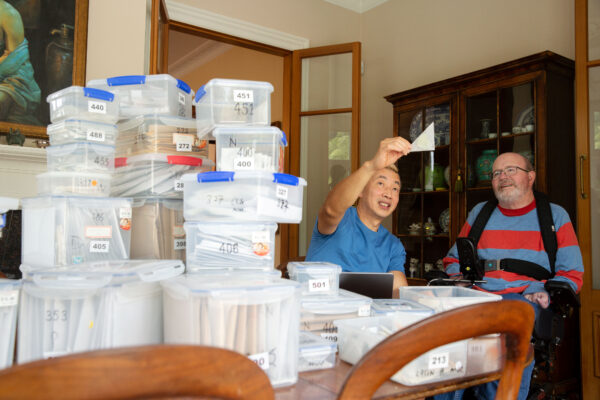
Dr Blanca Huertas is the museum’s principal curator of insects. She is a butterfly expert, helped along by her upbringing in Colombia—a country estimated to be home to 20 per cent of all butterfly species on the planet. She endorsed McArthur’s hope for his collection. “John always thinks of his collection as a repository of information, as we do in the museum,” she says. “We don’t think in terms of stamp collecting or pretty things to keep in the house. He’s always been very, very mindful of the data.”
Each of McArthur’s butterflies is accompanied by a tiny printed QR code, and scanning it provides a link to a database that he and a data specialist named Dominique Hawinkels developed, which contains the butterfly’s name as well as the date and location of capture. It is a record of what was living where at that point in time—vital information as humans cut down forests on which butterflies depend, and as climate change makes some parts of the world more or less habitable for butterfly species. Butterflies are particularly good markers of change. They offer, as Hu says to me, “a secret recording of the environment for the last few hundred years”.
*
For an hour at McArthur’s house we leave butterflies behind. Hu wheels McArthur to a table set with three bowls of pork dumplings, made from scratch and floating in a chilli broth. We eat and we talk about China, Hu’s home country. The two met when McArthur was a diplomat there. It’s also a country in which I have lived briefly. We compare notes on the places we’ve been, and on Chinese food. Hu brings McArthur’s chair to the table, and adjusts it so he can sit closer. And then, as we speak, Hu moves to him, bringing a dumpling to McArthur’s mouth, without breaking the conversation.
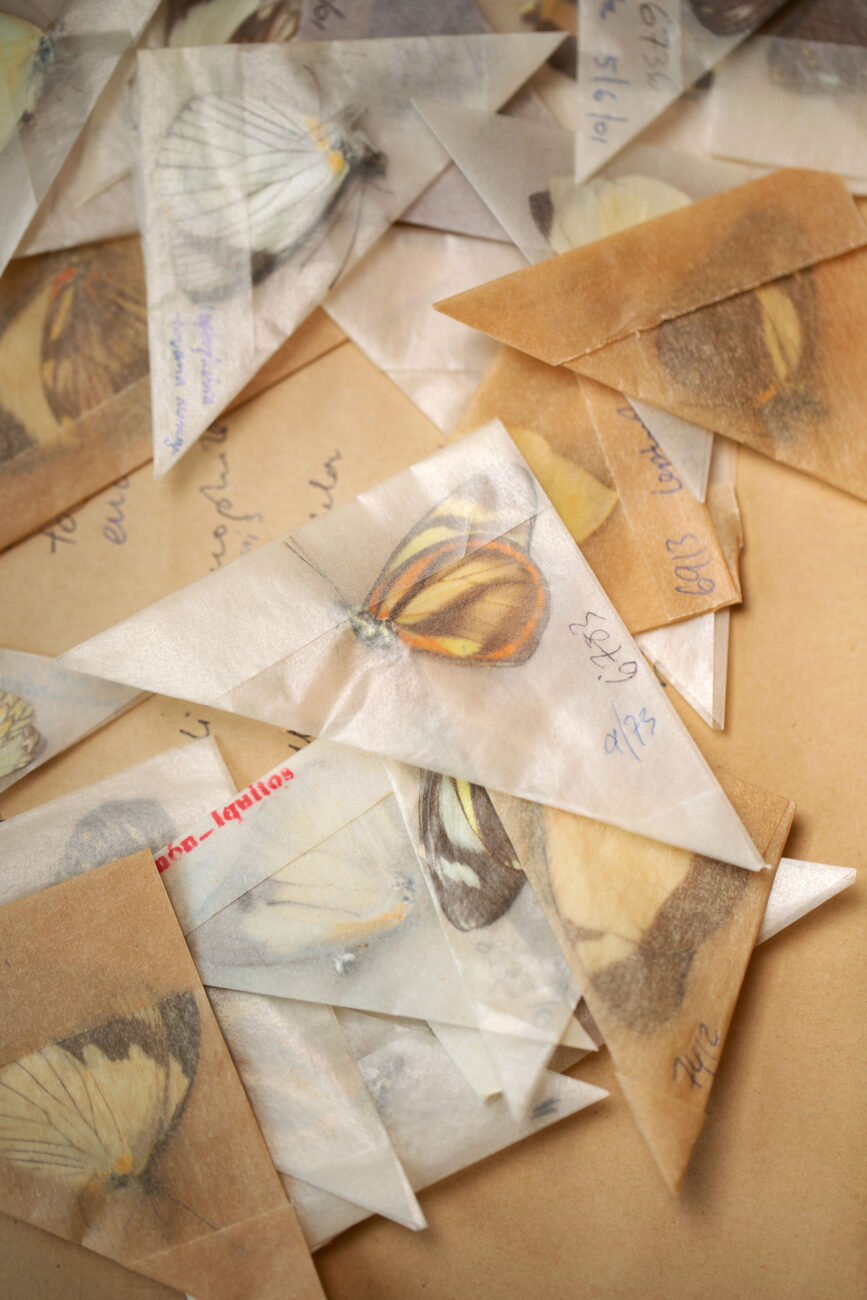
This is what they do, how they live. In the dining room next door, Hu’s laptop sits open on a handsome mahogany table, surrounded by small triangular envelopes of parchment paper. Within each is the dark shape of a butterfly. Beside a candelabra are Snap Lock boxes full of these envelopes. He and McArthur’s sister are working to update the database, to make sure their records are correct and ready for the museum.
Hu hadn’t given much thought to butterflies until he met McArthur, he tells me. But after they did meet, back in Shanghai, Hu would go out on his lunch break and attempt to catch butterflies for him.
The collection is a life story, he says to me. I wonder if it is a love story, too.
*
When he died in 1901, Herman Strecker of Reading, Pennsylvania, had amassed more than 50,000 butterflies. It was the largest and most important collection of butterflies in the Americas, and it was stored in Strecker’s home. He had built it up around his day job as a stone carver and tombstone maker. Strecker was an extreme case—there were rumours he stole specimens from museums, pinning them to a corkboard hidden inside his stove-pipe hat—but his story speaks to the common themes of the collector’s life: dedication to the point of obsession, and more often than not, an amateur pursuit. The best-known butterfly collector owes his fame to his day job. Vladimir Nabokov caught and studied a tribe of blue butterflies called Polyommatinae, straining his eyes peering at their genitals through a microscope and describing his findings for scientific journals. When not doing these things, he wrote Lolita, Pale Fire, and another 17 novels, not to mention his translations, and works of poetry, criticism and memoir.
New Zealand has its own enthusiasts, small in number but as dedicated as their foreign peers. During World War II, an Aucklander named Ray Shannon was sent to the Solomon Islands to work as a radio engineer, but found time for butterflies. He would later talk of leaping out of a radio tower while trying to catch, in his bare hands, a large birdwing butterfly. His collecting continued postwar. He still worked as an engineer, but holidayed in Asia and South America, catching what he could, and purchased specimens, too. Shannon eventually collected around 13,000 butterflies and built a library of butterfly books. He donated the lot to Auckland Museum on his death in 2008.
McArthur had met Shannon, and he knows of others. There is a plastic surgeon in the South Island with an extensive collection, and there is Laurie Wills of Northland. Wills enjoys fame among collectors as the Indiana Jones of butterflies or, as described in an online collectors’ forum, the Tarzan of the trade, a reference to his ability to catch specimens in jungle canopies. Wills has travelled in the Pacific, the Caribbean and South America in search of butterflies, discovering five new species in the process.
He has jumped out of helicopters, and taken his net to places populated by snakes, scorpions, and bandits. He contracted blood poisoning on one Caribbean trip, and had his boat stolen by pirates in the Pacific.
Wills’ interest goes back to childhood, and like McArthur he spent part of his youth in South America. When Wills was seven, his father, a devout Jehovah’s Witness, took his family to Uruguay in an effort to spread his faith. There, an interest developed into an obsession. Wills now has a collection similar in scale to McArthur’s and the two are friends.
“Madness” is a word Wills uses when describing collecting to me. In fact, he uses the term six times in our conversation. McArthur calls it a “sickness, a psychological issue”. Both descriptions seem like ways to concede that there is something irrational about their interest, while making the point that they are powerless against it, too.
This theme appears, unintentionally, in their anecdotes. When McArthur returned from the trip where he’d caught that rarest specimen, the Chilean police told him the llama farmer he’d stayed with was a gun runner. On another trip he realised he had been chasing butterflies in an area frequented by both the drug trade and Shining Path guerrillas. Wills has similar stories of discovering risks only after emerging with his paper envelopes of butterflies. It is as if they are unable to fully see their surroundings once butterflies are in sight.
As a sickness it is also slightly contagious. Ending my phone call to Wills, I find myself gazing at the bright wings of a monarch in the bushes at my home. After visiting McArthur, I take my two sons swimming and, as usual, stay in the water too long. Leaving the pool, cold, wet and hungry, I spot a red admiral, a kahukura, basking on a concrete wall and I drag the boys closer to examine its faintly furry brown wings with their splashes of burnt orange, black and white.
*
When McArthur began collecting, he carried a killing jar. In the bottom was tissue paper and chloroform or cyanide—you could buy both from a chemist or hardware store back then. He would put a live butterfly inside, screw the lid on tight and wait for the poison to work and the insect to die. But this method is now passé. A dying butterfly can thrash its wings ragged on the walls of the jar. And so, for most of his collecting career, McArthur has reached into his net and pinched the thorax of a caught butterfly between his thumb and forefinger. This ruptures something inside the insect, a more instant death than chloroform.
I ask McArthur if he ever feels regretful about this aspect of collecting and his first response is a joke. “When I go to Buddhist hell, I’ll be stuck full of pins.” But then he pauses for a moment. “Yes, I do,” he says. “I don’t like doing it.”
There is another question of killing, and that is of scale. His collection represents more than 20,000 butterflies taken out of circulation, no longer flying. Does he worry that he has contributed to the scarcity of some of these insects?
“No, not at all.” The real threat, he says, is the destruction of their habitats, “the food plants and sago palms. The rubber trees. The removal of the rain forest.”
The collector’s sample is nothing in the face of all this. If anything, McArthur feels that collections will soon become the only place to see many of these butterflies.
And yet he admits that if he were starting out again now, he might not collect physical specimens at all, but instead photograph and breed butterflies. He started collecting after noticing the beauty of butterflies. They were insects, and they were aesthetic objects, too. Flying flowers. He still sees this beauty, but his interest has enlarged to take in the science of butterflies, specifically their conservation. Laurie Wills holds a similar view. “The days of being collectors as we once were are long gone,” he says. “And so now it is about discovery, awareness and conservation. We’re a lot more committed to that than amassing these big collections that perhaps we would have 20 years ago.” But then again, Wills says, he wouldn’t have developed an interest in conservation if it weren’t for collecting. It was still part of that same passion, “a different aspect of the madness”.
*
When I next visit Hu and McArthur’s house, Darryl White, a general manager at moving company Crown Workspace, is standing beside half-empty shelves in the butterfly room. “Have you ever moved butterflies before?” I say this knowing that of course he hasn’t. I want to hear him express wonder at the task of moving 20,000 tiny winged insects out of a suburban home. Except that, more fool me, he says yes. It turns out he is an expert at moving butterflies.
“I’ve done big collections for Lincoln University, Canterbury University, and Invercargill Museum,” he says, and as he speaks he takes a case from the shelf (brilliant orange and yellow wings), wraps it in pink bubble wrap and places it in the cardboard box at his feet.
The trick to moving these most fragile of things, White says, is “plenty of base isolation in the packing materials” as well as a lot of stickers on the boxes so the next people to handle them and the ones after that will know to be careful. Once packed so, they will be taken to a depot in Porirua, transferred to a pallet, shrink-wrapped and placed within a container to be shipped across the ocean. No final flight, then, for these butterflies.
McArthur is in the kitchen, at that same table where I’d eaten lunch with him and Hu, watching as a young man named TJ tapes a box shut. Throughout the day, TJ asks questions as he works. “I’d like to know your favourite butterfly and why?” he says. I was right the first time: there is something about moving butterflies that demands wonder.
McArthur thinks for a moment. He can only narrow it down to a favourite family of butterflies, which are found in Peru. “The top side is black and blue and when you turn it over it’s grey and has the number 88 on it.”
“I think I’ve already packed that one.”
More by John Summers

McArthur is keeping his New Zealand butterflies—they’re not allowed to leave the country—as well some from one family, Riodinidae. A further 50 specimens will be kept and pinned not according to family, genus or species, but by when caught, creating a picture of a life of collecting, a kind of photo album of once-living things.
“So, you see, I am unable to let go completely,” he says.
Behind him, White, TJ and a young woman from Crown named Resse walk by with box after box, stacking them in the hallway. All the while, from the kitchen comes the constant screech, screech of packing tape being pulled from a roll.
“How do you feel?” I say.
“Very mixed emotions,” is as much as he says in the moment, but later, he considers the future.
“In 200 years, when there are no more butterflies, somebody will look at a specimen and say, ‘McArthur-Hu, I wonder how that happened?’”
Two more men from Crown arrive to take the boxes to a van parked outside. “I want to see them take them away,” McArthur says, and Hu wheels him into the hall. Stacked boxes line both walls. We watch quietly as those two men take away box after box, walking each out across the patio, down steps to the footpath.
On the street, there is work going on; a man with a stop/go sign has the traffic backed up. The drivers sit impatient, unaware that the boxes bobbing by contain the silken wings of four continents, a life’s collection. All that beauty is packed into a van.
Subscribe to our free newsletter for news and prizes
3
$1 trial for two weeks, thereafter $8.50 every two months, cancel any time
Signed in as . Sign out