What will it take to get landowners into native forestry rather than pine? (more…)
More by Veronika Meduna



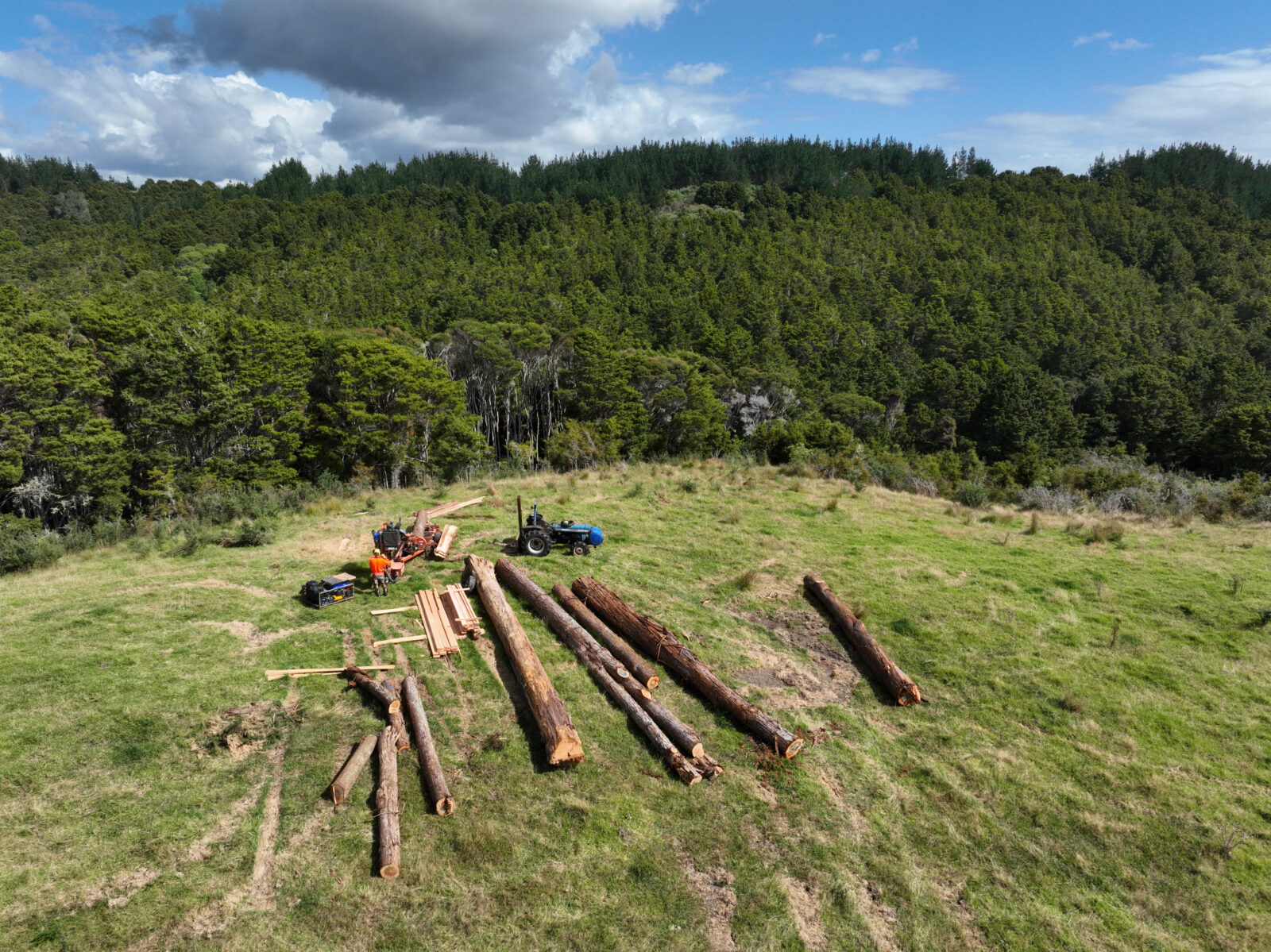
Paul Quinlan wakes up at four, vaguely nervous about the day ahead. The tūī are up particularly early, too, as if to herald a significant dawn. As Quinlan drives south from his home in Kaeo, others are hitting the road, too, headed for a patch of regenerating native forest on a farm just out of Kerikeri.
There, rooted near a stream at the bottom of a steep gully, stands a mighty dead tōtara. Nobody knows how old it is, except that it wears its “old-man bark”, suggesting centuries. There is something majestic about the tree, Quinlan says. “And a bit sad.”
Last night, there was a full moon. In the Māori lunar calendar, today is known as Rākaunui—a good day, decided local hapū Ngāti Rēhia, for the felling of this tree and a younger, living tōtara nearby.
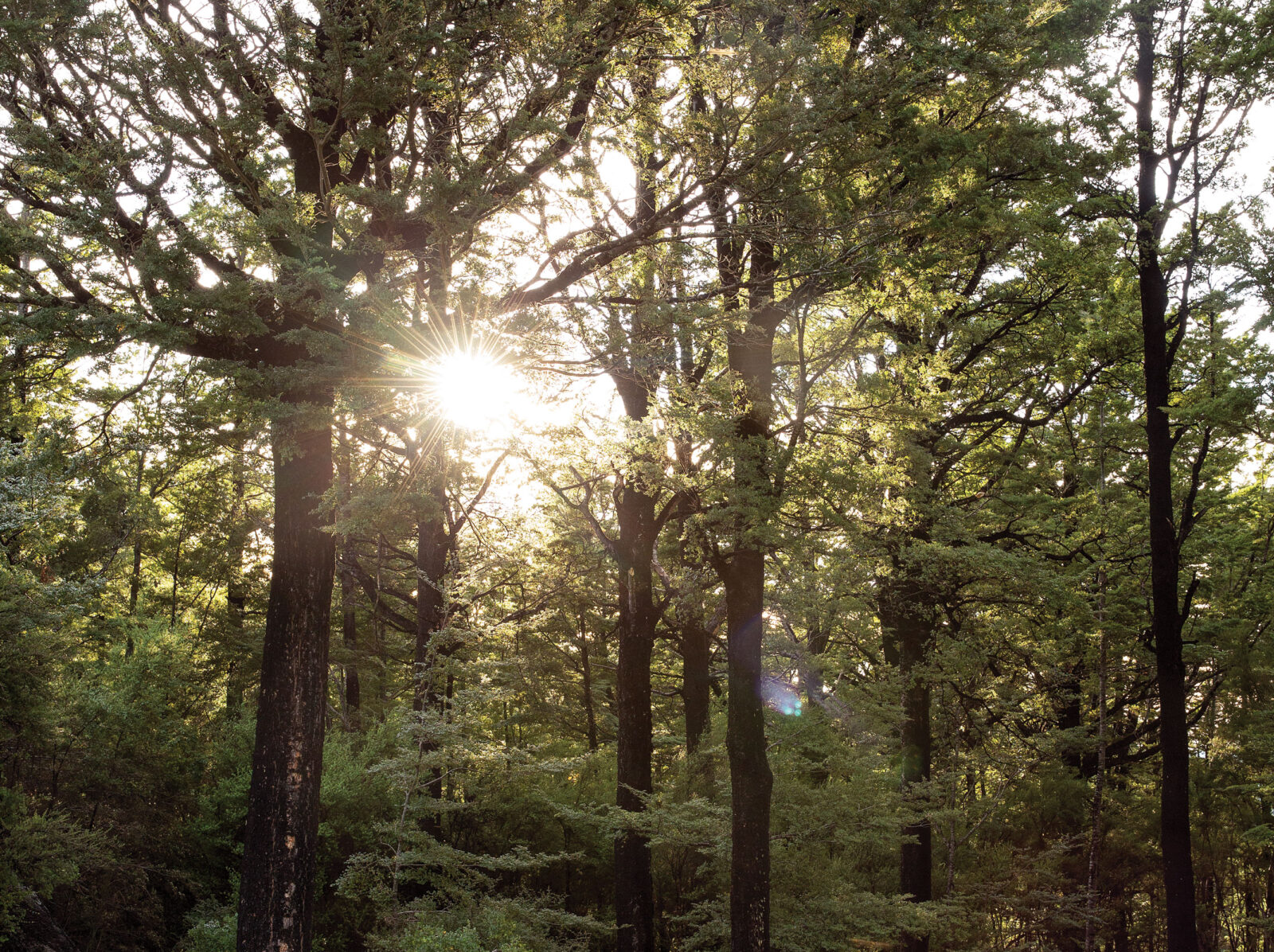
A karanga reverberates through the forest. Ngāti Rēhia master carver Renata Tane climbs down to the dead tree’s base to bless the harvest, rhythmically tapping the trunk with an adze while chanting a karakia. Surrounding the old forest giant, young nīkau sway along the damp banks of the stream. Rimu, taraire, kohekohe and gangly kānuka lean into the sun.
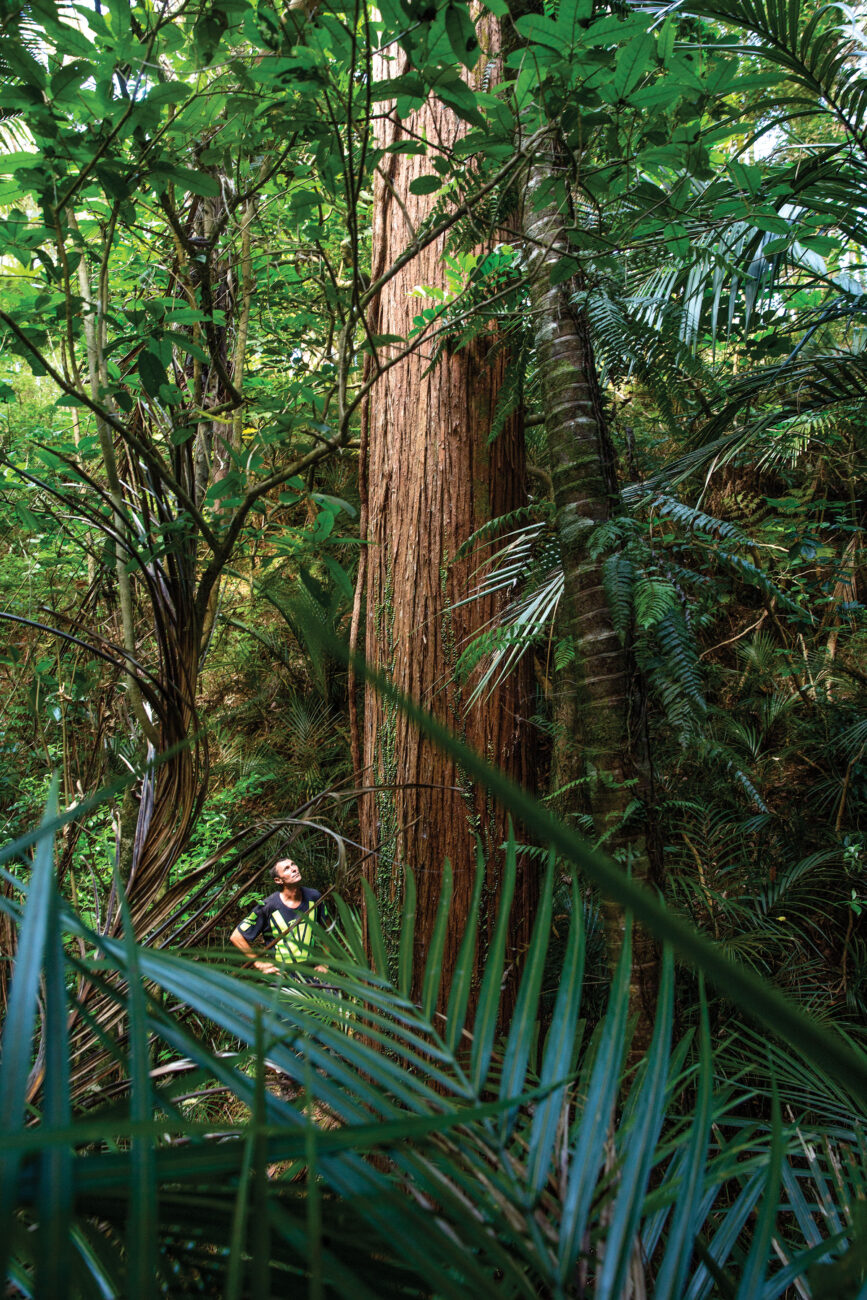
Tree feller Michael Harrison loops a chain around the tree, tying it to a bulldozer waiting at the edge of the forest.
The first chainsaw cut, a V-shaped wedge, determines the direction the tōtara will fall—between neighbouring trees, not on them. The second cut, opposite, stops just short of toppling the giant. Everyone retreats from the site and, with a tug from the bulldozer, the remaining hinge snaps. The tōtara comes down in a thunder of splintering wood. Its crown, white and leafless, shatters on the forest floor.
There descends what Quinlan calls “the quiet after the fall”: people watching in silence and awe as the shivering canopy returns to rest. Then the team gets to work, cutting off the broken top so the bulldozer can pull the 12-metre section of straight trunk from the bush, threading it carefully to avoid damaging other trees and saplings.
*
This and the younger tree are to be carved. But today’s harvest also has a broader purpose: each tōtara felled provides a plank of data for a native-forestry business model that could help transform struggling Te Tai Tokerau. Carefully choosing and felling individual trees, as the team did today, makes the most of tōtara’s remarkable ability to regenerate. “It grows like a weed,” says Quinlan, “and if you treat it right it grows straight and true.” Working a forest in this way—as kaitiaki—also keeps the land cloaked in carbon-sucking green.
Four years ago, a pilot project showed that this kind of selective harvest of tōtara could add up to $37 million a year to the local economy. Across the region, the report from that pilot says, “farm tōtara” already big enough to be milled grow on some 26,000 hectares of private and Māori-owned land (importantly, these trees are not propping up major forests, but rather scraps of bush, on land too difficult to farm). Those trees alone could keep an industry ticking for 10 years. Meanwhile, in the same patches of land, a legion of smaller tōtara—trees yet to hit half a century—are coming in strong. Well managed, they will provide a sustainable industry. Still-younger trees will pop up behind those. And so on.
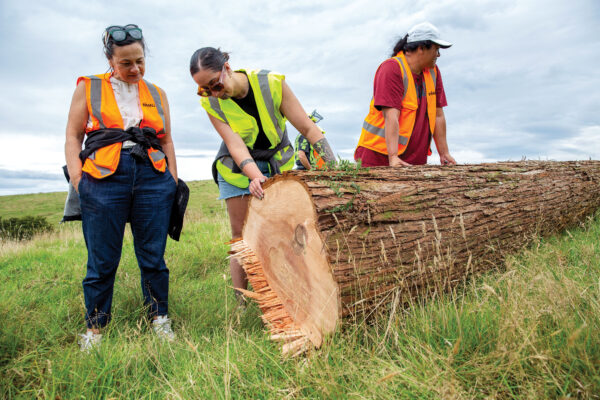
Quinlan is a landscape architect who harvests tōtara from his own forest in Kaeo and has built several farm buildings with the durable timber. He’s spent time learning from foresters in Germany, where selective harvesting is the norm rather than the exception. Ahead of the pilot study, he experimented with other native trees, but found tōtara’s exuberant self-seeding offers a big economic advantage. If we want to bring back native forests, he says, “natural regeneration is doing it at a much bigger scale than we could ever hope to plant, and at no cost apart from time”.
Undoubtedly, if we could do more forestry like this—log selectively, keep that leafy cloak on the land—it would be good for the planet. Native trees raised this way often do better than those in parts of the conservation estate where they are left alone: younger ones relish the light left behind by their elders, quickly pushing up to fill the gaps. The permitting system that covers native forestry usually obliges landowners to control pests and weeds, so that over time, the forests become rich ecosystems, home to a mix of plant species, as well as insects and birds. Allowed to push deep into the ground, and to hold one another, the trees stand up to storms better than plantations of radiata. When it’s time to take out a few trees, selective harvesters are able to tread lightly, without the heavy machinery used to clearfell—that means less soil erodes and runs into streams.
And all the while, the canopy inhales and exhales, barely missing a beat when the occasional big tōtara blinks out. Carbon sinks don’t get much better than establishing native forest.
Yet New Zealand remains mesmerised by the straight lines of pine.
Today, plantation forestry covers two million hectares—seven per cent of land in New Zealand. Ninety per cent of that forest is quick-growing Pinus radiata, grown and clearfelled on a 30-year cycle. Forestry is the country’s fourth-largest export earner, pulling in $6.6 billion per year, and it employs about 40,000 people.
The industry is largely driven, says Heidi Dungey, a forest geneticist at Scion, by overseas investors “excited by the regular returns it offers”. She says it’s been decades since we invested properly in other types of forestry. So the infrastructure—all the way from seedling production to harvest methods and the system that dictates how much money foresters can earn through carbon sequestration—remains heavily biased towards pine.
But people who work with trees, especially our long-lived native species, operate on long timescales. They’re watching the climate crisis deepen—the slash piling up on beaches, the rivers choking on mud, millions spent cleaning up storm-smashed pine—and hoping that eventually, the needle will shift.
*
Fifty years ago, when John and Rosalie Wardle bought 120 hectares of black-beech forest near Oxford, in north Canterbury, people thought they were mad. Back then, the only market for the durable, reddish-grey timber was firewood. Pocked with the black streaks left by pinhole borer, it was not considered saleable.
But the Wardles had a dream of becoming self-sufficient and John, a scientist at the then Forest Research Institute in Christchurch, had spent decades studying New Zealand’s beeches. Fiercely independent, he saw a chance to be his own boss and to put his knowledge into practice.
It was an every-weekend project at first—they kept their home in Rangiora, and John kept the day job. But in the forest, with three young children in tow, the couple set up tents among the trees to mark where their home would eventually be. When the camping wore thin, they built their first small hut. The kids got bunk beds; the parents were on lilos on the floor. “Invariably they went flat,” John says.
During their first winter, a massive storm dumped almost a metre of snow. It lasted for weeks, and John—who was a shorts-in-winter type—remembers trudging uphill through the drift to get to the camp, piggybacking his daughter, oblivious to the fact that his shins were being skinned. “I didn’t realise until Ro said there’s blood all down the snow.”
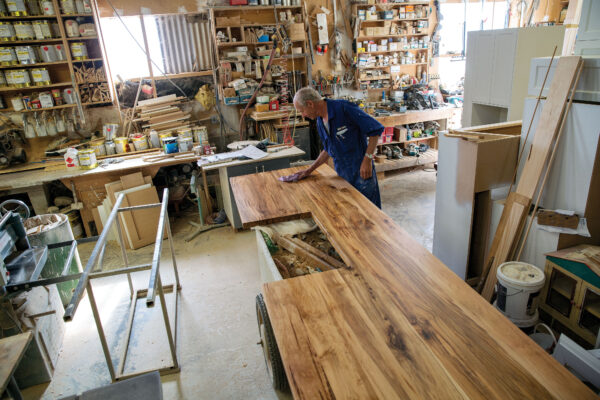
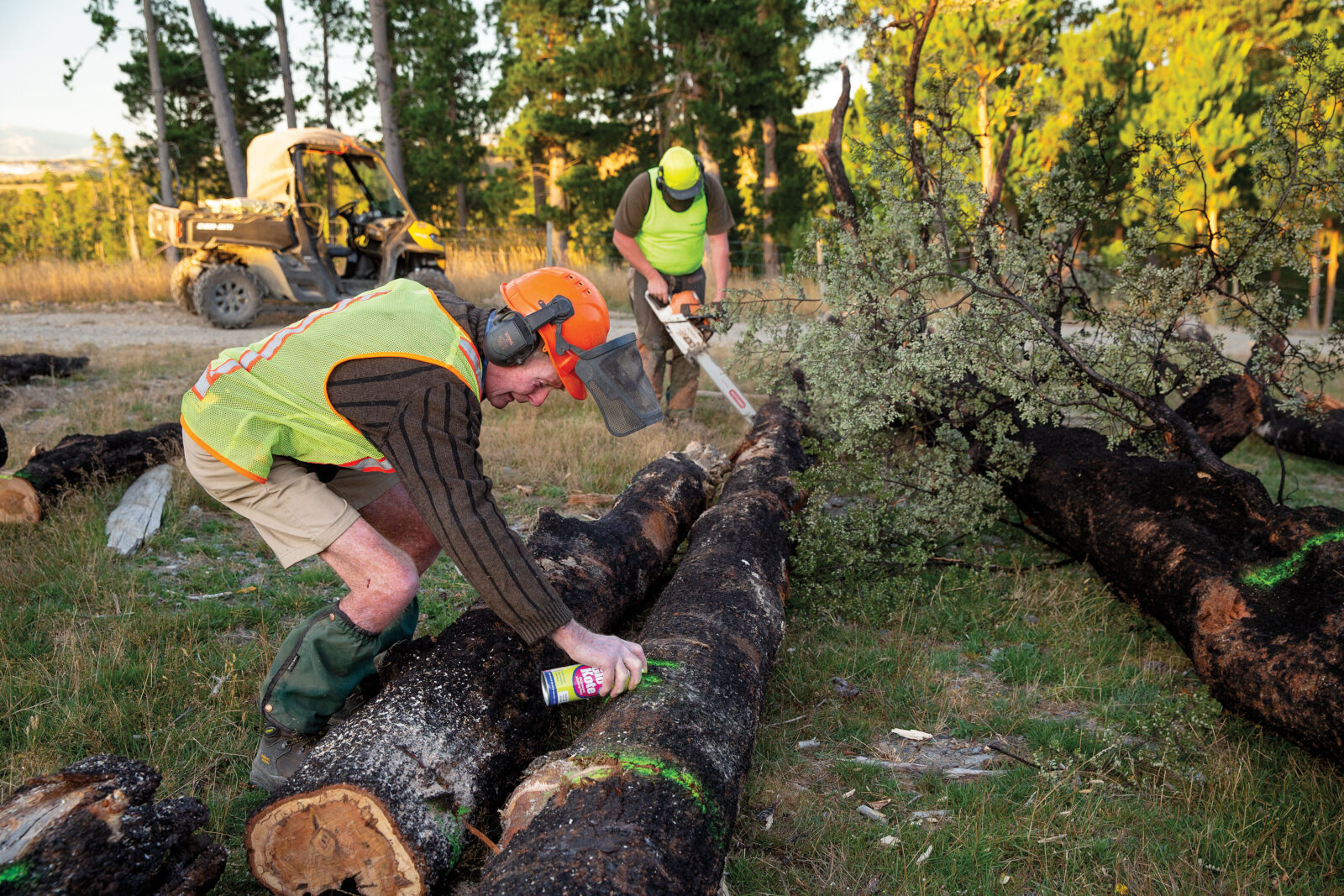
It’s midwinter when I visit. John picks me up in an all-terrain vehicle after my rental car looks askance at a ford. He’s wrapped up in long pants, thermals and a beanie against the chilly breeze—he’s older now and we plan to spend all day outside, exploring the forest. John is hosting a group of Lincoln University agroforestry students. Much of their other coursework is geared towards pine. But they’re keen to learn about John’s selective harvesting, as an alternative to clearfelling: forestry as applied ecology, as he likes to say.
After a slow walk through an experimental block of cypress and redwoods, we stop to huddle around John as he shares a brief history of this land, once covered in virgin native forest. It’s a familiar story: rampant colonial felling; a devastating fire; the swing to farming. The comeback of the trees started during the Great Depression, he says, when farming families were forced to walk off the land. By the time the Wardles came on the scene decades later, the beech forest was back, sprouted from trees that had survived the fire. “Native forest is very capable of coming back rapidly,” he tells the students.
Up north, Paul Quinlan insists it doesn’t have to be all or nothing—that native, selective-harvest forestry should complement the pine industry, not compete with it. The Wardles have lived this approach. For 20 years, they gathered fallen beech to sell as firewood—during droughts, this also helped to reduce the risk of fire. While tending the regenerating beech, they also planted pine on 27 hectares that were covered in gorse, and now harvest these blocks selectively, too. As anyone who works the land knows, a single income stream can be trashed in a season. The pine now provides the main income but the beech is a safety net. So is a small flock of sheep, and honey—in summer, bees hoover up the honeydew left by scale insects that live in the bark of black beeches. (John stresses that the beehives are moved into the forest only late in summer—this way, birds get first dibs on the honeydew during their breeding season.)
Not long after purchasing the property, the Wardles brought in a portable sawmill and began to feed it their beloved beech. They upgraded the hut to a home—“Rosalie developed Herculean muscles shovelling concrete”, John says—and started producing timber for sale.
Gradually, beech began to trend. The pinhole borer marks, which once wrote it off, now made the wood rustic and sought-after. Suddenly, people wanted it for door handles, panelling, flooring—and the Wardles secured reliable sales to timber merchants. The beech now fetches $800 per tonne, compared to $600 for pine, and the timber merchants pick up the cost of sawmilling, transport and processing.
It took 13 years of slog before John could quit his job. The Wardles moved into the forest fulltime and in 1994, secured the country’s first permit for continuous-cover native forestry.
For the couple, working a forest full of trees that are different ages and species acts, like the honey, as an insurance policy. It also helps to prop up the forest itself: John’s noticed that when he thins a stand of beech, the roots of the remaining trees get thicker and spread out, gaining a stronger foothold.
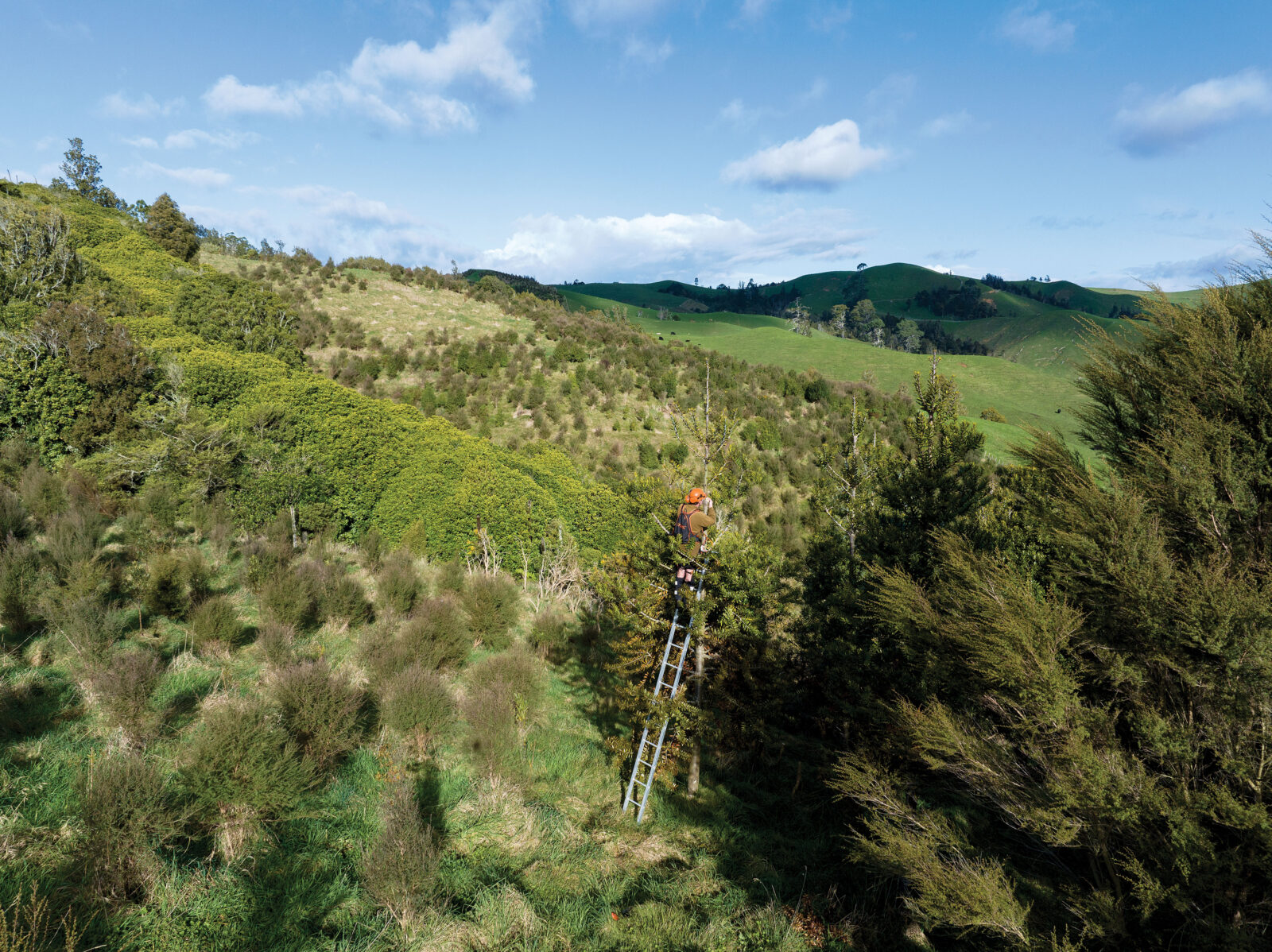
At 88, John still does all the pruning himself, although he is now limited to an extendable hand saw because Rosalie no longer lets him climb up trees. He walks in the forest every day, checking on trees coming up for harvest, and becomes restless when he can’t be out and about.
The couple have placed the entire property under a QEII covenant to make sure it cannot be subdivided. Nor can anyone waltz in and log the lot—but sustainable harvesting can continue.
Their decision to work the forest this way was partly pragmatic—it’s tricky, expensive and wasteful to harvest everything in one hit on hill country, because the trees grow in all shapes and sizes. Clearfelling also delivers an income only once every two to three decades, while selective harvesting makes for steadier, more predictable earning, John says. But it was also about simple instinct, and a love for trees. Rosalie, says John, “looked across the land and said she’d hate to see it clearfelled”.
*
Right now, struggling New Zealand farmers are, like the Wardles, looking at their land and trying to figure out how to make it pay. For many, it makes more sense to plant a forest, or sell to someone who will, than it does to keep plugging away on the paddocks. And so the country stands at an inflection point. In May, a report by analysts Scarlatti predicted that under the status quo, by 2050 around half of the five-plus million hectares now used to farm sheep and beef would be converted to forestry, mostly pine.
It’s tricky to make meaningful economic comparisons between typical pine forests, where harvests—and associated paydays—happen once or twice in a generation, and the dripfeed of income from selective harvests. Scion estimates that growing pine on highly erodible land could return the equivalent annual income of $330 to $640 per hectare. Research carried out at the Wardles’ forest shows that at least for pine, selective harvests are just as lucrative as clearfelling. Native timbers still lag—not because the wood is less valuable, but because the markets and infrastructure are less developed.
But forestry is no longer just about selling wood, of course. For any forests established after 1989, foresters can also claim carbon credits, with the payoff per hectare worked out depending on the tree species and their growth rate. The maths used to figure out these payments favours pine: pine grows much faster than native species, meaning it earns more. (As well, the official tables used to work out how much carbon different species of trees are stashing—and therefore how much money they should earn—are widely considered not fit for purpose. They are overestimating the power of mature pines to sequester carbon, a 2023 study found, and underestimating big natives, largely because the data for natives is based on individual species or kānuka scrub, rather than the complex, carbon-sucking network that is a multi-species forest.)
Scientists at the government-funded research group Our Land and Water/Toitū te Whenua, Toiora te Wai spent eight years attacking the wicked problem of how we might use land in a way that at once keeps farms productive and water clean. Figuring out how to make native forestry pay has been a big part of that work. Imitating nature by planting small-grade seedlings, as well as getting started with cheaper “nursery” species such as kānuka and mānuka to shelter the next generation of bigger trees, the team managed to slash the cost of establishing native forest on erosion-prone land. The typical bill was around $30,000 per hectare; the “Tīmata Method” pushes that down to about $10,000. (Pine is still cheaper, coming in at between $1330 and $1700 per hectare, depending on the slope of the land.) Thinking laterally, the scientists also looked at using pine as a nurse crop for natives—the idea is that pine pumps out quick cash in the form of carbon credits, then gets knocked back once it’s stopped growing (at which point the carbon earnings are maxed out) and the native species underneath are ready to take over.
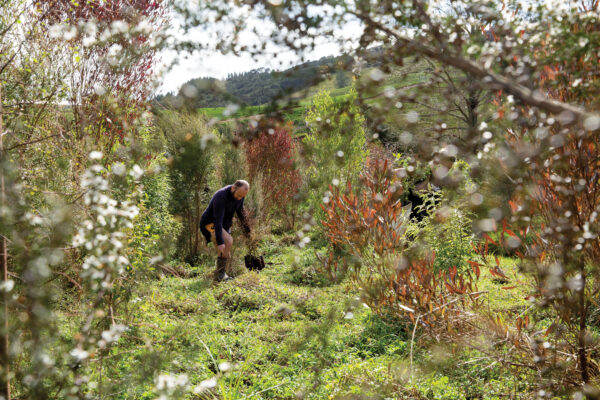
Another study looked at the benefits of planting a type of diluted native forest across farms still stocked with sheep and cattle. Pocking a paddock with species such as kānuka and rewarewa helps to prevent slips and erosion, the scientists found, as well as giving stock precious shade and shelter, supporting birds and insects, and potentially boosting nutrients and grass growth under trees. It also brings in money through carbon credits.
But in the face of a system profoundly geared towards pine, it seems all of that may be just tinkering around the edges. The Our Land and Water project wound up in August, and in its swansong days, sounded an alarm (albeit one delivered in measured, scientific tone). Results from four of the group’s major modelling projects had just landed, and although they came at the question of future land use from different directions, they all pointed the same way: pine. Farmers, despite wanting to swing to native forestry, are going to plant pine instead, the models predict, because so many economic and policy settings are driving them in that direction.
The scientists were not expecting such stark results. They convened a press briefing and published a white paper. “The extent to which pine forest was being put forward as the best option, the most obvious option, the easiest option to take, was surprising,” said project director Jenny Webster-Brown, a water-quality scientist. “These results are driven by policy choices. If we make different policy choices then we’ll get different outcomes.”
The white paper recommends, as a priority, converting the most vulnerable, erosion-prone New Zealand farmland to native forest. It flags what is lost when a farming region instead becomes a pine forest—jobs, community, a way of life—and notes that like farmers, the general public would rather see native forests. Such forests could turn a profit long term, the paper says, if new types of carbon credit are introduced—credits that reward biodiversity, or native forests planted to stabilise land, or simply the fact that the trees are natives, not exotics.
In 2023, before the election, there were whispers of a tweak to the emissions trading scheme that would incentivise people to plant more native forests. For now, such a change seems unlikely. Forestry Minister Todd McClay would not be interviewed, but agreed to reply to emailed questions. When asked about the potential of indigenous forestry on farmland, he said indigenous timbers have a niche role in the market and the government is not “intending any specific initiatives to expand or enhance native forestry”.
But perhaps an election cycle or two is not long to wait, for a tree. Stubborn new saplings of infrastructure are pushing through regardless, strengthening a future for a kind of native forestry that takes some trees but keeps the forest standing.
*
Tom Mackay-Smith, one of the scientists who worked on the project scattering native trees across stocked land, founded a start-up company last year helping farmers to do it at scale. “The response has been amazing,” he says; some keen farmers now have to wait as the company scales up. Over winter, the start-up planted hundreds of trees on 14 North Island farms, using their main innovation: a tree guard that protects seedlings from stock, but is also cheap and easy to use. Farmers want diversity, Mackay-Smith says, and are interested in planting trees for many reasons, including carbon credits and the welfare of their animals.
If left to its own devices, much of the farmland in Aotearoa would, over time, return to mostly native forest. The first to grow are kānuka, mānuka, karamū, māhoe—the pioneers that provide shelter, coaxing forth canopy-forming trees such as pūriri, rimu, rātā and tōtara.
Speeding up this process would make it much cheaper to turn farm into forest. Auckland University of Technology is working on that, with three long-term experimental plots already flourishing. At Te Muri Regional Park north of Auckland, the “nurse” trees have been planted at different densities, up to four metres apart, to track how well each spacing supports the big trees that come next. On a dairy farm near Pūkorokoro/Miranda, they’re only watering certain parts of the forested plot, to investigate drought resistance. I visit Pourewa Reserve, an extraordinary 34 hectares of green space overlooking the Ōrākei Basin in the heart of Auckland city. A native nursery on site is already producing hundreds of thousands of locally sourced seedlings, and a flourishing māra kai, designed in a circle with each quarter planted following the maramataka, feeds a hundred people each week.
On a hill sloping down to Pourewa Creek, two sets of nurse plants are in the ground. One is a monoculture of kānuka, the other a mosaic of māhoe, ngaio, tarata and karamū. Succession species such as tōtara and taraire are dotted among them, some planted singly, others in groups. Other saplings grow from seeds deposited by birds from a nearby block of native bush. Among Pourewa’s trees are perches set up with nets and funnels, to catch seeds and bird poo—scientists want to better understand how a neighbouring forest can help a new one to regenerate.
This is Ngāti Whātua land, returned as part of the iwi’s treaty settlement. Kaumātua Rob Small, whose own tribal affiliations are with the Ngāpuhi hapū Mahurehure, has been welcomed by the iwi to lead the site’s restoration. Walking me around the land, he shares its difficult history, and says the reserve is now managed “as a space that’s open to the people of the motu”.
AUT ecologist Hannah Buckley remembers what it was like in 2017, when the previous users of the land, a pony club, finally left: mostly tree privet, the odd cabbage tree, kikuyu grass. The grass is still there—it hasn’t been sprayed off because the site is managed according to hua parakore, a Māori system of organic food farming (as well as no spraying, no artificial fertilisers are used, and only seedlings with a provenance to this rohe are planted).
But tech is very much in play. Each canopy tree is pinned to a GPS location. Over time, the team will collect data on changes to native biodiversity using a range of methods: ground-penetrating radar, to track soil structure; eDNA; acoustic equipment, to monitor birds and insects. The team hopes to develop new remote methods, such as drone imagery, to identify tree species, assess growth, and monitor carbon removal rates across a regenerating native forest.
At Pourewa, one of the agreements with mana whenua is that harvesting of native trees will be possible in the future—meaning the tōtara at head-height now could one day be brought crashing down within cooee of some of the country’s most expensive real estate. If this is possible in the heart of our largest city, surely we can do this everywhere.
Over the Bombays, nurseryman Adam Thompson certainly thinks so. Six years ago, he bought a farm in Te Miro, near Cambridge, with 250 cattle, a patch of native bush and enough swampy unproductive land to set up a native nursery. He’s got his eye on foresting marginal land, rather than paddocks that are cranking, and his goal is to produce five million native seedlings a year at a price that gets more people planting trees. He calls himself a “greeny capitalist”. His strategy is automation.
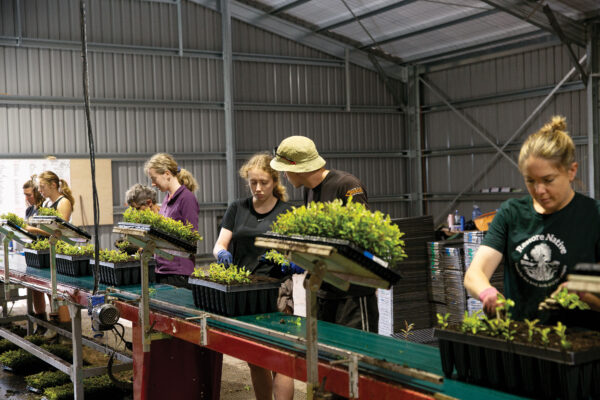
In a shed next to a massive greenhouse, a conveyor belt moves trays towards a perforated drum that uses compressed air to suck up seeds and shoot them straight into the potting mix. It can fill a tray every 10 seconds. “We did 180,000 plants in an afternoon,” Thompson says.
Once the seeds sprout, a bigger conveyor picks up each tiny seedling and sticks it into a pre-made hole in larger trays. It’s a technology developed for vegetable production in Europe, adapted to the needs of our natives. “We’re dealing with a wild product, which means inconsistent germination,” Thompson says. “There’s both science and art to it.”
Instead of nursery pots, he uses grooved trays that encourage roots to grow more strongly. The trays are also easier to carry: another efficiency. He sells 24 species of native seedlings for $2.50 a pop, or for $5 his team will take care of the whole process, from selecting plants to spraying down grass and getting roots in the ground.
Setup wasn’t cheap. But Thompson’s background—he spent 15 years as a mortgage broker—served him well. “You become very comfortable with debt,” he says. “We’re not a cottage industry. We’re here to help really shift the dial on making it easier for landowners to get more trees in the ground—and to show farmers that you can live alongside a native forest with wonderful biodiversity and great water and air quality, while still running a productive farm.”
*
In Te Tai Tokerau, the second, younger tōtara to fall is just metres from its tuakana. The straight part of its trunk, the bole, is only six metres long, but Paul Quinlan selected it with a view to the future: taking this stubby tree out will allow a thinner neighbour, more suited to timber, to grow tall and strong.
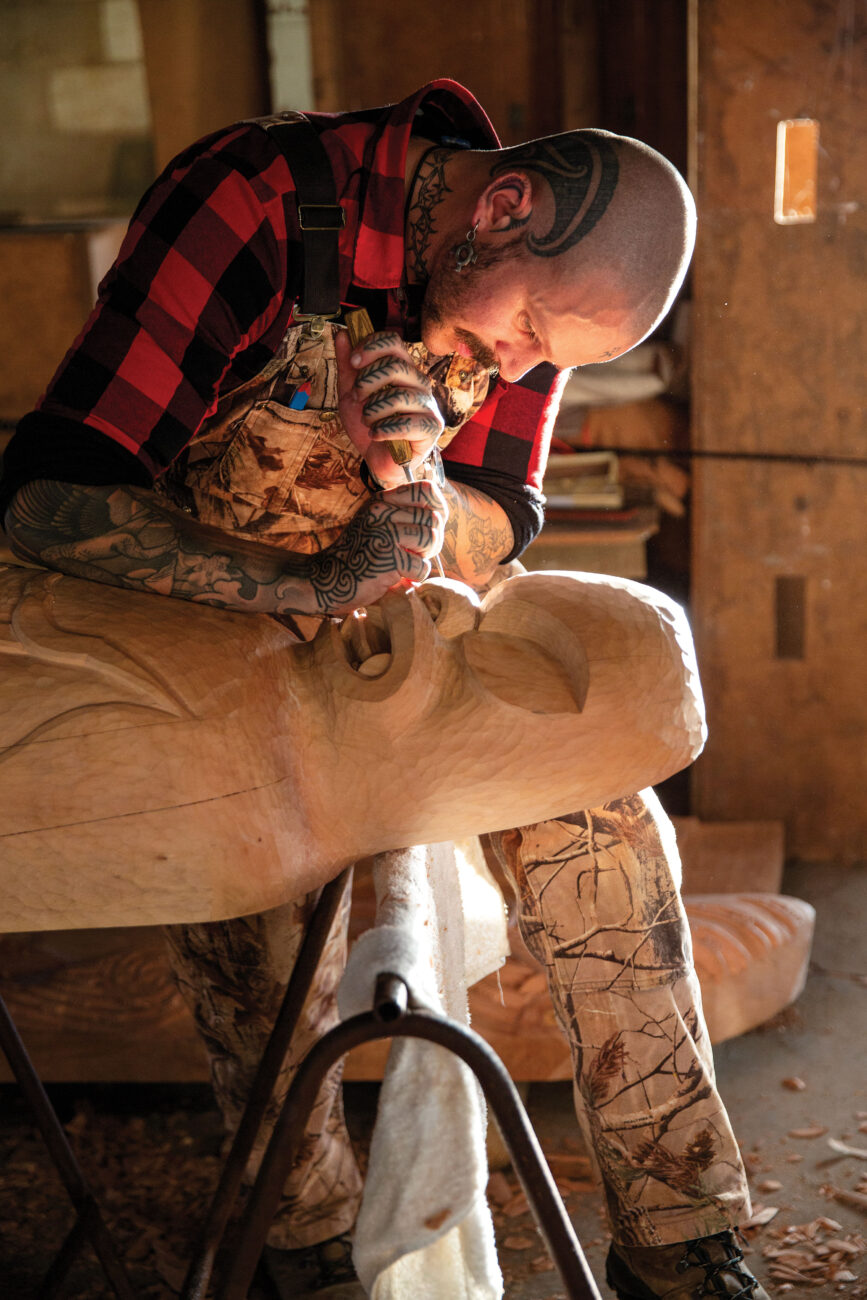
Kyla Campbell-Kamariera delivers a karakia for this tree. She represents the Te Rarawa hapū Te Tao Maui and Te Hokokeha. These hapū take the wood home to the west coast to carve a beautiful new waharoa, the arch over the entrance to their marae, Mātihetihe, near Mitimiti. In this way, the hapū are part of two processes of regeneration, Campbell-Kamariera says—bringing back a native timber and reviving the craft of traditional carving. “We were heavily influenced by the arrival of Catholic missionaries. A lot of our meeting houses throughout the North, but especially in Mitimiti, look like empty halls rather than a traditional wharenui. And so for us, it’s all about cultural revival.”
Master carver and ink artist Tristan Marler, who connects to Mātihetihe marae through his mother’s ancestral line, says tōtara is one of the best woods to carve because of its durability and rot resistance.
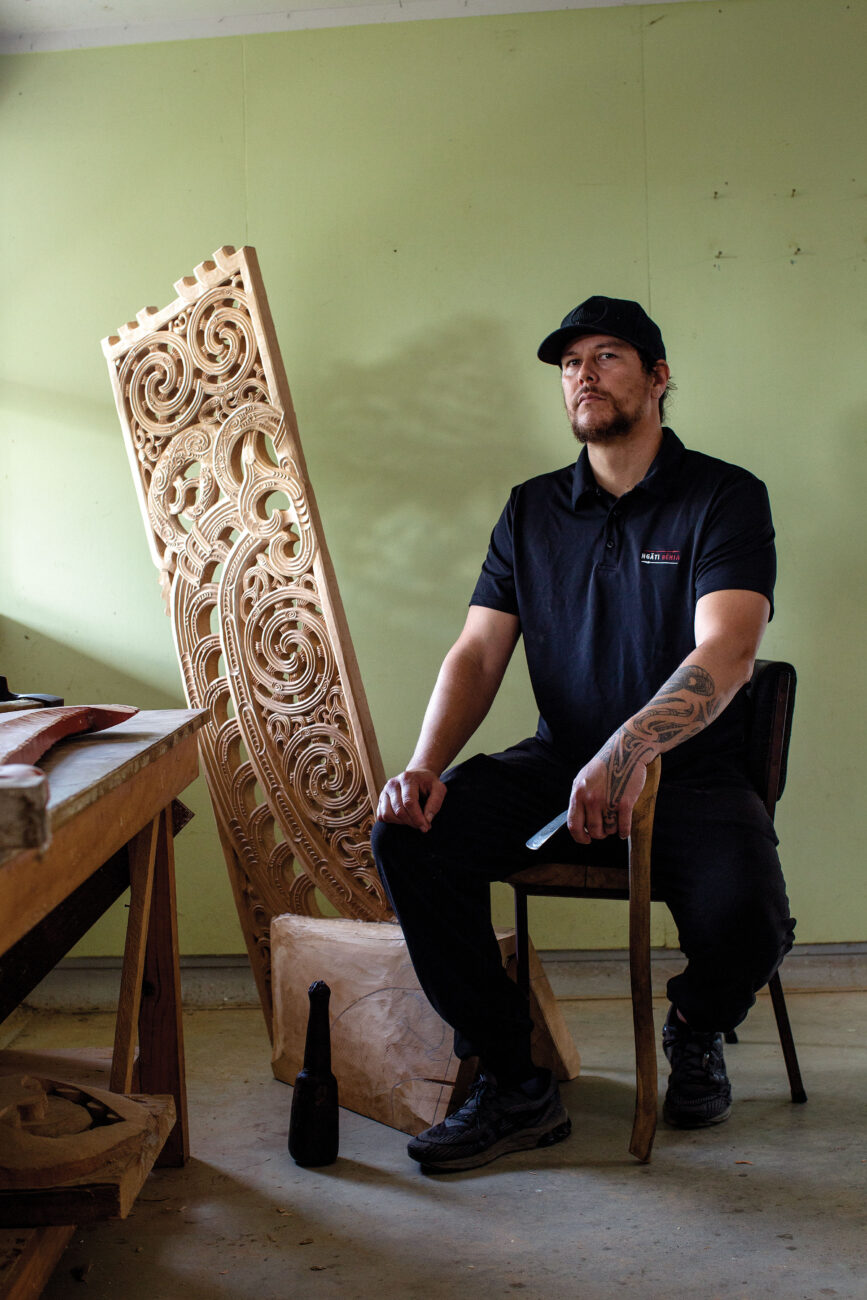
Renata Tane agrees. “When it’s the heartwood, it cuts like butter, patterns well, holds together well and looks beautiful.” But carvers are increasingly overlooking tōtara in favour of pine, he’s noticed, because it’s easier to source. Tane’s wife belongs to the people of the rohe where the trees were harvested, Ngāti Rēhia, and he has been adopted as their tohunga whakairo, or master carver. His own ancestors are Ngāti Kawa and Ngāti Rāhiri. Tane talks of how they once managed forests: identifying significant trees that would make splendid waka, for example. Such trees would be named and nurtured, the responsibility for them handed down to a certain person in each generation, until the tree was ready for its second life on the water.
Before today, Tane had not been part of the felling of a mature tōtara. He is thinking about what it would mean to once again name the trees, and to designate them for a future purpose, one that would perhaps not manifest for centuries. Although he knows he will never get to see it, he’s thinking about the wood that would come out of such kaitiakitanga, and the art.
Three months after the tōtara fall, I visit the site for a post-harvest inspection with Eva Glen, an officer with Te Uru Rākau, the Ministry for Primary Industries’ forestry service. This check is part of the compliance process for forest owners who harvest native trees. Map in hand, Glen goes in search of the tree stumps, taking GPS readings and measurements, checking the bush nearby for any scars, scanning the stream for debris. She finds no discernible damage, from the forest floor to the canopy.
Looking up, we see the old-man tōtara has left a small gap where the light gets in. Its neighbours stand as if nothing had happened. The forest floor is soft, littered with leaves. It takes me a while to notice the remains of the giant’s crown—the mouldering broken limbs, brittle and white like beached logs, are already becoming mulch. The stump glows ochre red.
More by Veronika Meduna
Subscribe to our free newsletter for news and prizes
3
$1 trial for two weeks, thereafter $8.50 every two months, cancel any time
Signed in as . Sign out