Kingfish are big, and they’re tough, and they fight like hell to stay in the sea. Unfortunately, that just makes us want them more. (more…)
More by Catherine Woulfe



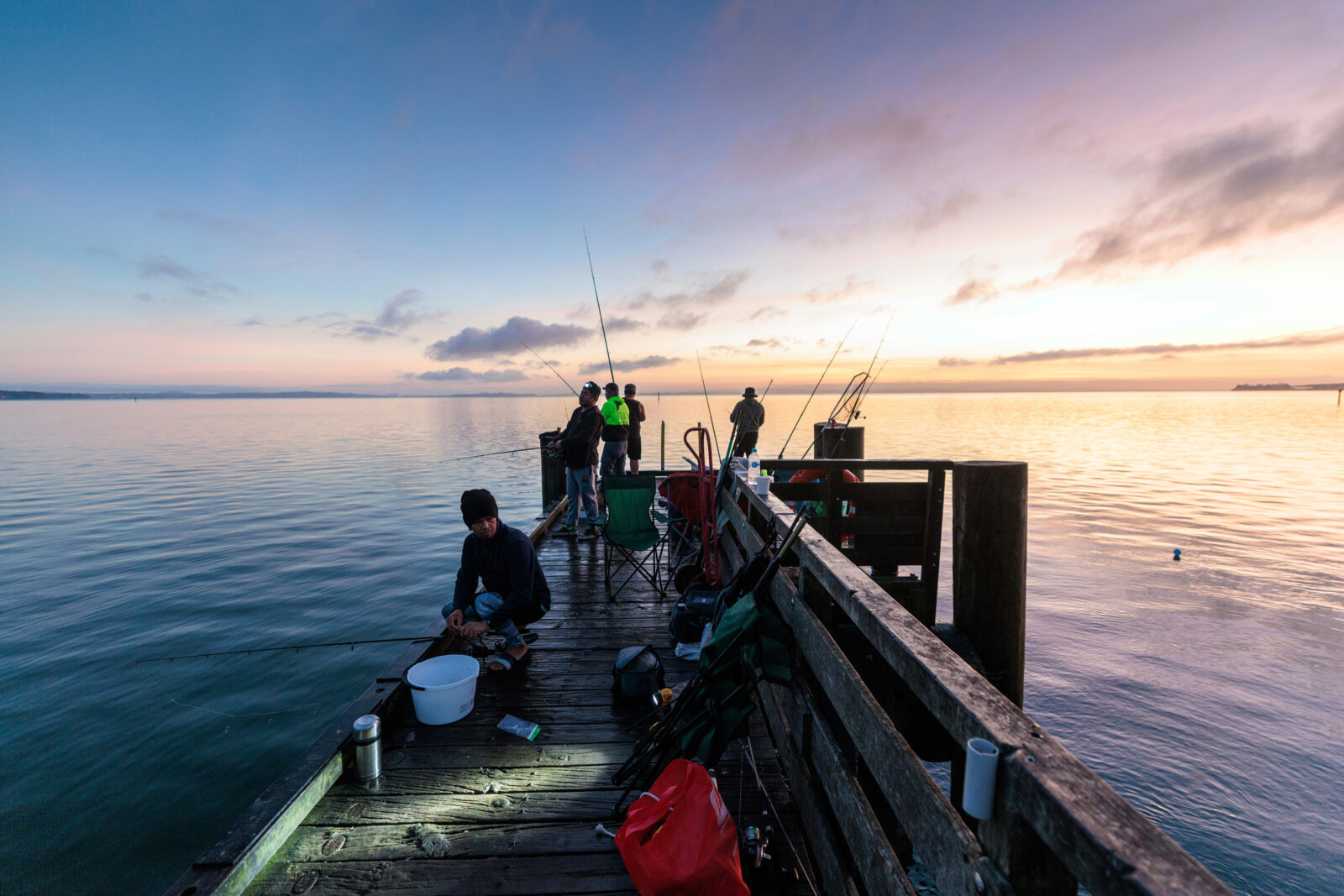
At ten past six on a Saturday, the sea rolls over and sighs. Gulls and swallows cut quick black shapes. Pōhutukawa bow low to the morning.
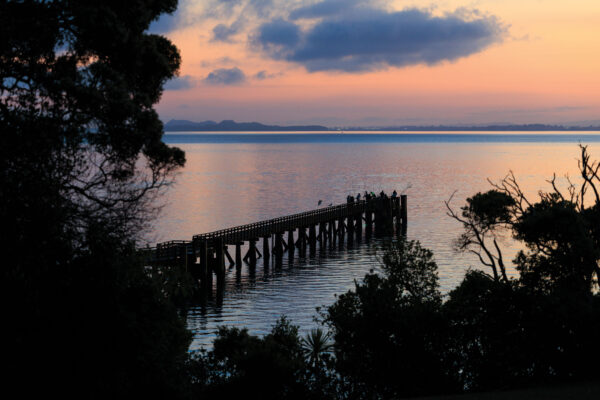
Auckland’s sleeping in, conked out for the long weekend. But on the west coast, Cornwallis is cranking. Twenty-four lines are deployed on the wharf. Against the pink sunrise, a flotilla of kayaks and tinnies bristle with rods. A few people pick their way around the rocks, buckets in hand.
I wander down the wharf trying not to look like a fishery officer. There’s a hierarchy. Newbies close to shore. Hard core further out. Blink and you’ll lose your spot.
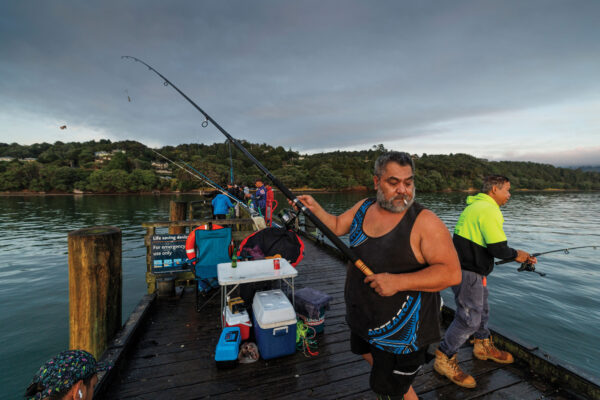
On the most coveted patch, the platform right at the end, presides the king of the wharf. Joel Wihongi, resplendent in black singlet and shorts, has been out here all night catching bait fish in preparation for the tide that’s turning in 20 minutes.
Any joy?
“No joy,” he says, beaming, reeling in a line. “That’s what fishing’s all about.”He chucks a soggy bit of jack mackerel to the gulls; slots a fresh head on the hook. He really hoped his wife, Carolyn, would be fishing this tide with him. She caught most of the bait fish, but fell asleep in their van an hour ago. Beside his sweet setup—chilly bin, table, deck chairs, stereo tuned to easy-listening Coast—is a bucket of seawater, with two precious jack mackerel swimming tiny laps. He’s saving them for exactly the right moment, for the kingfish riding the full tide.
“I don’t care what they say, everyone’s here for a kingi,” Wihongi says. “Because everyone knows they’re here.” He nods down the wharf at two men pulling in a net flapping with tiddlers. “They don’t want to say it, but that’s why they’re catching live bait. I’m using live bait. Yeah, I want one!”
Does he remember his first kingi? Wihongi laughs. Everyone remembers their first kingi.
“I was about seven or eight, with my dad on his boat in Paihia. And it was amazing.” Father and son followed the birds, tried their luck with a lure. Wihongi remembers the way the fish pulled, and the moment he brought it into the boat. He remembers that it was big. “But, my first fish, I had to let it go. It’s tikanga.”
The biggest fish, too—“our rangatira of the sea”—would always go back to Tangaroa.
Wihongi is Ngāpuhi and Ngāti Porou; his dad’s a kaumātua who supplied his Ngāti Hine hāpu with mussels, kina, ika. So Wihongi grew up fishing, with a spear as well as rod and reel. To him, fish have always meant food, not sport. You take home whatever bites, if it’s big enough, and you stop when you’ve got a meal. For kingfish, the maths is simple. “One kingi would feed the whole people,” he says. “You don’t have to kill many.”
Twenty years ago, when his daughter was small, Wihongi used to come to this wharf and fish while she played on the beach. Back then, the kingfish were bigger, he remembers, and plentiful. “There were so many more. So many more.” He still sees the fish swimming under the wharf now and then, here and at Huia and Whatipu along the coast, but nothing like the size they were.
Meanwhile, the wharf is busier than ever. “Today, this is a long weekend, you’re going to see the whole wharf covered,” Wihongi says. He waves an arm at all the boats, the people fishing off the rocks. Long term, any kingfish still here, he says, “don’t have a chance”.
He believes the species has now declined to the point where they should be treated like marlin—“tag and release, or take a photo and let it go”. Or at least bump up the minimum size, from 75 centimetres to a metre. Think of how many eggs one fish could lay given that extra time, he says. Think of this patch of sea, replenished.
But he also knows it’s a big ask for anyone to throw back a legal kingfish. If he catches one today, he tells me, he’ll be keeping it.
The fishing community is full of people pointing the finger at each other.
“Let’s be honest,” Wihongi says. “It’s all of us. It’s absolutely everybody.”
*
Scott and Sue Tindale’s home, in Auckland’s Dairy Flat, is a shrine to fishing. The walls are covered in plaques and photographs and trophy fish. New Zealand sportfishing royalty, the couple sit me down and talk for three hours. Well, mostly Scott talks.
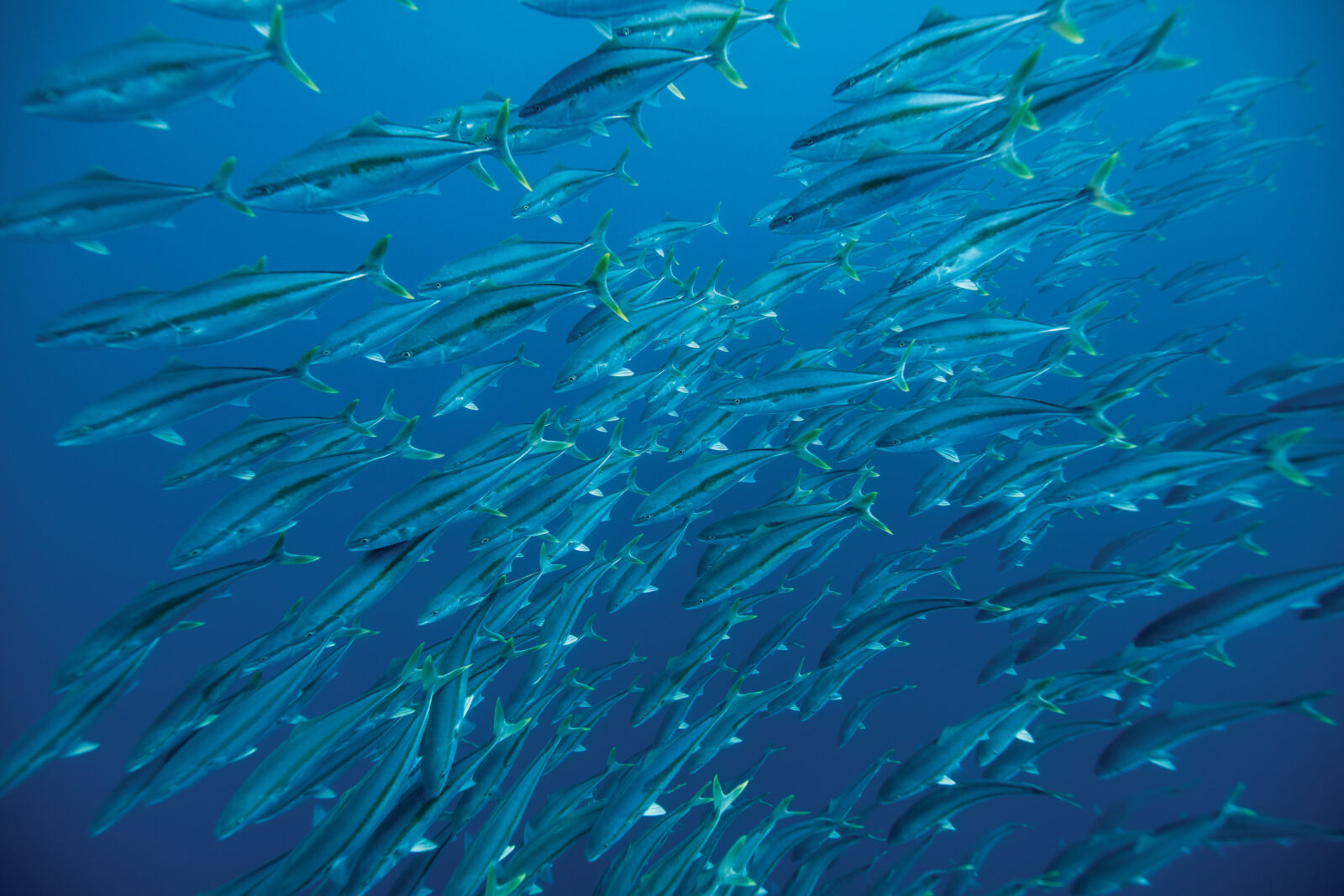
He tells me about getting vertigo diving with huge schools of kingfish—sitting on the bottom looking up through the vortex, watching the flicker and whorl. He tells me that kingis change colour. (Almost black by night, silver-white by day; green on top in brackish water. Over the mudflats, where they chase stingrays, kingfish turn a sandy colour, almost invisible to flyfishers, who have learned to watch instead for the rays.) Sue tells me about catching her first kingi—a deckhand grabbed her by the pants to stop her getting pulled out of the boat. Between them, the couple hold multiple kingfish world records.
But what the Tindales keep circling back to is their concern that recreational fishing has crossed a line—that fishers are now “bulk harvesting” to a degree that is difficult to comprehend, let alone get under control.
We’ve only really been trying to research recreational fishing since the early 1990s, and it was always going to be hard: New Zealand has too much coast, and too many fishers coming at the water in all sorts of ways. How do you possibly tally people on rocks, and flyfishers in the shallows, and charters, and launches, and kayaks, and spearfishers, and longliners? And Joel Wihongi, parked up on a wharf in the dark?
Officials have used planes to count boats around the coast, counted and questioned boaties coming in at ramps, and extrapolated fishing pressure from there. Fisheries New Zealand notes that kingfish slip past this method, though, because they’re often targeted around remote islands, from launches not picked up in the ramp surveys.
(For other species, too, the Tindales argue, that research will be off. They’ve sat at Aotea/Shelly Beach boat ramp in the Kaipara on a long weekend and watched a surveyor manage to talk with just two boaties because, ironically, the ramp was simply so hectic.)
Further tangling the matter is that fishers, famously, fudge the truth. Two national phone surveys meant to gauge fishing pressure have been blown out by fishers exaggerating their catch, or telling researchers they weren’t fishers at all.
Scott recently overheard a surveyor at a ramp asking a boatie what they’d caught. “Oh, nah, pretty quiet out there,” the guy said. His mates were chuckling away. Once the surveyor moved on, the guy asked Scott to help lift the chilly bin. “Nearly put my back out,” Scott says. Look at that lot, said the guy. “He lifts the lid. Absolutely full.”
The most robust statistics come from a national survey carried out every five years. It’s three rounds in. The latest iteration involved a year of weekly text message check-ins, plus phone calls, and almost a third of the 5600 recreational fishers who signed up simply bailed on the study altogether. The adjusted results, released in September, paint a picture of fishing on the ebb: that it’s not as popular as five years prior, and that people who do fish are going out less often. (According to this survey, the number of people targeting kingis, and the number of fishing trips they made, dropped by roughly two-thirds in five years, and their total catch halved.)
But ACC figures show a sharply different trend. In 2004, 1284 new claims were made for injuries sustained while fishing. From there the numbers rapidly climb, more than doubling by 2011, and reaching a high of 4125 last year. (The data does not include injuries sustained at work—that is, commercial fishing.)
Either fishers are hurting themselves more often or there are just more of them. The ACC data can’t tell us which.
Seven years ago the Tindales set out to gather their own data via a citizen science tagging programme, selling kits at cost, so that any fisher can quickly and gently tag their catch. These are like cattle ear tags, says Scott—they identify the fish, but don’t ping data back to base. Instead, whenever someone tags a fish, or catches one that’s already tagged, they feed information back to the Tindales: ID number, where and how the fish was caught, as well as its species, size and condition. The couple are forever fielding calls from fishers giving excited blow-by-blows of each catch. They don’t mind. For them, it’s a way of collecting solid data, and learning about each species—as well as the dynamics of the people fishing for them. They’ve had Michael Hill, bajillionaire, tagging off his super yacht; they’ve shown kids how to tag spotties on the West Coast; on a trip to Whakaari/White Island Scott tagged 75 kingis in two days (then slept for five, he says). All up, around 12,000 fish have been tagged.
As well, the couple have been instrumental in coaxing record-chasers towards an ethos of catch, measure and release, rather than the old-school rules that meant the biggest fish were killed to be weighed onshore. They have pushed for new rubbish bins to be installed at wharves, to keep a lid on all the bits of bait, nylon and tackle that end up all over beaches—and in seabirds.
As they work for change, they say, they’re watching fishing pressure boil over.
Part of this, Scott’s sure, is a function of population increase—there are now 1.7 million people in Auckland “who’ve got nothing to do on a Saturday”. But like many people I speak with, the Tindales also noticed that COVID lockdowns bumped fishing up. “You’re allowed to exercise at your local beach,” Scott says. “And what are you going to do at the beach? Every tackle manufacturer I spoke to sold out of fishing gear… You can’t tell me that post-COVID, there’s hardly anyone fishing.”
Muriwai Beach, where Scott used to fish all day and not see another car, has become “a motorway”. Areas of the Hauraki Gulf have started to feel like “Pak’nSave parking on a Friday”. Recently, the Tindales took their boat from Gulf Harbour to Waiheke. Chaos. “I had to slow the boat down and zigzag through the Motuihe Channel,” Scott says. “There was that many boats… it was just impossible to get through the amount of people fishing.”
Kingfish are one of the only species in New Zealand not targeted by commercial boats, although they do bring them in as bycatch. But to all of those fishers zipping out in a tinny at the weekend, stalking the rocks or snorkelling with spear in hand, a kingfish is the ultimate prize. Recreational fishers account for about three-quarters of the total kingfish catch, the Ministry for Primary Industries has estimated.
Which means saving the kingfish is a battle for recreational fishers. And if the kingis collapse, it’s because recreational fishers just couldn’t stop themselves.
*
Mark Kitteridge caught his first kingfish at about 15, using a hand line off the rocks in Wellington. The water was a reddy brown, due to the “interesting brew” of abattoir waste and sewage. Kingis would hoon through it chasing sprats. The fishing-mad teenager had wanted one for ages. He put a sprat on his hook and watched, elated, as his wine-cork float disappeared underwater. The line whipped through his hands, burning him. He hung on tighter. “Next moment, I just felt the power,” he says. As he landed the fish, his legs were shaking so hard he could hardly stand. “I just felt like I was the king of the world… They were the fish for me.”
He was addicted to that feeling for years.
There weren’t enough kingis in Wellington, so Kitteridge moved north, and started hauling fish after fish onto the Mangōnui wharf. He threw them all back, until a local fish shop owner offered to pay him a dollar per pound of kingi. That kept him going between jobs; he stopped when a fishery officer gave him the hard word.
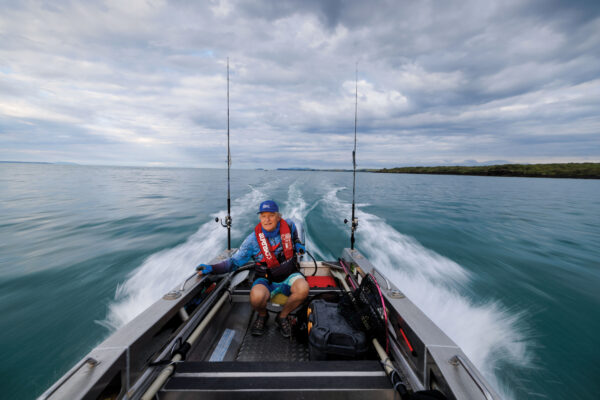
Kitteridge is 64 now and has tied his life to fishing: editing a fishing magazine, working in tackle stores, writing books. He still gets out on the water almost every weekend, either alone in his tinny or with his mates in their bigger boats. He loves it so much he often hollers a “yahoo!” to the Hauraki Gulf as he heads out. How many kingfish does he reckon he’s caught, total? He hesitates. He doesn’t like thinking about this.
“Oh. No. Well. Probably thousands… A lot. A lot.”
But you learn things as you get older, he says. “Or most of us do.” Kitteridge chooses certain hooks and tackle when targeting kingfish now, with the goal of being able to release the fish in as good a shape as possible. He’d never hold a kingi up by its tail like he used to—“you can separate the vertebrae”, he says. “You can actually feel it go click click in your hand.” He won’t leave a kingfish on a hot deck, or handle one with dry hands—both can burn the fish. He keeps in mind that for the fish, being out of water is like him being under it. There’s no mucking around for photos. But some fishers, he says, are so new and excited that good practice “just goes out the window”.
Kitteridge has noticed the big fish have been harder to catch in the past couple of years; this may just be a quirk of currents and weather, he says, but he thinks everyone going after kingis, including him, is contributing to unacceptable mortality for the species. He thinks the bag limit should be dropped to one, and that fishers should stop playing around with the really little kingfish—they’re feisty, they’re fun, he says, but “they can do quite a lot of damage to themselves, thrashing around the hooks… No one should target them just because they’re bored.”
He now feels so strongly about protecting the fish that he often wonders whether he’s going to give up fishing. He won’t. “There is that drive, still. I can’t get rid of that.”
What would 15-year-old Mark say to all of this? “Yeah,” Kitteridge sighs. He sees his fill-your-boots days as a rite of passage. “It’s part of proving yourself as a man, you know, that I could go out and catch all these big fish one after another, and not get tired, and have a big—it’s called a ‘death pile’ now, that’s what they call them.
“Death piles give me the absolute shits now.”
*
Because commercial fishers aren’t targeting kingis there’s no money in studying the species. For fish, it’s an existential paradox: we only really learn about a fish when we want to eat it en masse. But scientists who have had their faces in the water for decades are observing dramatic change.
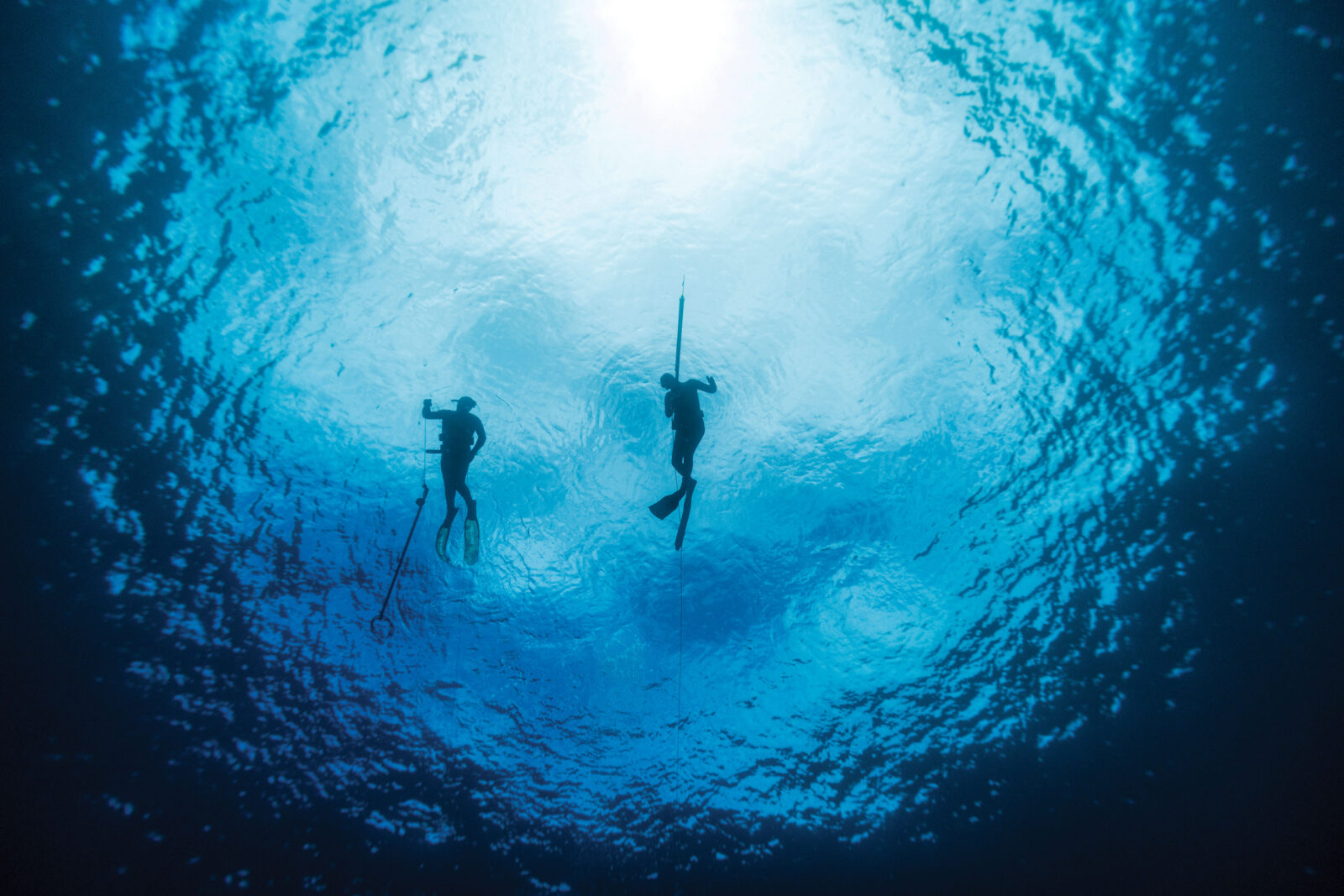
Clinton Duffy, curator of marine biology at Auckland War Memorial Museum, has been watching kingis since the late 1970s, when he was a keen teenager in the Wairarapa Underwater Club. They’d head to the west coast to dive the rips off Kāpiti, spearing what he thought were big kingis, in “massive schools”. Later, on scuba, in the clear water of the Three Kings, he saw his first properly big ones. “They just came steaming in, really aggressive. All the other reef fish dove out of the way.” Once, he watched, intrigued, as a three-metre bronze whaler cruised past him at the Poor Knights, with 61 kingis following her in single file. In 2004, at Denham Bay in the Kermadecs, he hopped in for a snorkel with three small Galapagos sharks.
“Then these three big kingfish that were about the size of the sharks cruised in, and the lead kingfish just went straight for the closest shark and bit the end of its tail. All hell broke loose.” He got out of the water.
Kingfish “certainly would have been really important predators”, Duffy says. “They probably ruled the water column.” He’s talking in the past tense?
“Yeah, because, you know, they’re nowhere near as abundant as they used to be, particularly the really big ones, the 25 to 30 kilo-plus fish.” There are still big fish in the sea, he says, but not in the spots they used to reliably be found—boaties are pushing farther and farther out to reach them. Officials have always struggled to get their arms around the size of the recreational catch, Duffy says, but he’s “pretty confident” about what’s driving the shift. “In my experience this species is absolutely hammered by recreational fishers.”
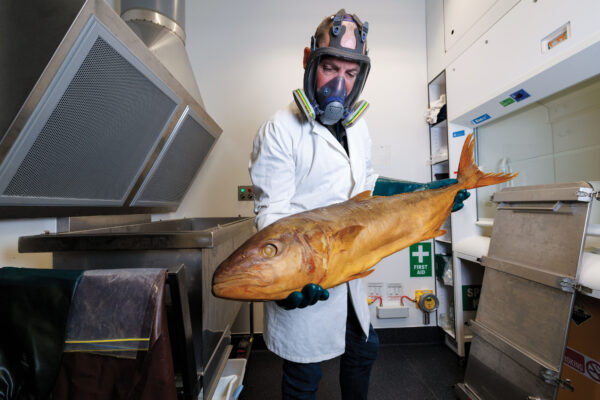
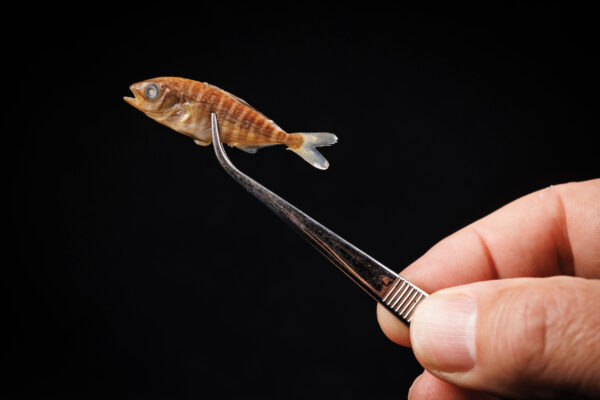
Unless someone can figure out how to properly limit that catch, he says, we’ll keep seeing “lots of little fish and very few over the legal size, except in remote, hard-to-get-to places”.
Vicky Froude, an ecologist and scientific diver, has been quietly surveying the sea for decades in prime kingfish territory. She started out the usual way, on scuba, using belt transects to count certain species. But each area she surveyed using this method was so small that she’d come away with spreadsheets full of zeros. That’s frustrating when you’re trying to detect change over time.
So she started snorkelling instead, chewing through much longer stretches of sea—imagine a ribbon of water five metres wide by two kilometres long, stitched along the coast. She used her smart watch to track distances. As her fish counts shot up, so did the robustness of her data.
Froude has been counting fish this way for a few years now, mostly in the Bay of Islands (she lives on the Russell Peninsula) and elsewhere in Northland. She has previously worked using scuba survey methods around Wellington, the Wairarapa and the Bay of Plenty, including offshore islands. She’s surveyed urchin barrens, too, and kelp cover. She rarely gets paid for any of it. Long-distance snorkelling is her meditation and a real way to contribute to conservation; she’ll spend up to four hours at a time, head down, documenting.
What has she noticed about kingfish? “I’m seeing fewer,” she says immediately. “Particularly the big schools.” The fish have been disappearing from Northland and the Bay of Plenty since the 90s, she’s observed, with a sharper decline over the past five to 10 years.
Protected areas such as Maunganui Bay in the Bay of Islands are faring better, but even there, Froude’s not seeing the huge groups that she used to—the schools of 50 to 100 fish or more that were once a highlight of her dives. Now, the groups are around four to 20, max.
[sidebar-1]
In March of 1992, her records show, she and her partner dived with more than 100 large kingfish on the western side of Moutohorā, Bay of Plenty. “I have seen nothing like that in recent years.”
Froude’s partner fishes a bit, but she’s told him kingis are now a no-go. She’s always had a soft spot for the species, she says, because they engage more than many other fish. But lately, she’s noticing a behaviour change, too: the kingfish that remain are less relaxed. “They’re much more reticent,” she says. “They’re not stupid.”
When the big schools were still around, she used to play with them, imitating their behaviour so that the kingfish followed her. She wonders whether her fins, the bright yellow of kingi tails, helped her to fit in. She loved the moments the schools would swing in for a closer look, and did her darnedest to be interesting, drawing out the interactions as long as she could. But two minutes, five, 10, and the fish would bullet into deeper water. Froude watched until they were gone.
*
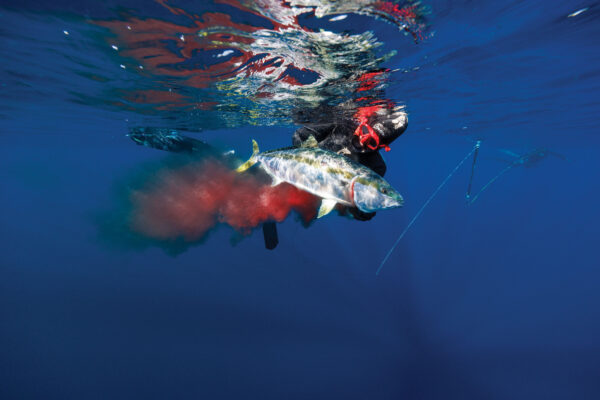
Elise Clynes reaches the boat and huffs the snorkel out of her mouth. “Whoo!” she gasps. “Definite shark action! We did not lack for sharks.” She’s puffing, knackered. She’s just dragged a kingfish the size of a toddler through a pack of four bronze whalers. The first two kingis she shot got nailed—the first in one big gulp, by a bronzie attacking from below. Three more sharks shot in to fight over the head. Clynes battled to haul her second kingi to the surface, away from the melee, but it insisted on swimming down. Two bronzies were waiting. “The sharky boys got that, too.”
Clynes heaves her third, intact fish on board and kneels on the duckboard. She looks like she’s been paintballed; her wetsuit’s splattered with gobs of scarlet. “Stay there,” says Darren Shields, a spearfisher who’s become a mentor to Clynes. “I’ll give you a washdown.” He sloshes buckets of seawater over her while she catches her breath.
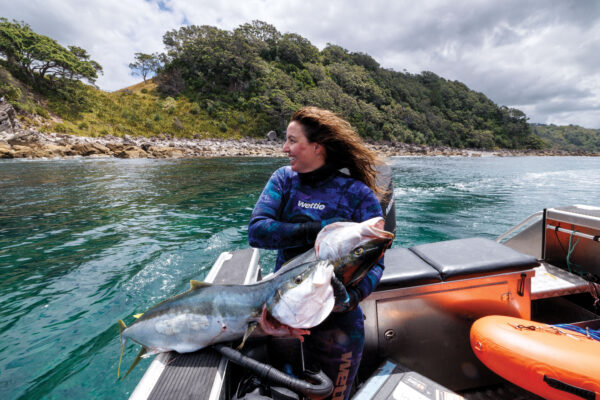
From the cliff above, a chehoo—Clynes’ partner and their flatmate are climbing today while she dives. “Yee-ah,” she yells back, “we got fish!” She knifes the kingi then sits, chugging water, cradling the fish in the crook of her arm like a baby. She’ll feed it to her kids later, and tell them it’s “sea chicken”. (They don’t like fish when they know it’s fish.)
Clynes is a park ranger for Auckland Council, based in the Waitākere Ranges. She surfs and climbs and white-water rafts and just won the women’s division of the national spearfishing champs. She was diagnosed with ADHD as a child. There’s always a lot going on in her head. But being underwater—even in sharky water—has come to feel like a hug, “like coming home”. The pressure of the water is soothing. And the absence of noise. All she thinks about is what’s in front of her. “Everything else gets really quiet.”
Clynes and Shields wouldn’t usually fish here, or continue shooting fish after a shark’s taken one, let alone two. They wanted to show us just how much of a problem the bronze whalers are now—not for people, but for the fish themselves.
Bronzies often won’t bother with a healthy kingfish. Too much work. But an injured, exhausted kingi, or one struggling on a line? Chomp.
In recent years, bronze whalers have rediscovered a trick they used in the 1970s and 80s, during the last big spike in spearfishing. They’ve learned to loiter in certain spots, particularly in the Hauraki Gulf. And the sharks have become conditioned, fishers have noticed, to sounds that mean food. The firing of a speargun is a particularly juicy signal; spearfishers know to load their guns quietly, and to move quickly once they pull the trigger. If a bronzie’s around, it will show up fast.
At one spot, Shields stops the boat and is over the side within moments. No berley, no blood in the water, no speargun fired, yet a three-metre bronze whaler is parked up right underneath us. Shields thinks it was attracted by the sound of the motor cutting out. That shark, he says, was waiting.
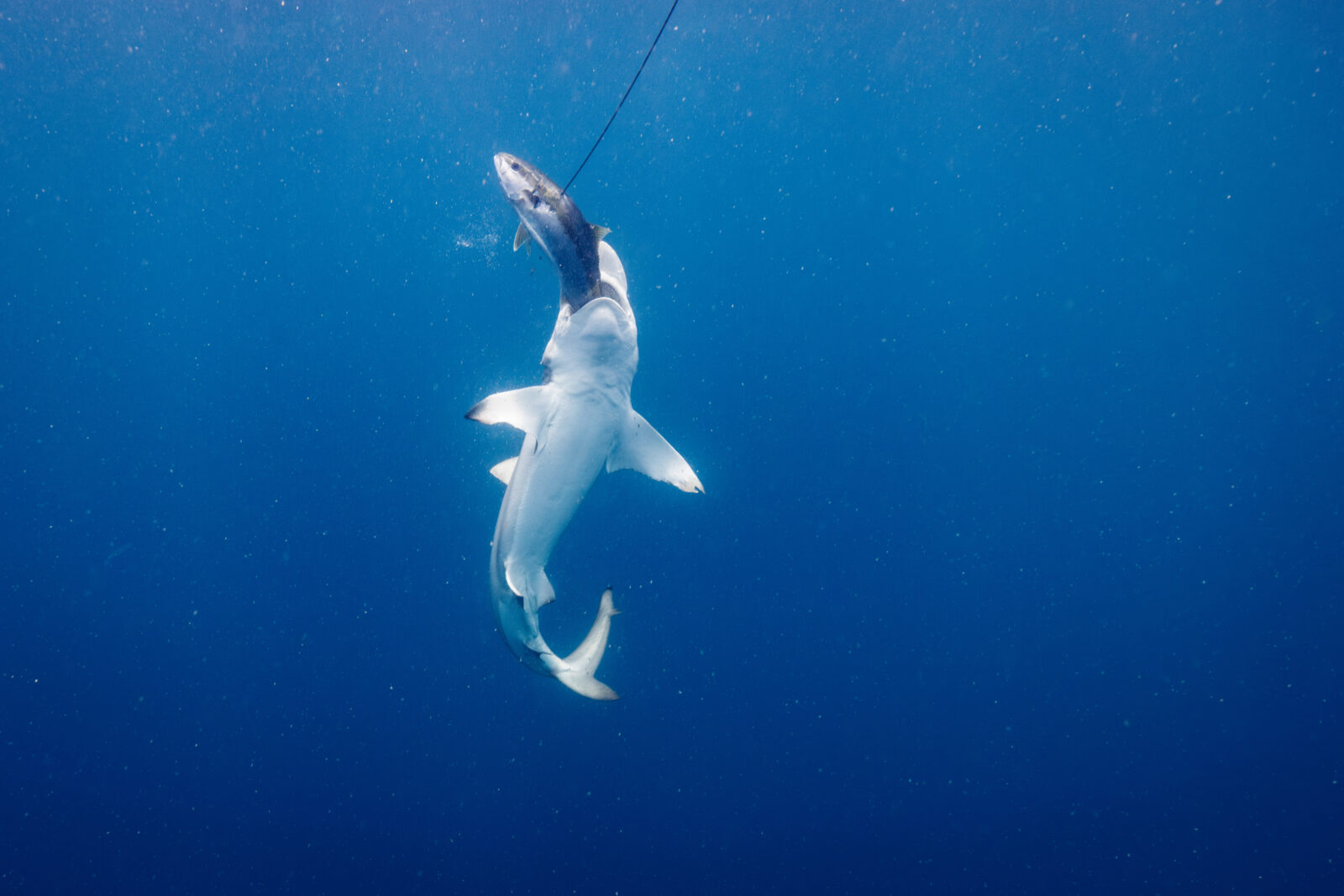
“Old fisherman comes along, he catches one of those kingis, old bronzie’s got it. I mean, that’s what he’s there for. He knows now.”
Until five or 10 years ago, Shields says, if you saw a shark while you were underwater, “it was, ‘Shit, we’d better get out, there’s a good chance we’re all going to die.’”
Now, bronze whalers are taking so many kingfish off lines and spears, especially in the Hauraki Gulf, that fishers call it “getting sharked” or “paying taxes”. They have become strangely casual about it.
But for the kingfish, the sharks mean carnage. Shields says sometimes they’ll hit lines and spears so hard it’s just impossible to get a fish to the boat. Pity, too, the fish that is caught on a line and released.
“Imagine a kingi that’s been fought on a light line for half an hour,” he says. “It’s buggered. And when they let it go and it goes over the side, those big bronzies, they’re full of juice, they catch those kingis.”
Bad enough on a runabout with two or three lines in the water. But do the maths on a charter operator, Shields says, that might be catching and releasing dozens of kingis a day, every day, all summer. Say 30 per cent of those die—given what he’s seen while filming underwater for fishing shows, he suspects it’s higher. That is, approximately, “a shitload of fish”.
(There’s little data on the proportion of kingfish that die after they’re thrown back. The species has a reputation for being hardy—they can vent their swim bladders, which means they can cope better than, say, snapper with being hauled up from the depths. But some thrown-back kingis will undoubtedly get eaten by sharks, or they’ll be badly injured, or go on to develop an infection. No matter the actual death toll of the fishing trip, of course, it’s only the fish each person takes home that count toward the bag limit—the single fish in the fridge might represent four or five that died en route.)
Spearfishers shoot to kill. They also get to select the biggest fish. The sport is now booming again in New Zealand, and social media is loaded with spearos brandishing massive kingfish, and egos to match. Unsurprisingly, lots of line fishers blame spearfishers for the decline of the species.
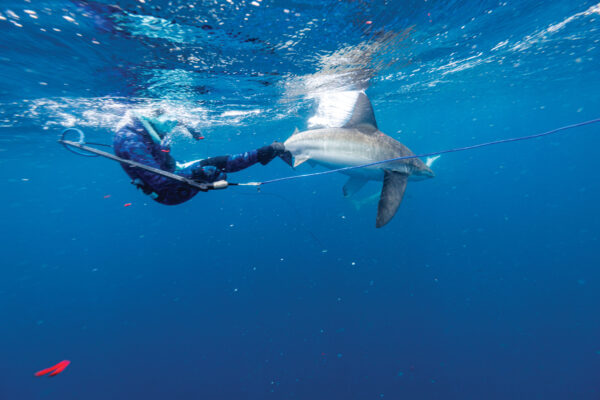
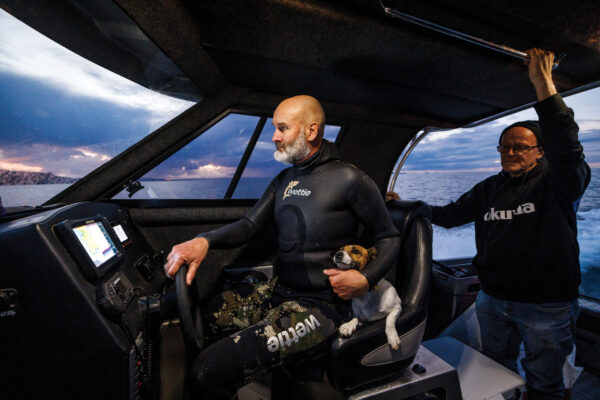
At Shields’ home, within cooee of the Ōmaha boatramp, Clynes unloads the boat while Shields doles out kingfish steaks. He tells me he feels like a black sheep. He’s built his life around spearfishing—he learned from his dad, and taught his own kids, spent decades racking up records. He owns Wettie, one of the biggest spearfishing gear shops in the country.
Yet: “I started saying years ago, ‘We’ve got to stop doing what we’re doing.’”
It’s time for spearfishers to treat the biggest kingis as sacrosanct, he says. And time, too, to cut back the overall kingfish take.
He feels like he’s getting absolutely nowhere. People have always struggled to consider their catch in the aggregate.
“It’s like scallops. I kept saying, ‘One day we’re not going to be able to take scallops.’ Guys used to laugh at me.”
Then the scallops started to disappear.
“I still remember this one guy goes, ‘What do you reckon’s happened to them all? Do you think they’ve just died off?’ It was like, mate, do you not see all the boats out on the beds every day?”
*
For Auckland Anniversary weekend we pack the kids up for a couple of nights at a bach on Umupuia Beach, just around the coast from Maraetai. On the lounge wall is a picture of one of the original owners of the cottage, Dick Duder, in outrageously short shorts. He’s holding two kingfish and has another 19 laid in two neat rows on the drive in front of him. That was fishing, here, in 1957. Duder probably caught those kingis right off the rocks, says kaumātua Laurie Beamish.
For Beamish, fishing here goes back much further than that. He can name 32 generations, back to when the Tainui waka landed on this beach. For him, fishing stretches forward, too—this summer, he formally introduced 70 Ngāi Tai rangatahi to their moana. “We took them out onto the ocean and gave them a tour around all of our spots,” Beamish says. He waves at the sea we can see from his deck, next to the marae. To Ngāi Tai, every little headland, every set of rocks, has a name, “and when you have the names, each one is a mnemonic aid to a whole history”.
Beamish’s four-year-old moko solemnly pours us tea made from water and blueberries. “I love Moana,” she says. “And actually, my middle name is Moana!”
She scrambles into her koro’s lap.
Beamish, a former commercial fisher, from a family of fishers, is the one person I talk with who is not particularly worried about kingfish. Even if they’ve disappeared from some spots, he believes, their range is so wide, and so deep, that they’ll just go elsewhere—there will still be “huge numbers and huge fish”. “It’s not a species that I’m fearful [for] in terms of population depletion,” he says. “We just see the very tip of the tip of the iceberg of the population, in my view.”
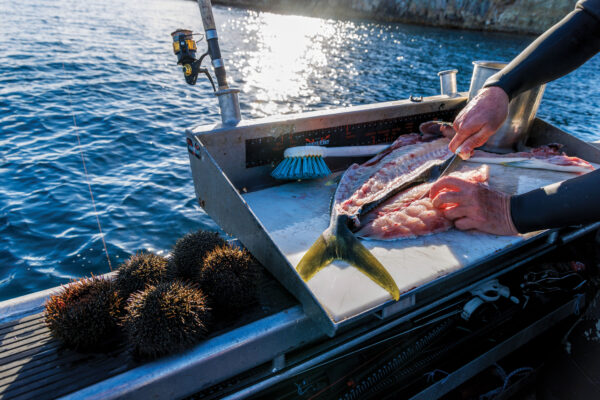
Growing up on Great Barrier Island, he remembers how the kingfish, “ferocious feeders”, would go after mullet, their frenzies frothing acres of water. You could tow anything through it, he says, even a white rag—“and next minute you had a kingfish on”. Then came the purse seines, huge nets that encircled whole schools of bait fish and pulled closed. The kingfish left to find food elsewhere. Purse-seining was banned off Cape Brett in 2023, and Beamish has heard the kingis there are now swarming back.
“Everything’s about the bait fish and the [food] chain.”
To maintain abundance, he says, it’s the culture of recreational fishing he’d like to change, not the rules around it. “What we’re seeing is a huge proliferation of YouTubers, TikTokers, fishing for that glory more than anything else.” Catch and release—people landing fish after fish, purely for sport—has always seemed cruel to him. And in his rohe he’s now seeing a lot of recreational fishers going after those crucial bait fish with none of the discipline or controls he was taught. It’s not so much the numbers they’re taking—for bait fish the limit is 50 per person per day—but the attitude.
“We would rāhui sections of ocean, put it aside, so that abundance could be generated and maintain easy fishing in other places. And then we would swap them out.
“Often our tohunga would be watching from an elevated position. They’d be guiding the setting of the net. ‘No, that school’s too big. That one’s too big… There, go for that little one!’ And it would be more than enough. So again, the practice was about fishing for a particular need at a particular time.”
His moko eyes my cup and drops in a single blueberry. I look, she says, like I am one blueberry hungry.
*
Fishing has always meant food, and it has always meant family. I suspect one of the proudest days of my dad’s life was when my brother staggered out of the water at Waipātiki in Hawke’s Bay, cradling his first kingfish. Dad died three years ago; always, in the water, my brother thinks of him.
Down the coast from Umupuia, at Mātaitai Bay, my kids chase crabs in the rocks. It’s noon. A scorcher. White ticks of high cloud mirror the lineup of rods on the wharf.
Karl Vasau has been here for four hours, with his partner and her aunty. Would he like to talk about fishing? He grins. Vasau’s family is Niuean and Samoan, and he grew up in central Auckland. As a kid, he would go with his cousins in the dead of night to catch red crabs at Browns Bay. “There were heaps of them. We’d come home, fill up the bathtub, and call the family to come. They would fill a bucket each. That’s how we helped out everyone.”
Another time his grandmother, from Niue, took the cousins fishing at Herne Bay. When they pulled in a fish, she skinned it, squeezed some limes into a little rockpool, and soaked chunks of fish. The kids were horrified. “Oh, Nana, no!” Vasau laughs. Tearing into the raw fish, he remembers, he felt a bit like Gollum. “But the lime, with the saltwater marinade… it was delicious.”
There is no fever to the fishing on this wharf today, no death pile. Vasau’s caught two tiddlers and quickly thrown them back. Any day out here’s a good day, he says.
He smiles at me, tips his head to the sun, and goes back to watching the rods.
More by Catherine Woulfe
Subscribe to our free newsletter for news and prizes
3
$1 trial for two weeks, thereafter $8.50 every two months, cancel any time
Signed in as . Sign out