We put bears in zoos and the bears bit back. (more…)
More by Asia Martusia King



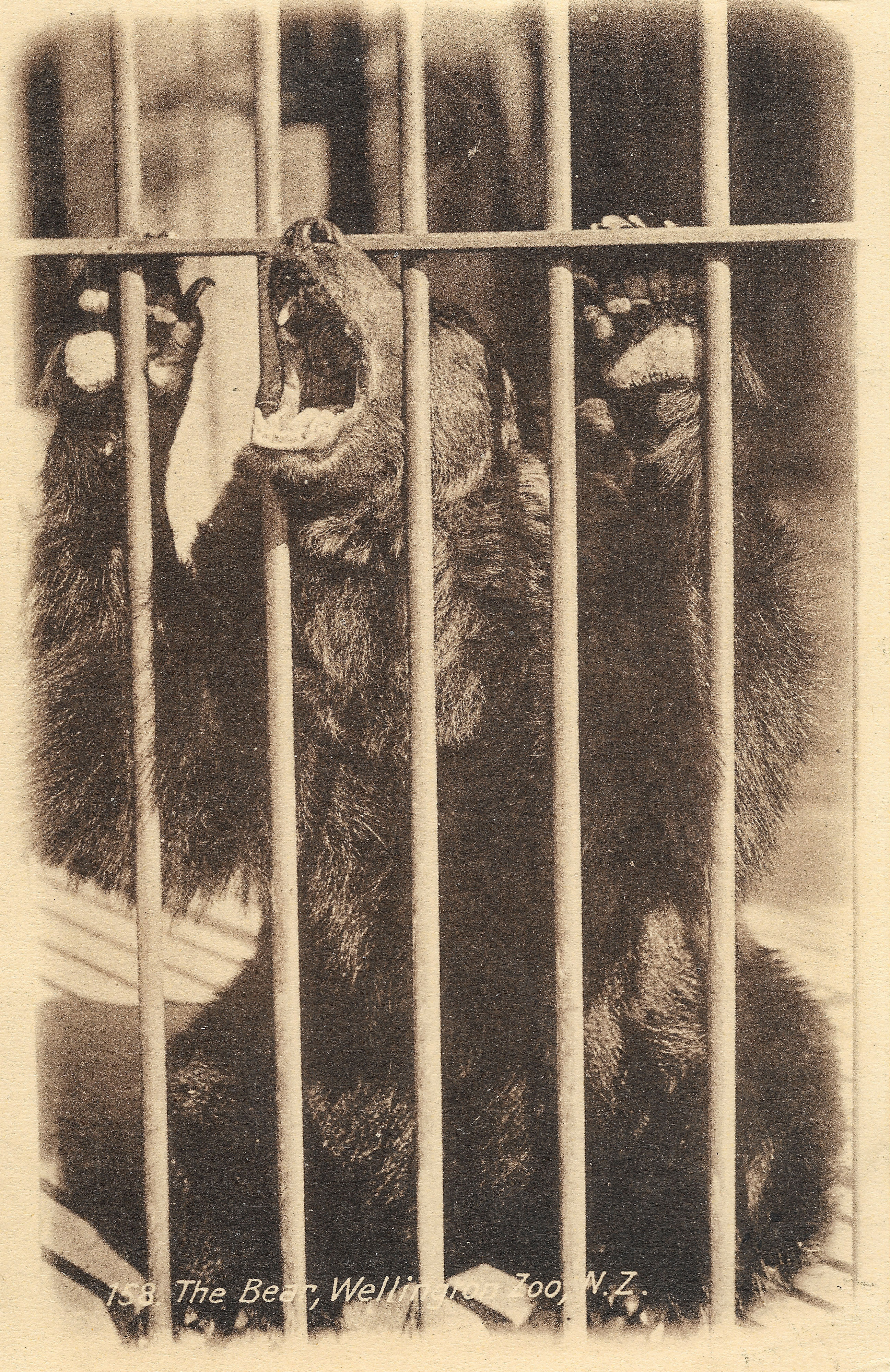
The first bear in New Zealand had a special trick. He would eat meat from his trainer Syd Rose’s mouth, muzzle to lips in a death-defying kiss.
He was a circus bear, and during his first Christchurch performance, in January 1912, he put on a show nobody would forget. He struck Rose with his paw and pinned him, sinking teeth into his arm. Spectators shrieked; stagehands ran forward, beating the grizzly with pitchforks, pipes, and wood. Rose was rushed to hospital and made a full recovery. The show continued as usual, but the circus diplomatically decided against keeping the bear. He was bought by Wellington Zoo for £50 (equivalent to $10,500 today), heralding a gory ursine history in Aotearoa.
By 1918, Wellington had two bears: the Evening Post mentions a “big brown bear (the notorious one that clawed a man in Christchurch)” and “a playful little Malayan bear”, who shared his enclosure with a pet dog for company.
The Malayan was known for his gentle disposition but when a 12-year-old boy stuck a teasing arm through the bars, the bear seized and gnashed his hand so badly doctors later amputated two fingers. It was thought to be the first attack by any animal in a New Zealand zoo.
The second came on a brisk summer morning in 1938. Keeper Bill Hawke strolled into the Auckland Zoo black bear pit for a daily muck-out. The hand-reared cub was a favourite and roamed freely while her keepers swept dung. But on this day, the animal was “out of sorts” according to Hawke; she attacked him, chomping his knee.
For seven decades until the mid-1990s, Auckland Zoo was also home to polar bears. Twin cubs were born there—a triumph—in 1957. But one cub died shortly after birth and the other drowned 11 weeks later, in front of a crowd, while its mother was teaching it to swim.
The zoo’s polar bears came to be known for endlessly swinging their heads, pacing like madmen in the subtropical humidity. They lived in concrete pits with “rocks” and “icebergs” painted blue; their pool water was supplied from Western Springs lake next door. Algae grew in the bears’ hollow fur, tingeing them sickly green. When the last polar bears died in 1995, they were not replaced.
Animal husbandry has come a long way. Yet we have only one bear left in Aotearoa. Sasa is a Malaysian sun bear at Wellington Zoo, possibly like the one that chewed little George’s hand nearly 90 years ago.
Is she lonely? Maybe. But sun bears are solitary by nature, and her keepers spoil her rotten. They serve her smoothies and herbal teas. They hide spices around her enclosure for scent enrichment, and present her logs ripe with mealworms. She basks among bamboo and receives daily health checks (with a welded grate between herself and a keeper). When the keeper whistles, Sasa gapes, lolling out her unusually long tongue as they perform a dental assessment.
Sasa is getting on in age. It’s likely she’ll be the last bear in a New Zealand zoo. Many zoo bears, Sasa included, come from rescues overseas, and (especially when geopolitics get in the way) it’s much easier for these organisations to keep bears than it is to send them abroad. There’s also a question of our own conservation politics—and whether Aotearoa’s the place to house bears anyway. The cost of keeping one massive, hugely intelligent, dangerous bear could cover the breeding of thousands of threatened native wētāpunga.
And bears, as we’ve learned, are very intense.
More by Asia Martusia King
Subscribe to our free newsletter for news and prizes
3
$1 trial for two weeks, thereafter $8.50 every two months, cancel any time
Signed in as . Sign out