Una Cruickshank, Te Herenga Waka University Press, $35 (more…)
More by Rebekah White



Let’s start with the name. The “ch” is silent, which makes “chthonic” a lot easier to say. It’s ancient Greek for “things that have to do with the underworld”, as in the afterlife, but Wellington essayist Una Cruickshank stretches the meaning of “chthonic” a little further. She’s interested in people who enter otherworldly states of being: a village whose inhabitants are gripped by hallucinations en masse, a person who takes on a completely different identity overnight, the first drowning victims to be revived by electric shock.
Her true obsession, though, is with long-buried things and the way that time transforms them. Five of the 10 essays are devoted to objects that come to us from the depths of the past or the reaches of the ocean, such as jet, the gemstone, which is another form of coal.
The ingredients for making jet, writes Cruickshank, include Araucaria trees and epochs. (Cut down the trees while dinosaurs still roam the Earth; wait.) Jet has long been precious: some children in Roman Britain were buried with thumb-sized bear figurines carved from it. There’s a seam of jet in Whitby, the English town where James Cook learned to captain a ship, and set sail for the Pacific in HMS Endeavour, and in the 1860s, the production of jet ramped up in tandem with the vogue for jet jewellery. In fact, no other gemstone was appropriate for the Victorian aristocrat to wear when mourning a death. This wasn’t a coincidence; the companies selling mourning apparel were inventing age-old traditions left and right. It was unlucky to keep old mourning clothes in the house, for instance. You’d need a whole new wardrobe every time someone died.
Each essay is ostensibly about a certain object or person or event, but Cruickshank doesn’t like to stand in one place, leaping to ideas near and far. Start, for instance, with the fact that it’s very hard to become a fossil. If the entire population of the US died overnight, they would leave behind enough bones to reconstruct perhaps a quarter of a human skeleton, writes Cruickshank in the book’s introductory essay. Speaking of mass extinctions, she adds, the first of them was probably caused by the evolution of land plants. Through their “silent, diligent photosynthesis”, they poisoned the atmosphere with oxygen, extinguishing one set of life and creating the conditions for another. And, on the subject of masses: remember the time Victorian Britain staged a Great Exhibition of everything people in its colonial empire could make? Muttonbird oil, maple sugar, artificial silver noses, wallpaper, wigs, violin strings, young seal-skins—many of these were advertised as “inexhaustible” or “available in any quantity”. Reading the catalogue today, Cruickshank struggles to imagine “believing that any natural resource was infinite”.
There are essays that begin with pearls, with coral, or with the Public Universal Friend, a gender-non-
conforming preacher from the time of the American Revolution; but Cruickshank pushes coral, for instance, to a contemplation of where the border between one organism and another lies. If coral depends on the zooxanthellae, tiny algae which live in its polyps, and we likewise depend on the many microorganisms that live in our digestive system, where is the edge between one and another?
Another essay moves briskly from amber, which comes from trees, to ambergris, which comes from whales, to the time millions of Lego pieces fell off a container ship and washed up on beaches, to other things that have toppled off container ships en masse (bath toys, Garfield telephones), to the amount of money a whale or its insides might be worth.
The themes are big, but Cruickshank also succeeds in distilling history and natural science to the bits you would enjoy telling other people. Ambergris, for instance: did you know it forms as a fatberg in a sperm whale’s gut? The whale dines on squid, but then some indigestible squid bit lodges in its intestines, and whale poo begins to congeal around it, and that accretes over decades, and somehow, it comes out smelling fantastic, so fantastic that it’s part of the recipe for Chanel No.5. The scent of ambergris can last for 300 years, and if you think that’s amazing, a Garfield telephone lives even longer.
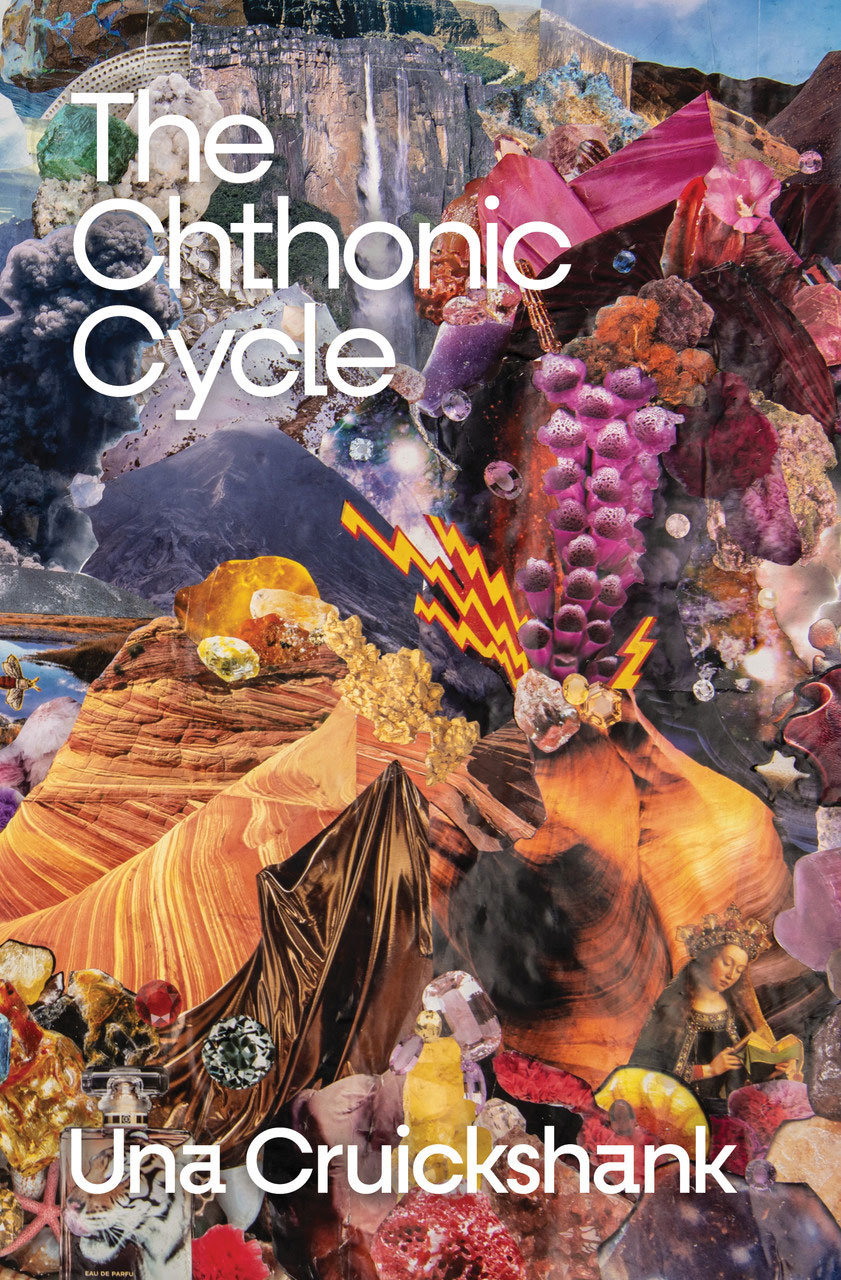
Like the book’s cover, a hectic collage in which Renaissance portraits are pasted on top of tropical fish, this collection is a mashup, a mixtape, and it functions through juxtaposition. Geological time against human time. Roman funerary traditions against Victorian ones. Disgust and beauty. “We should be chastened and scared by our world,” writes Cruickshank, “but it’s critically important, even revolutionary, to also be amazed by it.”
In the wrong hands, this subject matter could be too whimsical to add up to anything, but Cruickshank has more on her mind than assembling funny anecdotes.
She’s picking moments out of the immensity of the past that have something to show, like choosing the one rock on the streambed that contains a geode. (The Crystal Palace, built to house the Great Exhibition, went up in flames in the end, but someone opened the door to its aviary in time and set all the birds free.)
Beneath it all, she’s tracing how the cycles of growth and breakdown fit together, and she depicts them as concentric circles on vastly different scales. Mount Everest was a seafloor, once; a pearl was grit; cliffs fall and become silt; a person dies and returns to their constituent atoms. “It’s the fate of everything on Earth to be dismembered and reconfigured over and over,” she writes. “Only the intricate whole persists.”
If there’s an underworld in this book, it’s the immense patterns that operate on more-than-human timescales, extending backwards and forwards from the present day. “We don’t need magic to see the future,” she writes. “It’s easy to read it in the past.”
More by Rebekah White
Subscribe to our free newsletter for news and prizes
3
$1 trial for two weeks, thereafter $8.50 every two months, cancel any time
Signed in as . Sign out