A handful of environmentalists on Niue are waging an urgent battle against invasive species. Will reinforcements arrive in time? (more…)
More by Pete McKenzie



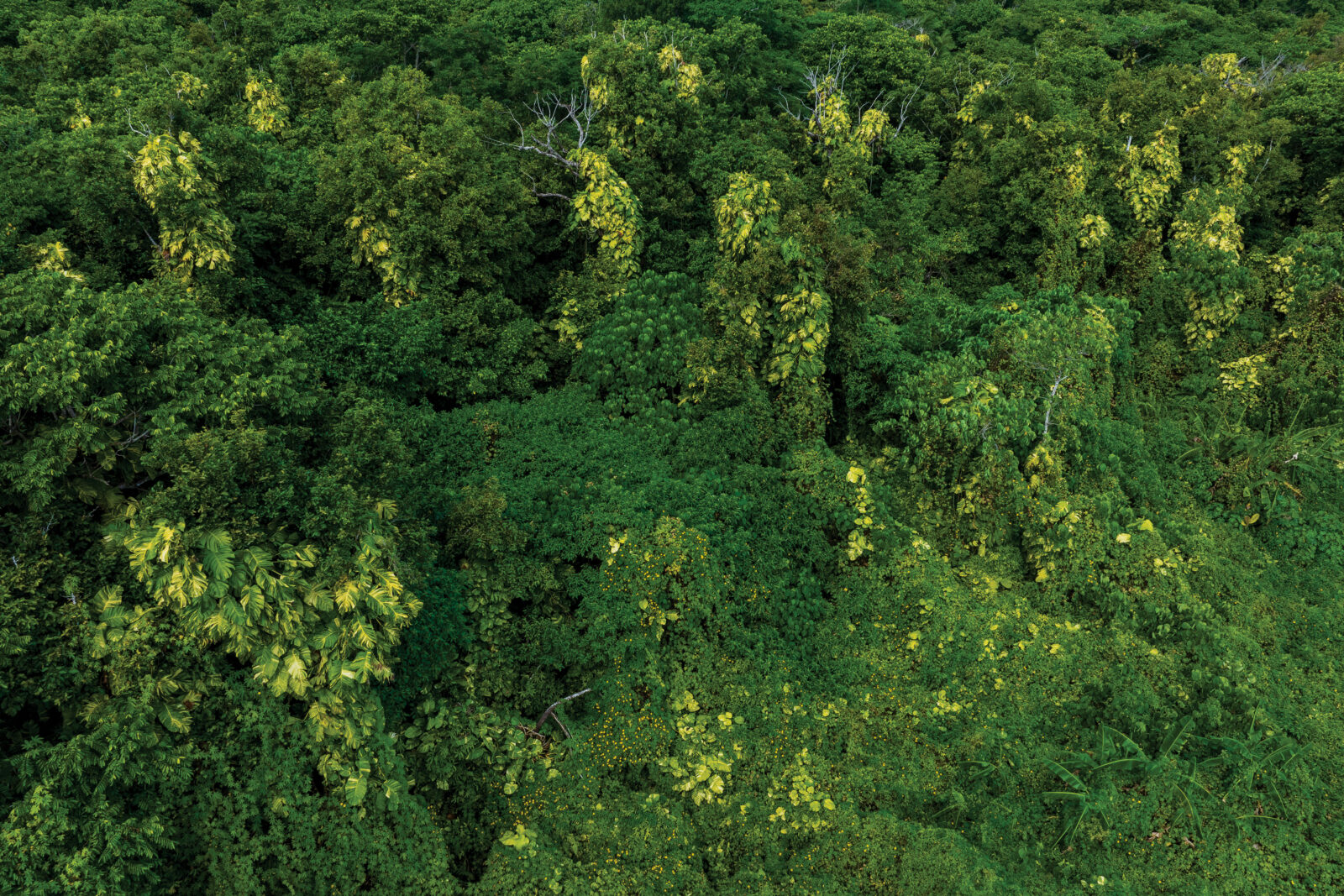
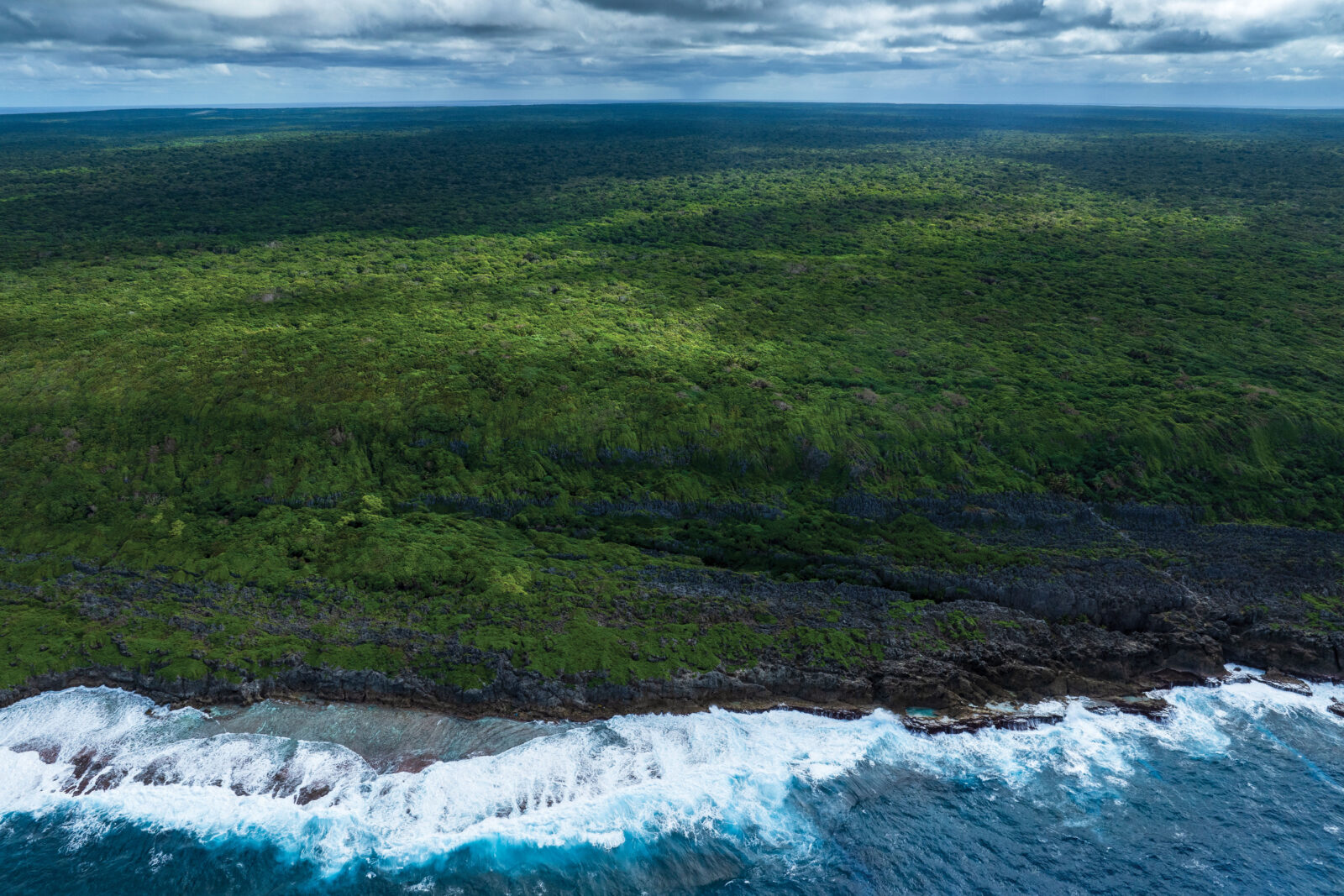
At the northern edge of Hakupu Village, on the small Pacific island of Niue, a signpost welcomes visitors to Huvalu Forest. Around it, lush ferns and densely clustered trees mark the fringe of Niue’s last pristine rainforest, which generations of Niueans have used as a source of food for their families and a place of rest for their ancestors.
Below the sign, a vine the thickness of my little finger emerges from the undergrowth. In the sudden light, the vine climbs and coils around the post in an embrace, and sprouts into two small and glossy heart-shaped leaves, green marbled with yellow. For Bradley Etuata, who lives in Hakupu and helps lead a local environmental group, the taro vine is a familiar sight. Where I see beauty, he sees a threat. “It looks pretty, but it’s crazy,” he tells me. “It spreads like wildfire.”
I peer deeper into the forest and realise that the vine is draped across the branches of the towering koliva and kafika trees. Behind me, it is tightening ropes around the trunks of a grove of coconut palms. Everywhere I look, it is suffocating and strangling and smothering.
Soon, Etuata fears, “our young ones won’t even recognise our trees, because that vine will just take over”.
He takes me several hundred metres deeper into the forest, to the heart of the outbreak. Here, the vine has inundated the strip of forest between the track and the main road. It carpets the ground, rises in green waves over fallen trunks and undergrowth, and sinks parasitical roots into nearby trees while splaying out plate-sized leaves to catch the sun.
Waiting for us is Huggard Tongatule, the lead officer in Niue’s Department of Environment, and three assistants. They’ve brought a ute towing an enormous neon-blue water tank.
Etuata explains that they carved out the track in an attempt to quarantine the vine before it infected the rest of the forest. Now, however, the vine’s thin creepers are spreading across that firebreak towards the untouched rainforest.
Etuata has injured his foot, so he sits on a nearby log while Tongatule and two of his assistants begin hacking taro vine from the trees. Another assistant lights a bonfire. The men throw on what they chop: mats of tangled green tentacles, like armfuls of Christmas lights. A blue haze shrouds the canopy.
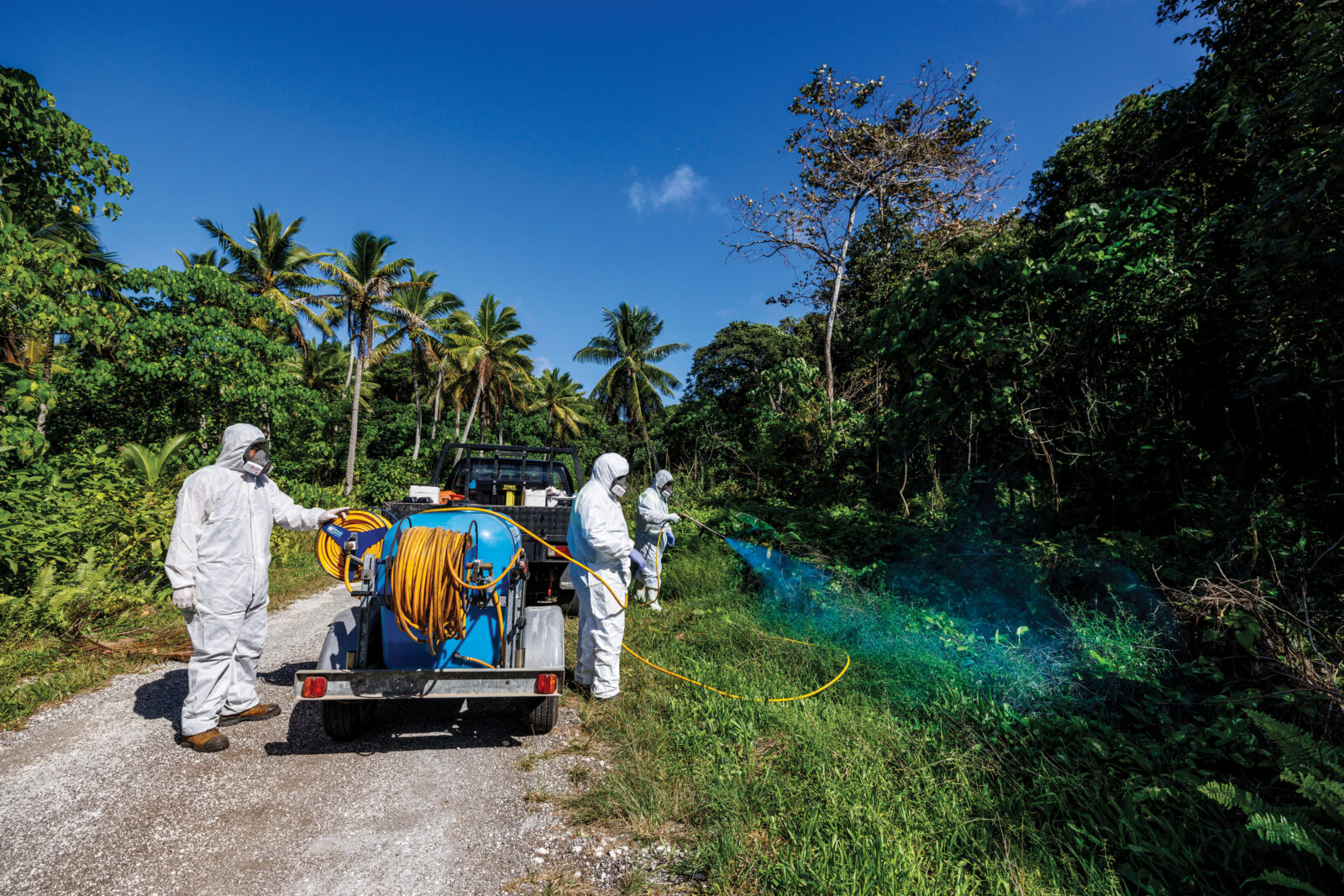
This is not a solution: even a fingernail-sized piece of vine can re-establish itself. But the men have a plan. After cutting away much of the protective layer of leaves that shelter the vine’s more sensitive creepers, they squeeze into spray suits. “Join us on our mission to the moon,” jokes Tongatule. Terence Moheni-Lakatani begins measuring beakers of golden liquid into the water tank: AGPRO Triclop 600, a strong herbicide. He mixes in some dye, then stands back as Kendrick Talaiti, another of the assistants, grabs the sprayer hose. He mimes using it as a machine gun or a pump-action shotgun, then begins to spray great gusts of blue across the remaining taro vine, painting the trees the colour of Gatorade.
The poison does not discriminate. “We have to sacrifice some of the trees,” says Tongatule. They would have died anyway if the vine were left to its own devices. But now, native seedlings that pop up here will have a shot at survival.
Etuata had been hoping some other men from the village would join us to help fight the vine. As we drive through Hakupu settlement, he sees several of the men emerging from their houses. He yells out the window at one. “Where were you?” The man smiles and waves.
“People have so much to do,” sighs Etuata. “Taro vine is a full-time job. You don’t go to work, you don’t provide for your family, it’s all you do.”
Jobs are few on Niue and it’s a tough place to get by on gardening or fishing alone: the volcanic rock is covered in a thin and patchy layer of soil, and the fishing is nothing like what it once was. So imports are a lifeline. The island’s 1600 inhabitants could not get by without supplies from the flights that land here twice a week and the boats that arrive once a month. But now the island is swarming with exotic pests. Taro vine escaped in Niue after being brought in as an ornamental. Feral cats, rats and mice are decimating birds. Wild pigs are devastating hard-won farms. Underwater, thousands of snails are steadily chomping through corals.
If the people of Niue do nothing, in a matter of decades their island will go silent—their reef sucked dry, their forest replaced by an alien emerald monoculture.
“It’s like a war,” says Moira Enetama, Tongatule’s aunt and a community leader on the island.
But Niue has an audacious battle plan. It’s not just going to do something, it’s going to do everything—the aim is to be the first country in the world to eliminate or control its main invasive species by 2030. Taro vine, pigs and snails are first on the list. And later, rats.
*
Early one morning, before the heat of the Niuean day begins to beat down upon us, I sit beside Tongatule in the passenger seat of his ute. A stocky, quiet man with a light dusting of stubble, he toggles between jokes about the demands of his work and discomfort with being the centre of attention. “I do pretty much everything, but it’s not really about me,” he insists. “It’s about the island.”
He is paid for only 40 hours a week, but the tasks required of him are so extensive that he works much longer than that. Tongatule’s four-man team is not only responsible for protecting the country’s forests and waters, but for maintaining the rubbish and recycling plants and handling any environmental emergencies that arise. He is eager for outside help. Painted across the side of his ute is the campaign’s logo: a pair of crossed machetes and the words Invasive Species—Everyone’s Responsibility. It’s a theme he emphasises at every opportunity.
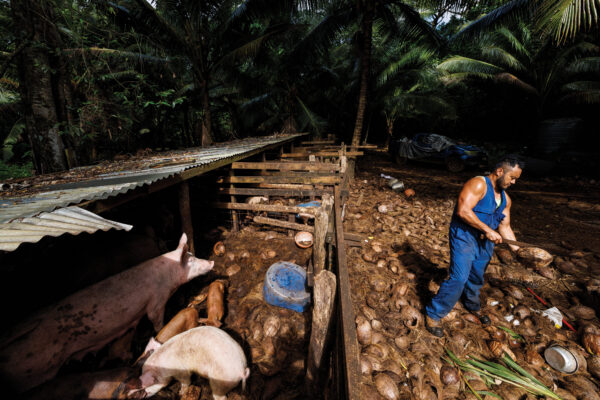
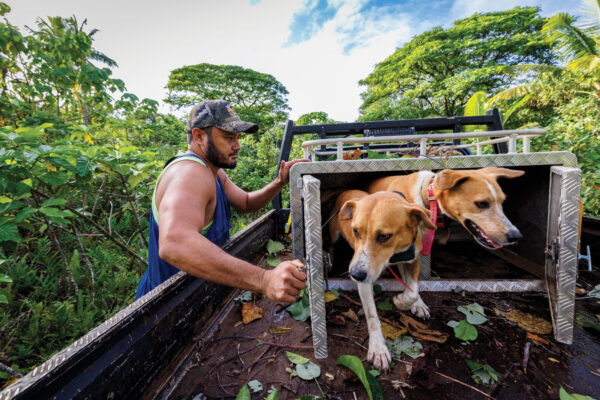
But most people who have stayed on Niue are too busy juggling work, family and civic obligations to volunteer in the way Tongatule would like. Others are disillusioned by their own history. “There’s a lot of history in Niue of failed control efforts. We think we can get rid of something and we can’t,” Tongatule tells me. As we travel around the island, he points to the newcomers that have taken root as a result: rat’s tail, mile-a-minute, Honolulu rose. “Every time we have a consultation, people bring that [failure] up.”
Tongatule is intimately familiar with these ecological histories. His father was the founding director of Niue’s Environment Department and oversaw efforts to control the invasive species plaguing the country. Now, Tongatule has taken on that legacy. At times, he says, it’s a frustrating responsibility, given the lack of community buy-in. “They expect me and my team to go and get rid of it all. It’s humanly impossible,” he says. For now, however, he’s doing his best to achieve the impractical.
He hops out of the ute, pulls down the tailgate, and opens two cages. Four lithe dogs shoot out and disappear into the bush. We’re going pig hunting.
While taro vine is the most visible invasive species on Niue, pigs are arguably the most damaging. Practically every family on the island has its own plantation, where they grow the taro on which many people rely for their meals. One pig can devastate a farm in just a few hours.
“They’re so aggressive,” says Haden Talagi, the current director of the Environment Department.
“Feral pigs have been a problem year after year. Now, it’s a food security problem. You go to harvest your taro and there’s no taro left to harvest. It’s just flat; everything’s demolished.”
A small group of Niueans are running an extensive pig-snaring programme: the Environment Department pays a small bounty for each pig they catch. But traps can only do so much. Tongatule is one of three men on the island who know how to hunt with dogs and have the animals required. As a result, as with taro vine, he has become responsible for much of this fight.
After his dogs go bush, he pauses by the side of the ute. “If they all start barking, you know they’ve found one,” he says. Almost immediately, a cacophony of growls and yaps breaks out. Tongatule grabs his rifle, strides down a rough path, then cuts into the bush. Several metres from the path, one of his dogs has found a young boar. The other three dart around it. The hounds nip and bark and bite and scurry; in the melee, Tongatule can’t be sure he won’t hit them if he fires. Spotting an opening, he lifts the rifle to his chest. There isn’t time to bring it to his shoulder. He fires.
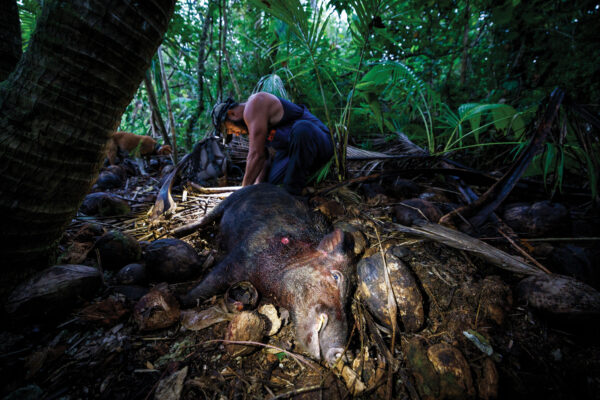
“Good boy, Trump! Good boy!” He pats the head of one of the dogs, which was given to him on the day of the 2016 US election. The dog tears at the pig’s torso, smearing blood across his snout. “Get off, get off!” Tongatule pulls out a knife and slices off the pig’s testicles. “It affects the flavour. This way, you get rid of the boar scent.” He throws a globe of luminescent blue flesh into the bush, where a dog snaps it up. Tongatule hauls the pig back to the ute. Dinner.
Cracking open a pair of coconuts, he whistles the dogs back and they lap up the milk. He’s surprised by how easy today’s hunt has been. After almost a decade of regularly hunting with the dogs, which the New Zealand government sent over to help clean up the pigs, he thinks he’s reduced the wild pig population from several thousand to around 600. It usually takes much longer to find one.
That said, he hasn’t done much hunting in recent weeks. He started chasing pigs here as a young man, soon after winding up a stint studying and playing rugby in New Zealand and Australia. He could do anything he wanted back then, he says. Now, he must support his parents, a wife and two young daughters. It’s difficult to find the energy to hunt, especially since a hunt pushes him far beyond his paid working hours.
But taking such breathers is dangerous. “You can’t take a step back,” Talagi, Tongatule’s boss, tells me. “You need to keep going.” Many Niueans keep their own pigs, which often escape from their pens or are allowed to roam loose, which means that the feral population is always at risk of exploding again.
Today, Tongatule is happy just to be back in the bush. But others worry about the load he’s carrying. Enetama, his aunt, admires how hard her nephew works but thinks “he is losing the battle”. If the island carries on this way, she says, “we won’t get anywhere. We’ll lose the fight.”
*
Several hundred metres off the rocky shore of Niue, in a sturdy yellow motorboat laden with scuba tanks, Esthereena Tonga smiles nervously as she contemplates the ocean around us. The 17-year-old deputy head prefect of Niue’s high school has dived only a handful of times: the water remains an unfamiliar world.
Beside Tonga sits her teacher, Roxy Damseaux, a South African and self-described “ocean frother” who helps to run Niue Blue, the island’s largest dive operator. She first visited Niue several years ago, fell in love with the island, and has pretty much stayed ever since.
Niuean cultural norms dictate against girls and women swimming or exploring beyond the reef: traditionally, only men were permitted to fish, while women were expected to gather seafood from shallow, wadeable corals. Eventually, Damseaux grew frustrated with the lack of women on the water. In 2022, she created a local branch of Daughters of the Deep, a global charity supporting women to explore the ocean, and taught Tonga and half a dozen other students how to snorkel. Next, she began taking them whale watching. Most of the girls were more focused on their own island, which they’d never seen from the sea, than on the whales. “It was like seeing the island from outer space,” says Tonga.
Soon, inspired by Damseaux’s stories, Tonga decided she wanted to learn how to dive.
“When I saw the ocean from underneath, everything was new to me. It was unbelievable,” recalls Tonga.
“I felt so lucky to be working with her. To be the one.” On Tonga’s second dive, she noticed Damseaux plucking something from a coral. A souvenir, she assumed. But when they got to the surface, Damseaux showed her a drupella snail.
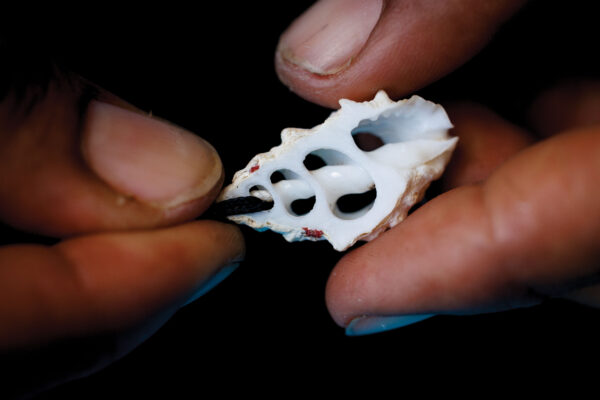
An adult drupella is roughly the size of the first joint on your index finger, with a crimson shell covered in spikes. Their size belies the damage they cause. As they feed, they tear the living tissue from coral reefs, leaving skeletal wreckage behind. At Western Australia’s iconic Ningaloo Reef, a drupella outbreak destroyed 90 per cent of coral cover. In Niue, where coral is essential to the island’s tourism industry, such an outbreak would be devastating.
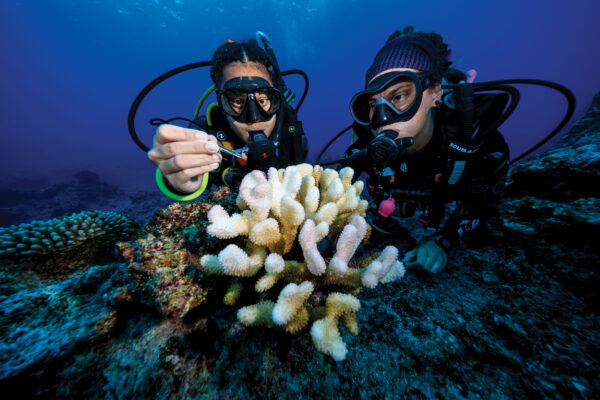
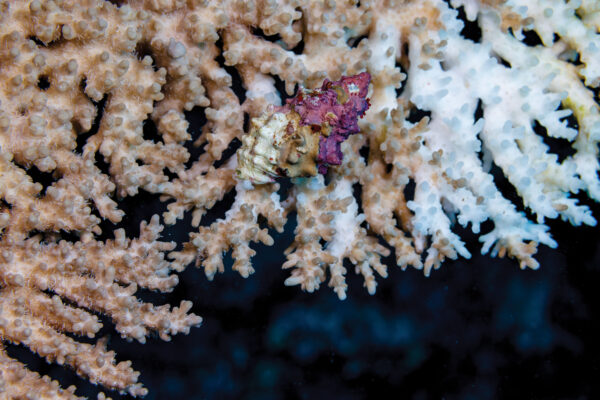
It’s Damseaux who leads this fight. She first began noticing drupella in the years leading up to COVID-19. When the tourists disappeared, she and Niue Blue’s other divers started spending their time crawling across reefs and plucking out drupella. Often, that required using tweezers to extract the fingernail-sized baby snails that tend to cluster out of sight on the underside of coral outcrops. After noticing Damseaux’s efforts, Tonga volunteered to help. (Tongatule and his assistants have also recently earned their dive certifications, so that they can pitch in.)
This dive is Tonga’s first drupella collection. She, Damseaux, and a Niuean man named JinNam Hopotoa shrug on their scuba gear, then tumble into the water. I jump in with a snorkel and watch from above. Damseaux takes her partners slowly from coral to coral. Schools of angelfish drift past. Tonga and Hopotoa are still getting the hang of diving: they swim with wide eyes and jerky movements. Soon, however, they pull out tweezers.
One snail really does not want to be got. Damseaux lets her feet float over her head, and attacks from above. A sea krait writhes out of a nearby coral and swims up beneath her; for a strange few seconds, snake and diver hang in the water half a metre apart, each focused on the coral below. Then Damseaux shifts slightly. Startled, the krait speeds away.
As we drift along the reef, patches of white coral—drupella-gnawed skeletons—stand out amid the healthy pinks and browns. But in this patch of coastline at least, Damseaux and her fellow divers are keeping the drupella under control.
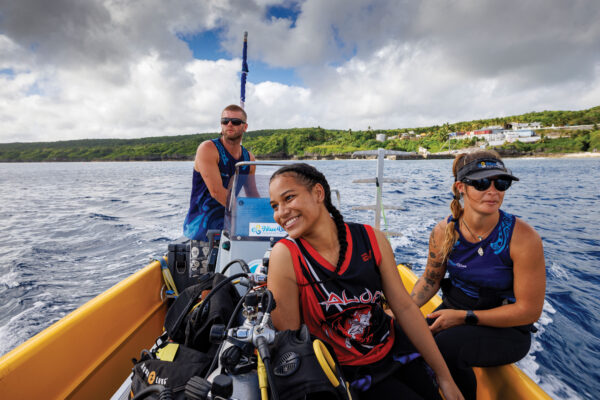
On the surface, Tonga is fizzing. She has decided she wants to be a marine scientist when she’s older. “I want to save them,” she says of the coral below. “They look so beautiful, and there’s so many around. I just want to save everything.” Damseaux grins. Long term, the campaign depends on its ability to recruit new battlers.
I ask Damseaux whether she had noticed the snake (kraits are highly venomous, but that’s only a worry if they manage to get their tiny mouths around a bit of you—like the web between your fingers). She hadn’t: she was too focused on the snail cull. “We always say that it’s not a competition, but it is,” she says. Who wins? “Me. I can’t believe you asked.”
*
Government officials such as Talagi and Mona Ainuu, the country’s Environment Minister, know they have set themselves a big, bold goal. If successful, Niue would be the largest inhabited island in the world to eradicate rats. They believe they have no other choice.
The Environment Department sits in a low-slung prefabricated building on the outskirts of Alofi, the capital. The office is surrounded by palm trees, most of which are consumed by taro vine. The rest of Alofi is much the same. Seen from above, the forest canopy surrounding the village is speckled with flashes of bright green: infestations. So far, the outbreaks have largely been confined to the island’s coastline. Left unchecked, the vine will soon consume Niue’s forested heart.
“It’s quite shocking to me how fast it has spread,” says Talagi. “We need to go big.”
Niue is now receiving some assistance. As part of a wider campaign against invasive species across the Pacific, the Secretariat of the Pacific Regional Environment Programme, the region’s top environmental body, has assigned staff to work part-time to support Niue’s effort. It has connected Niue with Manaaki Whenua—Landcare Research in New Zealand, which has sent teams to assess the threats facing Niue, and is helping Niuean officials look for the funding necessary to fight back: a global search, to cover a bill expected to be in the tens of millions of dollars. The Pacific Regional Invasive Species Management Support Service (PRISMSS)—primarily funded by New Zealand—has been the first to chip in.
Biocontrol is very much on the table. Natural predators have not been deployed in Niue yet, but a research project is under way involving the Fijian lace bug, which feeds on taro vine. Asma Bibi, a Fijian scientist supported by Landcare and the Environment Programme, is exploring whether the lace bug also takes out other Niuean plants. Soon, officials hope, she will be able to prove it does no broader harm, and they’ll be able to release the lace bug on the island to do some of Tongatule’s work for him. If the bug succeeds there, it could be used elsewhere, too: Niue is one of many Pacific nations struggling with taro vine infestations.
Biocontrol has a spotty history. Weasels and stoats were first introduced in New Zealand, for example, in an attempt to control rabbit populations. But Niue will try anything. “It takes a toll on you when you keep trying and failing to eradicate,” says Talagi. “If people see evidence that it’s working, that will encourage them to join the battle.”
In the meantime, Tongatule is in a holding pattern: hunting, slashing, burning and spraying to keep the invaders at bay. Whether he can keep that fight going long enough for reinforcements to arrive remains in doubt.
Partway through my stay in Niue, he and I drive down the road connecting his home, near the Huvalu Forest Conservation Area, with Alofi. He pulls over, into a grove of towering trees, and points into the darkness below the canopy. Taro vine cascades from the branches above and pools on the forest floor. Tongatule reckons he would need 20 people and a month just to clear this patch.
He takes a few half-hearted swings at the vines with his machete, then turns to me and shrugs. “Helpless,” he says. In this moment, as in so many of his waking hours, he is just one man, trying to save an island.
More by Pete McKenzie
Subscribe to our free newsletter for news and prizes
3
$1 trial for two weeks, thereafter $8.50 every two months, cancel any time
Signed in as . Sign out