A vicious strain of myrtle rust is burning through our bush. Dozens of native species—and the ecosystems they support—are at risk. Scientists think we have three, maybe four years before the biggest pōhutukawa start to fall. They’re racing to find a way to stop the rust—and to save seeds from plants we stand to lose forever.
A vicious strain of myrtle rust is burning through our bush. Dozens of native species—and the ecosystems they support—are at risk. Scientists think we have three, maybe four years before the biggest pōhutukawa start to fall. They’re racing to find a way to stop the rust—and to save seeds from plants we stand to lose […]
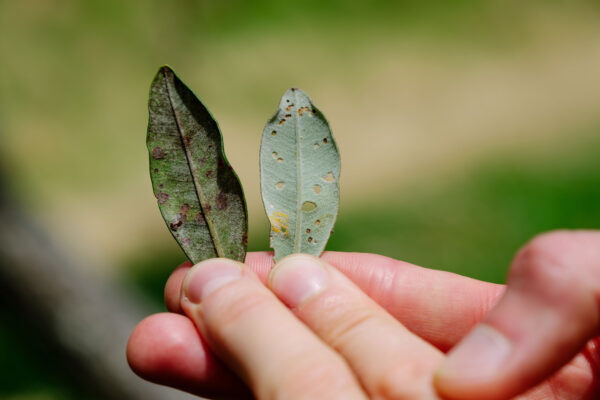
It comes from the sky. A westerly wind sweeps up microscopic spores from trees in Australia and wafts across the Tasman Sea. Settling on a pōhutukawa leaf, the spores take hold. Over 10 or so days, purple splotches spread across the leaf’s soft silver underside, erupting into mustard-yellow pustules. The leaf buckles and crumples, splitting off its twig.
By the time anyone notices, canopy leaves across a small copse of mature pōhutukawa on the Kermadecs/Rangitāhua have died off. A Department of Conservation (DOC) ranger visiting Raoul Island, some 1,000 kilometres northeast of Northland, spies the ailing trees and collects samples of the strange yellow blemishes. Lab tests confirm the culprit: myrtle rust.
Six weeks later, Tom Lindesay notices the tell-tale yellow staining on the leaves of two-year-old pōhutukawa seedlings in his Kerikeri nursery. Further discoveries sprout in quick succession, centred on Taranaki. By the end of May, myrtle rust has been found at 25 sites in the North Island. For our myrtles—eucalypts, guava, feijoa and, critically, 37 native species—an existential clock is now ticking.
*
Rusts are fungi that parasitise plants. In the late 1800s, a rust destroyed all the coffee plants in south east Asia. Wheat rust epidemics routinely cripple cereal crops around the world. Most rusts, like these, target just one species—but myrtle rust can infect more than 350.
Myrtles are the major plant family propping up Australia’s forests: experts predict the rust will soon take out more than 16 native species. A “plant extinction event of unprecedented magnitude”, they’re calling it. Four years ago, after the Black Summer fires ripped through swathes of bush, regenerating new growth was annihilated by a tsunami of infection, leaving a vast graveyard of bare wood.
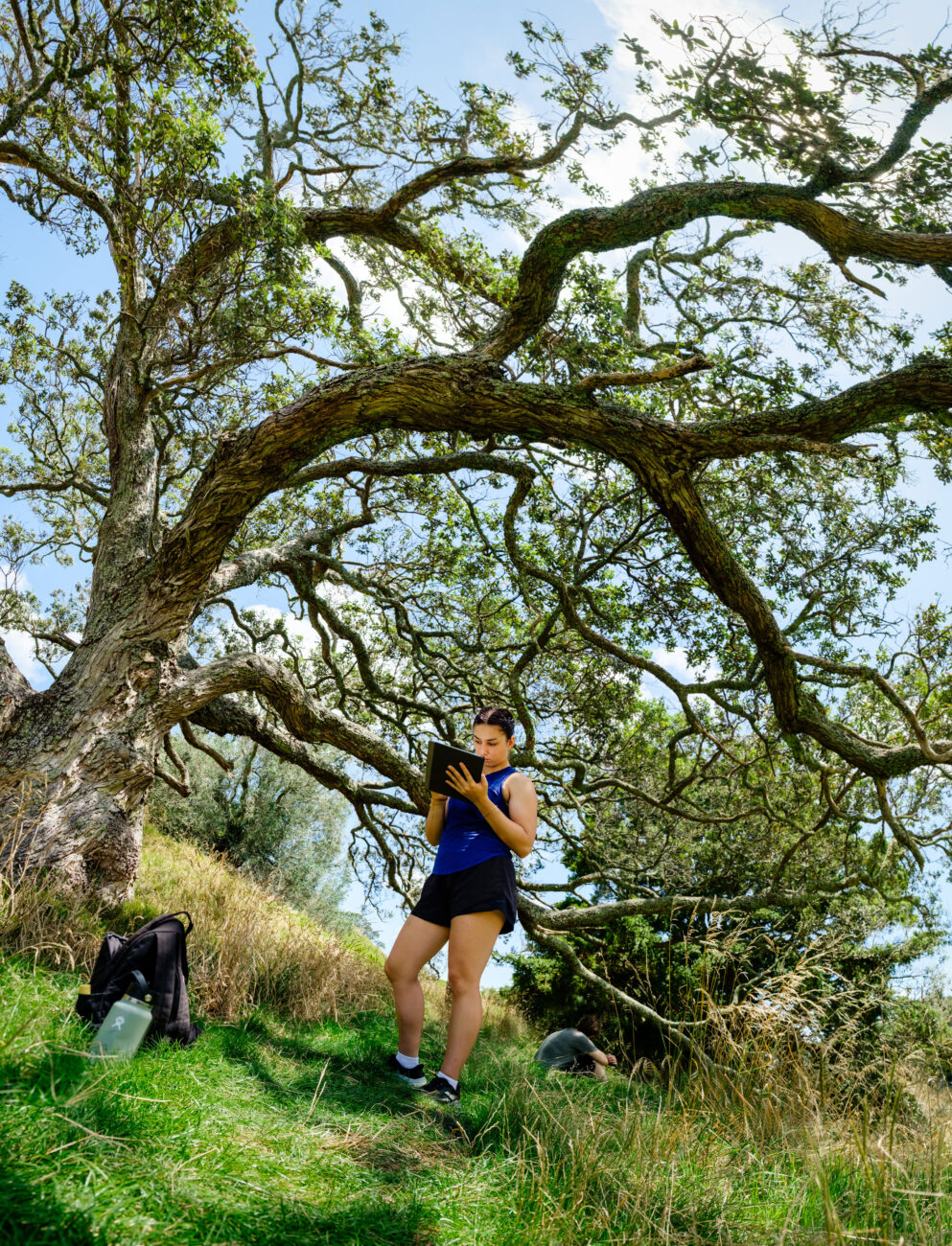
Cecilia Beck, an intern at Manaaki Whenua Landcare Research, checks pōhutukawa on Auckland’s Maungakiekie/One Tree Hill for signs of infection. These usually start as splotches on new leaves, before erupting into powdery yellow lesions.
Not all plants are affected the same way. Some die. Some survive. Some become hotbeds of sickly yellow spores that spread infection. In New Zealand, swamp-loving maire tawake with its white starburst flowers, glossy-leaved ramarama with deep red berries, and densely branched shrubby rōhutu have been hammered. Feijoa, which probably co-evolved with myrtle rust in its native Brazil, seems to be faring okay. Lilly pilly, an Australian import often used in garden hedges, is a myrtle rust superspreader.
Death by myrtle rust happens in slow motion. The fungus attacks soft young leaves and tender shoots and stems, leaving skeleton twigs where new growth should be, then lying in wait for the next burst of spring growth. Season after season, the plant can’t renew its crown of greenery—the engine that turns sunlight into energy—or set the seeds it needs to reproduce. It must rely instead on the older, tougher, less efficient leaves. How long can those leaves hang on for? That’s how much time we’ve got.
*
Beccy Ganley had been dying to see myrtle rust. A plant pathologist, she had had it on her radar since 2008, when the pathogen was first identified in Hawaii. Two years later, myrtle rust made it to Australia and the threat to New Zealand “really ratcheted up”, she says. Finally, on a misty June morning in 2017, at the end of a quiet cul-de-sac in Te Puke, Ganley donned a white protective spraysuit and came face to face with the fungus.
At first glance, the 25-year-old ramarama tree didn’t look yellow—just a bit tatty. “It wasn’t until you actually got closer [that you realised] it was just everywhere. It was amazing,” Ganley recalls. A concerned homeowner had reported the possible infection to the Ministry for Primary Industries (MPI), and now her backyard was ground zero for myrtle rust in the Bay of Plenty. MPI removed the tree and treated the garden with fungicide. Not long after, in a “heart-stopping” moment, Ganley found a single infected leaf with a tiny lesion on another ramarama in Te Puke. “Ramarama was the canary in the coal mine,” she says. Looking back, that first infected tree had been sick for a long time.
*
“From a Māori perspective, we were ready to hit the ground running. We had a plan,” says indigenous environmental sociologist Melanie Mark-Shadbolt.
Long before myrtle rust arrived here, colleagues dealing with it in Hawaii had told her the fungus was like the common cold. “It’s going to weaken you, it’s going to make you feel sick.” And when a second deadly fungus hit Hawaii, they told her, the sickly forest was decimated.
Aboriginal groups from Australia shared a different story. There, myrtle rust was devastating forests. There were local extinctions of some species, they said—diversity irreversibly lost because people hadn’t banked seeds quickly enough.
“That propelled us into looking at myrtle rust more seriously,” says Mark-Shadbolt. With other Māori researchers, she travelled Aotearoa talking with communities about myrtle rust (as well as kauri dieback and biosecurity). In April 2017, the group created Te Tira Whakamātaki, the Māori Biodiversity Network. A month later, myrtle rust hit.
The newly formed network offered their plan and support to government agencies, but, as Mark-Shadbolt sees it, “MPI threw it in the trash”. Instead, she found herself fielding calls from whānau concerned that officials were turning up on their land in boiler suits and ripping plants out. She was told some officials had been collecting seeds from wāhi tapu sites without mana whenua knowledge. “You can imagine how Māori reacted to that,” she says.
The group turned to Kew Gardens in London for help implementing their plan, which hinged on collecting the seeds of myrtle plants and keeping them safe, so species wouldn’t be lost forever. Kew immediately diverted several emergency seed collection drums, usually deployed in the wake of natural disasters or war, and sent seed collection experts to New Zealand to train 35 kaitiaki.
Hapū and iwi started collecting seeds, but they were doing it without any government help. “We’ll just progress without you,” shrugs Mark-Shadbolt. Meanwhile, separately, DOC began collecting seeds, too. Across Aotearoa, dozens of seed collectors rushed to shake millions of tiny seeds into packets—to be safe, we’d need 10,000 good-quality seeds per species, scooped from at least 50 individual plants. It was a strange task: tapping pōhutukawa with long poles and sweeping seed off tarps, the future of a species suspended in a handful of specks and flakes.
*
A year after myrtle rust was first detected, MPI conceded defeat: containment or local eradication was impossible. Instead, officials said, they would focus on science and set up regional programmes to manage the spread. The promises sounded good, cohesive. And the science has been excellent. But for the people on the ground, watching rust spread and cripple their forests, real-world progress has been questionable at best. “Now we have nothing,” Ganley says. And research funding is about to hit a dead end.
Today, myrtle rust peppers the North Island and top of the South Island like chicken pox. Surveillance is scattered and largely crowdsourced, relying on ad hoc sightings uploaded by members of the public to the website iNaturalist.
The number of observations falls year on year—even as myrtle rust flourishes here, it fades from public consciousness. Mahajabeen Padamsee, a mycologist at Manaaki Whenua Landcare Research, is among those pushing for a proper national monitoring system. “Where is the pathogen? What is it infecting?” she says, frustrated. Basic information, but we don’t have it.
I join Padamsee on an overcast, sweltering January day in Auckland’s Cornwall Park, with doctoral candidate Vladislav Kholostiakov and summer interns Cecilia Beck and Rebecca Greenwood. We’re here for an annual check-up.
Along the iconic Pōhutukawa Drive, curled branches touch overhead to form a tunnel. Most have finished flowering for the summer, but the green is punctuated by the odd burst of crimson. Beneath these towering 95-year-old pōhutukawa, scraggly successors line the road. Their vegetation is sparse, with leafless twiggy ends—a symptom of infection.
Beck and Greenwood buzz from one tree to the next. They set a timer for two minutes, and then speed-count patches of sickness, lifting up branches and inspecting under leaves. They use tape measures to record the length of new growth—a proxy for tree health. Kholostiakov has taken to calling the trees “patients”.
What they’re doing today is part of a project monitoring 100 pōhutukawa across the city. It’s been running two years.
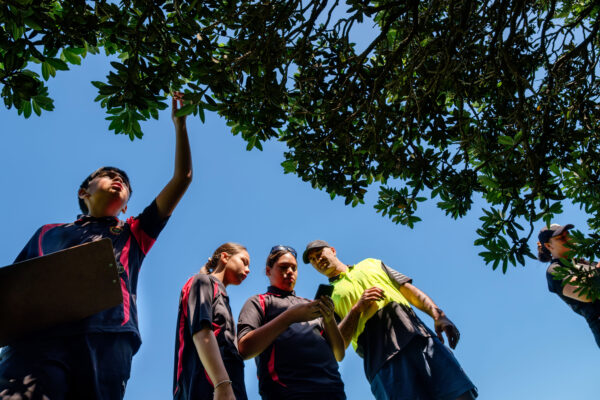
Scion’s Jacqui Bond inspects rust on ramarama. In Tairāwhiti, this species has been all but wiped out.The Te Whakapae Ururoa team (left) is working to save the region’s other vulnerable plants—and connect locals, like these Te Waha o Rerekohu Area School students, to the ngahere.
When myrtle rust first reached Auckland, it mostly infected hybrids—crosses between pōhutukawa and its close relatives, like rātā, that crop up by chance in nature or are cultivated in nurseries. “We thought maybe the pure pōhutukawa would be okay,” says Padamsee. “But now it’s changed.”
The wet, warm summer of 2022-23 drove what Ganley calls “phenomenal infection… pōhutukawa just dripping with spores”. That summer, for the first time, the project discovered myrtle rust on Rangitoto Island, home to the world’s largest pōhutukawa forest. The island’s uncertain future keeps Padamsee awake at night: if successive “really bad” seasons hit Rangitoto, she says, the forest could become a graveyard, perhaps with the odd resistant straggler clinging to the volcanic rock. “That’s worst-case scenario. It would be awful to see.”
“I think in three to four years’ time, we will see the first collapse of mature pōhutukawa,” says Ganley. “And when I say mature, I mean big ones.” This prediction stems from what happened across the ditch. In Australia, the trajectory of some species has mirrored the pōhutukawa’s plunge into the throes of infection—but about seven years ahead. The next stage, according to the Australian experience, is collapse.
Much of our coastline is held together by a knotted labyrinth of pōhutukawa roots. When the trees collapse into the sea, the earth will follow. It’s also a health and safety risk, Ganley points out, with pōhutukawa ubiquitous in urban streets, parks and schools in the North Island. “Kids run up and down the branches, kids play underneath them in the shade—at the moment that’s okay, but in a couple of years’ time, I think we’ll be looking at a very different picture.”
Today, Kholostiakov looks at the trees and he sees a race. Every now and then, the scientists find an oddity: a single tree that seems in good health. He points out a pōhutukawa that has slightly longer leaves and no signs of myrtle rust. Could there be clues to resistance in its genes, or perhaps in its microbiome? Many scientists think pinpointing such resistance, then breeding it, could help ecosystems hold on. But while we work on that the blight is quietly getting on with killing. “Who will get there first?” Kholostiakov wonders. “Scientists finding resilient trees, or myrtle rust?”
*
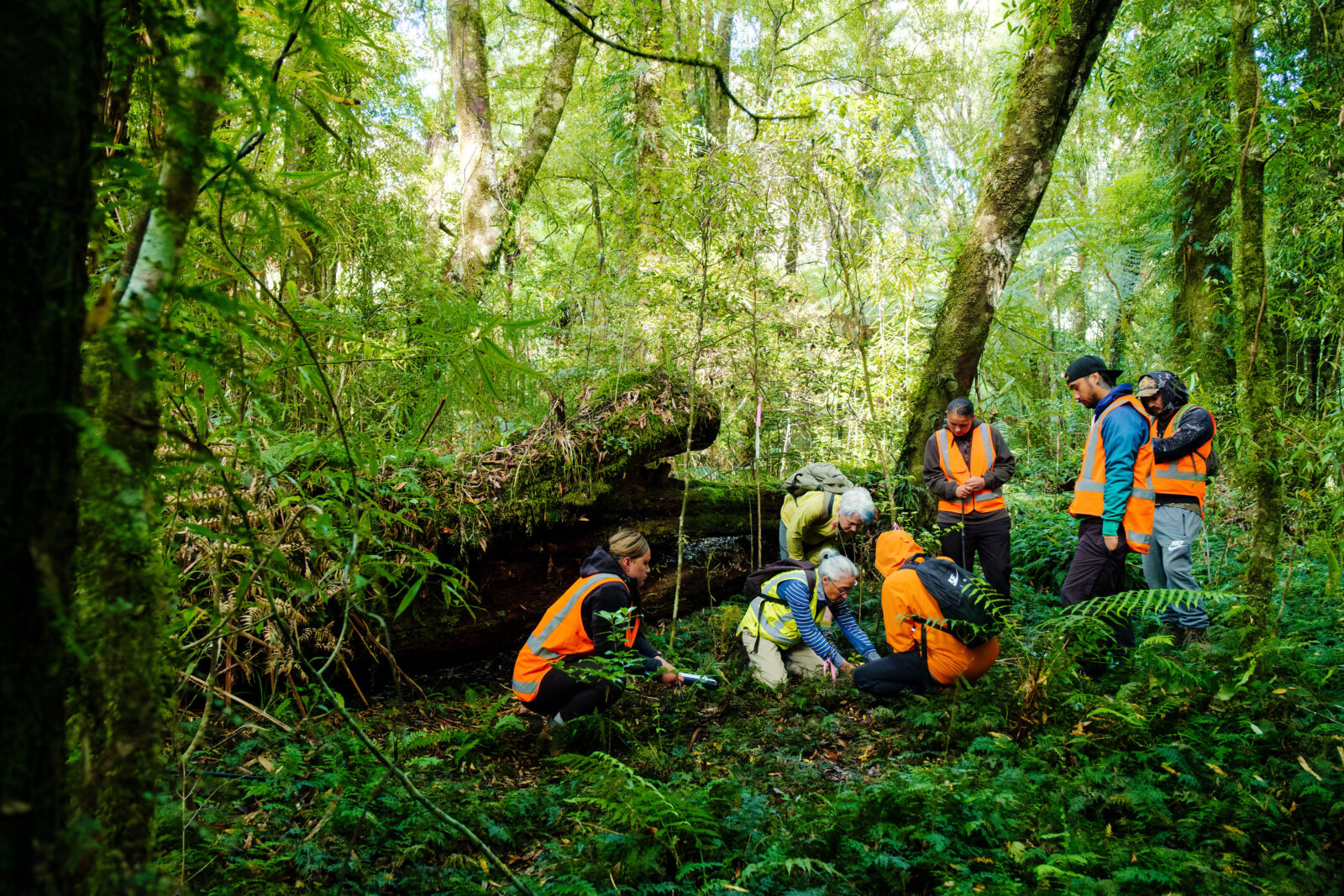
Otaki Kahika Grant digs her bare fingers into the soil, feeling the long, spindly stem of ramarama for roots and shoots. “There’s a little new growth here,” she calls. “On the stem.” Wai Riini (Ngāti Porou, Ngāti Awa, Ngāi Tahu) snaps a photo of the tiny shoot. The pair are bright in hi-viz against ferns and tree trunks and moss.
Kahika Grant and Riini are hōmiromiro, or field technicians, for a Jobs for Nature project monitoring myrtle rust around the Rotorua lakes and collecting precious cuttings of at-risk rare species. We’re in the lush ngahere on the shores of Lake Ōkataina/ Te Moana i kataina ā Te Rangitakaroro. The team fans out to check ramarama for signs of infection—and for signs of health.
Riini is quiet and wears his hood up, but says that being in the ngahere clears the mind. Kahika Grant feels that this mahi is in her DNA. “I’m a late bloomer. I should’ve been here when I left high school, but life took other turns,” she says.
The ramarama they’ve just checked was pinned horizontally to the ground by a strap of supplejack, a growth-boosting experiment that Kahika Grant calls “layering”. In the bush, the crew had noticed a few plants had flourished even when tumbled on their side. They replicated this in the nursery using cuttings. “They grow quicker, there’s a lot of sprouting. They’re standout performers,” says Kahika Grant.
Ramarama is an evergreen shrub with shiny, blistered leaves. It usually prefers the sunny forest edge, but here the glossy plants are scattered below a towering canopy. The plants here are also unusual in that they show little sign of myrtle rust die-off—but whether that’s a result of the protective canopy, other environmental factors, or perhaps a deeper form of resistance, is a mystery. It’s one the team is hoping to unravel with a new breeding trial.
At the Scion nursery on the outskirts of Rotorua, a tile of seedlings bristles in the breeze: these are ramarama from seven mother trees, a handful of rōhutu hybrids grown from cuttings collected here on campus, and rose apple. The seedlings are bared to the spore-laden wind, and infection is expected to take hold within weeks.
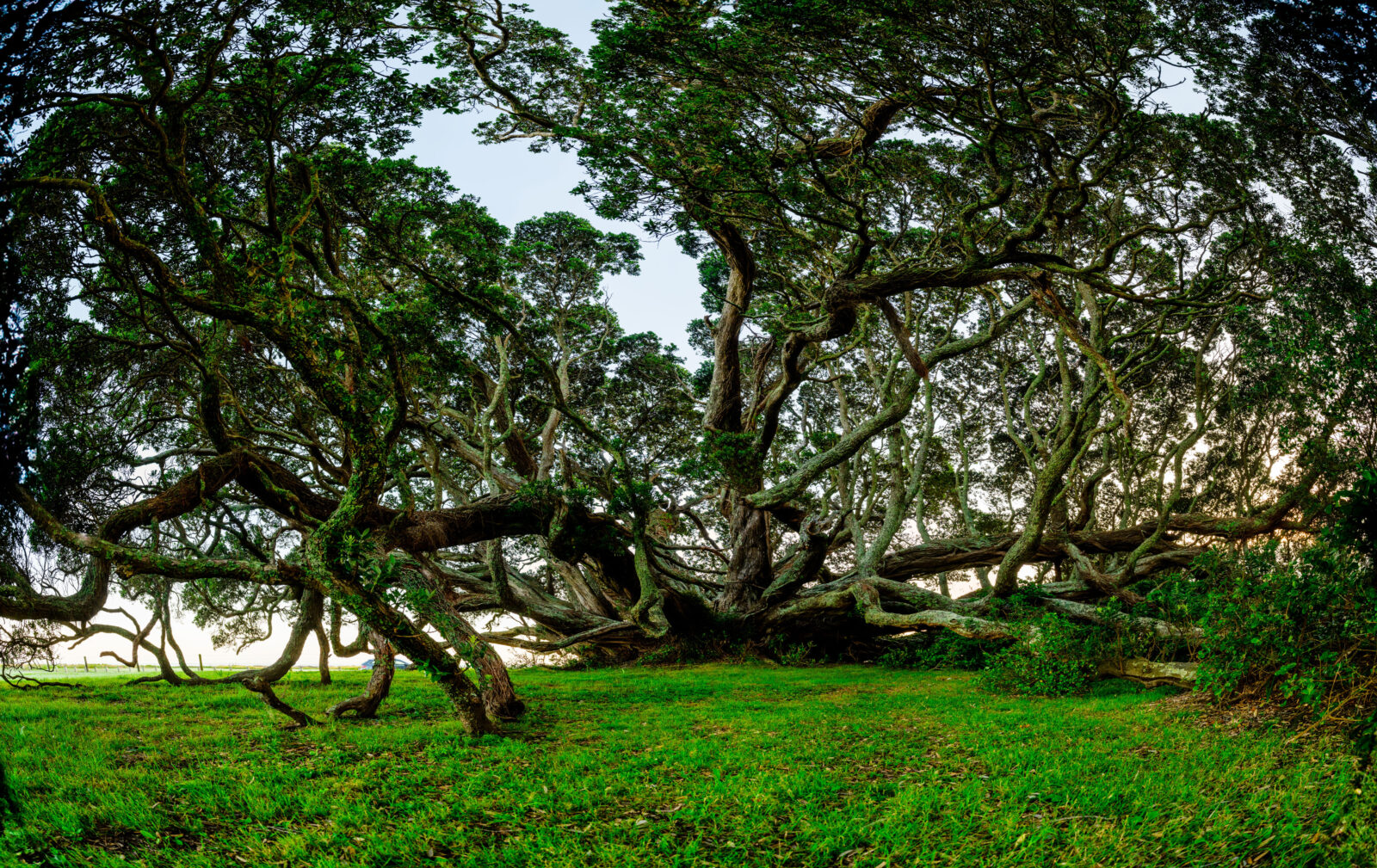
Otaki Kahika Grant (in stripes) checks a tender young ramarama for new growth. The plant has been laid horizontal and pinned to the ground with supplejack—a growth-boosting technique the Te Rātā Whakamaru team hope will help give the ngahere a fighting chance. The strategy epitomises western science in kōrero with on-the-spot field work: “expertise from all angles”, says Kahika Grant (Te Whakatōhea, Te Arawa, Te Whānau-ā-Āpanui).Could myrtle rust bring this 600-year-old tapu giant to its knees? Te Waha o Rerekohu, thought to be the largest pōhutukawa in the country, is named for Ngāti Porou tipuna and rangatira Rerekohu. Rust was spotted on its leaves in February 2023. A new RNA spray can combat myrtle rust in the lab, and—given the funding—could one day be deployed to save important individual trees like this one.
Among the ramarama and rōhutu, tree breeding expert Heidi Dungey is hoping to find signs of resistance. (The rose apple, highly susceptible to myrtle rust, acts as a control.) Any promising seedlings can be cross-pollinated, and the next generation deliberately infected again. “That will show us whether resistance is heritable,” says Dungey. If the answer is yes? “That will give us hope.” But it would still take time and money to get a breeding programme up and running. These realities drift in the air, unspoken.
Each seedling sports a coloured label that records its origin story. “All these plants, we can trace their whakapapa, we can trace them back to the plants they came from [in the wild],” says Kahika Grant, who helped to devise the system. Eventually, the idea is to propagate tolerant individuals and return them to the ngahere, where they can give wild populations an edge.
This trial is a pilot, says Dungey. Given the funding, it could be replicated by hapū everywhere, in their own rohe.
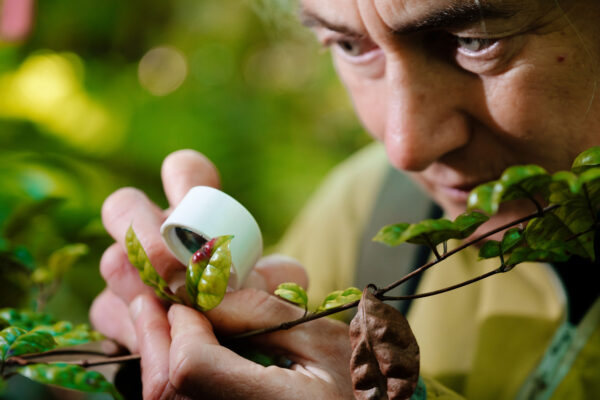
Near the shore of Lake Rotomā, three men in boiler suits swarm a tree. It’s one most walkers wouldn’t glance twice at, blending into the bush palette of green and brown. Taupe Poasa (Te Arawa, Tainui, Matatua, Fakaofo of Tokelau), a manukura or field leader, has a bottle of disinfectant strapped to his chest, and wields a magnifying glass for examining tiny heart-shaped leaves. If myrtle rust continues on its devastating trajectory here, this species, rōhutu, could disappear from the lakeside. Most people wouldn’t realise it was gone, or that it had ever been here at all.
“It’s not a postcard pōhutukawa flowering tree,” says manukura John Cunningham (Tainui). “It’s not a commercial pine tree in the forest. It’s an unknown to a lot of people in Aotearoa.” A former police officer, Cunningham didn’t know what myrtle rust was when he applied for this job—he looked it up before his interview. Now, he sees the ngahere with new eyes. “These trees are hidden away under the canopy. But it’s one vital part of the forest as a whole.” If this tree goes, he says, what about the creatures that feed on it? That live on it?
All things are connected. The team use as much te reo Māori as they can while out in the field, part of “giving mana to our reo, so it doesn’t die like our ngahere”, says Cunningham. They’re learning Latin names for plants, too; it’s the international language of botanists.
This project wraps at the end of 2024, when funding is set to stop. But for Cunningham, the growth of this new crop of kaitiaki doesn’t end there. The knowledge they’ve built, like any resistant trees, will be propagated and shared. For the ngahere, of course, and for future generations. “But I’m still here,” he says. “It’s for me as well, for the now. You can’t forget the people that are here now.”
*
Graeme Atkins, Ngāti Porou kaitiaki, was one of the first to notice the arrival of the rust on the myrtle-garlanded East Cape. He watched it slam the region’s ramarama and rōhutu. He mourned those species and he waited, knowing they didn’t have the “cultural punch” of pōhutukawa. The punch came a few years later: myrtle rust began to infect pōhutukawa seedlings, garnering some attention. But it was gold-rush honey that delivered the deciding blow. All over the region, even with myrtle rust in the wind, farmers were putting in commercial crops of mānuka. Atkins, aghast, planted some of the mānuka cultivars farmers were using next to a copse of heavily infected ramarama. Within two months, the mānuka began to show signs of infection. Official concern really ramped up, and Atkins secured three years of Jobs for Nature funding.
Seven kaimahi now monitor myrtle rust from the East Cape Lighthouse to Cape Runaway. “When they started in December ’22, they didn’t know the difference between pōhutukawa and mānuka,” says Atkins. “Now, they know them all, keen as, they know what they’re looking for.” Kaimahi in this hapū-led project also collect cuttings of the 14 myrtle species found in the region, for propagation and planting out.
Meanwhile, fast-growing lilly pilly, often used as hedging, is a myrtle rust superspreader. Some want the Aussie import added to Auckland’s list of pest plants.
In all his years of rust hunting, there’s only one species Atkins has never seen infected: kānuka. Here, the tall tea-tree is the most common native of the lot. In an attempt Atkins admits “might be grasping at straws”, the group is working with a local mānuka factory to distil the brush and leaves of kānuka, creating an experimental spray. They plan to spray at-risk trees, like street pōhutukawa, hoping kānuka’s apparent resistance might be conveyed in the resinous mist.
The winding branches of Te Waha o Rerekohu span the length of two and a half busses. Located in Te Araroa, in the mana whenua of hapū Te Whānau a Hinerupe, the tree is perhaps the largest pōhutukawa in the country and is at least 600 years old. It’s a tourist attraction for Tairāwhiti, and a taonga for iwi Ngāti Porou. It is also sick with myrtle rust.
Atkins first discovered the dreaded yellow spots on a few lower leaves late in the summer of 2023. He announced the finding three months later, writing on Facebook, “Our pōhutukawa has seen 24 generations of locals born, live and die around him. To think that we could be the last generations to have the presence of our rākau rangatira amongst us is pretty sobering.”
Mark-Shadbolt, who has whakapapa to Ngāti Porou (as well as Ngāti Kahungunu, Te Arawa, Te Āti Awa, Ngāti Raukawa and Ngāti Tūwharetoa), worries about the loss of cultural connections, such as an ancient burial practice that involves suspending bodies in pōhutukawa. “For us as tangata whenua, when you don’t have those connections to whenua or to te taiao, you lose very much part of who you are. We don’t want to lose those old species that have been there for a long time that contain our memories, and our stories.” Then there’s the risk of losing wildness. Like kākābeak, a species now mostly confined to urban gardens, pōhutukawa could become an urban refugee, because that’s where we can—and will—protect it, Mark-Shadbolt warns.
*
There is no silver bullet for this pathogen. But there are, it turns out, a number of things that eat it.
Insects hum on a humid afternoon in Rotorua—although the insect Michael Bartlett is searching for is silent, and very small. A researcher at Scion, Bartlett jostles elbows with flourishing mānuka and kānuka and stoops to examine the leaves of a stubby ramarama. We’re in a plot of myrtles, planted to test which species are susceptible to infection under natural conditions. Five years in, ramarama and rōhutu have been hit hard, but mānuka and kānuka are faring well.
Today, Bartlett is scanning for the amber signs of myrtle rust—because where there’s rust, there’s often the larvae of the midge Mycodiplosis constricta munching away.
Soon, he finds one, a caterpillar-like larva, no bigger than a grain of rice, on a curled and dying leaf. The larva is orange, stuffed full of a meal of rust spores. Back in 2018 a Scion researcher began to notice these strange little larvae feasting on the pathogen’s spores. She collected some and took them back to the lab, coaxing them through pupation until a little adult fly emerged. It was a new species.
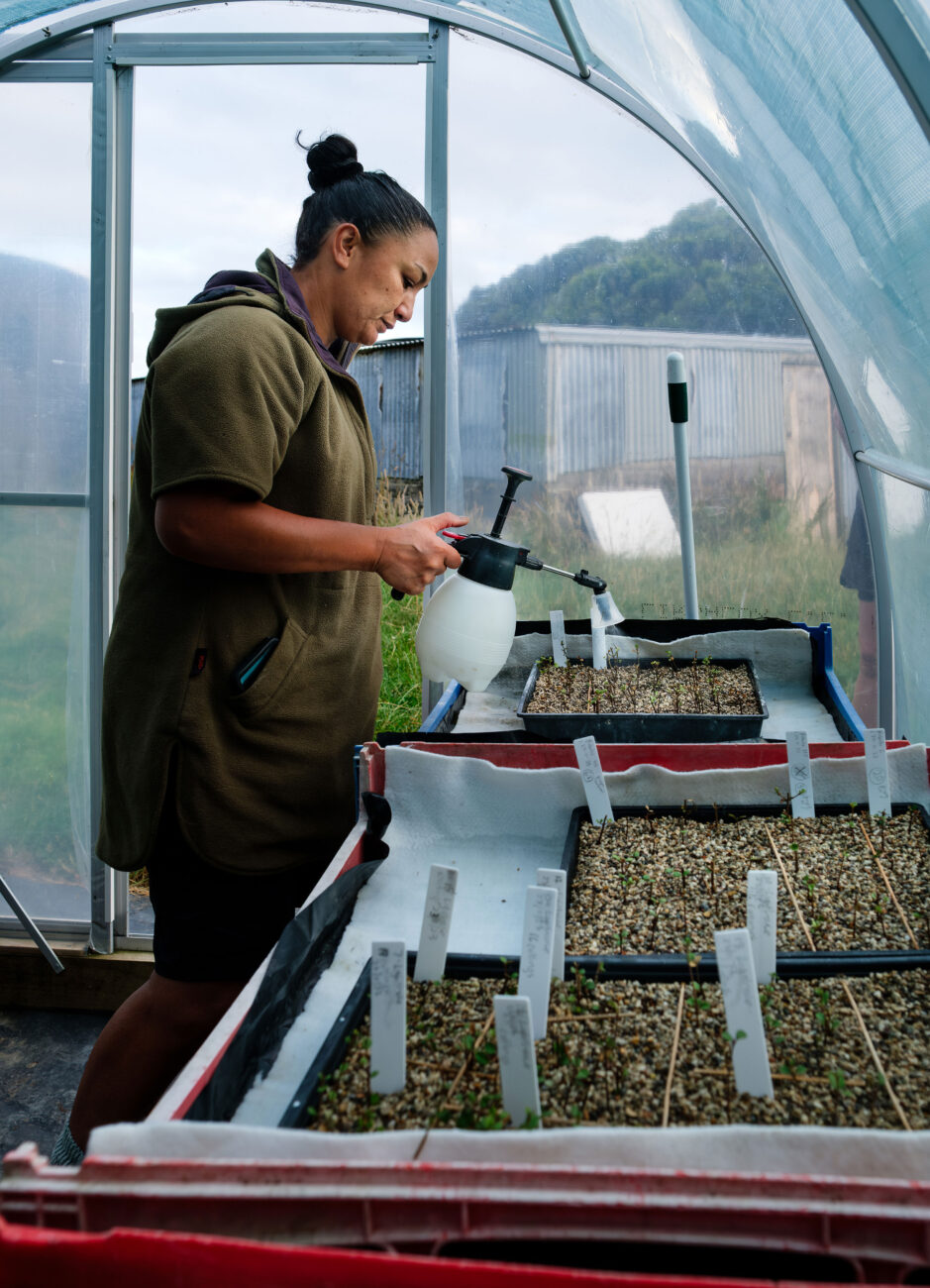
Linda-Jones Lee (Te Ākītaī Waiohua, Ngā Puhi) tends rōhutu cuttings and seedlings in the Āwhitu Landcare nursery. Myrtle rust has hit rōhutu so hard the species is now classified as “nationally critical”.
If this midge dines only on myrtle rust and leaves native rusts untouched, perhaps it could be bred in big numbers and used to reduce levels of infection. “They’re eating spores, so they’ll be reducing spore loads. But whether they make an appreciable difference to an epidemic is another question,” says Bartlett. Researchers are now searching for insect allies, combing through rust-laden leaves in the national fungarium—a collection of more than 100,000 dried fungi specimens, stored in a Landcare facility in Auckland—to see whether any other fly larvae have been inadvertently scooped up in years gone by.
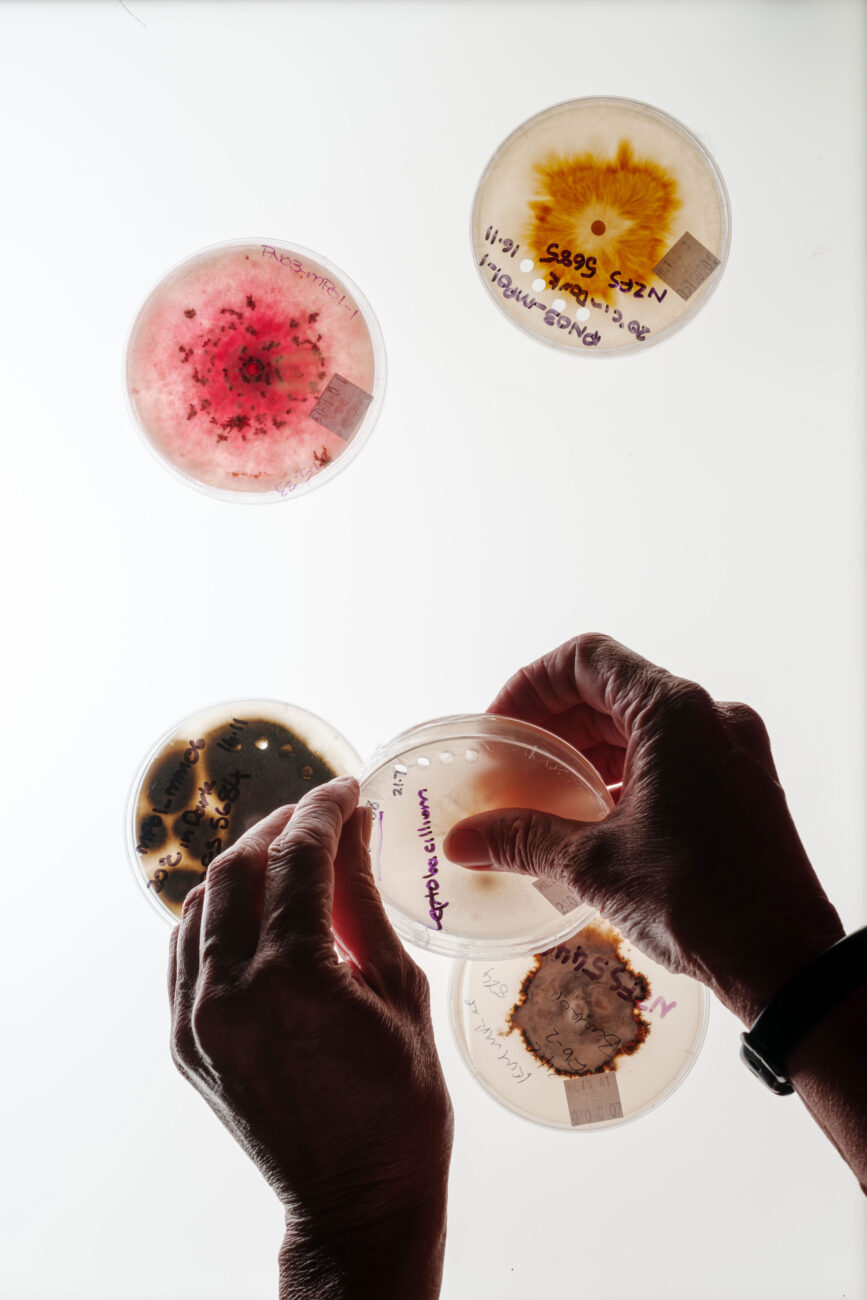
Deep in the bowels of Scion, Bartlett dons a white coat to introduce another rust-eater. Kiryn Dobbie lays out Petri dishes, with dates and species names scrawled on the lids. Some house patches of white fuzz; others are caked with thick black growth. One is pink with a central brown splodge. These are mycoparasites—fungi that eat other fungi.
Bartlett first noticed the odd little chia-seed spots on myrtle rust in the Kaimai Ranges. It was the summer of 2019-2020, blistering hot, and he had tramped two hours to reach a monitoring site. The spots were on ramarama, the last plants on his check-up list. “We definitely knew it was this strange thing, but we weren’t really sure what we found, to be honest,” he recalls. He plucked the leaves and popped them into an envelope.
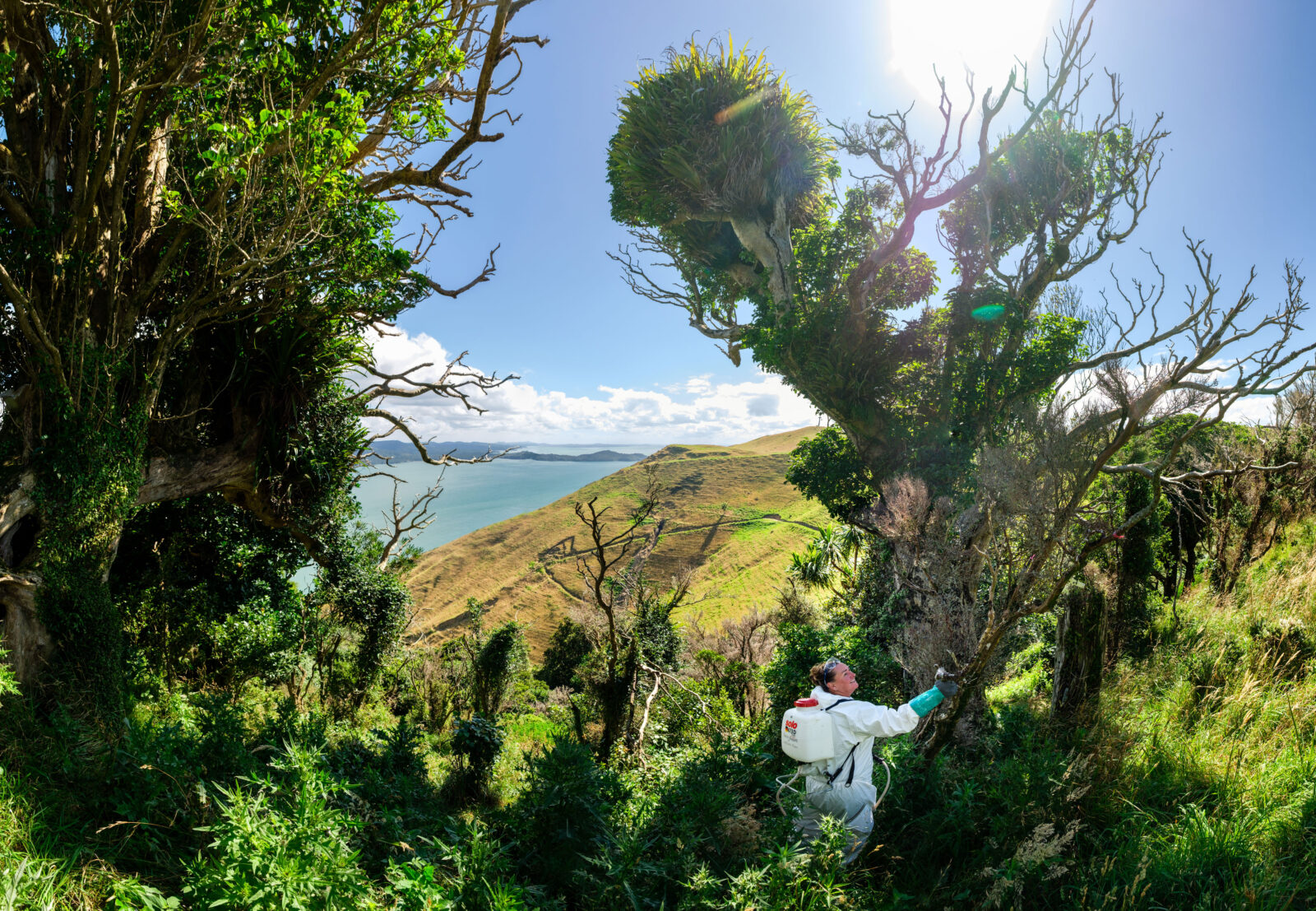
Lisa Field of Āwhitu Landcare dispenses a fine mist of fungicide over rōhutu at Manukau Heads. Identifying naturally resistant individuals is the best hope for wild trees—in the face of myrtle rust, as well as climate change more broadly. But as trees get taken out by the rust we’re losing that precious genetic variation forever.
Back in the lab, Bartlett painstakingly extracted the black spots from their cosy yellow cushions with very fine forceps under a microscope. Dobbie investigated further, growing up the spores enough to run DNA analysis and revealing the identity of the myrtle-rust-muncher: Sphaerellopsis.
Like the midge, the mycoparasites could perhaps one day be deployed to fight myrtle rust. Bartlett says that maybe, just before myrtle rust dwindles and hunkers down over winter, sending out “quite a few natural enemies” could impair the rust when it’s already weak, lessening the severity of the next infection season.
[sidebar-1]
But even as scientists find ways to stymie the rust, they know the emergence of a new variant could change everything. The myrtle rust in New Zealand is the “pandemic strain” also found in Australia and across the Pacific. Strains in South Africa and South America could make their way here, too, combine with the rust we have, and push already-weakened species off the cliff.
And the strain that’s already here could adapt, thanks to its sneaky double-pronged reproduction strategy. The rust can reproduce by cloning itself, or it can reproduce sexually, combining different genes. It’s this genetic intermingling that can enable myrtle rust to adapt to attack new plants, resist fungicides, or survive in different conditions. “We need to pay attention to what the pathogen is doing in response to what we do,” says Bartlett.
*
A research ecosystem has bloomed in New Zealand since myrtle rust’s arrival. We have built apps to engage tamariki, and developed thermal sensors that can detect infection before it becomes visible. We have helped to decode the rust’s genome: it’s the largest fungal genome decoded yet, with one billion letters that would fill 400,000 A4 pages (that’s 3500 copies of this magazine). But the most tantalising breakthrough came a few months ago, from Australia.
A project led by the University of Queensland, with input from New Zealand researchers, had made a high-tech spray using RNA, a long coil of biological code similar to DNA, found in all life forms. And it worked. Not only did the spray protect healthy plants from infection—sick plants, covered in lesions, recovered.
Stuart Fraser, a forest pathologist at Scion, says the spray is “the most promising thing we’ve got”.
Scientists in New Zealand have isolated several mycoparasites: fungi that eat, or parasitise, myrtle rust. Tiny spores of these potential allies are grown on Petri dishes for identification. Some mycoparasites might even live harmlessly within a plant’s leaves, and activate when myrtle rust attacks.
On a sprayed plant, when myrtle rust moves in, the RNA is taken up by the rust and triggers a self-destruct process. It begins to disable the rust from the inside, withering its roots and shoots and preventing the production of tiny “pegs” that attach to the leaf surface. This sort of “interference” by RNA happens in nature, but here the RNA has been tweaked to target only myrtle rust, leaving other fungi untouched.
If it works in the field like it does in the lab, sprays such as this could be “really impactful”, says Fraser—particularly for protecting significant individual trees and special sites. Getting to that point, though, would require funding, and right now scientists don’t have it. So work on the spray—including testing how it would behave in New Zealand forests, and how communities would feel about deploying it—is in limbo. Funding for the studies on resistance, parasitic fungi and rust-gobbling insects, as well as all the monitoring and plant collection by the Jobs for Nature groups, is also set to expire this year.
Those fighting the rust are contemplating where to go from here, in a climate of tightening government budgets. Meanwhile the rust erodes forest canopies, eating away at leaf and flower and seed.
*
Even if the new RNA spray works like a dream, or we deploy an army of hungry midges and mycoparasites, by the time it’s all ready, we might not have any plants left to protect. The ngahere still desperately needs a backup plan.
“We’re looking down the barrel of nothing but scattered seed collection here and there,” says Ganley. “Without seeds, we’re completely screwed and there’s nowhere else to go.”
DOC last collected myrtle seeds for contingency seed banking in 2019. It’s unclear how long the seeds last, dried and frozen at –20 degrees Celsius, before they die. But Karin van der Walt, who studied seed banking of myrtles for her PhD, says in her experience ramarama and rōhutu seeds remain viable in the fridge for about three to five years—and those frozen, like DOC’s, might drastically lose viability in that time. Maire tawake, the swamp maire, on the other hand, can’t be seed-banked at all.
To bank a seed, you first have to dry it. Otherwise, as the seed freezes, its cells are destroyed by the sharp-edged ice crystals forming inside. But if you’re a swamp species like maire tawake, your seeds really, really don’t like being dry. So van der Walt has been investigating whether we could cryopreserve maire tawake, flash-freezing it in liquid nitrogen. The problem is that maire tawake seeds are relatively big—about 10 millimetres. “The bigger your thing is that you’re trying to freeze, the slower it’s going to freeze. And the slower it is, the more chance… of ice crystals forming,” says van der Walt.
She tried excising the teeny embryo of the seed and cryopreserving that, using a substance like antifreeze to protect cells from spiky ice. It failed. The embryos survived frozen for two weeks, but were then overcome by a fungal contaminant. Next, van der Walt will try to cryopreserve tiny slices of shoots—if she can keep finding seeds to grow. At her field site in Taranaki, she used to pick from trees cloaked with red berries. The last time she visited, there were almost no fruits. “We’re definitely running out of time.”
Rangitoto Island in the Hauraki Gulf is cloaked in the world’s largest pōhutukawa forest—and these trees are infected with myrtle rust. If they die, the island will essentially revert to bare rock. Three annual surveys are needed to gauge just how much trouble the forest is in. But funding runs out this month, with only two surveys complete.
Mark-Shadbolt feels an urgency “to teach people, to reclaim our seed-collecting practices, and to get people, at place, collecting.” Myrtle rust is hardly the only blight on the horizon: the climate crisis and biodiversity loss will drive epidemics through our forests, just as they are through human society. Then there’s the spectre of wildfire, or plants that are simply unable to cope with the changing conditions. With all this in mind, Mark-Shadbolt and Te Tira Whakamātaki are calling for an overhaul in the way our seeds are collected and banked. “We need something that’s respectful of our culture and the importance of our seeds. And something that represents New Zealand, that’s inclusive of all,” she says.
She doesn’t know whether this rust will be the end of certain species in Aotearoa. “It’s certainly going to get worse,” she says. “But our kāhui rangatira, our elders, will pull me back and go, ‘Do you really think that it’ll be gone? And if it does go extinct, is that the end of the world?’”
Things come and go, the elders tell her. It’s not a perspective intended to soothe or console. The rangatira are seeing beyond myrtle rust and the thousands of dying trees. They are looking to what comes next.
A vicious strain of myrtle rust is burning through our bush. Dozens of native species—and the ecosystems they support—are at risk. Scientists think we have three, maybe four years before the biggest pōhutukawa start to fall. They’re racing to find a way to stop the rust—and to save seeds from plants we stand to lose forever. (more…)