Solutions to some of our most pressing problems have been waving at us from under the sea, all along. (more…)
More by Kate Evans



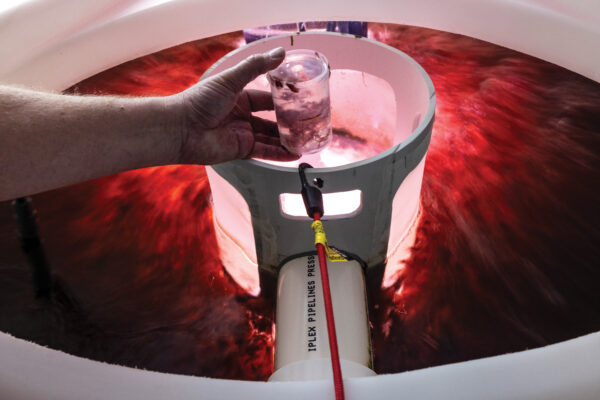
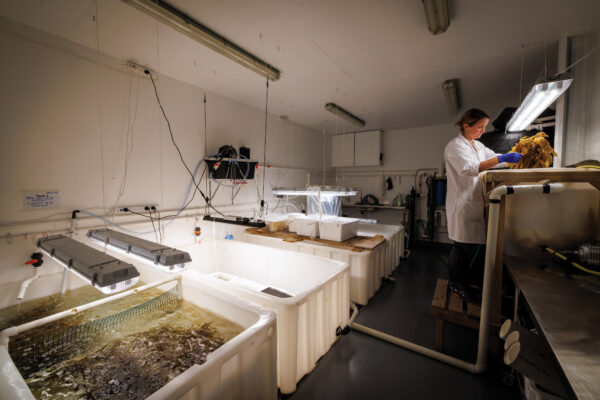
At night, the only light in the warehouse comes from row upon row of truck-sized tanks, each lit from within like a gigantic lava lamp. The contents roil, the colours shifting with the movement from burgundy to maroon to gold. I think of gaseous planets, of firestorms on the surface of the sun. But this is not outer space, it’s algae—a species of pretty native seaweed known as Asparagopsis or harpoon weed—and it’s prevented from settling by the constant flow of air pumped through illuminated seawater. For the seaweed, just as for the scientists and entrepreneurs racing to deploy it, there is no staying still.
The same species is flourishing naturally just a few hundred metres from here, in the chilly, storm-lashed waters of Foveaux Strait. But the founders of the company I’m visiting, CH4 Global, are convinced the world needs more Asparagopsis than nature can provide, so they’re farming it.
Here in Bluff, and in other aquaculture outfits and labs around the world, seaweed, and the many ways in which it might help save the planet, is having a moment.
Some scientists are focused on what seaweed can store—carbon—and they’re trying to find ways to measure and manipulate that.
In Queensland, seaweed is showing promise as a cleaner: gobbling up waste nutrients in land-based fish and prawn farms, before the water is discharged back to sea. (The algae themselves are then turned into a “plant juice” that is great for growing sugarcane roots.) Scientists in New Zealand are testing whether seaweed might help mop up waste from salmon farming, or clean rivers drenched in farming runoff.
Other researchers are more interested in getting at the stuff inside all those slippery stems, fringed fronds, and grippy holdfasts. In the US, scientists are investigating whether some of the rare-earth metals we need to build cleaner technology could come from seaweeds, rather than mining the fragile sea floor.
Perhaps most encouragingly, we’re learning that seaweeds contain a vast array of powerful compounds that form nowhere else—and might just help us solve some of agriculture’s biggest problems.
Scientists are not often given to gushing. But right now, on seaweed, they’re ebullient. “Very exciting,” one told me. “There’s so much unexplored potential.” Another emphasised “major discoveries” that will make “radical and meaningful differences”.
We just have to figure out how to grow many, many tonnes of the stuff.
*
Farmers have fed seaweed to their animals for millennia. But Canadian environmental and agricultural scientist Robert Kinley first heard about the practice only around 15 years ago, when he was approached by a cattle farmer with an intriguing story. Over several generations, the farmer’s family had noticed that the cows on the beach side of the farm—which regularly ate storm-tossed seaweed—were healthier, happier, produced more milk and were more likely to conceive than those on the inland side.
Curious, Kinley designed a study to test the farmer’s hunch. He also measured the cows’ methane emissions, and was shocked to discover the seaweed-eating cattle were belching less of the potent planet-warming gas than the rest of the herd. The difference was in the region of 12 to 16 percent, and with methane, each increment matters.
Methane is increasingly a target of international efforts to slow climate change, partly because it’s creating a lot of heat—around 13 per cent of today’s warming comes from methane produced by agriculture. But its action is short, as well as sharp. Methane hangs around in the atmosphere for just 12 years—meaning any reduction in emissions will have a rapid impact.
Knowing this, Kinley decided to double down on seaweeds. The species at the farm was the only one he’d tested. Could other algae be even more powerfully beneficial?
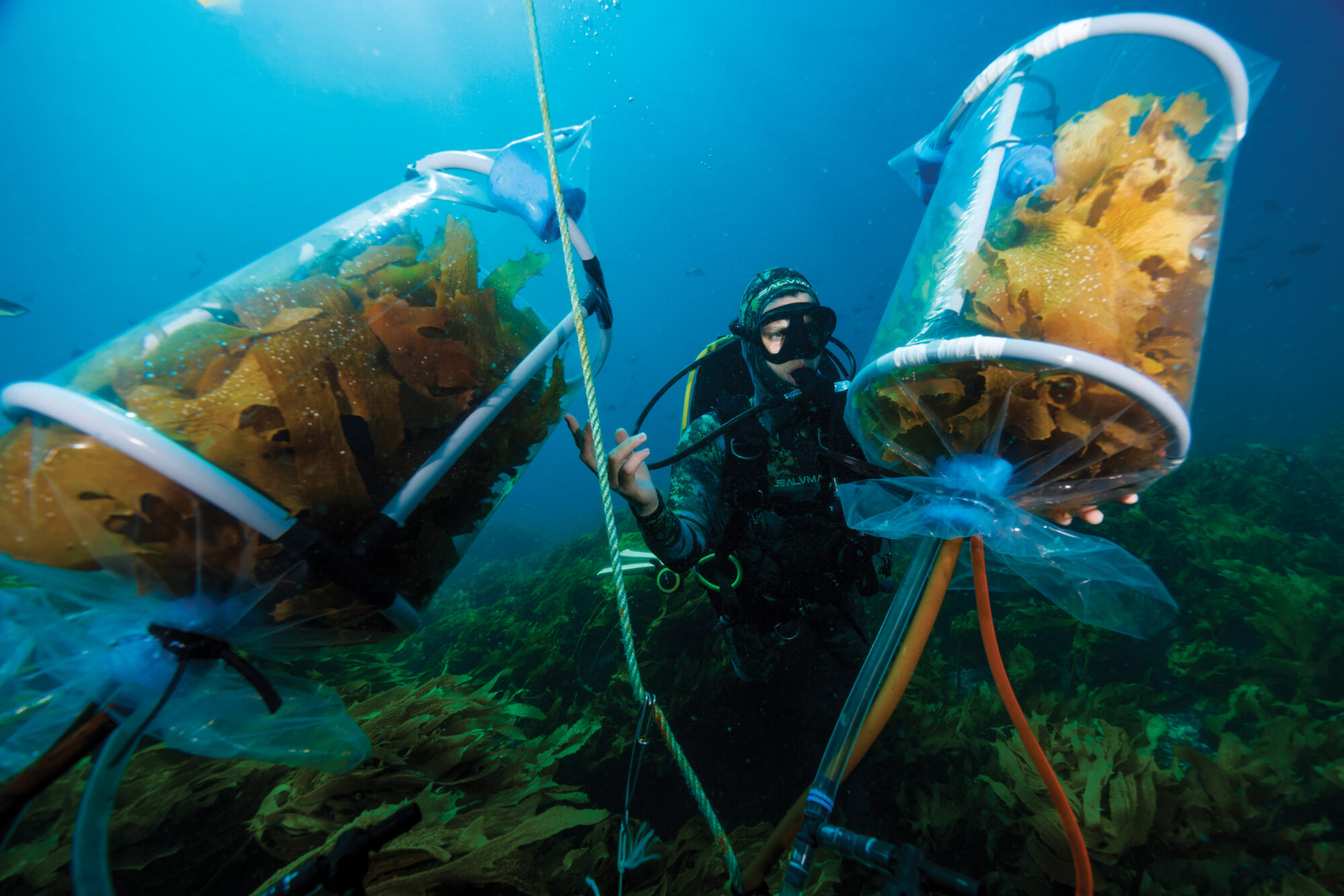
He found like minds in Townsville, Queensland, and moved there to work with animal scientists at Australia’s national science agency, and seaweed scientists at James Cook University. They tested an array of tropical seaweeds for their methane-busting capabilities, using a lab-based system that mimics a cow’s digestive processes.
When the seaweed made up 20 per cent of the feed, a handful of species did dramatically reduce methane emissions—but such a high concentration is uneconomic and potentially harmful for the animal.
The scientists kept cutting back on seaweed—10 per cent, five per cent, two per cent. Soon, only one species was left standing: Asparagopsis taxiformis. In the lab, and in later trials with sheep and cattle, it was still having a strong effect when it made up just 0.2 per cent of the feed. “That makes it all possible,” Kinley says. “We don’t have to grow or ship lots of it around.”
Many other studies followed, mainly in Australia and the US, trialling different ways to get the seaweed into the animals. In some experiments, the seaweed supplement slashed methane emissions from cattle by more than 80 per cent without reducing how much weight the animals stacked on. (This was in a feedlot system, over the short term. A longer study of steers over 200 days showed closer to a 50 per cent reduction in methane. Again, the animals put on just as much meat, and it tasted just as good.)
Kinley and some of the people he’d been working with formed an enterprise to commercialise the technology. They now sell the intellectual property rights to the use of Asparagopsis in animal feed to interested companies—such as CH4 Global.
*
Steve Meller got the idea for his company at a conference in Wellington in 2018. The leader of a Pacific Island nation—he’d rather not say which one—was showing photographs of the drastic effects of sea-level rise. “And then he said, ‘What would you all do about it?’” Meller remembers. “There was just dead silence in the room.” He didn’t say it aloud, but an answer dropped into Meller’s brain: “I’d grow Asparagopsis at massive scale.”
Meller, an Australian entrepreneur, had just audited government research programmes to help flag “innovative and disruptive” projects, and among them he’d clocked the Asparagopsis discovery.
Walking out of the conference session, he mentioned the idea to New Zealand impact investor Nick Gerritsen. He was in. So were some of his friends. Within hours, CH4 Global was born.
Meller has spent decades in the US, including in Silicon Valley. He is a man in a hurry, and his sense of urgency is twofold. There’s the climate emergency, and the need to secure large amounts of capital to elevate the seaweed gambit to a mass-market proposition. Meller isn’t interested in boutique.
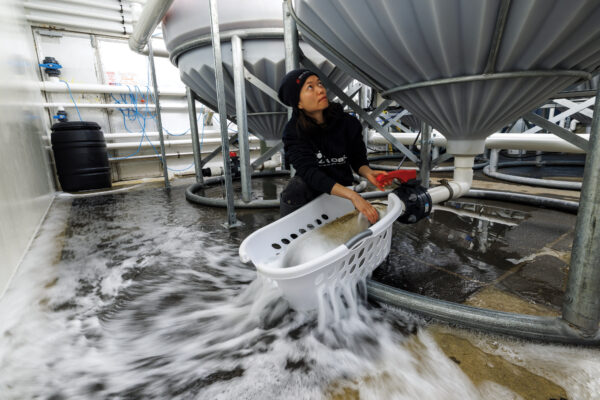
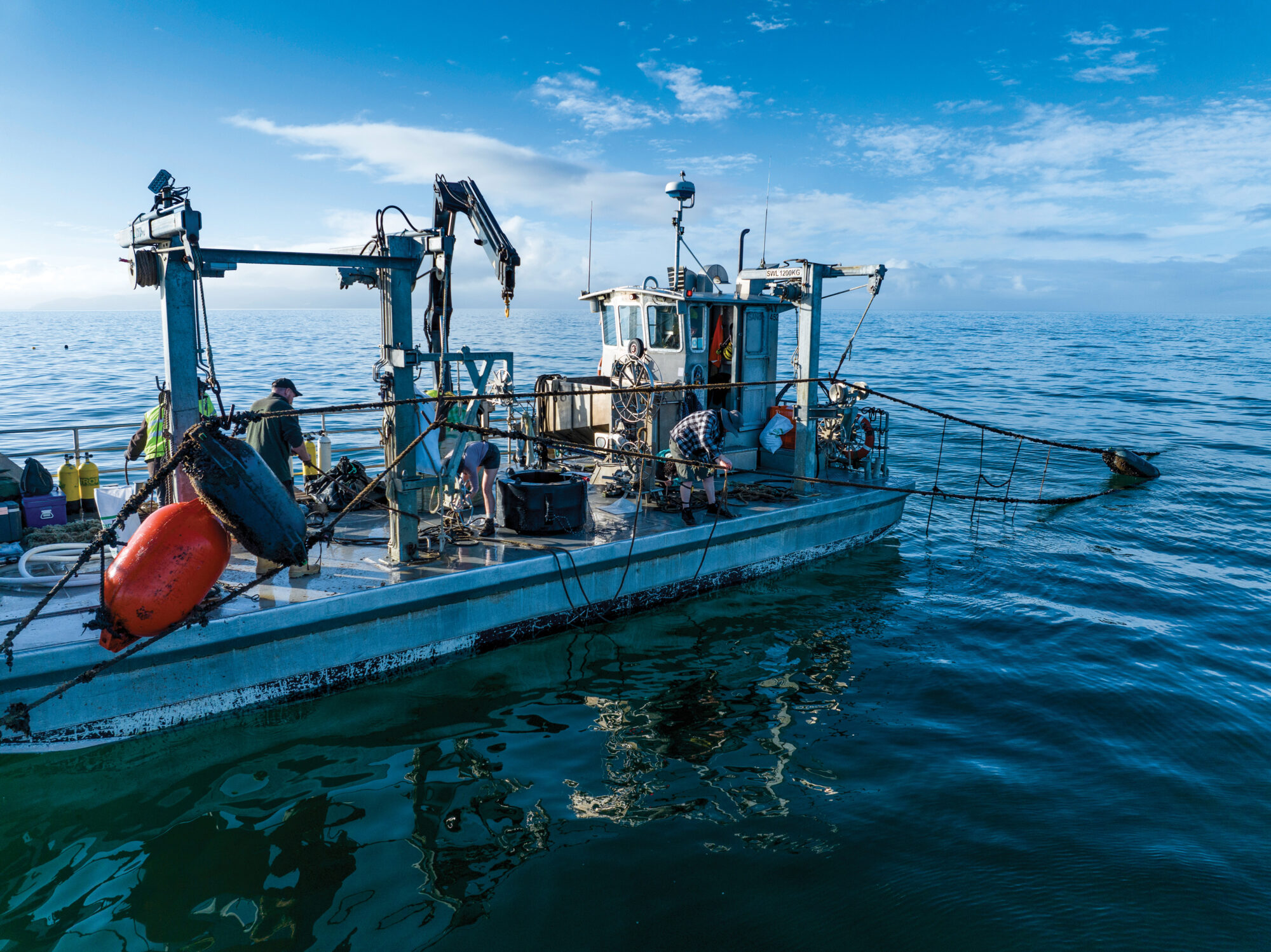
After less than a year of trials in the Marlborough Sounds, the CH4 team figured out that growing the seaweed in the ocean was too tricky and expensive. Hence the massive lava lamps in Bluff. And they don’t bother growing “the whole big, gangly seaweed”, says Meller. “We grow an earlier life stage, and it has everything we need.”
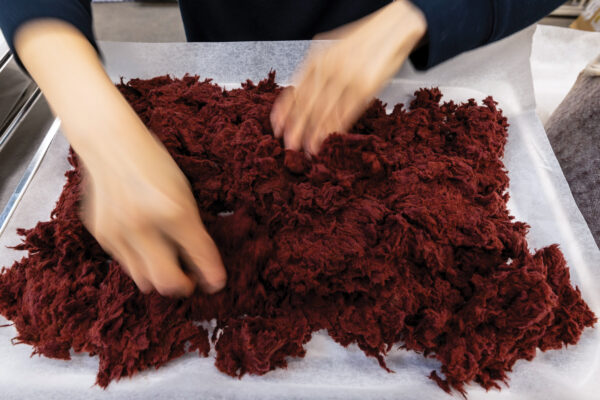
When I visit in late 2023, site manager Robert Stack shows me these arrested-development Asparagopsis pompoms, bouncing around their glowing tanks like red blood cells in plasma. They’re round, fluffy, a delightful red-wine colour, and they double in size every 10 to 12 days.
Will I burp less if I scoff one, I ask? Nope, says Stack—our own insides function very differently from a cow’s— “but it is edible. It’s not particularly delicious. You wouldn’t line up a plate of it. But have I eaten a few grams of it? Yes.”
When a cow or steer eats some Asparagopsis mixed through its food, however, a compound called bromoform and a handful of other active ingredients in the seaweed get to work. Normally, in a cow’s rumen, an enzyme assembles the broken-down bits of carbohydrate from its food into methane—CH4. As Meller explains it, bromoform and the other seaweed goodies block that enzyme, so the methane can’t get made.
Simply knowing that, however, won’t solve the problem of ruminant animals all over the world pumping out methane. So here in Bluff, and at another larger facility in South Australia, the company has been testing combinations of light, nutrients, temperature, tank size, and seaweed density to produce the active ingredients as quickly, reliably, and cheaply as possible.
*
In Bluff, aquaculture technician Karma Chau uses a machine like an industrial salad spinner to remove the water from the seaweed pompoms, turning them into a mass of maroon candyfloss, like felted wool. I take a sniff. It smells subtly of the sea, I observe. It’s actually the other way round, says Chau. “This is where the ocean smell comes from—seaweed.”
In Bluff, the candyfloss is freeze dried. But that’s not how the company will do it in its new mega-farm in South Australia, says Meller. “Freeze drying is not commercially feasible. It takes too much energy, costs too much, takes too long, and you lose roughly half of your activity. You’re starting to lose the activity the second you harvest it.
“You’ve got to stabilise it rock solid, so when I sell it to a farmer six months later, it’s still exactly the same. To people who say, ‘I can grow seaweed’, I say, ‘Big deal, if you can’t process it.’ And if you can’t do it in a cost-efficient way, you really don’t have a business.”
Meller’s team hit on a technique that he claims costs 20 times less than freeze drying and loses just five per cent of the bioactivity—but it’s being patented, and he won’t tell me any more about it.
The Australian operation dwarfs Bluff. Commercial production began in January at Louth Bay on the Eyre Peninsula. There, the Asparagopsis grows in 10 vast vats, each as long as an Olympic swimming pool. Together, they contain two million litres of water, enough to produce 80 tonnes of seaweed per year.
But Meller’s planning much bigger than that. A hundred more swimming pools. Five hundred. By 2032, the aim is to prevent methane emissions equivalent to a gigatonne of carbon dioxide. That would entail 10 per cent of the world’s cattle—150 million of them—eating red seaweed daily.
“I could have a nice little 20- or 30-million-dollar business doing this,” says Meller. “It’s not why we started the company. We’re doing this to address climate change at scale with urgency. And if you’re going to be able to build something at scale, it has to be driven by the economics.”
The product must be reliable, consistent and profitable for cattle farmer and seaweed farmer alike, he says. “Not a little bit profitable, a lot profitable.” Without that, “you don’t have a business, and you don’t solve the climate problem”.
There’s no international capital set aside for sustainable aquaculture for methane mitigation, he points out. “I’m competing with commercial lenders that might lend money to a solar farm, or a new shopping centre. It’s not like there’s a separate pot of money for people trying to solve the cows’ problems.”
Several large Australian feedlots are already using the company’s Asparagopsis product, “Methane Tamer”. There’s interest from Japan, Korea, India, South America. But even though agricultural methane emissions account for a huge proportion of New Zealand’s contribution to global warming—43 per cent—it may be a while before Asparagopsis gets into the guts of our own cows.
*
For the bioactives to do their methane-busting work, they must meet every mouthful that slides down a cow’s throat. In a feedlot system where the animals eat grain, the seaweed product can simply be mixed into the feed like coconut threads into muesli.
It’s trickier with grass-fed animals—the vast majority of New Zealand’s cattle herd. But, Meller says, “we’ve solved it. We know how to do it.” The company has come up with a gradual-release formula that can be doled out to dairy cows once a day at milking, when many farmers already feed out supplements and vitamins. He says the company is now finishing tests that will assure the market the product is good to go.
But so far, bromoform—the main active ingredient in Asparagopsis—has not been approved for use on New Zealand farms. Our regulatory processes are much slower than Australia’s. And bromoform may have an image problem. The US Environmental Protection Agency has classified the substance as a probable human carcinogen. That’s not as bad as it sounds; like all carcinogens, from sunshine to processed meat, dose matters.
Every time you swim in a pool, you’re absorbing small, safe amounts of bromoform—it’s a byproduct of chlorine. No-one has found any evidence of the compound ending up in meat after animals have eaten Asparagopsis; some has been detected in milk, but in tiny amounts—similar to background levels in drinking water.
Still, to safeguard our lucrative export markets, we need to be painfully careful. All new products have to go through strict assessments and expensive trials. To pass muster, Asparagopsis products will need to be tested in studies that last more than three months, on New Zealand farms, and on dairy cows specifically.
Ticking these boxes just to access our small market might not make financial sense for large-scale companies such as Meller’s. So we could well end up watching how mitigation tools such as Asparagopsis fare overseas before adopting them here. Slow and steady: it’s understandable, but it’s also a costly delay in the face of the climate emergency, and anathema to a seaweed-booster like Meller. “If I have to try to convince somebody to do something, they’re just not ready. But I don’t spend time trying.”
*
In a greenhouse in Hamilton, rows of young kiwifruit vines wait to get infected. Crimson-pink hairs line their exploring stems, and their leaves are a bright, healthy green.
“Those leaves, if you touch them, they’re very soft,” says Plant & Food Research bacteriologist Joel Vanneste. “So they’re perfect because they’re very susceptible.” Perfectly vulnerable, I suggest. “Exactly. It’s how we like them.”
When they’re big enough, Vanneste will water each plant’s roots with a diluted mix of seaweed extract. Then, three to 14 days later—depending on the experiment—he’ll move them to a biosecure greenhouse next door and spray them with the dreaded bacterial disease Pseudomonas syringae pv actinidiae, known as PSA.
In November 2010, PSA was discovered in a Te Puke orchard. It nearly destroyed New Zealand’s billion-dollar kiwifruit industry. Vanneste and other plant pathologists worked seven-day weeks for months to learn more about the disease and to find new, PSA-resistant cultivars. (Vanneste was at the office on Christmas Day that year. His kids were not impressed, but “it had to be done”.)
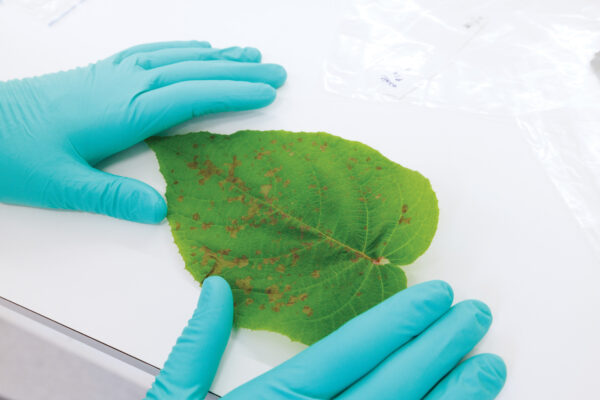
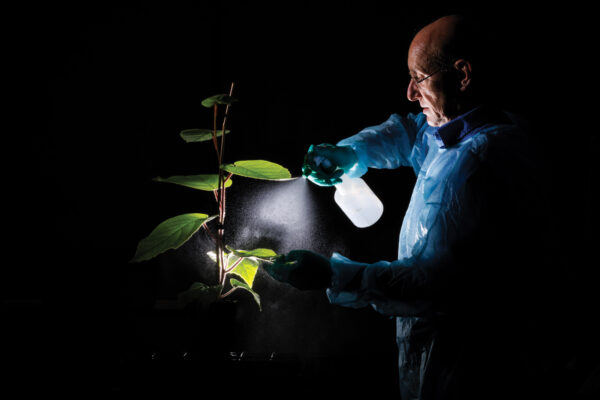
Eighteen months later, the Plant & Food team identified Gold3, a yellow-fleshed kiwifruit that can put up with PSA—the vines get infected, but develop few symptoms, and the disease can largely be controlled with good orchard hygiene and copper sprays.
The new cultivar saved the country’s biggest horticultural industry, but PSA “is not yesterday’s problem”, cautions Vanneste. The bacteria could evolve to evade Gold3’s defences, he says, or become resistant to the few compounds and antibiotics we use to control them. When that happens, we need to be ready. Resistance can spread through a pathogen population in the span of one season. So Vanneste is looking for other ways to fight PSA—and he’s extremely excited about seaweed.
*
At the University of Waikato’s dock-side Tauranga campus, algae expert Marie Magnusson shows me 10-metre-long bathtubs full of an edible seaweed aptly named sea lettuce, or Ulva. The leaves are gecko-green, plasticky and see-through, and they look like plaited cellophane or shredded cabbage, depending on the age of the plant.
“I try to come out here every day so I can poke around the ponds a bit,” Magnusson says—she leads a research programme to develop seaweed farming in New Zealand, and finds the tanks a therapeutic antidote to computer work.
Like Asparagopsis, sea lettuce is a native alga, and it’s commonly found washed up on beaches near here. It’s also a great candidate for aquaculture.
“It grows really fast, it handles floating around without being attached to anything, and every part of the tissue photosynthesises,” Magnusson says. Most importantly, it’s full of different types of polysaccharides—long chains of carbohydrate molecules that are technically types of sugar (though not the same as the spoonful of sucrose in your tea.)
It’s these polysaccharides that the Plant & Food team think may help the kiwifruit vines to ward off PSA. Polysaccharides from other seaweeds have already shown promise: they can trick plants into boosting their immune response, by turning on a hormone pathway that tells leaves, stems and roots to prepare for a threat. Then, when a pathogen actually arrives, the plants have a better chance of fighting it off.
More by Kate Evans
In October 2024, Magnusson’s team started sending Ulva extracts over to Hamilton so that Vanneste’s team could begin experimenting on kiwifruit. Today, three weeks after they’d infected the latest batch of seaweed-inoculated plants with PSA, researchers Deirdre Cornish and Magan Schipper pick all the leaves and run each one through an image scanner.
I watch Schipper work through the photos, manually marking up the diseased areas of each leaf, and using software to analyse the proportion of sick tissue. The team have already identified which of the kiwifruit’s genes are involved in the immune response; with each leaf they now need to check whether those genes have been activated.
Until recently, measuring gene expression in a kiwifruit plant required two weeks of chilly work, manually bashing up leaves in mini mortar and pestles under liquid nitrogen (while gossiping, researcher Janet Yu tells me. Three of the four team members have been working together for 30 years.) Now, they have a fancy expensive device that does the job in a fifth of the time.
After just six months, the results have far exceeded everyone’s expectations. “It works very well. We really think we’re onto something,” Vanneste says. Critically, the kiwifruit’s whole system responds: unlike some plant-medicines, you don’t have to hit every leaf to protect it. Just douse the roots and the whole plant is ready to fight.
The short-term goal, Vanneste says, is to give kiwifruit growers, particularly organic ones, who can’t use antibiotics, a product they can apply to their vines a few days before humid, rainy weather is due—prime time for PSA infection.
Long-term, though, he’s dreaming big. The seaweed extract also seems to protect tomatoes and apples—the only other plants the team have tested so far—and not just from PSA, but other common diseases also.
Beyond pathogens, seaweed-derived polysaccharides could even help make plants more resistant to drought or flooding, Vanneste suggests—climate stresses which will only become more common.
*
For Lucas Evans, the thrill of seaweed is less about the end products—though he’s brimming with ideas for those—than its capacity to convert some of our vast aquatic real estate into well-paid jobs and rural development.
“It’s about creating opportunity and social impact,” he says. “For me personally, seaweed provides a sense of hope.”
In 2011, Evans was a burned-out Canberra public servant. On holiday in the Coromandel, the red-bearded Australian fell in love with the place. He also learned about the region’s problem with Undaria—the highly invasive but edible northwest Pacific kelp known as wakame in Japan.
“It’s a food source and it wasn’t being utilised… And the more I went into this rabbit hole, the deeper I got. Now I don’t know how to get out.”
For eight years, Evans worked on his seaweed side-project: “hiding in the stationery room, ringing MPI [the Ministry for Primary Industries]”. Finally, he quit his job and moved to Coromandel town as a full-time seaweed entrepreneur.
His company, Premium Seas, harvests the Undaria that grows naturally on mussel-farm lines in the Firth of Thames, turning the fronds into wakame-infused sausages that are now sold in Woolworths. The waste bits become a bio-stimulant for gardens; he says it makes root systems stronger, and he hopes one day it’ll be on the shelf at Bunnings.
He also imports mozuku seaweed from Tonga and extracts a fucoidan from it—fucoidans are another type of polysaccharide and are used as a health supplement. And he sources a native red seaweed from the Bay of Plenty, processes it into a freeze-dried powder or concentrated liquid, and sells it to a Norwegian cosmetic company for use in high-end face creams.
That’s the kind of thing the fledgling New Zealand seaweed industry should be targeting, Evans says. We can’t compete in the international bulk commodity market. “We need to turn it into something else that’s high value, unique, pull back to that ‘clean and green and handpicked by mermaids in New Zealand’—though sometimes the mermaids are middle-aged men with beards.”
Catch 22: there’s no point figuring out how to farm seaweed, or anything else, if you don’t have a market for it—but you can’t get into those commercial markets if you don’t have consistent supply.
To try to coax New Zealand’s nascent seaweed industry over this stumbling block, Evans is working with Magnusson’s University of Waikato team and Greenwave Aotearoa, a social-enterprise offshoot of the environmental consultancy EnviroStrat.
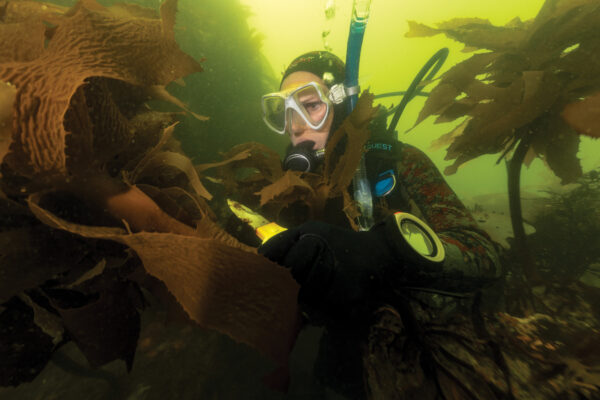
Greenwave’s general manager Rebecca Barclay-Cameron talks me through it. Her group’s goal is to restore the ocean’s mauri through large-scale, regenerative ocean farming. Embroidering some of our many bays with lines of healthy, tame seaweed could buffer the coastline from storm surges, sequester carbon, provide (temporary) habitat for fish and marine invertebrates, and filter out nutrients like nitrogen and phosphate from the water, she says.
It could also make a lot of money for seaweed farmers—but it’s a gamble that, so far, no-one has been willing to take. “New Zealand was incredibly innovative in the 1960s,” Barclay-Cameron says. “We created this amazing mussel industry, but since then it has kind of stagnated, and there has been less appetite for putting money into these high-risk ventures.”
Some mussel farmers and oyster farmers are keen on diversifying, she says, “but they want you to prove what the price point is for them first”.
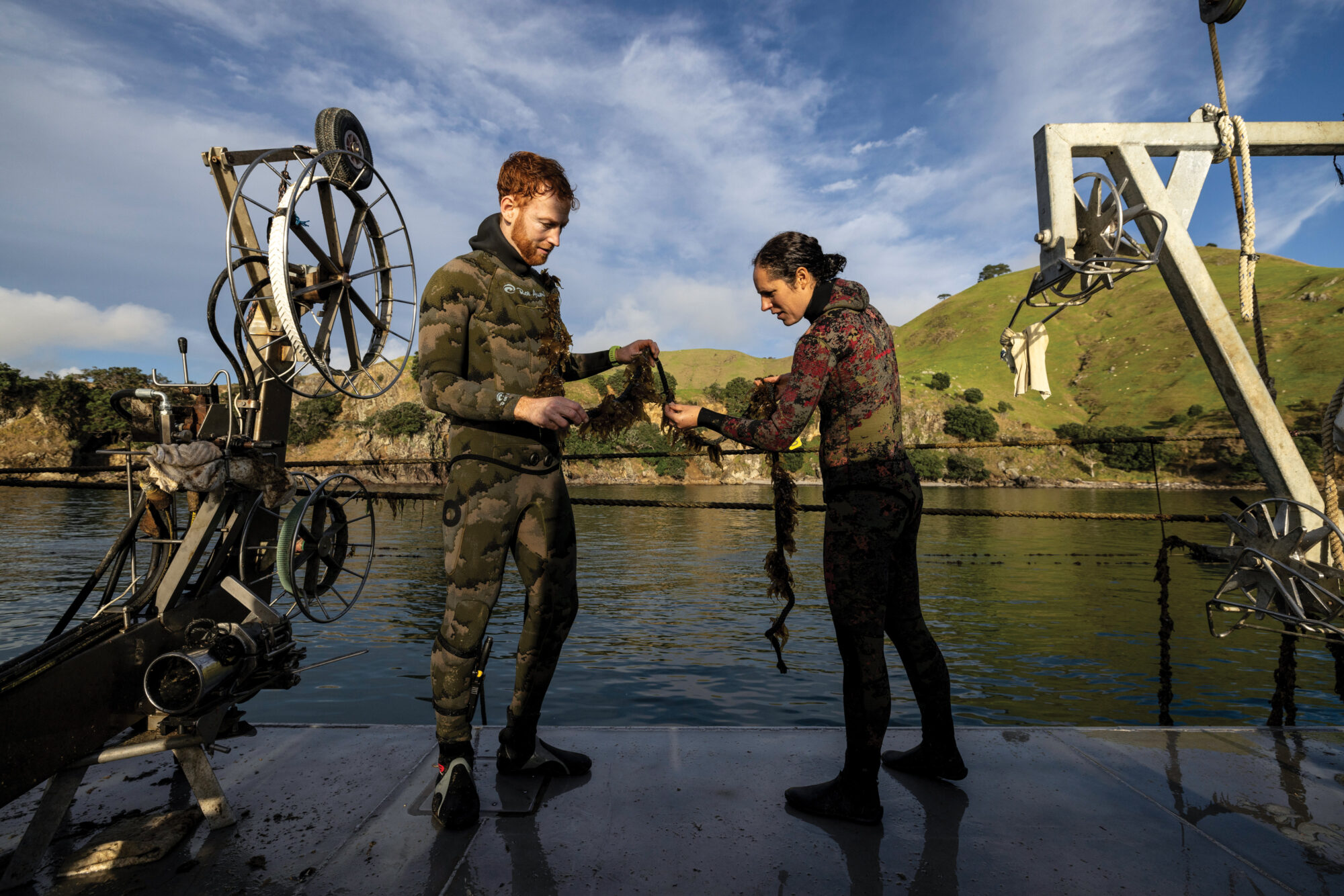
Greenwave and its collaborators, including Ngāti Pūkenga and Ngāi Tai ki Tāmaki, are working on it. For three years, they have been growing seaweeds on mussel lines in the Firth of Thames. They prioritised the common native golden kelp, Ecklonia. It’s a robust seaweed that grows wild all the way down the country, “so we thought if we can grow it we can unlock quite a large sector for New Zealand”, says Barclay-Cameron.
It… wasn’t easy. “We didn’t successfully grow Ecklonia at any commercial scale,” says Evans. Barclay-Cameron has a more positive take. “We grew it very well in the hatchery, and we grew it okay in the ocean.”
To be fair, the pilot took place during COVID-19 disruptions and extreme marine heatwaves. There were other challenges, too: marine pests nibbled on the Ecklonia babies, and the warm waters supercharged biofouling on the lines—sponges, shellfish, and other algae outcompeting the young kelp. “The ocean’s a big, gnarly place,” Barclay-Cameron says. “All the little critters out there love any new substrate, so they all just home in on it and latch on and grow.”
They learned the Ecklonia perform best when the little hatchery-grown seedlings are planted out mid-winter. “It’s like planting a vegetable,” Barclay-Cameron says. “They all have their seasons where they grow really well.” They also learned how to get the kelp in the baby-making mood, producing spores on cue.
But the native kelp grows a lot more slowly, and it’s fussier about location, than, say, Undaria—which Evans is convinced would be a better commercial option. “Undaria is fast growing and it’s resilient and it bloody loves it out here.” The trouble is, it’s an invasive species—regarded as one of the worst in the world—that can alter ecosystems and outcompete native kelps.
Could using Undaria in aquaculture enable its spread, or has that horse bolted? In the Hauraki Gulf, at least, “it is everywhere”, says Barclay-Cameron. “You pull up your mussel lines and it’s all over them.” We farm plenty of invasives already, she points out—Pacific oysters, deer, pines.
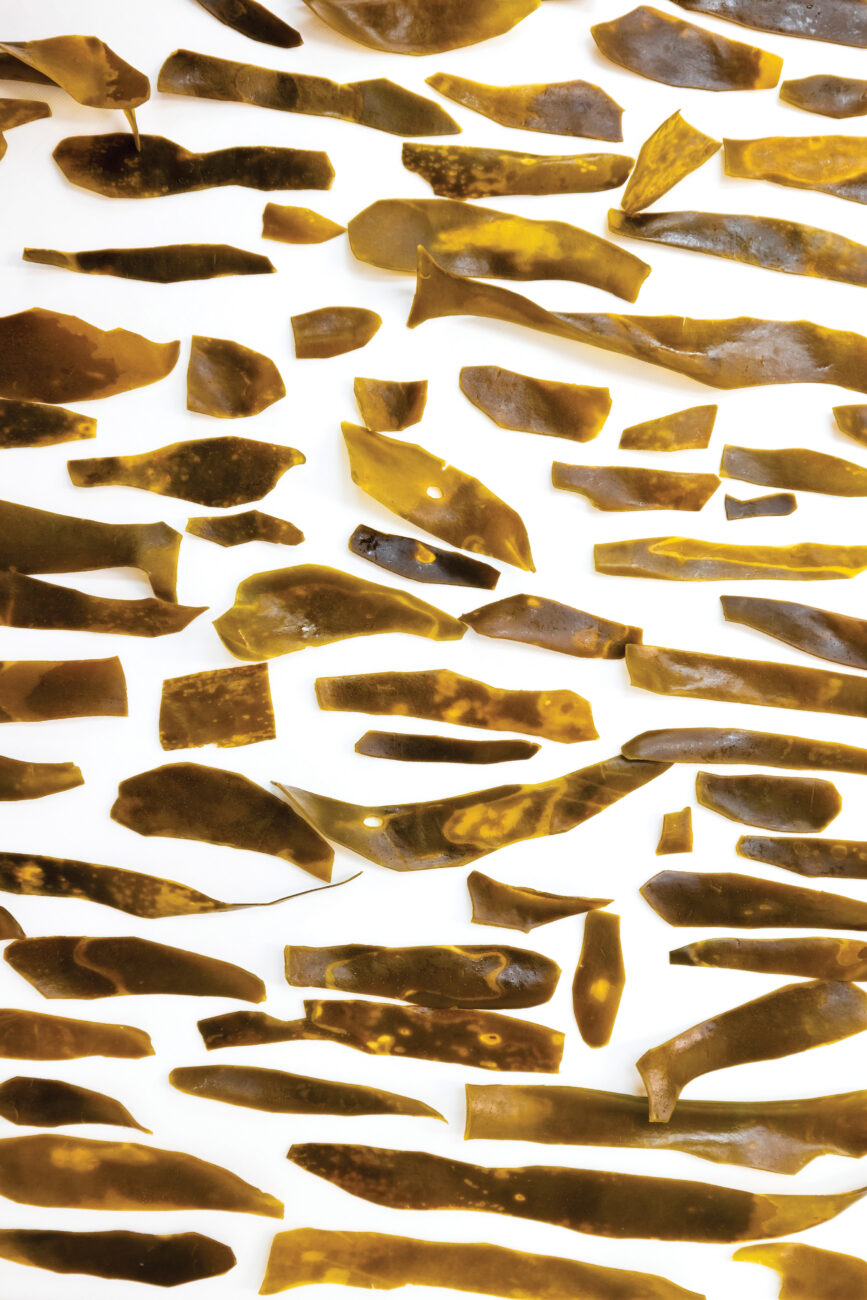
MPI already theoretically allows Undaria farming “in selected heavily infested areas”, which include Wellington, Marlborough, and Banks Peninsula. Evans wants the green light to grow it on dedicated lines in the Hauraki Gulf, too—vastly cheaper and more practical than steaming around trying to haul it up from the ocean floor.
Greenwave hasn’t given up on Ecklonia, though. Trials are gearing up in the Marlborough Sounds, Foveaux Strait and a new spot in the Hauraki Gulf. “There’s still great potential there. We just need to find the sweet spot to grow it,” says Barclay-Cameron.
At the same time, Greenwave is working on finding international markets for our seaweed, and developing new products—such as a vegan pet food supplement. “It’s amazing how much people pay for their pets.”
It’s also finessing that crucial step between farming and marketing: processing the seaweed and stabilising its bioactive compounds as soon as possible after harvest. Lately, whenever Barclay-Cameron wakes in the night, this is the problem her tired mind snaps back into solving.
*
Near the end of my visit to Tauranga, Magnusson leads me into a lab crammed into a shipping container. It’s the university’s hatchery, supplying the experiments and larger tanks with baby seaweed—adorably, Magnusson calls them “germling clusters”—and it feels like a miniature version of CH4’s giant Bluff warehouse. Plastic buckets and glass jars line the shelves. Inside are the seaweeds: tiny beads of mauve Asparagopsis, spidery lettuce-green Ulva, blades of golden Ecklonia, all bobbing and bouncing under the fluorescent lights.
Coincidentally, they represent the three main types of seaweed in the ocean—red, green and brown. They’re actually extremely distant relatives, Magnusson tells me.
What they have in common is their harsh and ever-changing home. The waves, the tides. The light, salinity and temperature all in flux. Imagine being immersed in a soup of minerals and bacteria and predators and things that want to grow on you. Imagine you have zero ability to run away.
Over millions of years, seaweeds turned inwards instead, investing in powerful compounds that helped them slough invaders off their surfaces, made them taste disgusting to grazers, or supercharged their immunity. It took people a while to notice, but now we can’t afford to look away.
Subscribe to our free newsletter for news and prizes
3
$1 trial for two weeks, thereafter $8.50 every two months, cancel any time
Signed in as . Sign out