Wayne Keen is a man impelled. Even after official searches wind up he’ll go back to a patch of bush, and back again, looking for those who are lost. Why? (more…)
More by John Summers



In 2011, a man named Alan Hill walked into the bush in Ashley Gorge, a rugged area of beech and podocarp northwest of Christchurch. He never walked out. This is a sad story, a familiar story, almost routine. “Hope given up” was how they headlined a missing man in 1928, “Tramper still missing”, they wrote about another in 1954. “Search Continues”, I read just the other month. In Hill’s case, the search lasted a week, the experts of Land Search and Rescue, or LandSAR, combing the valley. Among their methods is what is known as purposeful wandering: following the likely routes, the paths of least resistance, the riverbeds, the animal tracks and downhills.
LandSAR came across signs of Hill’s movements. He had been trapping possums and his trap line was visible. There were dropped staples, chocolate wrappers, a pair of gloves. But Hill himself remained unfound and their search was suspended. There is no happy ending here. Hill was elderly. His heart wasn’t strong. It was clear he’d come to rest out there beneath the beech trees and in this his family had some comfort. He had once told them he didn’t want to die in bed.
But still they must have had an unknowing, an absence the size and shape of a man.
They continued to look and others did, too. And on one of the days they spent looking in the bush, they met one of the original searchers, a man named Wayne Keen, also out there looking for Hill.
It would take almost six months before Hill’s body was found. And it was Keen, still looking, working alone, who found Hill lying on a riverbed. Keen contacted the police, and they contacted the Hills that same day. It was Christmas Day.
*
Keen was a deer culler once, one of the many men who lived in huts and tents, paid by the government to shoot deer all day for fear they were eroding and destroying the backcountry. In this role, he spent days in the bush, many of them alone. Occasionally, he got lost—“bushed” is what he called it—but always found his way out and was never, he says, totally disorientated. It was through all this that he was first introduced to tracking this other prey, people—he and his fellow deer cullers were often called on when someone was lost. Deer culling as a job ceased to exist in the 1980s, and Keen went on to do other things. He enrolled in courses at Waikato University, he took odd jobs and worked for a time as a fumigation technician on log ships bound for South Korea and China. But the bush remained a constant. And so did aloneness. He lived by himself in his childhood home. “There’s a difference to being alone and being lonely,” he said. “I guess I’m an only child, not used to having other people around, raised in the country. I’m just used to being alone. It just doesn’t bother me.”
He said this over the phone. I had conducted my own very slight search to find him, contacting various Search and Rescue chapters and finally tracking him down through that most persistent of trails: Facebook. I had learnt of him years earlier when he’d been given an award for his efforts and, in the brief description provided by the Search and Rescue Council, the words “Christmas Day” stuck out. They stayed with me, had me wondering who this person might be who would spend that day alone in the bush looking for a stranger. An ex-culler then, was the answer, a man who liked the outdoors, but still it seemed that there must be more to it than just that. There was, for instance, this business of knowing that it was only a body that you might find. I told Keen I’d be frightened to think that alone, in the gloom of the bush, I might encounter a dead person. “It’s a shock,” Keen said, even though he’d been prepared. But then he went on to quote the Greek philosopher Epictetus, a leading thinker of the Stoics: “Man is troubled not by events but by the meaning he gives to them.” Philosophy was another constant in Keen’s life. He had made an informal study of it for years, he said, with a particular interest in why people made mistakes. And on this, on everything, he spoke methodically, carefully. He answered every question I asked him but that same methodism seemed to leave something out, held something back for himself.
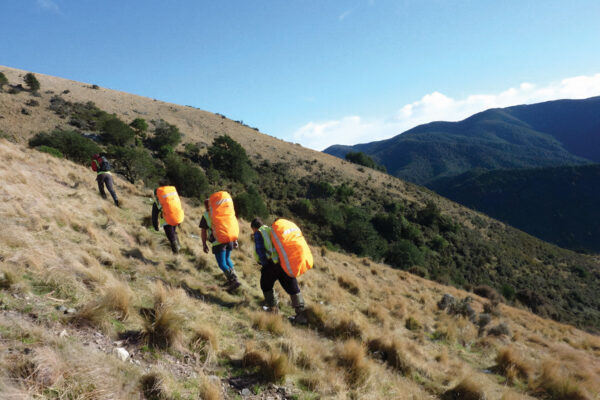
I told myself that speaking over the phone was the problem here. Keen and I needed to meet in person and only then could I understand his desire to search, and so a few months later, I drove south from Christchurch. Keen’s house was in a place near Waimate called Morven, partway down a gravel road, with no near neighbours, surrounded instead by land which, like most down there, had been given over to dairy.
I found Keen in the yard inspecting a bundle of second-hand fishing rods he’d bought the day before. He wore outdoorsy clothes, a bulky down jacket, and his hair was ruffled, which made him appear oddly boyish. He greeted me a little suspiciously, before leading me into his house, a bachelor’s home—the rooms tidy but austere, the table pushed up to a wall, the couch close to it, this furniture arranged according to the patterns of that single life, not for guests or visitors. We sat at that table with a cup of tea each. We left our coats on and we talked, mostly, about dead people—Hill and others like him—who had come out of the bush as bodies, or not at all.
*
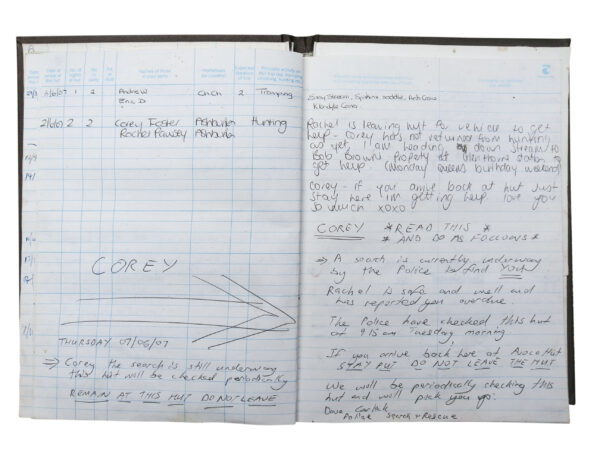
We talked about Corey Foster, a builder from Ashburton, who had gone missing in the Avoca Valley, tough country near Arthur’s Pass. As in the case of Hill’s disappearance, Keen had been part of the original, official LandSAR search, and he recounted the details of it in the sort of clipped, succinct sentences that seemed of that world. “Corey went missing on Queen’s Birthday,” he said. “He went in there with his partner. They drove in most of the way. Camped for a night. His partner shot some video footage. The weather deteriorated. They walked through to Avoca Hut the next day, stayed there the night. It snowed that night and Corey decided to go out for a shot the next morning.” He didn’t return. His partner wrote a message in the hut intentions book, an explanation of what had happened for anyone who might come looking, concluding with words for Foster himself: If you arrive back at hut just stay here. I’m getting help, love you so much.
The official search went on for eight days. It was June, cold and snowy in the Avoca Valley. “We came to the conclusion that we could have just walked literally over the top of him,” Keen said. “If he’d snuggled up against a log and died, you wouldn’t see him. He was wearing camouflage, good camouflage, too, which makes it really hard to see a person.” Seventy-five people were involved in the search, and divers scoured the river.
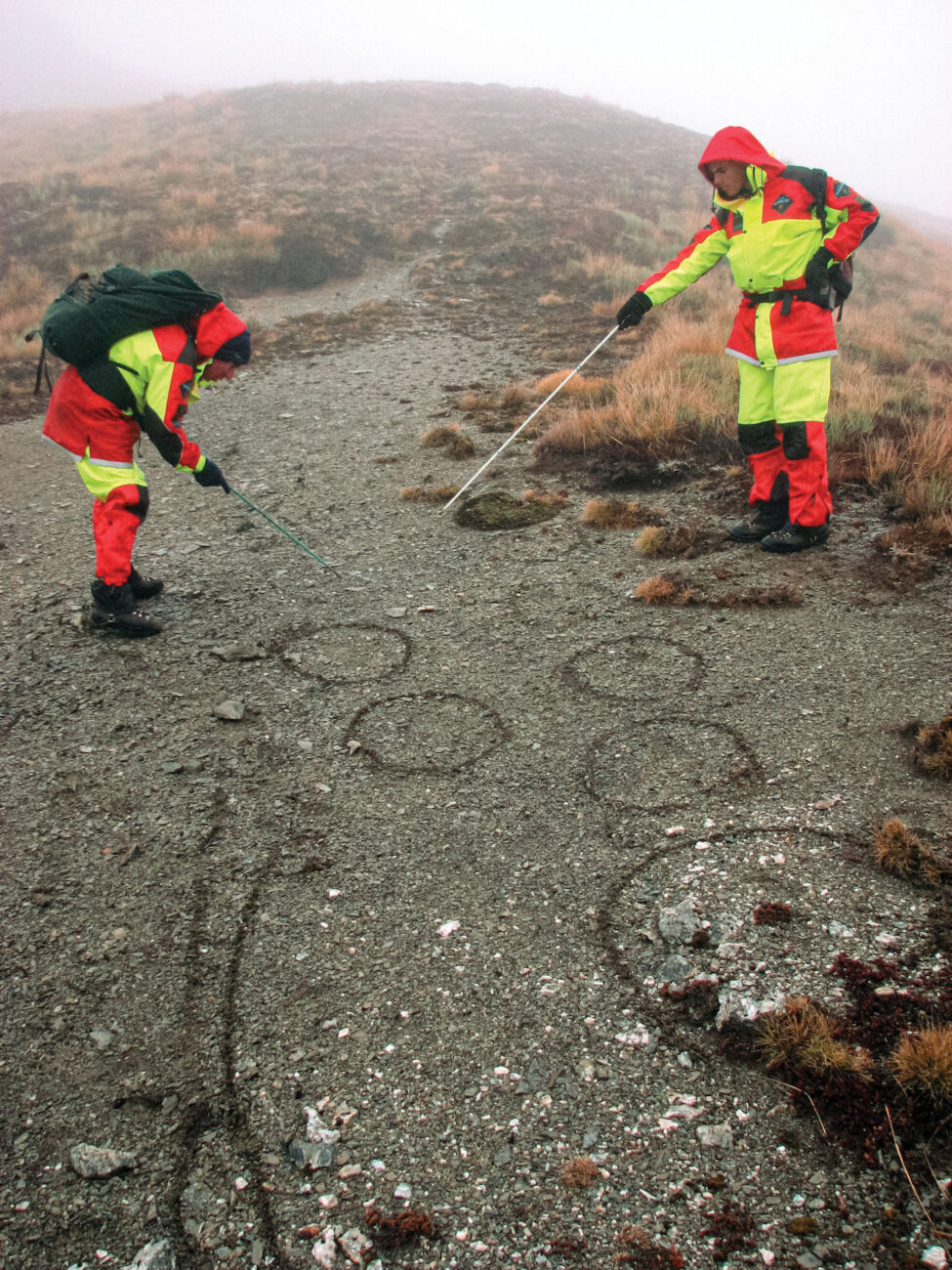
“The family went in near the end of the search. The police flew them around, showed them what the circumstances were like.” The search was called off, ‘suspended’ in the language of Search and Rescue, who don’t regard any such decision as final, and will return if new evidence is found. In Foster’s case, they did go back at one point, using the mystery of his whereabouts as the basis for a training exercise, but still left empty-handed. Keen returned, too, no longer part of those searches. His first solo attempt didn’t go well. “I got to a saddle and hit ice and said, ‘I’m not going down there, I’m not equipped for that,’ and I walked back out again. I went back in a bit later and the ice had gone and one search led to another and another and another.”
He spent about 10 days on each of these searches, and a chunk of this time was used just getting to where Foster had last been seen. The area around Avoca Hut is one of the more remote in the region, deep within Craigieburn Forest Park. It’s the same park where, as a student, I made my own first attempts at tramping. I still recall having the feeling, at all times, of my smallness and inconsequentiality. All around were grey peaks, grey scree slopes, and vast areas of dull tussocky hillside, on a scale like nothing else I’d seen.
It is the only landscape I have known to make me feel I understood the sublime, a concept I previously knew only from the classroom, the notion that nature can possess a beauty that is overwhelming and can hold a sense of horror, too.
As a tramper, I was inexperienced and ill equipped—I took an old jersey of my grandfather’s and the same thin raincoat I wore cycling to high school on rainy days. Both barely kept out the wet or the cold, and I knew that if I were delayed, or lost, things would go very wrong very quickly out there. I considered the place with love and hate, and I knew, and never forgot, that it held no love for me. But there are people who do love these fearsome places, even if it is unrequited. Corey Foster was one. When the search for him was called off, his parents spoke of his love of the outdoors and of that area even as these both had been a part of his death. He was in “exceptional country”, his mother told a reporter, and surrounded by good hunting. “When he went over to Australia and came home after 12 months for a holiday, the first thing he did was roll on the grass. Over in Aussie, in Melbourne, it’s pretty coarse old stuff over there.”
Keen started his walk in from the Waimakariri River. From the river bed, a stream leads up into the hills, then it’s a boulder hop to a mountain saddle. The route is not marked on maps. It’s a nine-hour walk on the guides I’ve seen, and only after that could Keen begin his search proper. But, of course, his travels began much earlier. There was the drive to the start of the track, well over three hours from Morven. Keen did all this about half a dozen times, he told me, alone but for the time he went with a dog handler whose four-wheel-drive meant they could barrel up the river bed rather than walk, as Keen had. Even so, once in the hills the pair split up in order to cover more ground. They had been teamed up, Keen mentioned, by someone else who knew them both. I inferred that while he was happy enough to have company, it wasn’t something he had been seeking.
*
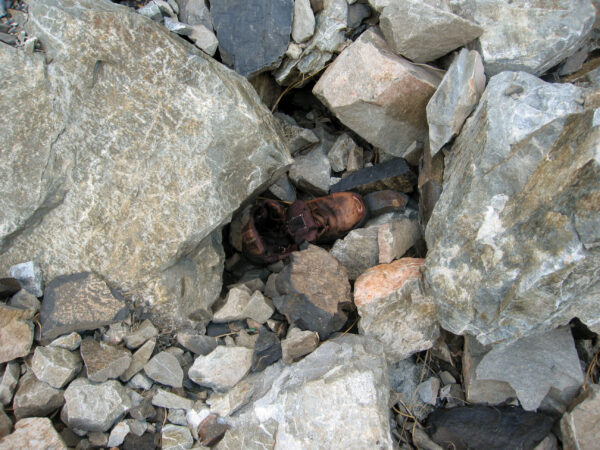
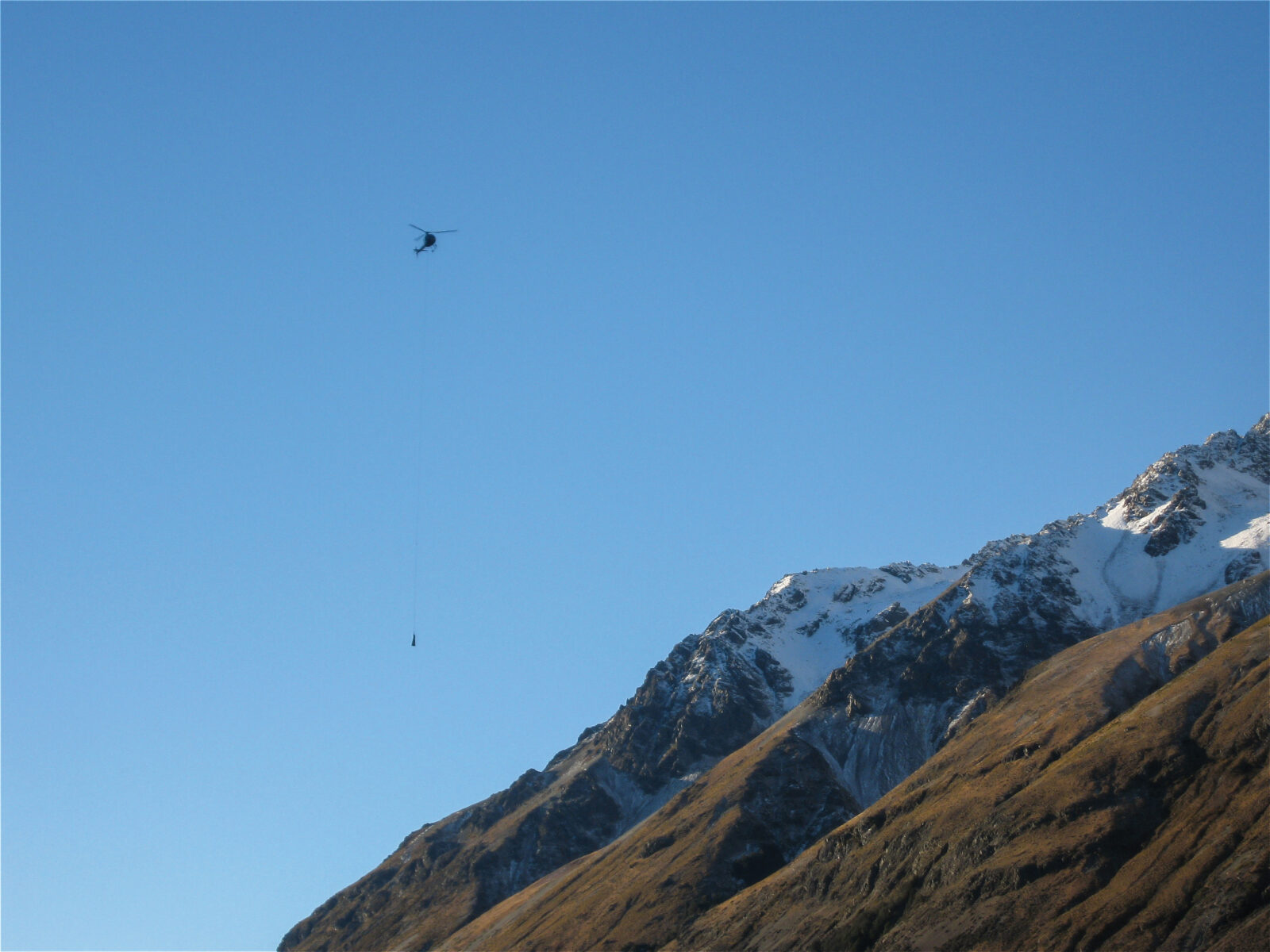
Keen never did find Foster. What he did find was a Steel Blue-brand boot, enough of a clue for the police to send a helicopter to the location. There the pilot spotted Foster’s body at the bottom of a bluff. The search was over, yet still Keen went back. “They never found his rifle and I thought, ‘Oh well, I may as well find the rifle.’ Never did. Found his bumbag though, which I handed into the police and it ended up with the family. It was buried under boulders. The police must have missed it.”
“It’s a lot of your time,” I said. “Six months of searching.”
“I like that sort of thing.” He laughed. “I enjoy it! You know, I’ve been a member of a tramping club for years. I’ve been to a lot of interesting places.”
I put it another way. Was this an obsession?
“Oh yeah. It’s definitely an obsession. I mean, you’re hoping to find the person but you’ve got no guarantee, [no] expectations that you ever will.”
I would bring it up again, searching as obsession, and again Keen explained it in terms of an opportunity to spend time in the bush. Tramping itself was an obsession for people, he reminded me. He reached again for philosophy, in this case the Chinese thinker Kŏngzĭ, better known to English speakers as Confucius, who, Keen said, preached of the benefits of time in the mountains. “I guess it’s a bit like a drug. It’s good for you. It’s good exercise. You can forget all the daily struggles. I mean, if you’re hanging off a bluff by your eyelashes, you don’t worry about the everyday trivia that bothers you in the office.”
*
In the weeks after my meeting with Keen, I went looking elsewhere for an explanation. I spoke to Carl McOnie, the CEO of LandSAR. It wouldn’t be uncommon, McOnie thought, for a searcher to continue looking beyond the official search. “You certainly do get invested in getting an outcome. That’s why we do it.” He used words like this often, words like “outcome”, as well as “competencies” and “frameworks”—the sort of language that invariably is heard when people speak, as McOnie did, within the pale rooms of an office. “Volunteers are very committed to getting a resolution,” he said. In this way he was no more revealing than Keen, but no less either, and despite the corporate tone it was clear that McOnie was sincere. He’d been a searcher himself, beginning back when he’d been a member of the army, drawn initially by the chance to improve his tracking skills. His very first searches with LandSAR were not in the wilderness but in the suburbs and the city. He spent four days walking through Christchurch parks calling the name of a 14-year-old girl who, he’d later learn, had been abducted and murdered. “When the body was found, you know, that’s an emotional burden,” he told me. His second search had just as grim a conclusion. He was part of the team looking for a young woman, a prostitute, who would turn up murdered, that most Christchurch of crimes. It wasn’t until his fifth search that he was able to play a part in an actual rescue. A 14-year-old autistic boy went missing in farmland on a winter’s evening, and the worst was feared. The boy loved water, and was known to strip off and jump into ponds or streams, a sure ticket to hypothermia. Thankfully, the searchers found him alive, curled up beneath a pine tree at 3am.
Sometimes, McOnie lapsed into language that was more urgent. “Hypothermia makes you do some crazy shit,” he said. And I paid close attention at these moments, thinking he was revealing something closer to his own emotions rather than the careful position of the career CEO. But then again, who knows? It could be that the language of the corporate world, of people passionate about outcomes, was just as useful to McOnie in explaining this mysterious thing, this highly specific strain of altruism: the drive to search. No searcher was paid; they spent their spare time honing the skill of finding. They were assessed, needed regular training. Some went further, learning specialist skills. There were cave experts, mountaineers and canyoners. There were dog handlers who spent years training their animals to meet LandSAR standards. I was a slug, I realised as I listened to this. I gave so little compared to these people. This was something I’d felt, too, as I tracked down Keen, trawling the Facebook pages of several Search and Rescue groups. Like many, I spend too much time on social media and am well aware of the performative do-gooding that goes on in places like X, where users of ill-considered language are routinely taken to task. And so, something flickered in my brain on sighting a post by one LandSAR group that made mention of the “great work being done by our LandSAR females”. It was a clumsy, blokey phrase, it seemed to me, and yet, whoever had written it was, like everyone else in this organisation, playing a part in an unalloyed force for good. It was something so few of us could claim with such certainty. There were no politics to it, no shades of grey that I could see. People were lost and they looked for them. It didn’t matter who the lost where, they gave their time, they answered the call. They saved the lives of strangers, foreigners, drunks and idiots. They did this and studied up so they might do it again.
*
Keen hadn’t gone unrecognised. When he received a LandSAR certificate of achievement, it was reported in his local paper. “Mr Keen admitted he was quite a solitary character,” they noted. But generally, there was little glory in searching. His role in the Foster search hadn’t been publicised. The Fosters themselves only learnt of Keen’s efforts a year later, when police gave them some of the items he’d found with their son’s notes and phone number still tagged to them.
There were few heroes in Search and Rescue, McOnie told me. The type of person who saw it as an act of heroism generally lasted six months, a year tops. The business of searching was too much of a trudge, too methodical and careful to appeal to anyone expecting instant results. “They’re not going to be the person who finds the person every time.”
In some cases, there was no result at all. It was rare, occurred maybe once every three years, McOnie said, but it did happen: people have walked into the bush never to be seen again. This was nearly the fate of Corey Foster. It has, to date, been the fate of Christian Prehn, a young German who arrived in New Zealand on a gap year. Just out of high school, he had plans to become a ship mechanic. One photograph shows a neat, preppy young man—tidy blond hair, a smile, a tennis racket. Another shows that here, he let the hair grow, and he grew a scruffy red beard. Journalist Naomi Arnold wrote about Prehn for Wilderness magazine, and it’s there that I saw those photographs and read comments from Prehn’s father. He described his son as wonderful, gifted, but also critical, hard to handle, “rather [more] intellectually than emotionally orientated”. He sometimes struggled with authority, he said. There was something in this honesty that stopped me, reminded me, after evenings reading about the lost and missing, what this really meant. It was not the absence of a collection of fine qualities, a creature only of memory and imagination, but this very real person: a saxophone player, a hockey fan, a pain in the arse sometimes, too. The messy business of a human life, gone into the trees. In Germany, Prehn’s father drank a beer each year and thought of his lost son. Where was he? It is entirely possible, even probable, that we’ll never know. Prehn was last seen on 25 February 2014 near the Travers Saddle in Nelson Lakes National Park, where he spoke to two other trampers. Six days later, his pack was found around that same saddle in the shadow of Mount Travers, and the alert was raised. A first search lasted two days before being called off due to snow and strong winds; a second was held a few days later. The next year, Prehn’s parents organised a third. A fourth was held last year.
And there were other, unofficial searches. The man in charge of the original search told Arnold that one of their team still went looking, and so, he said, did someone from North Canterbury. But I wonder whether he meant to say South Canterbury, where Keen lives. Keen had been there five or six times, he told me. Mount Travers was far from his own home, a long drive and then plenty of walking, too. It was a good excuse to go to that part of the country, he said. I nodded at that, but struggled and still struggle to entirely understand.
*
Keen also spoke of another type of lost, people who have no interest in being found. There was a young man he’d looked for in the Mount Cook region, again as both a member of the official search party and by himself unofficially, without any success. It was possible, Keen said, that the young man had got lost. It was possible, too, he thought, that he had simply travelled elsewhere. If so, this would be an example of a phenomenon with a long history. Searching through old newspapers, I came across the story of Ted Fyson, an accountant from Hāwera. On a Friday in 1935, Fyson was seen heading into bush near the Whanganui River. He was due out on the Sunday but never emerged. Searchers entered the bush. A plane flew over the area, and an overturned billy was discovered beside a stream, leading to theories he’d drowned. But in April the following year, six months after his disappearance, an old rugby buddy spotted Fyson in a Wellington office, and learnt that he now lived and held a job in Levin. This meeting is said to have “restored” Fyson’s memory. He got in contact with the family that had surely presumed him dead.
*
It had been the words “Christmas Day” that drew me to Keen’s story and were the reason I had carried it in my head all those years, until finally I found myself in that living room in Morven. A part of me had expected to find something troubling or strange, something that might explain Keen’s aloneness and obsession. But he was only ever friendly; he could be charming even, with his boyish hair and frequent grin. He explained that he managed to find Hill on only the second day of his second search. He’d been expecting to be in the bush for Christmas, yes, but many more days, too. It had simply been a case of the most convenient time to search and, as he was childless and lacked close family, Christmas was just another day. “I actually had a little bit of time off then. I was doing some work and there was a window of opportunity then and the weather was good, so I went.”
I found my wonderings about Christmas float away; I felt that maybe I had been overthinking. Keen’s explanation had logic where I had expected something stranger, something like mystery. In this and in much else he’d said, there seemed to me to be the trace of his philosophy; pragmatics is what he called it and the study of common sense is how he described it. It was an interest, like the house that he’d inherited. His father grew flower bulbs commercially, but in his free time he was a self-taught philosopher, a member of the Association of Rationalists and Humanists, as well as the Skeptics. Like many of his generation, he’d left school young, needing to provide income to his family, but remained determined to make up for his lack of formal education. “He didn’t get it through the system,” Keen said. “If you wanted to improve yourself, you did it yourself. You just read and read and thought and thought and practised what you’d learnt, which is how you acquire wisdom.” It was also how Keen himself sought to learn, reading widely and applying what he’d learnt, and so he was most interested in those thinkers who offered lessons for life. “There’s the ‘how many angels can dance on the head of a pin’ stuff. I mean, what’s the point in that?” Epictetus came up, and he’d also refer to Socrates, Plato and Aristotle. He reeled off the names of Chinese philosophers, and Indians. “I’ve read some of their sutras and there’s some good stuff there. It doesn’t get anywhere near the mention that the Greeks do.”
There were photographs in that room where we spoke—one of his parents, his father the rationalist and his mother, who, he said, was quite the opposite: a superstitious person—and for a moment I thought I caught the hint of something dismissive in his voice. And then there was another picture, one of a woman with short, dark hair, not old, not young, smiling broadly at us both. I had been working myself up to prying further and asking who she was, but it was the subject of philosophy that prompted Keen to tell me. In light of his interests I had said, what was he reading now? He pointed to the picture. “The old girlfriend Catherine,” he said, and explained that he was reading a book by her father, an academic, on linguistic theory. He had met Catherine during his stint at university and they were together for many years. But things fell apart. “We went our separate ways and for a long time, maybe 20 years, we didn’t actually meet up again but we caught up maybe 10 years ago. She was in the States at the time, I was in New Zealand, so we didn’t spend a lot of time together. And then I just got an email one day with some bad news.” Catherine had been killed in a car crash.
*
The details we have about Epictetus are few, but among them is the fact that he was born into slavery in the 1st century, in a part of the Roman Empire that is now Turkey. He walked with a limp, and it’s suggested, although disputed, that this was the result of a beating inflicted by a past master. Somewhere along the way, he was permitted to study philosophy. Later, he was granted his freedom and went on to found his own school in the Greek city of Nicopolis. What we have of his thinking was written down by a student, and purports to be a transcript of Epictetus’s lectures. I bought a copy not long after meeting Keen. Epictetus’s concern was with how to live, and he delivers this message in a tone that is direct, almost hectoring at times. Throughout, the recurring message is the one I’d heard from Keen: there is no use worrying about those things beyond our control, whether it be illness, social status or even death. In these situations, our only choice is how we respond and react. When embarking on an ocean voyage, Epictetus says, you may pick the ship, the captain, the sailing date and so on, but when a storm strikes, coping with that is the captain’s concern, not yours. And should you sink?
“I do the only thing I am in a position to do—drown, but fearlessly, without bawling or crying out to God, because I know that what is born must also die. I am not Father Time; I’m a human being, a part of the whole, like an hour in a day. Like the hour, I must abide my time, and like the hour, pass. What difference does it make whether I go by drowning or disease? I have to go somehow.”
More by John Summers
I saw the truth in this logic, but then, like most, my mind rarely follows logic. It wanders, it becomes bushed. And yet, perhaps because of the repetition of his argument, Epictetus would turn up unbidden in my mind for weeks after reading him, months after ever meeting Keen. I couldn’t adopt his thinking completely. I am sure that I would go down with the ship bawling, but that same relentless logic did offer a brief handhold during the petty stresses of the week. I would recall them while waiting for a late bus, or waking to rain on a weekend. These situations were beyond my control, and so I could only choose to accept them as such.
There was something to be said for even just attempting to think this way; it provided distraction to my default state, which was something closer to self-pity. And it could be freeing, too, to recognise the limits of your control. This is a point Epictetus makes, giving the example of having crappy parents. If it’s depressing to think that you’ve had no say over this most important aspect of life, imagine the alternative. A world in which you did have agency of things like choosing your parents would be one in which you’d carry the most crushing responsibility.
Keen told me he’d read of Epictetus, rather than the work itself, but whatever he’d read had proven useful, had become a talisman. Twice he quoted that line about being troubled not by events but the meaning we give to them, once over the phone and then in person. And in that room in Morven, he would paraphrase another of Epictetus’s precepts: “If you lose something you love, don’t feel regret, just feel that you’ve given it back.” Keen said this and he smiled. He pointed to Catherine’s picture.
*
Christian Prehn was likely to be Keen’s last search. On his last attempt, he’d spent 20 days looking in Nelson Lakes, and had come to the conclusion that he was too old now. This wasn’t just a question of fitness but also one of psychological suitability. It had been hard enough for him to inhabit the mind of Corey Foster, the young hunter from Ashburton, so that he could guess at his likely steps. It was almost impossible then for him, the 68-year-old ex-deer culler, to imagine the last decisions made by a young German on his gap year. In this there was a clue to how Keen searched, his attempting to think like those he looked for, and possibly a reason for his unwillingness to give up: a connection created through all those hours spent imagining his subject’s last thoughts. I am surmising here—Keen resisted this kind of explanation—and I did a lot of that as I tried to understand what drove him.
I had recorded our conversations and I listened back, always feeling that his words didn’t entirely describe his motivation, a sense that there was something more beyond my knowing. Of course, there was another voice in those recordings, my own. I heard myself again and again quizzing Keen, always listening past his answer for that greater explanation. At one point, he asked me a question, wanting to know how I’d learnt of him, and I said something about reading about him winning that LandSAR award. It sounded like a good case of someone dedicated, I said. I wasn’t trying to hide anything, but it was a feeble answer. Beneath it lurked something more, something of my own worst fears: loneliness and death. Both had appeared to me, distilled, in that original brief description of Keen finding Hill on Christmas Day. Both could also be a part of being lost in the bush. It was the sum of all fears in this way, containing them, but also containing humiliation, despair, panic, confusion, cold and hunger.
While I had never been truly lost myself, those early tramping trips had been enough for me to worry about what lurked on either side of the track. Our days began with the exhilaration of stepping out of the world of concrete and shops and telephones and into the bright green of the bush on a sunny day, but by late afternoon as the sun dropped, cold rose from the ground and the trees presented a wall, or worse, a maze. I never tramped alone, but at those moments my companions and I walked in silence. We made our days too long for our abilities and by then all I wanted was to find shelter, to feel the relief of the hut or the road end.
Talking to Keen was to not hurry away from this, from loneliness, from death, but to confront it all in the safety of a living room, and so I asked and asked my questions. I don’t know what answer I was expecting. What I heard, though, was that he carried maps, and a personal locator beacon. He had made his study of “pragmatics”, of why people made mistakes, something he also carried into the bush. No neighbours nearby, but he wasn’t lonely. He knew how to find his way, to track, to use logic. I had come to talk about the lost and he was telling me over and over that he was that other thing, a searcher.
Subscribe to our free newsletter for news and prizes
3
$1 trial for two weeks, thereafter $8.50 every two months, cancel any time
Signed in as . Sign out