How building a traditional vaka, and navigating like her ancestors, led Ana Maine home. (more…)
More by Rachel Reeves



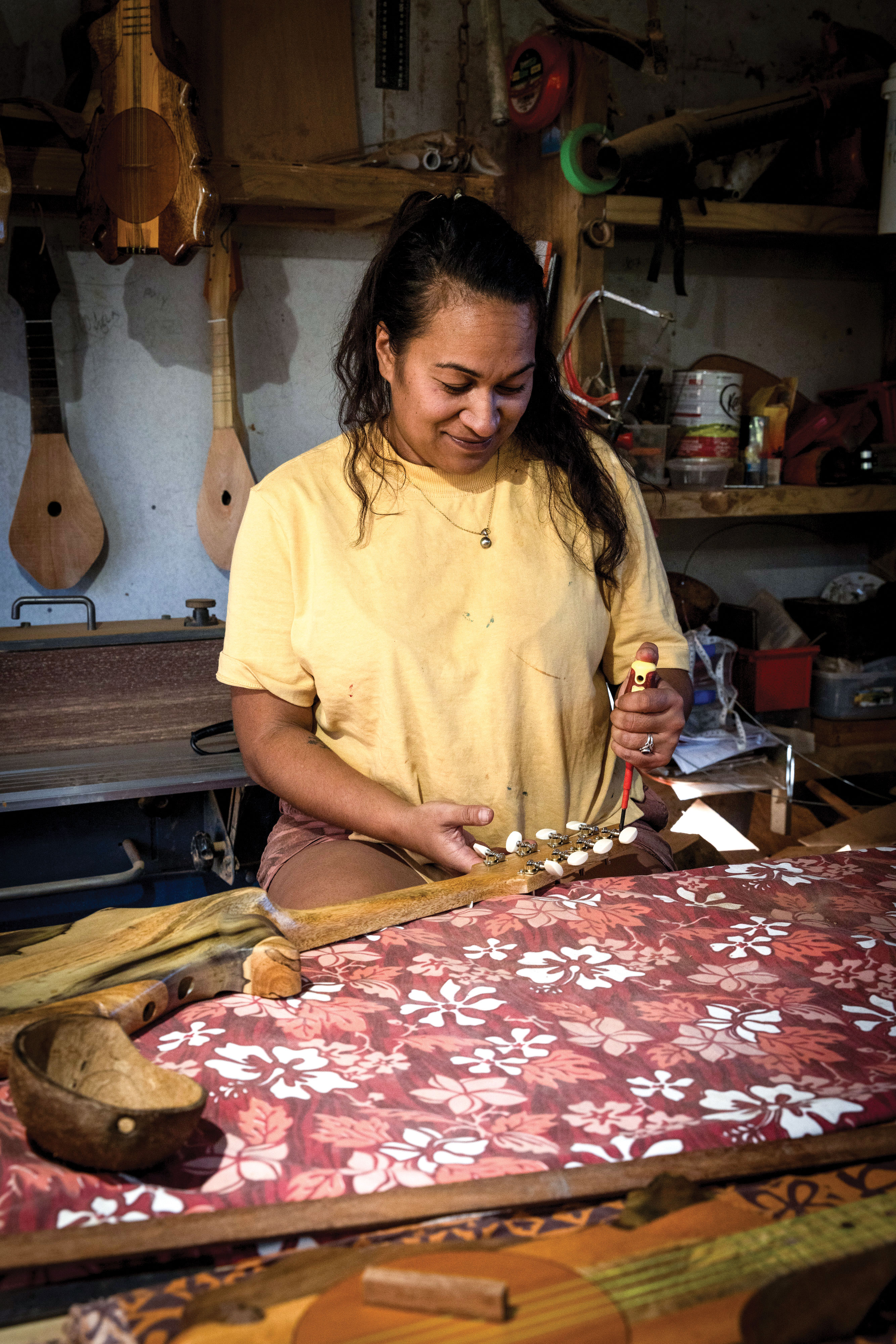
In all the settings of her world, Ana Maine plays ukulele, and sings.
Lullabies for her toddlers, Ahipakeka and Amos. Cook Islands Māori when she’s earning her living, carving and building ukuleles. When she’s voyaging aboard Marumaru Atua, a traditional canoe on which she’s a crew member, she serenades the night watch.
Maine, 35, grew up on music. She was born in Invercargill. Her parents, who still live there, steeped their five children in the song, dance, and ethos of the Cook Islands culture. Both are first-generation migrants to New Zealand; the threads of their respective heritages connect to Rakahanga in the north of the Cooks and Mangaia in the south.
Maine was trained to be the lead dancer and soloist in the Cook Islands dance troupe her father ran. Her sisters trained in dance, too; her brothers learnt ukulele.
“We had no time for play after school,” she recalls. “It was always: practise dancing. It was always: practise a new song till midnight.” She studied art at the Southern Institute of Technology and started working at the age of 17. She also kept dancing.
Years later, she danced at a friend’s art exhibition in Gisborne and got talking to Te Aturangi Nepia-Clamp, a Māori carver who had lived in Rarotonga for eight years. He was helping to build a traditional canoe, or vaka, that would soon make the journey between Auckland and Gisborne sans modern navigational instruments. This was 2017, and the Pacific Islands were several decades into a renaissance of traditional navigation and voyaging—an intentional disproving of the European theory that the early islanders drifted to their islands by accident.
Maine was looking for a place to rent in Gisborne. The man was looking for a tenant.
“So I moved in with him and from there on it was just, ‘Vaka, vaka, vaka,’ every day,” she recalls. “Every day he’ll talk about the vaka. I was like, ‘Okay. Okay. How do I join?’”
Voyaging became the passion that would lead her home. She learned to set the double-hulled canoe’s sails, to tie knots, to read a map of lights in the sky, and to study swells when clouds obscured the sun and stars.
On her maiden voyage, the trip from Auckland to Gisborne, she connected with the only other islander on board, a Samoan captain named Fealofani Bruun. She invited Maine to crew trips to Fiji and Samoa; Maine ended up staying in Samoa for eight months, teaching sailing.
Then came a move to Auckland to help build Marumaru Atua, a traditional canoe financed by German philanthropist Dieter Paulmann and gifted to the Cook Islands. The gig was unpaid; the payoff was landing a spot on an upcoming voyage to Rarotonga.
Soon Maine was sleeping on board, working seven-hour days building the boat’s deck. Another islander, Maurai Villa, was the only other person working daily shifts; soon he became her partner and together, the couple decided that they, like Marumaru Atua, would relocate to Rarotonga.
They took over the business of Maurai’s parents, a ukulele shop on the back road in the village of Arorangi, and like many tourist-facing businesses on Rarotonga, theirs boomed. They were in the workshop until eight at night, churning out 20 or 30 ukuleles a week, packing them for tourists. They were also running make-your-own-ukulele classes. And then COVID-19 unfurled. The borders closed, the tourists stopped coming, and Ana delivered two baby boys.
“Just like, everything, boom, at one time.”
She took on other carving jobs: signs, block lettering, the oversized keys Cook Islanders give on 21st birthdays. She and Maurai began making their ukuleles from local wood, sourcing it raw, stripping it, and letting it dry in the sun. The drying process alone can take years (see page 58).
And though the borders are open again, the slow approach has stuck. Sometimes the couple make just one or two ukuleles a week. Maine says the change of pace—and the opportunity to make space for voyaging—was the point of moving to the islands.
Marumaru Atua remains a big part of her life. It’s a portal to a past and heritage she’s proud of, a means to a deeper understanding of natural rhythms, and a teacher of discipline.
On Saturdays, Maine and her family are on the vaka, varnishing, practising, or provisioning for an upcoming voyage. Lately, most of these trips are charters taking non-government organisations to the outer islands for funded projects, such as eradicating rats.
“It’s all a balance. It is a struggle financially,” Maine says. “But I think I’d rather struggle financially and be free, you know?”
She was lonely in New Zealand, in the hustle-bustle. It was not where she saw herself growing old, or having kids. It was not even the New Zealand she remembered from her own childhood. On one visit to Invercargill, she was dismayed to find an empty mall “that nobody shops in because they buy online. And you go to use cash and they say, ‘No cash’.
“I’m glad I’m here where I’m just at a standstill, you know… I want my kids to run outside and make mud pies in the long grass. I want that for my boys.”
More by Rachel Reeves
Subscribe to our free newsletter for news and prizes
3
$1 trial for two weeks, thereafter $8.50 every two months, cancel any time
Signed in as . Sign out