Get out of the city this summer and you’re bound to glimpse a kāhu. The powerful, clever native hawks are revered by those who come to know them. And yet we’ve been slaughtering them for a century and a half. Why? (more…)
More by Bill Morris



I’m in a line of traffic, speeding south along a ruler-straight stretch of State Highway One just south of Christchurch. Hedges, irrigators, and fresh spring pasture paddocks flash by.
A twist of aerial movement catches my eye—a kāhu, or swamp harrier, New Zealand’s largest bird of prey, is circling the verge just a couple of metres off the ground, locked on some kind of roadkill.
I’m seconds away from smashing into it. The hawk clocks me but doesn’t seem to panic at all. This bird’s ancestors preyed on wild mountain ducks and battled the mighty Haast’s Eagle for rights to fallen moa. Now, it’s a highway bandit in a world of hurtling metal and exhaust fumes.
I brake, the bird looming large in my windscreen. The hawk’s wingtips feel for lift as it gauges the risk of ripping a bloody morsel from the road.
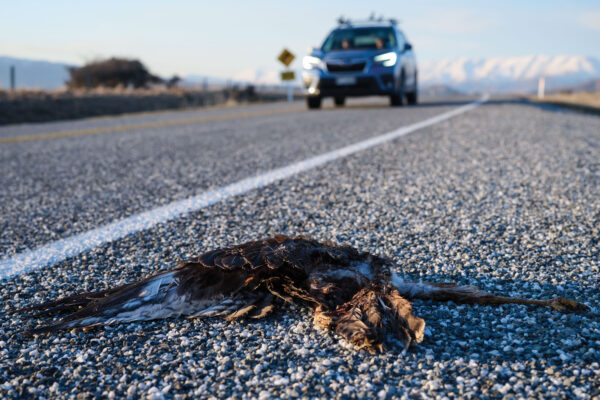
At the last minute, it aborts its fall, soaring up and over my car to safety. I breathe out, slowly resuming my former speed. I hope he gets his meal, I think.
Before I can get back up to full speed, a white Holden slides past me on the right. The passenger-side window slides down and out pops a hand, an angry middle finger extended in my direction.
*
There is perhaps no New Zealand bird—native or exotic—that has been vilified, persecuted, and hated like the kāhu.
Kāhu are native; they likely self-introduced by flying across the Tasman from Australia around a thousand years ago, just as humans were beginning to reshape this land forever.
Now they’re at the top of our avian feeding chain, ruling the roost with the kārearea/New Zealand falcon. These predators perform vital roles in the ecosystem, cleaning up carrion and keeping smaller birds and rodents in check.
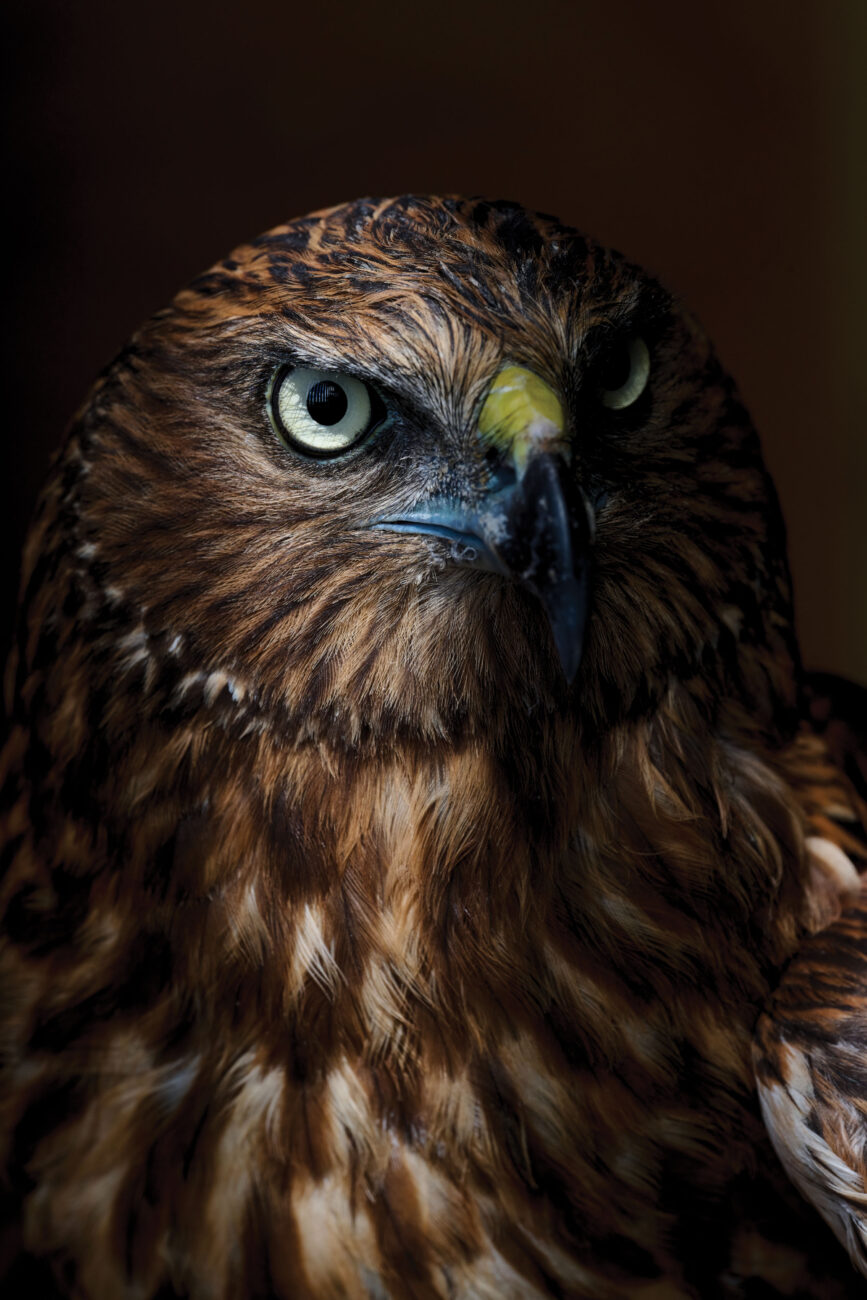
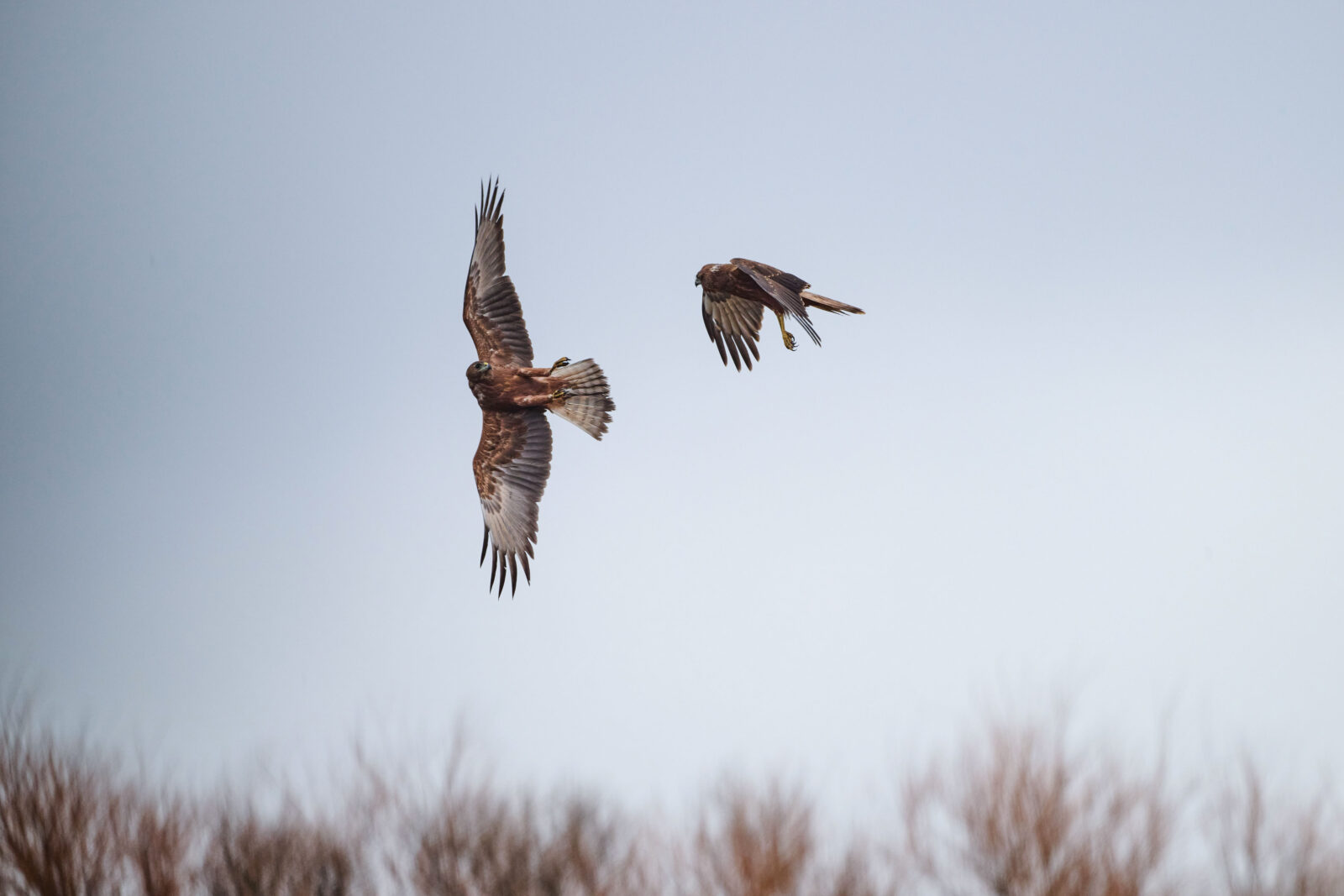
Kāhu search for food from great altitude, scanning the ground below with their incredible eyesight, or hunt just metres above the ground, working over grass or rushes in a slow “quartering” hover before dropping on their prey.
Māori hold kāhu in high esteem, revering them for their hunting skills and noble bearing. They are seen as allies, particularly in regards to mahinga kai—food gathering.
“Kāhu have always been right through our creation stories,” says Clint McConchie, of Ngāti Kuri, a Kaikōura-based subtribe of Ngāi Tahu. “The kāhu are the eyes. They are the watchers.”
That role has held even as the ecosystem changed around them.
“When we’re out on the hill, there’s a saying, if you see kāhu, you see pork. It is an indicator of where other things are at.”
But to European colonisers importing animals from their homelands—sheep, game birds and domestic fowl—the “harrier hawk” came to be seen as vermin.
Farmers, accusing kāhu of hunting and killing lambs, set about an indiscriminate slaughter. One Canterbury sheep station killed at least a thousand hawks a year, even as saner voices, such as the ornithologist Walter Buller, questioned how much of a threat the birds actually posed.
“I have been assured by eye-witnesses that three or four [kāhu] will sometimes detach a lamb from the flock, and then assailing it from different points, tear out the animal’s eyes, and ultimately kill it,” Buller wrote in 1873. “I am of the opinion, however, that these attacks are confined to the weakly or sickly lambs of the flock, and occur only in times of great famine.”
I grew up on a sheep farm. Kāhu watched over my childhood, soaring on the high winds that blew through the mountains, staring down through hot summer days and winter snows, always searching for their next meal. We never saw kāhu attacking lambs.
In fact, I grew up thinking they were just scavengers. A search of the scientific literature reveals a more complex truth. There are 19th-century reports of kāhu hunting eels. Modern accounts have them plucking fish from the water in their talons, in the manner of sea eagles. Kāhu, it’s clear, are intelligent and adaptable predators, traits that have allowed them to flourish in a rapidly changing landscape.
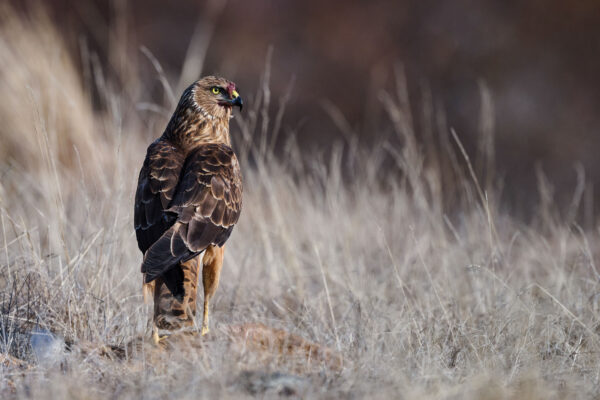
When rabbit numbers exploded in the late 1800s, kāhu took off, too, most likely as a result of this plentiful new prey source. Farmers started to see kāhu as an ally.
At the same time, though, acclimatisation societies around New Zealand were bent on creating a sportsman’s utopia by filling every waterway they could with introduced ducks and trout. There was no room in their grand vision for a predatory harrier known to hunt and kill ducks, pheasants, quail, and other game birds.
So for the best part of a century, kāhu had a price on their head, and the relentlessness with which they were pursued bordered on biblical.
In 1923 alone, the Auckland Acclimatisation Society paid out on 15,200 pairs of kāhu feet, a haul that threatened to bankrupt it.
The most common method of kāhu destruction was to nail a piece of meat to a plank of wood, then sprinkle it with strychnine. Kāhu that turned up to tear at the meat would die almost instantly, and could then be divested of their talons. Over nine years, the Auckland society paid bounties on more than 130,000 harriers. Such carnage continued all around the country, for decades.
Nature filled the niche. As kāhu numbers dropped, some observers noted, rats and mice prospered—along with the stoats, ferrets and weasels that ate them. These mustelids, of course, also decimated the chicks of pheasants and other game birds.
It should have been a lesson: the removal of a natural avian predator simply allowed even more voracious mammals to flourish.
*
My southward journey brings me to South Canterbury, the Southern Alps gleaming with an early spring powder dump. I spot several kāhu silhouetted high against the silver sky. It’s hard to imagine the open country of the South Island’s east coast without them.
In 2006, American ecologist Wade Eakle and some friends drove 4000 kilometres of New Zealand’s roads counting harriers out the car window. They spotted 243; that’s about one kāhu every 17 kilometres. This road trip (subsequently written up as a scientific paper) is probably the only systematic study on kāhu abundance ever undertaken in New Zealand.
Kāhu are found from one end of Aotearoa to the other. And yet, somehow, they still exist on the edges of our lives. They nest out in the hills and deep in wetlands where we never see them. They will abandon their eggs at the slightest intrusion, such is their commitment to solitude and secrecy. Perhaps, with our decades of persecution, we have made them this way—among us, but apart.
The first great wars on kāhu failed to stamp them out. But now, the hawks inhabit a legislative no-man’s land. In 1986, the birds were afforded “partial protection” under the Wildlife Act. That means landowners are still allowed to cull kāhu if they’re considered a threat to livestock (the definition of “livestock” is left open to interpretation).
It is thought kāhu, along with the black-backed gull, may be “superabundant”—that doesn’t mean, necessarily, that there are masses of them, but rather that the population is pumped up artificially high, bloated on easy pickings of mice, rabbits, and other small, tasty tidbits.
That’s a big problem if you’re a wildlife manager trying to save some of our rarest birds.
Colin O’Donnell, principal science advisor with the Department of Conservation (DOC), monitors a recovering pohowera/banded dotterel population at Tiwai Point, near Bluff. After years of trapping, he tells me, cats and stoats declined dramatically. But dotterel numbers didn’t respond.
Nest cameras soon showed why—kāhu were eating 65 per cent of the eggs. “Our mammalian predator control was working really well, but we were essentially just replacing one predator for another,” he says.
For a veteran conservationist like O’Donnell, it’s disheartening— “we’ve spent years working out how to do mammalian predator control on wetlands and braided rivers and finding out it’s not that simple,” he says. Far from having answers to the kāhu problem, “we’re just starting to understand how complicated it is”.
There are native birds so close to extinction that having a kāhu take out even a few chicks could be the final straw—birds like the tuturuatu/shore plover and tara iti/fairy terns, for example. Kāhu are also one of the biggest threats to the critically endangered matuku-hūrepo/Australasian bittern.
For this reason, kāhu have often been culled around some highly endangered bird populations. Until 2010, wildlife managers had to go through a convoluted permitting process to do so. Then, kāhu were shifted from Schedule Two of the Wildlife Act to Schedule Three. The downgrade means wildlife managers can now take action against kāhu without having to navigate the bureaucracy.
But, as the acclimatisation societies learned all those years ago, culling is not necessarily the answer.
*
Kevin Evans coordinates the breeding of captive flocks of pāteke/brown teal around the country, in his role with the Brown Teal Recovery Programme.
In the early days of the programme, only 700 of these birds remained, and losing any of them to kāhu seemed intolerable.
At a facility that housed pāteke alongside a number of other endangered birds, Evans tells me, staff used to shoot up to 1200 harriers a year. “It didn’t make a bloody difference to the population,” he says. “If you shoot a harrier, a new one would just move into that territory. We learned from that.”
Now, he tells me, kāhu are rarely culled around pāteke. Kāhu have long been a natural predator of pāteke—so the prey animal has adapted, too. Occasionally, says Evans, a hawk will make a kill, but “nine times out of ten, as long as [the pāteke] have a good body of water, they can dive and get out of the road.”
More by Bill Morris
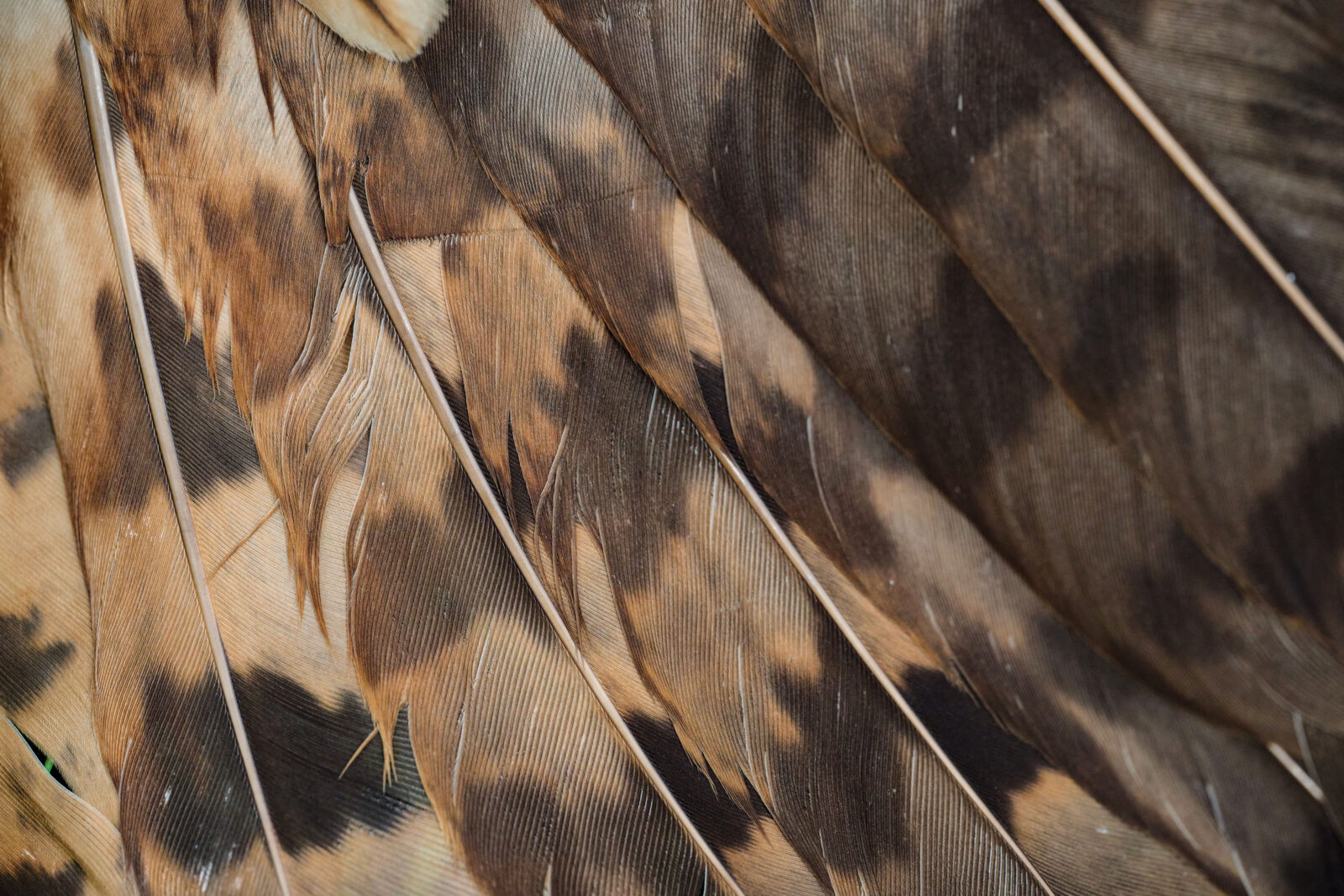
Kāhu also have an appetite for endangered tarapiroe, or black-fronted terns. On the bed of the Waiau Toa/Clarence River in Marlborough, a conservation team led by Wildlife Management International Ltd report that kāhu are, alongside cats and ferrets, one of the worst predators of these featherweight, boulder-nesting birds.
The team, who are contracted by DOC and Environment Canterbury, have repeatedly filmed distraught parent terns wheeling over the nest as a kāhu gobbles down an egg or chick. In 2012, researchers analysed 192 discarded egg shells from Waiau Toa tern colonies and found incriminating kāhu DNA on 171 of them.
For five years, until 2020, the team used leg-hold traps to catch feral cats around the tern colonies. Despite their best efforts to conceal the traps from the air, they snared 372 kāhu as “bycatch”. These kāhu were culled.
It’s something that didn’t sit well with mana whenua partners Ngāti Kuri, who insisted on more research being done into kāhu populations.
So, for the past three years, the team has been catching kāhu and fitting them with leg bands; 132 have been banded so far. Among other things, they’re trying to ascertain whether all the local kāhu present a risk to the terns, or if it’s just one or two “rogue” birds that have cottoned on to an easy meal.
“It’s about trying to get a good balance,” says team director Biz Bell. “We’re not wanting to put one bird above the other.”
Clint McConchie believes that, far from being “super abundant”, kāhu are actually under threat from landscape modification—pushed to prey on species such as tarapiroe because there’s little else out there for them.
“Show me the data,” he says, when I suggest they’re super common. McConchie says that culling kāhu and other taonga species (such as native black-backed gulls, which are also frequently culled in New Zealand) without understanding their populations and movements—“playing God,” in his words—is a dangerous game. “We just see a problem, and we go and bash the problem. Do we actually know how many pockets of kāhu there are?”
After a century and a half of persecuting kāhu, it seems, we are finally taking the first steps to understand them. In Canterbury, ornithologist Peter Reese has been banding kāhu for several years, while two other research programmes are now running under the wing of DOC.
In the Waikato, science advisor Kerry Borkin is collecting dead kāhu to study the stable isotopes, or enduring elements, of their feathers, bones, and beaks. This will tell her roughly what the bird was eating, and when. She’ll then line up that information with the landscape, and try to build up a clearer picture of how each bird moved in the course of its 20 plus-year life. We think some kāhu migrate, while others stay put, Borkin tells me—but we don’t really know yet.
Meanwhile, DOC technical advisor Thomas Emmitt is attaching GPS trackers to kāhu to learn more about their movements. So far, he and his team have tracked eight in the North Island and three in Marlborough. One bird tagged in the Whangamarino wetlands in Waikato travelled all the way down to Central Otago—a distance of around 1000 kilometres. Another, tagged in the Clarence Valley of Marlborough, flew off to Mid Canterbury the next day.
Results like this, says Bell, show how little we know about kāhu, and why we should hold them in higher regard. “People just think, ‘It’s another hawk.’ They don’t really think about how amazing they are.”
*
To Noel Hyde, kāhu are magnificent. “They have all of the presence and majesty of an eagle, just in miniature,” he says.
Hyde, a trustee of raptor rehabilitation and outreach centre Wingspan, in Rotorua, is a falconer—a practitioner of the ancient art of training raptors to hunt on command.
Falconry, he tells me, is “like a sickness. You can’t shake it… It’s over 4000 years old. You’re swimming in an incredibly deep pool of knowledge and history. You have this deep love and appreciation for birds of prey and for flying them.”
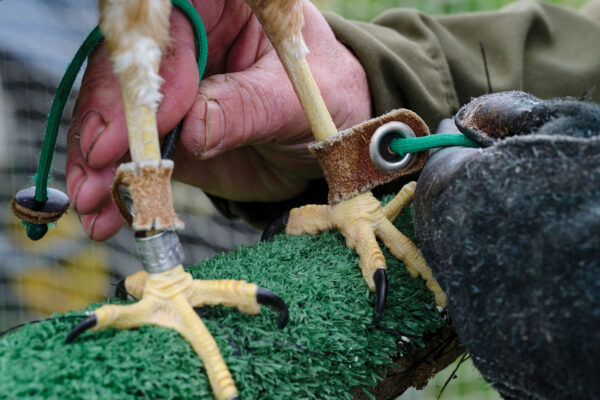
Hyde, like every other falconer in New Zealand, uses kāhu to hunt with (kārearea are off limits in New Zealand, though they’re widely used in the UK).
While kāhu may lack the fighter-jet speed of kārearea, they are, says Hyde, still a thrilling bird to work with. He has used kāhu to hunt pūkeko, rabbits and even hares. While he’s never actually had a kāhu catch a hare, he’s “had some really close, exciting chases”.
There are only a handful of falconers in New Zealand. Chris Brooks, director of Kāhu Conservation, a rehabilitation centre north of Auckland, is one. Kāhu, Brooks says, “are incredibly good hunters. Some flights I’ve had with them have been jaw-dropping.”
They’re powerfully intelligent, he tells me, even compared with other raptors he’s worked with.
“I have to give them a lot of enrichment tools in the aviaries, because they get bored.”
Vaughan Skea, who learned falconry in his native Zimbabwe, set up the New Zealand Raptor Trust in 2016 to rehabilitate injured raptors.
They’re a temperamental bird, he says.
“They have a really diverse range of different characters. You get some that become attached to you; they’re friendly, they’re endearing. And then you get others that just want to rip your head off.”
The trust’s purpose-built facility, on the outskirts of Timaru, is run entirely by volunteers. It takes in a steady stream of kāhu, kārearea, ruru and little owls from around Canterbury. Many of these birds have been hit by cars or have flown into windows, suffering severe physical trauma.
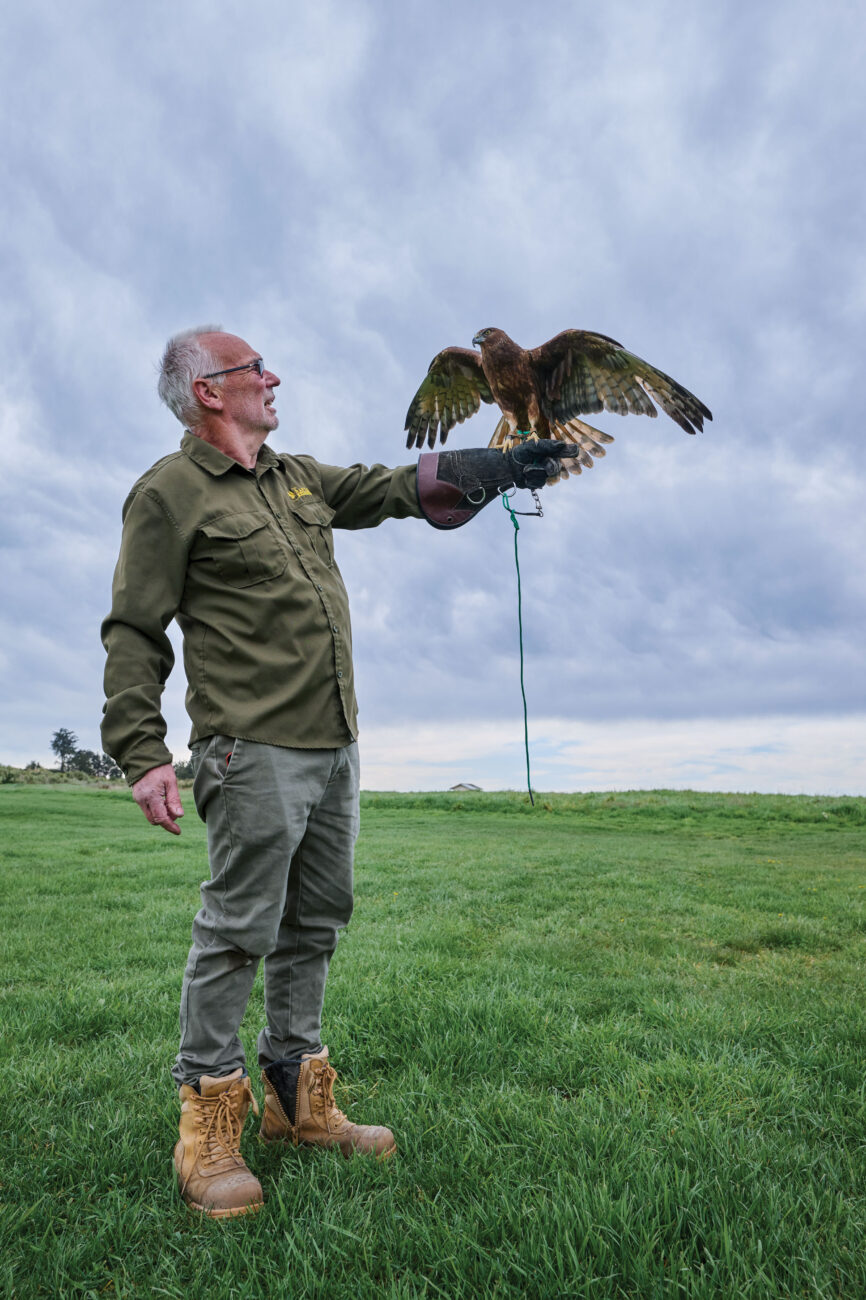
That’s where falconry can help. By using falconry techniques, Skea says, “you can have them doing a lot of fitness training and exercise before you let them go, so that they are going back [into the wild] really strong”.
And strong they need to be, for theirs is a world fraught with danger.
*
To kill a kāhu in Aotearoa is really no big deal. The Wildlife Act is clear on this.
If you own or occupy land with “livestock” on it and these animals are threatened, or at least perceived (by you, the landowner or occupier) to be threatened by kāhu, you can shoot the offending raptor. Or poison it, or trap it (within the bounds of other legislation pertaining to the treatment of animals and the use of poisons).
There is no need to apply for a permit to kill the harrier. There is no need to seek scientific justification for a cull, and no need to report the dead kāhu. There is also no limit to how many you may kill.
For Noel Hyde, this is disturbing. “In real terms, it is no protection,” he tells me. “It’s a small step to open slather on them.”
Hyde fears that places where kāhu are frequently killed become “sinks”—Bermuda triangles into which hundreds of hawks disappear. He suspects game preserves, where pheasants and other game birds are kept for paying clients to shoot, might be significant sinks for kāhu.
I contacted several game preserves where pheasant shoots are held but none of them discussed the matter on the record. Free-range poultry farmers are upfront about the issue; kāhu are a big problem for them.
Chris Martin, of Wairarapa Eggs, farms 24,000 hens near Carterton. He tells me kāhu kill his chickens “every day”. On the afternoon I call him, he’d just watched two kāhu fall upon one of his chooks, pin it to the ground, and rip its throat out.
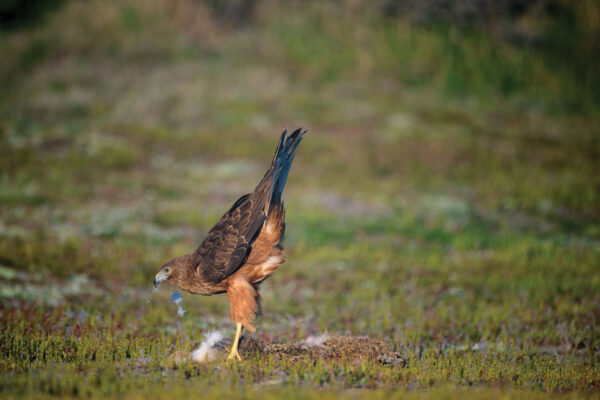
While Martin has tried culling kāhu in the past, he says he found it to be “pretty ineffective”, with more quickly arriving to fill the void. He’s also tried keeping his enemies close—offering the kāhu free meat on feeding stations to keep their bellies full so they won’t bother his hens.
It’s a struggle to keep up with the kāhu’s enormous demand for food, however. “We just needed too many feeding stations to keep our kāhu population busy.”
Reluctantly, he’s decided to take the losses on the chin.
Kāhu are not considered an endangered species, but the falconers that fly them are. Great white sharks are to blame for that, sort of. In 2018, Rakiura pāua fishermen temporarily won a court battle against operators running shark-cage dives in Foveaux Strait. It forced DOC to clamp down on a range of activities that, like shark diving, were considered “anthropogenic”—among them, falconry. All existing falconry permits can run their course, but no more will be issued.
To Hyde, the hypocrisy is extraordinary—we now have a situation where a farmer can legally kill kāhu at will, and yet a highly experienced falconer who wishes to keep a kāhu in good health for hunting is not allowed to do so.
Falconers are lobbying DOC, seeking a change to the law with the current rewriting of the Wildlife Act.
*
My southbound journey brings me at last to Timaru, to the hillside home of Jenni Fraser, one of the New Zealand Raptor Trust’s dedicated volunteers. In her sprawling garden, hens peck around the daffodils. New lambs bleat in a paddock next door.
The raptors are kept safely locked up in a large enclosure near the house. Fraser leads me inside. Three kāhu are perched in the depths, watching me with fierce, intelligent eyes.
These are birds that have been hit by cars, left flapping and stunned on the side of the road until a member of the public scooped them up.
Over the years, Fraser has built up a network of more than 50 volunteers she refers to as her “Uber drivers”, who deliver such injured birds to Timaru when required. They include a home-schooling mum, a truck driver, a commercial pilot, and the local member of Parliament.
Other birds come via the Wildlife Hospital in Dunedin.
Rehabilitating raptors is intensive, exhausting work. The birds need to be fed frequently, and if they suffer from lead poisoning, which is often the case, they need two injections a day and fluids three times a day.
Lead is the ubiquitous, silent killer of predatory and scavenging birds in New Zealand. Much of it comes from rifle slugs—the country is littered with animal carcasses laced with fragments of the toxic metal. Kāhu consume these and become very, very sick.
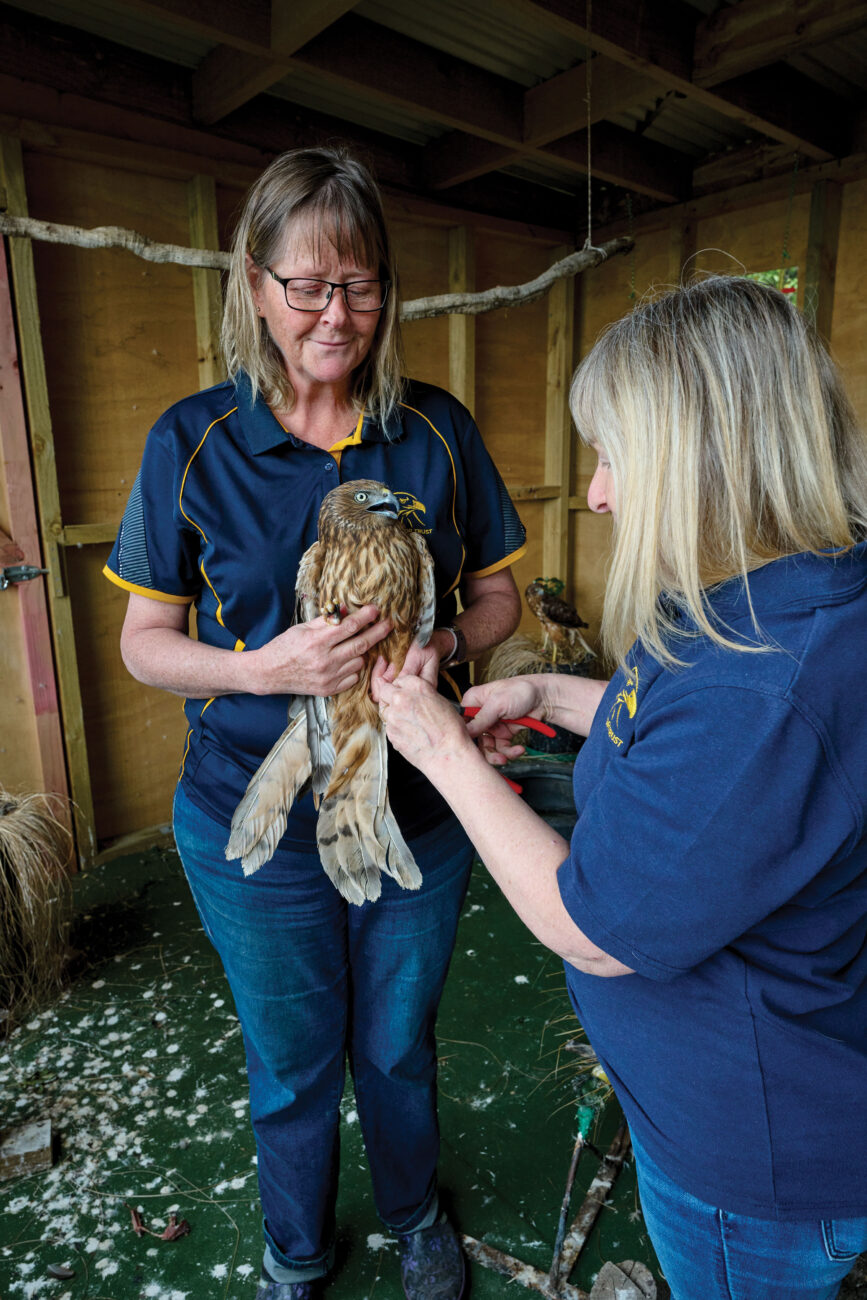
The symptoms are cruel. The birds’ talons clench so they are unable to feed or move. They have seizures and, without intervention, quickly die. It’s a final indignity: not only have we been deliberately killing kāhu all these years, we’re doing it without even meaning to.
Lead-poisoned birds also require daily physiotherapy—Fraser and the other volunteers massage the birds’ talons to try to unclench them.
Despite the enormous work that goes into these birds, two-thirds don’t end up surviving. It takes a toll on the volunteers. “I feel I’m a lot harder now than what I used to be,” Fraser says. “I think you get that way because you have to save yourself.”
*
On a blustery Dunedin day, I meet Fraser and a crowd of others in a carpark at the top of Three Mile Hill, overlooking the Taiari Plain. We’re here to release two kāhu. They’re survivors—part of the minority cohort that made it through.
The first kāhu is brought out of its travel case with a leather hood around his face. When this is removed, the bird blinks a few times and looks around, taking in with calm astonishment the small crowd of people, the vast landscape before it.
“People used to say to me I must be sad when they leave,” says Fraser, “but no, I’m not, because you know that that one’s gone, it’s gotten away. I always have a grin on my face.”
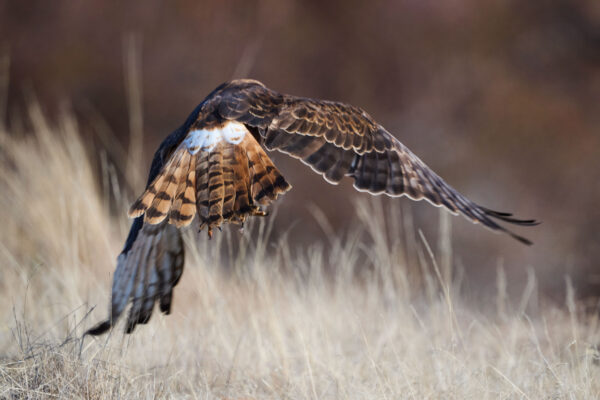
The volunteer holding the kāhu braces himself. The bird raises its wings and, with a powerful downstroke, takes off. Its wings form that distinctive shallow “V” as it draws widening circles over the plain.
Pine trees frame the scene of the bird gliding across a patchwork of farms, roads, power lines, towns and, in the distance, Dunedin’s international airport.
The Taiari Plain was once one of the southern hemisphere’s great wetlands. Now, you’re hard-pressed to find anything native at all in this expanse. Just that kāhu, growing smaller now, as he fades into a human-made world.
He looks, to me, to be quite at home there.
Subscribe to our free newsletter for news and prizes
3
$1 trial for two weeks, thereafter $8.50 every two months, cancel any time
Signed in as . Sign out